Tag: TV
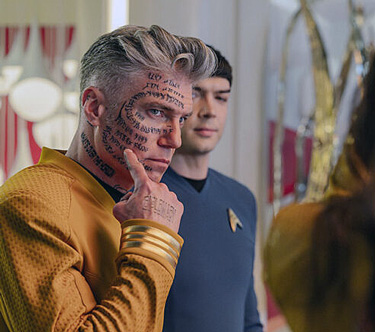
SNW 403: Human Best Friend
Does anyone know what I had tattooed on my face?
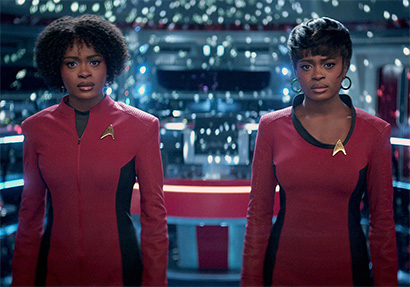
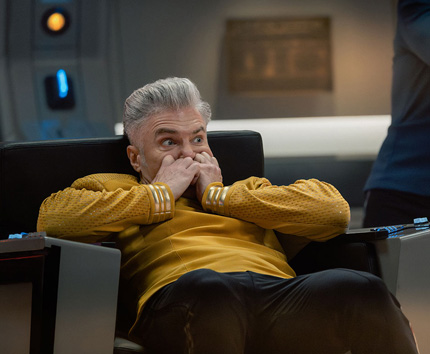
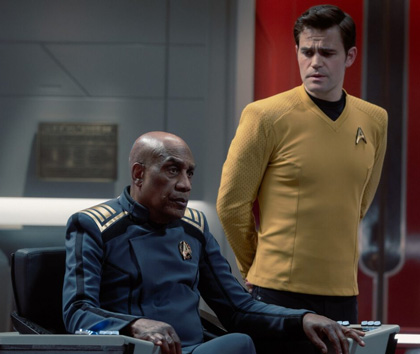
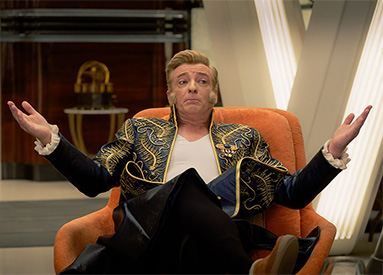
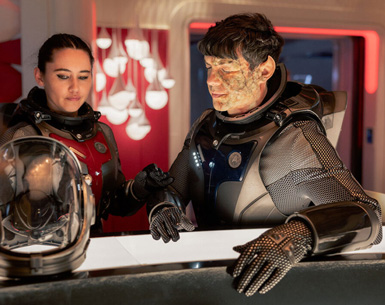
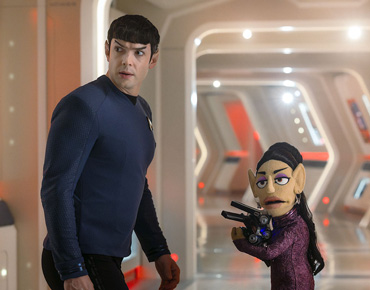
This week's episode of Strange New Worlds actually isn't terrible. Part of me does hate it, but it's the part that has been disappointed by the writing in so many streaming era and 21st century film installments of the Star Trek franchise; here we again have an episode that has little to no depth to it, another junk food meal of empty calories. On the other hand, I did find it entertaining despite my qualms. It's very much like last season's "Wedding Bell Blues" in that regard, though not as steeped in the series mythology and a whole lot more derivative.
Had I known in advance what they were going for with this one—it's a stoner comedy that borrows heavily from lowbrow films The Hangover and Harold & Kumar Go Wherever They Went; it could be titled "Dude, Where's My Shuttlecraft?"—expectations would have been lower than low given what came last season, in which case this post would be about how I was pleasantly surprised by the not-terribleness of it. But even though I kind of liked it, it does nothing to assuage my fears that the rest of the series is going to be frustrating. Especially knowing that both this season and the abbreviated next season was all either in production or the can before any of the flawed and troubling season three had aired (dropped? What is the proper terminology for the release of streaming internet TV?). I suspect that no one in this writers' room ever came to any realizations that last year had real problems before it was too late and all was completed. Thematic depth? Nah. Ethical quandaries? Meh, we might touch on them vaguely. Dumb humor? Oh, yeah, that's our jam, and if we can cheapen what comes later in the timeline, so much the better.
There is plenty of dumb humor and cheapening what comes later in this one, to be sure, but in large part—not entirely—I am choosing to overlook it because there's some fun to be had.
Let's get into it.
See full post: "SNW 403: Human Best Friend"...
SNW 402: The Griffin Incident
The latest episode of Strange New Worlds is another "genre of the week" installment, this time the genre is "horror flick." It's not the first time Star Trek has gone this route, exactly, but it is more overtly in-your-face in terms of horror tropes and scenes of mutilation. Generally, I am most definitely not a fan of such things, and while I don't exactly hate it here, it's not good, either.
Which isn't to say the episode itself isn't good taken as a whole. It's...well, it's hit-and-miss, like most SNW efforts. There are some semi-interesting character bits, and some things that may or may not move a season arc along, but once again we have a script that wouldn't have been deemed ready for production under Gene Coon or Ira Behr.
Let’s get into it (spoilers and very nerdy nitpicks ahead):
See full post: "SNW 402: The Griffin Incident"...
SNW 401: Valles Marineris
Can you stun a T. Rex? Let's find out.
Star Trek: Strange New Worlds returned last week for its fourth season premiere, and, wouldn't you know, I have thoughts.
After the painfully flawed mess of the third season, I was prepared to be disappointed. However, I was also hopeful that, without the rush-job environment that produced the season three scripts, we'd get back to at least the level of quality we saw in SNW's first two seasons. The premiere landed smack in the middle of those poles—there's stuff that doesn't make sense, there's some lazy shortcut writing, there's avoidable science mistakes; but there are also really funny moments, a clever premise, and good character stuff that almost makes me give them a pass on the bad character stuff.
Let's get into it (spoilers ahead):
See full post: "SNW 401: Valles Marineris"...
Diamond doings, etc.
Making up for some fallow weeks earlier in the spring, I'm getting assigned a lot of umpiring of late. Mostly that's good, I can certainly use the extra money in this age of Felon47’s economic sabotage. But it does cut into my TV time, and I'm just getting around to finishing the latest season of For All Mankind (not its best season, to put it mildly, but FAM remains a great show) so I can start on the first season of its companion show Star City. I still haven't gotten around to The Testaments, either, and need to find time for Spider-Noir sometime despite it being an Amazon property. (Is it kind of ridiculous to be singling out Amazon as an evil corporation these days? I mean, SNW returns next month on Paramount and I'll still watch that despite the CBS/Paramount takeover by fascist enablers.)
But the umping has been fun this week. Since the ugliness at the end of last Sunday's shift, I've had three nights calling games and they were all positive. Tonight I only had one or two familiar faces among the four teams on my schedule, but Monday's and Thursday's slates included a lot of old faves. Last night, in fact, included a championship game that was won by a team that goes by the name "Jeans," as several of them wear jeans or jean-shorts as their "uniform"; when I handed Robin, their captain, the team's winnings (a voucher for substantial bar credit and a discount on their next signup), he asked why they weren't getting the typical nothing-prize of league-branded wristbands again. It was sarcasm, as those prizes are pretty lame, but I hadn't been given any to hand out. But, as I was packing up the equipment bin, I found a stash of prize wristbands left over from previous seasons, so I handed some of those out to Robin and his team. He then led his team an a "Tim! Tim! Tim!" chant as they put on the wristbands and jumped around. It was goofy and made me laugh.
Tonight's only issues were with spectators. There were two versions of a peanut gallery in the seats behind the plate: the 8:00 game had the small children of some players doing cheers and chants for everybody; it was cute for two innings or so, then it was very much NOT. The 9:30 version was the boyfriend of one player and a friend of his that were drunkenly heckling me on nearly every pitch. Hard to say which version was more annoying. (Wait, no, it's not, the kids were way more annoying.)
The nights I didn't work this week were spent playing with the Spuds (Wednesday) and taking K & E to the Mariner game on Tuesday. That M's game vs. the New York Metropolitans was a fun one; we had terrific seats and the Mariners won handily to extend their winning streak to eight games (where it stopped, as they've dropped two straight since then). I don't know if their expenditure matched what I spent on the tickets or not, but K & E bought our concessions, which were plentiful and included the biggest soft-serve ice cream cone I'd ever seen, let alone eaten. It's three days on and I think I still feel some of it in my gut. Sure was tasty, though.
Another thing about these full-up weeknights is that I've been consuming less news than usual, but I still get the headlines and a few stray articles. This, from John Scalzi's newsletter today, I thought was worth sharing because schadenfreude. Felon47’s grift-scam "Freedom 250" event in DC has lost most of its star power as every musical act it had advertised as participating has either bowed out or insisted they were never going to be there in the first place. Except for Vanilla Ice and Lee Greenwood. Per Scalzi: "Trump is now having a rally on June 26th, where his aimless meandering mouth pooping will be occasionally interrupted by Lee Greenwood singing 'God Bless the USA,' or some such. If you attend, you deserve what you're going to get, and that's all I have to say about that. Greenwood's own reputation as a musician will not be notably dinged for his appearance; being hauled out for a single moment of performative patriotism for politicians who actively hate the majority of Americans is what he's been known for this entire century. I hope it pays well."
OK, I need something to eat and perhaps I'll start on Star City before calling it a night.
No Comments yetArtemis II, Congressional backbone, and a no-drama ump shift
I could do separate posts on separate topics tonight, but I'm not feeling really coherent about any of them so I'm just gonna wing it with a hodgepodge.
-
ITEM: If We Can Put a Man on the Moon, Why Haven't We Put Anyone on the Moon Since 1972?
Well, we're on our way to rectifying that with the success of Artemis II, which has been quite impressive and which has been a needed reminder in this age of chaos and idiocy that is the early 21st Century that we as a species and as a culture can achieve great things for the common good if we just choose to. The Artemis II mission went off without a hitch, with the Integrity spacecraft successfully testing and evaluating the launch infrastructure and vessel components as well as navigation to the moon and back. Thus providing key information on what needs to be tweaked and improved for the scheduled Artemis III mission next year—for orbital tests of new lunar landing craft—and Artemis IV in 2028, which will be a crewed lunar landing. Of course, I can't help but be somewhat skeptical of those schedules because the landing craft are to be provided by SpaceX. Any outfit owned and run by Elon Musk can't really be trusted, can it? So for that Artemis III mission I expect problems. We'll see.
Seth Masket wrote this in his newsletter today and it resonated with me:
One thing that really stood out is that this is really NASA at its finest. Not that this is the most important mission they ever pulled off, but they did this in a competent way that celebrated the achievements and kept the crew and the science at the forefront of the project. This wasn’t some billionaire throwing celebrities or cars into orbit as a vanity project—this was a collective effort to send experts in to do a job and come home safely. We don’t see that sort of thing much these days. I’m guessing few people would describe many government agencies as inspiring, but this one counts for me.
Plus, the photos from Integrity are fantastic:


-
ITEM: We Finally Have an Answer!
Having asked the question for over a year now, we know the answer to "what has to happen before people in Congress call for impeachment?!!" What had to happen, evidently, is for the alleged president of the United States to threaten genocide. Good, yes, this is a war crime and undeniably an impeachable offense, but we all saw some version of this coming the whole way. It's not even his first war crime. But, OK, let's not get hung up on why you were late to the party and just be glad you finally got here. There are now dozens of Congressional Democrats calling for impeachment (or the invocation of the 25th Amendment, but (a) 25A isn't going to happen with this VP and cabinet, and (b) if it did happen it wouldn't work, though the chaos it would instigate would be interesting). I doubt any are under the impression it will go anywhere so long as Mike Johnson remains Speaker, but it's absolutely necessary for Congresspeople and Senators to be calling for the removal of Felon47, loudly and frequently, lest the public fall victim to the wider corporate media's repeated implications that this is all normal and acceptable behavior from any public official let alone a President. Calls for impeachment need to be in the news each and every time Felon47 does or says something criminal, stupid, corrupt, and insanely dangerous, which is basically every day. And the calls should be varied in their presentation—some should be emphasizing the utter stupidity and madness of his war, others the flagrant corruption of the entire regime, still others the abuses of ICE and DHS, still others the rampant racism and misogyny exhibited in all of the various atrocities the regime commits.
As columnist Will Bunch put it: "We must stop the killing and the crime spree—not 33 months from now, as Trump’s mental health continues to deteriorate before our eyes, but today. The indisputable truth that the president took America into an undeclared and illegal war for no reason, and lost that war in barely a month, should be the wake-up call for everyone still in denial."
Now, the remaining question is what has to happen before Republicans figure out he needs to be removed?
-
ITEM: Still No Bingo!
I had a three-game umpire shift at Capitol Hill last night, which had very little in the way of drama or oddities. Except that it was a championship series, and usually I have prizes to give out to the winning team at the end of such things. Certificates good for credit at a sponsor bar and a discount on future league fees, typically, sometimes along with a token like championship wristbands or T-shirts. Actually, we haven't had T-shirts since pre-COVID. Those might never come back, I don't know. Anyway, last night I had nothing. No prizes to be had. I presume this was an oversight, because some of the other, regular game stuff was also not present in my provided batch of gear, so I merely noted it in my report and assume that the winning teams will be given their prizes at a later date. Meantime, the Bingo card remains un-bingoed:

-
ITEM: For All Mankind is Back!
The brilliant alternate-history series For All Mankind is three episodes into its fifth season on Apple TV+ and it is, as usual, awesome. It's changed a lot since its first season, but that's by design—the show begins in 1969, when the Soviet Union is the first nation to land a person on the moon and thus history as we know it begins to diverge and the space race continues on in a much different fashion, with the US feeling the need to one-up the Soviets and vice-versa. (Technically, the point of historical divergence, according to showrunner/creator Ronald D. Moore, was in 1966, when Sergei Korolev survived a routine surgery rather than died from its complications; Korolev was the prime force behind the Soviet moon mission in both "our" reality and in the FAM history, where he was able to continue on.) Each new season begins with a time jump of about nine years, each season premiere showing a brief retrospective on what has happened in the world in the interim, where we not only see things like new technological advances borne of the continued space race, but what became of President Ted Kennedy (who due to the Soviet moon landing fallout canceled his trip to Chappaquiddick in 1969 and defeated Richard Nixon in 1972) and his razor-thin loss to Reagan in 1976; how the astronaut program forges support for the ERA, which is ratified in 1974; how the Camp David Accord meetings end in failure under President Reagan; how John Lennon survived an assassination attempt in 1980 and reunited the Beatles for a concert tour in 1987; that Blockbuster Video opens its first store on the moon in 2007; and so on. All that stuff is just background, though, the show is really about a cast of astronaut/cosmonaut characters and their support people and families, a few of whom appear in all five seasons (spanning forty-some years). Some of my faves aren't in season 5, but maybe they'll make appearances later on even though they'd be pushing 80. As the series goes on, life in space becomes more and more prevalent—by season two there is a permanent moon presence, by season three we have space tourism, season four establishes permanence of a sort on Mars, and here in season 5 we have a proto-Mars colony complete with refugee immigrants. It's more and more sci-fi as we get further and further from 1969, but the show is still, well, grounded in realism and logical politics and is just damn well written with compelling human dramas. It's an awesome show and you should watch it.
Art imitating life imitating art
After listening to some recap analysis of Felon47’s pointless address to the nation last night—no, I didn't watch the thing itself, that clearly wasn't going to be useful—I decided to switch gears into some comic-book inspired escapism and watch the latest two episodes of Daredevil: Born Again. But it turned out not to be much in the way of escapism.
The series reimagines a more-than-a-decade-old Marvel Comics storyline wherein Wilson Fisk, the Kingpin of Crime, becomes mayor of New York City. It's good, well-done in a way that's true to the characters and compelling to watch (though brutally violent in spots), but also depressing because the parallels between Fisk's governance of New York and Felon47’s governance of the United States are a bit too on the nose.
Not intentionally, of course. The source material predates even the administration of Fraudster45, and the scripts for the series were being written before the 2024 election campaign. But how could it not parallel?
The premise of placing a career criminal in a position of massive political power demands plotlines and story tropes that show staggering corruption, manipulation of the press, mob-tactic intimidation, shocking levels of cruelty, even an extra-legal "police force" terrorizing the public. So it's really inevitable that the real-life career criminal given a position of massive political power mirrors the fictional one.
Thankfully, the real-life analog of Wilson Fisk is not nearly as smart. Fisk is a cruel, psychologically broken, utterly corrupt narcissist, but he has intelligence enough to be truly terrifying. Our alleged president is, by contrast, one of the stupidest people on Earth. Which is its own kind of terrifying, to be sure, but does set him apart.
Fisk is opposed by our hero, Matt Murdock aka Daredevil, a lawyer by trade and, despite his tactics of masked vigilantism, believer in the rule of law ultimately taking down Fisk and his corrupt empire. Also on the side of good is internet journalist BB Urich, who by day produces videos that show New Yorkers supporting Fisk's outwardly keeping-us-safe policies while by night making subversive videos that mock Fisk as "Mayor Kingpin," exposing what she can of Fisk's corrupt and violent underbelly. We don't have Daredevil to oppose Felon47, but we do have rule of law, at least for now. We don't have a BB Urich either, and we could use one; but there are journalists outside the mainstream that keep digging for evidence of criminality that might finally take the regime down.
As the series approaches resolution, we know Fisk will be deposed and receive some sort of comeuppance; sadly, we don't have the same surety for his real-life analog. But it does give me a weird sort of hope.
No Comments yet
SFA honors The Sisko
SAM taking in the exhibits of the Sisko Museum
The newest Star Trek show, Starfleet Academy, dropped its fifth episode this week. Titled "Series Acclimation Mil," which is the full name of the holographic alien character known as SAM, it does everything right that much of Strange New Worlds season three did wrong. It's offbeat but true to theme, character-driven in ways that are wholly satisfying, and honors what came before—specifically, major aspects of the third Trek series, Deep Space Nine—with reverent fealty.
SAM is a character that we knew nothing about other than that she's a delightful mystery. This episode, as she tells us directly in the first minute, is all about her. We learn about her background, but we also learn a lot about who she is—and so does she, which is precisely the sort of writing a show like this, with a YA focus, absolutely needs.
We learn that SAM is an emissary from the planet Kasq, created to learn about the species and cultures of the Federation and determine if they, as organic beings, are basically trustworthy or are they likely to behave as the organic beings that created the Kasqians long ago did and attempt to oppress artificially-created beings like the people of Kasq into servitude. SAM refers to the Kasqians as her "makers," and the makers are really impatient. They've given SAM a task and want results; they're not interested in SAM's experiences on a personal level or what she thinks about music, just find out if it's safe to leave isolation and present copious evidence why or why not.
So when SAM learns that there was an historic figure named Benjamin Sisko that was not only a great Starfleet wartime captain but also a mythological figure in the planet Bajor's culture as the emissary of the alien beings known as the Bajoran prophets, she immediately feels a kinship and wants to learn more. When it seems that Sisko's reluctant acceptance of being the emissary and his ultimate disappearance—believed by the Bajorans, at least, to be a transition from living as a human being to living among the prophets themselves—meant that he was not able to live the life he wanted to live, she really identifies.
It's brilliant. It uses both in-universe history and a writers' room expertise and respect for DS9 to tell a story all about this new character of SAM, one that parallels a lot of people's experience as a youngster gone off to college to fulfill a parent's desire for them—become a doctor, a lawyer, a business mogul—only to discover for themselves that they want to be something else, or at least to find their own way to a path. As with the best of DS9, we also get mysteries of spiritualism versus provable facts, ponderings of what traits are really the important ones in a personality, and questions of free will and destiny and whether they can co-exist.
There's other goofy stuff in this one too, small bits furthering the stories of other characters and a B-story developing Holly Hunter's Chancellor Ake and her War College counterpart Commander Kelrec's odd relationship and giving Bob Picardo and Tig Notaro scenes to show off their comic chops (my favorite line in the episode might well be when Tig's Commander Reno just says "No" through a mini-bullhorn to Picardo's Doctor). But really this is SAM's journey, and I'm loving it.
There's still a lot of ambivalence about Starfleet Academy as a project; it is a YA-oriented show and as such isn't as interesting to some in the demographic that has long enjoyed this now-60-year-old franchise. But this episode, written with reverence by Tawny Newsome and Kirsten Beyer, two women who both know their Trek backwards and forwards and know how to handle story structure and character development, shows how appealing to a YA audience doesn't have to mean dumbing down your material.
No Comments yetAcademy points
The latest Star Trek series premiered this week, and as will surprise no one, I have opinions.
What might surprise some is that generally my opinions are positive.
From the moment it was announced, this new show—Starfleet Academy—was met with cynicism, or at least trepidation. Some of that comes from previous projects centered around the titular institution that never got very far along in a production process before dying at the studio. Some just comes from the idea that by its nature, a series set at Starfleet Academy will largely revolve around youngsters, and the derisive nicknames began flying around social media: Star Trek: 90210, Dawson's Starship, Ten Things I Hate About Starfleet, Hogwarts in Space, you get the idea.
For myself, I wasn't concerned about the potentially YA-focused nature of an Academy show; Star Trek's universe is vast and can support all sorts of shows. Besides, some of my most favorite TV series have been YA-centric, from My So-Called Life to Buffy the Vampire Slayer to Freaks & Geeks. It's all about how its written.
Which is where my concern lay, because at its core Starfleet Academy is a spinoff from Star Trek: Discovery, a series that was... let's say problematic. I liked Discovery generally, but it suffered from writing issues throughout that annoyed me no end. As this new show was building off that one, and it was coming on the heels of the disappointing third season of Strange New Worlds, my expectations were low. But so far I'm pleasantly surprised. It's well done. At least, I think so; your mileage may vary.
Somewhat counter-intuitively, by placing the show in the far-future of Discovery's later seasons (the mid 3100s), thematically SFA can be about more contemporary 21st-Century issues—as established in Discovery, around the turn of the millennium an event colloquially known as The Burn happened, which effectively prevented interstellar travel for over a century and thus fractured the United Federation of Planets and plunged the various galactic civilizations into a kind of technologically varied dark age of isolationism and conflict. By the end of Discovery, the issues of The Burn had been solved and galactic society was beginning to interconnect again. So this new show exists in an era where the next generation has to clean up the messes of prior generations and where a regression in human (and alien) behavior has become something of an embarrassment in need of repair. So, climate change metaphors, political overtones recalling some of Felon47’s policies, things like that can be done in a way that would be impossible in other, more utopian Trek eras.
The characters, both the young cadets and the more mature adults, are all interesting in their own ways. The "legacy" characters imported from previous shows—Bob Picardo's holographic Doctor from Voyager and Jett Reno and Charlie Vance from Discovery—are delightful, series star Holly Hunter is as brilliant as one would expect Holly Hunter to be as Captain Ake, and the villain played by Paul Giamatti is fun in a completely over-the-top melodramatic sort of way. As for the young'uns, the main cadet, Caleb Mir, is played by Sandro Rosta, who thankfully has the acting chops to make him likeable and indentifiable while also being a young punk with a chip on his shoulder. With the rest there are some TV tropes used, but so far not to the point of being detrimental.
Mir and fellow cadet Darem Reymi suffer from too much machismo, both exuding the sort of manly-man competitive alpha-dog energy that I would hope would be extinct by the 23rd century, let alone the 32nd. They are clearly being set up to be the bully and headstrong tough guy types that initially hate each other but become buds, and the pilot episode (cleverly) contrived a scenario where they and their fellow core cadets have to work together in a crisis and learn to respect each other's skillsets. Then we have Cadet Genesis Lythe, the requisite nepo baby; daughter of a Starfleet admiral, she's lived her whole life in space and likes to verbally prank people. She's the one with natural leadership ability that takes charge. Our "outsider" character, a must in Star Trek casts, is Cadet SAM (short for Series Acclimation Mil, whatever that means), a "photonic" (read: hologram) that while programmed to feel 17 has only existed for four months. SAM is a delight, but I have many questions about her character that have yet to be addressed, not the least of which is, how does she exist and what sort of culture created her and why? We also have med student and oddly gentle Klingon Jay-den Klaag, who likes to birdwatch and has no desire to seek glory in battle. We've not seen much of him yet, but I like the concept.
The character I don't like much at this stage is Lura Thok, the "cadet master" and first officer of the Athena, which is both starship and, when docked on the Academy grounds, main campus facility. Thok is a Klingon/Jem'Hadar hybrid (something that also demands explanation at some point since the Jem'Hadar of the 24th century are all grown artificially), and thus has an overtly militaristic attitude and a hostile affectation. She behaves much like a drill sergeant, which I would also hope would be out of favor in the future but I might be able to headcanon as appropriate in a post-Burn society.
Most of these are supporting characters to the leads of Captain Ake and Cadet Mir, who have a relationship based in Ake's guilt for being part of a legal proceeding that separated Mir from his mother during the Burn times, an event that started Mir on a path of petty crimes in a lifelong quest to find his mom (played in a flashback sequence by the exquisite Tatiana Maslany, whom I hope we'll see more of). Ake is recruited to head up this new Starfleet Academy in part by Admiral Vance pulling strings to locate Mir and put Ake in position to free Mir from an alien prison, though the whereabouts of Mama Mir are still a mystery. The dynamic between the two is complex and it works very well, with Ake supporting and nurturing Mir while Mir works to balance his own agenda with being a cadet and learning to respect and forgive Ake for their past history.
So I like it. It's a strong pilot episode with a lot to work off of.
The one real problem I have, and I'm not sure how to mitigate it, is the use of contemporary language and slang in the scripts. One of the great jokes in Star Trek IV: The Voyage Home revolved around Kirk and Spock trying to fit in with 1980s Americans by using profanity and doing it poorly because it wasn't part of their contemporary culture. Yet here in 3100-whatever, people are using 2020s slang terms all the time. It's jarring and takes the viewer out of the scene. And yet, I understand using it; it's unreasonable to think young 20-somethings would not use slang, and the alternative is to go the Battlestar Galactica route and invent made-up slang and swears, but that would also be jarring. Still, I don't think anyone of any age would be saying things like, "I'm [fill in the blank], bitch" in a thousand years' time.
Episode two brings more characters into the mix amidst a story centered on Vance and company's attempt to being Betazed back into the Federation; two children of the Betazoid president end up enrolling at the Academy (well, one does, the other enrolls in the Starfleet "war college," a remnant from the Burn years that we've yet to learn much about). It's a classic Trek episode with diplomacy and politics and smart dialogue with none of the failings of Discovery anywhere to be seen. A strong and promising start to a series I didn't think I would care for.
What'd you all think, fellow nerds?
Nerdy observations
- In addition to the prominent "James T. Kirk pavilion" and "Sato Atrium," the Academy grounds has a "Boothby Gardens" and the Athena has a wall of heroes with prominent names from Star Trek history. Amusing to me was "Admiral Harry S.L. Kim," referencing the ensign from Voyager who appeared destined to never be promoted, a thing that was expertly parodied on Star Trek: Lower Decks; it would be hilarious if sometime later on we learn that that refers to someone else with the same name. Irritatingly, it also lists "Lt Julian Bashir," which, great, shoutout to Julian, but the dude never got a promotion? Come on. :) Oh, there's also "Cmdr Hugh Culber," which is nice but I presume all the names on the wall are memorials for deceased folk? Is Hugh dead (again)? He's still fine last we saw him in Discovery.
- Stephen Colbert voices the "digital dean of students," which means we hear his voice announcing various things in the halls. Sometimes funnyish, but is "hanger" also a term that will still be used in the 32nd century?
- Ake and her bridge officers are quick to consider and eventually implement lethal measures against the pirate crew that attacks the Athena in the pilot, and characters are seen to celebrate them (one joyfully declaring the casual obliteration of the pirates' ship "a teachable moment"). I'm hopeful that this sort of thing will be an ongoing sort of subplot of the show, a look at behavior that during the Burn era became acceptable and second-nature but will be recognized as something counter to what Starfleet and the UFP are supposed to be; this seems like a good area to utilize Tig Notaro's Jett Reno, someone who spent the majority of her life in the 23rd century, as a voice of conscience. I'm not confident in that, though, given that this is still an Alex Kurtzman-led show and he remains tainted in my head as a big part of the J.J. Abrams movies.
- A cover of the song "San Francisco (Be Sure to Wear Flowers in Your Hair)" by Rufus Wainwright is played during the sequence where the Athena docks at the Academy grounds. It's just score, it isn't something heard by the characters, but it's still an anachronism that I could have done without.
- At the end of episode two, Betazed agrees to return to the Federation when they are offered to host the new UFP capitol/seat of government. Cool. But I am now wondering about any Vulcan/Ni'Var officials having to live on Betazed surrounded by telepaths who are comparatively hedonistic. I imagine it might cause people to think twice about running for a Federation Council seat. Human politician: "You would be great on the Council, T’Zal, you should run for a seat." Vulcan: "Perhaps, though I am reluctant to commit to lengthy residences on Betazed; it would tax my psionic discipline." Human: "Well, you've got the figure for formal events. Besides, it could be worse, the capitol could have gone to Delta IV." Vulcan: [silence for several seconds, then turns and walks away]
- Captain Ake continues the tradition of Starfleet captains that prefer paper books to reading on PADDs. She also wears reading glasses, an anachronism that might be explained away the James T. Kirk way (allergies) or the Kovich way (stylistic affectation). Unlikely that it would be the Pelia way (hoarding things from her Lanthanite youth) as she's too young at 422 to have been around when eyeglasses were a common thing.
- The look of the show is largely appealing, but there's a bit too much J.J. Abrams/Discovery creep with things being shiny. Also, the bridge of the Athena is impractically ginormous, and what's with the sort of heatlamp-like overhead lights?
- It's going to be a sort of drinking game with this show whenever they need to include a line explaining why the instantly-jumping spore-drive-propelled USS Discovery can't come to the rescue. We got the excuse that's it's undergoing a refit in episode one.
- Sadly, the tradition of pointed sideburns did not survive the Burn, it seems. The 'burns were burned?
- I've seen/heard a few Californians nitpick that for all the talk of Starfleet Academy being in San Francisco, when the Athena lands and docks on campus it's across the Golden Gate in Marin County (consistent with where The Next Generation placed the Academy). I can easily explain that away by saying the boundaries of the city of San Francisco have had plenty of time to expand and subsume other Bay Area territory, just as Seattle has annexed huge swaths of land since its inception! By 3100 Berkeley, Petaluma, Oakland, and Palo Alto are probably just neighborhoods in San Francisco. :)
Pop culture and fighting the black hole
My mood since returning from my California travels has been in a state of flux, vacillating between "meh" and "we live in the worst timeline everything is misery." OK, I exaggerate slightly—truly miserable hasn't been part of my black-hole-of-depression episodes since the Zoloft Rx, it's actually more ennui than misery. But you take my point, it's not been peaches and cream. Unless the peaches are moldy and the cream curdled, I guess you could go that route in your metaphors if you like. "Darmok and Jilad at the expired food buffet."
Anyway, I won't go into the state-of-the-world portion of what's depressing in this post. You can look to the news media or your health insurance renewals for those sorts of bummers for now. In fact, for this post I don't think I want to go into any of the stuff that's been bumming me out, the bulk of which is something I don't really have a handle on anyway. Instead, let's discuss some stuff I've actually enjoyed lately.
My consumption of entertainment on the TV machine of late has included a few standouts that I heartily recommend:
-
The Big Thing of the Moment in the streaming world is Plur1bus, on AppleTV+, and it really is as good as its hype. It's high-concept sci-fi, so not for everyone, but the story follows Carol (Rhea Seehorn), a romance novelist with contempt for her readers, who is among a very few people worldwide who have not been afflicted with a mysterious ... something? Ailment? Virus? Extraterrestrial takeover? Freak sunspot storm? ... that has put the vast majority of the global human population into a sort of group mind. There have only been three episodes so far, so the mystery is still quite mysterious, but it's a premise that poses a Big Picture question, if you will, which is: Are people better off content in a happy groupthink mental commune, or as individuals with all of the messy conflicts that are possible between them? Created by Vince Gilligan of X-Files fame, the show's tagline is "The most miserable person on Earth must save the world from happiness." The show works only because Carol is such a well-realized character and Seehorn is so good at embodying her. Without Seehorn in the role I think the show would fail, or at best be something quite different. It's intense, but very well done.
-
Wayward, on Netflix, is a mystery show from creator/star Mae Martin. I liked Martin's prior show Feel Good, so I thought I'd give this one a shot too. It's a whole different kind of thing—Feel Good is a semi-autobiographical slice-of-life comedy/drama, Wayward is about a tiny town in Vermont where there are no children and an academy for teens that "students" run away from as often as possible because horrible things happen there. Based at least in part on the experience of a childhood friend of Martin's who was sent away to a "troubled teen" camp of sorts called CEDU—that friend is a consulting producer of the show—the series follows two parallel tracks: one, a pair of Toronto teenagers who find themselves "enrolled" in the cult-like academy; and two, Martin's character, a cop newly-transplanted to the tiny town who dives into figuring out the mystery of the academy while the entirety of the town tries to prevent anyone exposing its secrets. It's good, but the ending is unsatisfying; it gives two different versions and its unclear which character imagines the false one or if it's supposed to be more of a you-the-audience-can-choose-which-ending-you-like-better kind of thing or what. I liked it overall, though, and it's worth spotlighting the sort of "troubled teen" institutions that still exist and still cause problems in our world of abuses.
-
Then there's The Lazarus Project, a British sci-fi show that follows George, a new recruit to a secret government agency that intervenes to prevent disaster from befalling humanity and uses its most powerful tool to turn the clock back if the worst comes to pass. George notices he's in a time loop, repeating three months of his life, and since people aren't supposed to remember things that happen before a "reset" the agency takes interest and brings him into the fold. When someone has the power to reset the world—always back to the most recent July 1st—there have to be understandings that resets only happen in the most critical circumstances or else there's nothing but chaos. But what if one of the agents feels his/her personal needs outweigh the rules? And what happens if other people discover this whole time-reset thing and try to develop their own method? Or a way to send someone back beyond a reset point? Time-travel stories all tend to have similar elements, but I like the way this one skews them and the way the multiethnic British cast fills out a complex bunch of characters. It's not a show that has any real standout staying power, but its well-produced and well-performed. I enjoyed it.
- A Man on the Inside is a show I watched when it first came out last year, but I rewatched it while visiting Dad & Marty in California a few weeks back. It has a new resonance for me now that my dad is going through some stuff that relates heavily to some elements of the mystery Ted Danson's character of Charles is placed in a retirement home to investigate. Really great stuff, and season two is scheduled to drop this week. Looking forward to it.
Then there's the world of comics. I've been asked a few times, mostly by my friend Nikki, why I, a middle-aged adult man, still spend anywhere from $50-$100 a month on comic books. I don't always have a good answer. Lifelong hobby, appreciation of the art form, investment in the fictional worlds they embody. A lot of them I read and then say, well, that's not memorable or special at all, and think I should reassess my ordering habits. (I'll turn some of them around and sell them on eBay if I don't find any other value in them.) Sometimes I keep getting a particular title for the collector-completeness motive even though there's not much there. Mostly, I simply enjoy them and that's good enough for me. But occasionally something will surprise me, a mainstream superhero comic or a little indy curiosity that reminds me, yeah, that's why I always loved comics.
The most recent of those standouts are Detective Comics #1100 and the 2025 Titans Annual.
Detective #1100 is an oversized milestone edition with several Batman short stories, all of which are stylishly done and satisfying in their own ways. "Lost and Found" is a silent (i.e. no dialogue, no narrative captions) tale of Batman, aided by Ace the Bat-Hound (a deep cut going back to the goofy Batman comics of the 1950s), helping a deaf child recover his lost dog. It's derivative—Matt Fraction and David Aja did a fantastic issue of Hawkeye several years ago that was from the perspective of Hawkeye's dog Lucky (aka Pizza Dog) that wasn't exactly silent, but the only dialogue rendered in non-gibberish were words Lucky knew—but still fun. "The Knife and Gun Club" barely features Batman at all, it's a peek into the doctors and nurses on staff at the emergency room that treats people involved in a typical night in Gotham City—victims of crime and perpetrators of same that, in one way or another, are sent to the ER by Batman. One doctor is outraged at the number of injured people arriving thanks to the actions of Batman. Another much prefers the injuries they treat now over the fatalities that were the norm pre-Batman. A reveal at the end has Batman himself sneaking in to have a laceration stitched up. "Your Role in the Community" juxtaposes Batman's crime-fighting efforts with the image cultivated by his alter ego Bruce Wayne, who is shown at a fund-raising event in Gotham being browbeaten by a journalist who takes him to task for merely throwing money at society's problems. The last story is "The Fall," which doesn't do anything for me but is illustrated by Bill Sienkiewicz, whose gritty, ink-wash style is always interesting even if not particularly appealing to me.
Titans Annual 2025 is a more traditional single-story issue, entirely character-based as Donna Troy recounts her attempt to meet and get to know her birth father. That particular character has had a mysterious background for a long time and there have been a few iterations of "Who is Donna Troy" going back to the ’80s, but this was a welcome addition to the canon, spectacularly written and drawn by Phil Jimenez. The regular Titans title I should probably quit buying, it's one that I simply have a lot of nostalgia for as one of the favorites of my comics-fan heyday even though lately it's been forgettable and ... let's say, unsophisticated. But, had I not been getting it I might have passed on this Annual, and I'm glad to have gotten it.
I've also started the novel Ancillary Justice, by Ann Leckie. It was recommended to me as "in my wheelhouse," but thus far I'm kind of struggling to get into it. Hopefully it'll pick up soon.
So, anything y'all would recommend I add to the entertainment pile?
No Comments yetLazy writing: SNW season 3 fails to meet high standard
It will surprise no one that I have very high standards when it comes to Star Trek. The original series was, along with superhero comics, the biggest cultural touchstone of my youth; it informed my thinking, development, maturation, ethics, politics, and more. I was a nerd's nerd, if you will, while growing up and then reveled in the resurgence of Star Trek on television that began when I reached voting age.
It's important. It not only means something to me when it's done well, it also feels almost offensive to my soul when it's done badly.
The just-finished third season of Star Trek: Strange New Worlds, the prequel series that leads up to what we saw in the original 1966-69 series, had its moments, but by and large was done badly. Seasons one and two were consistently good, with a couple of caveats, but this one was just ... sloppy.
With one exception, no episode of SNW season three really stinks, and even that one has one or two brief moments of fun; there are no analogues to "Profit and Lace" from Deep Space Nine or "Code of Honor" from The Next Generation here. But the writing across the season is slapdash, like each script went into production as a first draft and at no time did anyone do any refinement on them or get a second set of eyes to see if things made sense or not, let alone run them by a science adviser.
There might be a reason for that—the season was delayed for a year thanks to the writers' and actors' strikes, and perhaps the studio rushed these episodes into production to get them out as soon as possible. But we already waited two years for it, I think everyone would agree that it would have been worth it to wait another few months if it meant the scripts were run through a better quality-control regimen. On the other hand, the people running this show—executives Alex Kurtzman, Henry Alonso Myers, and Akiva Goldsman—don't exactly have stellar track records when it comes to quality (I mean, they have Star Trek Into Darkness and Batman Forever on their résumés) and they may simply have thought these were all good to go. Despite being retreads of episodes from past Trek series and/or inconsistent within SNW, let alone all of Trekdom, and/or fundamentally misunderstanding why Star Trek (the shows) is Star Trek (the overall cultural phenomenon).
Star Trek is not space-fantasy, it's science-fiction. There are some less-realistic elements that we accept, concessions to television budgets and formats—transporters, a plethora of humanoid aliens, the universal translator, subspace radio—but we accept them within the overall worldbuilding established in the original and refined in the shows from the ’80s, ’90s, and ’00s. There are rules to be followed with the technology and anything outside of those few accepted conceits has to pass an at least rudimentary scientific smell test. Also, it's fundamentally about ideas and allegorical to the human society we're living in today; at its best, its stories have something to say, ideally through well-developed flawed but idealistic characters.

Gene L. Coon and Ira Steven Behr, the best of Trek's showrunners
The Genes—Roddenberry and Coon—famously either rewrote or rode herd on every script during their respective tenures as line producers on the original. Rick Berman may not have been all that good a writer, but he took it seriously when he was charged with safeguarding the franchise for Roddenberry after the latter's health became too poor for him to keep working on TNG. Ira Behr ran the best Trek writers' room as showrunner of DS9, insisting on a certain fidelity and depth of storytelling despite the demands of a 26-episode season. For the most part, these streaming series—with a new normal of first 13 and now merely 10 episodes per year—haven't had someone like that in charge, someone who knows what makes Star Trek work.
I don't know why it's apparently so hard for people who are by all accounts enthused to take on Star Trek as a property—J.J. Abrams (films), Kurtzman (all streaming series and the Abrams films), Gretchen Berg/Aaron Harberts (Discovery)—to comprehend what it is. Why it has had such staying power. Why it appeals to the people it appeals to. Abrams was and seems to remain completely clueless, he thinks it's a space-fantasy like Star Wars. The others seem to grasp only a surface-level understanding of it. Mike McMahon of Lower Decks and Terry Matalas of Picard season three get it. Michelle Paradise (Discovery season 3-5) fell somewhere in between getting it and just knowing the trappings, as did, I had thought, Goldsman and Myers. After seeing SNW season three, I have to reevaluate; Goldsman and Myers might be closer to the Abrams end of the scale.
In this admittedly lengthy and probably too-nerdy-for-most post, I want to break down the season episode by episode and look at what worked and what didn't. To prevent this one nerd-post from overwhelming the home page, I'll shunt the bulk of it to its own page, so follow the link below to read on.
See full post: "Lazy writing: SNW season 3 fails to meet high standard"...
The work is mysterious and important
The celebratory fruit head of mourning
Let's talk about Severance for a minute. I have questions.
If you haven't been watching the utterly fantastic Apple TV+ show, you're missing out. A friend who hasn't seen it asked me a while back, "what other shows is it like?" as a shorthand way of seeing if she'd like it, but the answer is, "none, there are no other shows similar to Severance." I mean, it's a workplace drama, sort of, I guess, but don't look for any other connections to, say, ER or Hill St. Blues. The closest parallel to it that I've seen is probably the film Being John Malkovich, which is still very much different. It's uniquely weird and incredibly well-written. So check it out if you haven't already. (Or if you kind of forgot about it because it took three years for season two to drop after COVID and writers' and actors' strikes combined to delay production.)
Then maybe you too will be wondering:
- Just what is Milchick's backstory? At times he looks to be a gung-ho Lumon partisan, but with his new supervisory gig he seems to recognize himself as a sort of Uncle Tom, and not just because of the racism-tinged gift he got from the higher-ups. He appears to really want to make things better for the severeds, and aware that he's balancing on a knife's edge to do it, but is now doubling down on being the good employee. I think. He's a tough nut to crack.
- What the hell has Irving been doing all this time on the outside with his research into Lumon? Who has he been talking to on the pay phone?
- How much, if any, of Burt and Fields' religious rationale is for real and how much, if any, is a cover story? What's Burt's real history with Lumon? Is he an OG Lumon architect or was he doing something else with them pre-severance? Or is Fields just drunk?
- Who was the guy with all the keys that was going through Irving's things? Is it Donovan? Someone else? How does he know about Irving's research? (I don't recall if that might be something Helena learned while "undercover"; I don't think so.) Is he in cahoots with Burt, going into the apartment while Burt had Irving occupied elsewhere? And what did the guy do, if anything, to Radar? Radar wasn't growling and barking at the intruder?
- WTF is up with the goats?
- Why is Gemma/Ms. Casey "essential?" What is she doing in that sub-basement when not doing wellness sessions with the severeds? We know that "Ms. Casey" only exists on the severed floor, so is she just, I don't know, comatose or something down below, or does she have a third persona? Or is she Gemma down there?
- Is Helena doing what she's been doing all season just as a way to spy on and manipulate the gang, or is she also motivated by intense loneliness and jealousy of Helly R. and Mark S.'s spark for each other? I think her line that she "didn't like" who she was on the outside was at least partly honest, and when she joked with Mark Scout that he would "be the first" guy she'd ever introduce to her father she wasn't making that up. Britt Lower plays that double role with uncanny subtlety.
- Is Miss Huang severed? If so, holy moly. If not, also weird, as Dylan has asked multiple times, "why are you a child?" She's on a fellowship? What's "wintertide material?" Is Wintertide some sort of Lumon college, maybe?
- What were Ricken's other books? That's not really important to the plot, I just wonder. I want more revelatory observations like, "Bullies are nothing but bull and lies," and especially like, "What separates man from machine is that machines cannot think for themselves. Also they are made of metal, whereas man is made of skin."
- Will Dylan tell his co-workers about his family visits? If he does, will Milchick cancel them?
- Why didn't the production crew make the hole in Mark's head more realistically tiny? Big as that seemed to be he (and all the severeds, presumably) would be at constant risk of massive infection. :) (Yeah, yeah, nerdy nitpick that means nothing, I just think it wouldn't have been that hard to put a magnifying lens in the shot for a hole that more realistically would have been about 1/16"-1/8" in diameter.)
- And, of course, what is the macrodata, why is it being refined, and what's the "Cold Harbor" project intended to do? (I think we can safely assume it's not, as Irving once postulated, to take the swear words out of movies.) If even the upper echelon at Lumon says the work is mysterious, how much do they even know about it?
Tune in Thursday for probably no clear answers and even more questions, because that's how good this show is.
No Comments yet
The world sucks, and other observations
Quality TV as an escape from the world crumbling around us
It's been a rough week. Following a rough few weeks. I mean, in the world. I've already mentioned how it's been influencing my state of mind, and it continues to. But there is life beyond the chaos and destruction raging all around us. For now, anyway.
Some stray items and thoughts on the past week or so:
- I had some folks over the other night for food and conversation and general socializing, which was good. It was good in that some of these folks I hadn't seen in a long time and it's always good to catch up a bit; it was good that some people got to meet some other people that had only existed as faceless anecdotes before; it was good in the very base sense that human interaction is necessary. I've not had as much of that as I'd like of late.
- Some of the human interactions of late weren't good, though, including a near-fistfight at one of my umpiring shifts the other day. It made no sense to me, was based entirely, it seems, on some machismo bullshit carried over from prior seasons—the sort of Phil Nevin/Anthony Rendon/Jesse Winker-type posturing I have no patience for even on the best of days—and it ruined an otherwise decent afternoon/evening. I had to stop being Fun Umpire Guy on a dime and immediately shift into Guy In Charge With Authority, warn players, and was a hair's breadth from ejecting multiple men and women (!! it's almost never the women, but this time...) before one of the team captains settled his crew down a literal instant under the wire. There are on occasion days when I half-expect some sort of nonsense to occur during a shift, but never in the winter time. The teams that sign up for winter league are the die-hards that play all the time, that are so familiar to each other and to we the umpires that it's generally easy-going. (The real assholery tends to happen in the summer, when guys that are bitter about not making their JV teams in college sign up for a slot and ruin things with uber-competitiveness.) Fortunately, my relationship with the involved teams is good enough that when I saw a bunch of the players the next night everyone was cool and ready to play a conflict-free game, but hoo-boy was I not receptive to being told by rec-league softball players in a stakes-less environment that I needed to abide by some macho code of utter crapola because they were pissed off about a guy on the other team lining one back through the box. Half a dozen f-ing Phil Nevins in my face at the end of that game. Get a grip.
- Apple TV has some really good programming. If you've got budget for only one streaming service, that's probably the one you want—not just the best-of-the-best Ted Lassos and For All Mankinds, but there's great stuff in Severance, Silo, Shrinking, The Big Door Prize, The Morning Show, Sunny, Dark Matter, and the two shows I binged through in the past week: Constellation and Shining Girls. Both are just single-season, eight-episode series; the former deserves a renewal and more but won't get it, the latter wrapped up at an end point. Constellation—I had to watch it with that name, right?—is a mind-bending story following an astronaut who survives a massive accident on the ISS and returns to Earth to find things not as she left them; we learn over the course of things that two other former astronauts experienced much the same thing in years past and it's a WTF sort of mystery and psycho-thriller sci-fi exploration with quantum physics. Shining Girls is a more gritty, Earthbound murder-mystery sort of thing that also hinges on mind-bending quantum physics weirdness that stars Elisabeth Moss and only disappoints a little bit when it gets to the end and the source of the mind-bendiness is located but remains unexplained. Ambitious and well-done, both of them.
- Ty France has a job again. The former Seattle Mariner first baseman signed for the upcoming season with the Minnesota Twins and explained to reporters why he's coming off of some bad seasons. Spoiler warning: I was right. France had some smallish injury issues last year, but as he said to the press, it wasn't really the injury. He doesn't name-drop former Mariners manager Scott Servais or former Mariner "batting coach" Jarret DeHart, but he said that after he hit a rough patch early in 2023, he focused on analytics—Stacast-type nonsense like launch angles and barrel rates—which are the only things DeHart seemed to know anything about or care at all about. “There was a lot of it—the analytical side—where I tried to tap into, that I shouldn't tap into,” he said. “I should just worry about being a baseball player and hitting the ball.” After leaving the Mariners and the Servais/DeHart school of not-hitting, France started coming back into his own with Cincinnati. “When I’m at my best, I’m not focused on analytics. I’m just simplifying hitting ... the last year or two hasn’t been fun baseball for me. I think my time in Cincinnati last year, having that reset, I found that joy again." Do I still think Ty France is going to win a batting title or two? Well, I'm not as sure as I was when he first came to the M's, but if he can stay away from Jarret DeHart and keep from getting hurt too much, then...yeah, it wouldn't surprise me at all.
- And, back to the collapse of the nation, I thought last night's "A" block form Rachel Maddow was worth passing around. I live in the Pacific Northwest, and though it's not like Hanford is in my back yard, it is in my state. And similar issues are rampant across the country now that POTUS47 and his boss Elon are taking a blowtorch to the government. It just astounds me that this is allowed to happen—every single elected Republican, it seems, is on board with destroying the United States. The Senators just confirm these dangerously unqualified and destructive cabinet officers without objection, the Representatives in the House have the power to impeach all of these agents of chaos and disaster but don't see any need. They've all got to go. All of them.
No Comments yet