



SNW 404: A Case of Chiaroscuro
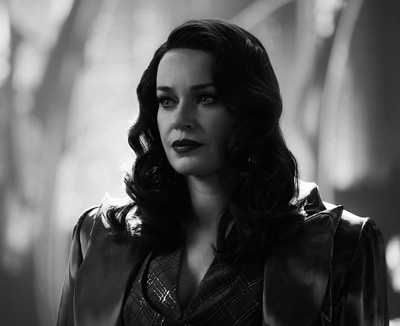 You're looking a little ashen, Number One, are you feeling OK?
This week's episode of Strange New Worlds brings to mind this exchange from the 1967 Star Trek episode "The Squire of Gothos":
KIRK: You don't find this unexpected, Mister Spock?
SPOCK: That his food has no taste, his wine no flavor? No. It simply means that Trelane knows all of the Earth forms, but none of the substance.
Substitute "Myers/Goldsman" for "Trelane" and "Star Trek" for "Earth" and Spock would be accurately describing this fourth season (and the third) of SNW.
The latest episode is yet another gimmick-of-the-week installment that fumbled along through its runtime without actually delivering anything significant. The gimmick: Film noir. Sort of.
The entire episode is shot in black-and-white and the bulk of the story takes place on a Klingon-occupied subject planet that looks like Fritz Lang and Tim Burton designed it. It's also home to people who are not only for all intents and purposes humans, but humans with a 1940s sense of style. It's a Star Trek version of Casablanca, without the romance and with the doppelgänger plot of Hollow Triumph thrown in.
It could have done something interesting. I mean, our characters find themselves wrapped up with the resistance movement of a society under the thumb of an authoritarian occupying force—seems like there might be some good allegory to be had if a little thought were to be put into it. The film noir movies generally involve not just mysteries and capers, but characters navigating moral grey areas and hard-choice dilemmas; all of that is here, but only at a surface level—nothing resonates. Once again, the SNW writers' room thought the gimmick was enough, the underlying structure could just be phoned in.
Episode 404: “A Case of Chiaroscuro” | Written by Skylar Ojeda & Dana Horgan | Directed by Meera Menon
★★½
I had assumed that last season's issues stemmed from a rushed production schedule following the Hollywood strikes, that scripts were being shot that in other circumstances would have had more refinement done first. Now, I see that I was giving the SNW writing staff too much credit. So much of this episode feels like a first draft, or at least a script with so many details that no one who looked at it ahead of production paid any attention to.
The setup is fine: A Federation surveillance probe has strayed from its intended route along the UFP/Klingon border and crossed into Klingon territory. The Enterprise is tasked with retrieving it before it's noticed by the Klingons, and for stealth purposes the Enterprise stays on the UFP side of the border and sends a shuttlecraft—manned by Number One, Ensign Uhura, and, for some reason, Dr. M'Benga—in to do the work. The probe is found in the Mat'aar star system, wherein stellar radiation includes what M'Benga calls "infrared blackbody spectra," which interferes with humanoids' ability to see color. Thus, everything is in black and white, not just for the viewers but for the characters. The probe is given a new trajectory back to the Enterprise in short order, but before the shuttle can follow a Klingon D7 cruiser enters the system and the shuttle has to hide to avoid detection.
OK, I said the setup was fine, but I will digress for a moment to point out the thing that isn't: "Infrared blackbody spectra." This is nonsense, and if SNW bothered with a science adviser we'd have gotten a sci-fi rationale for shooting this in black-and-white that wasn't utterly stupid. Still implausible, probably, but better. "Blackbody" radiation might sound like something that would impair color, but it isn't; it's simply the heat and electromagnetic energy radiated by any object, called "blackbody" as a reference to, basically, zero—a theoretical blackbody object that would absorb all light and heat and em energy, reflecting none back. Every star emits blackbody radiation. Anything generating or reflecting light or heat does. Infrared radiation is electromagnetic waves too long and too cool to be visible, and since our heroes can see just fine, albeit with no color, the star is clearly emitting some not-infrared em radiation. (Also, if the Mat'aar star emitted only infrared radiation it wouldn't be hot enough or bright enough to support a Class-M planet.) Instead, the sci-fi explanation should relate to something that affects the cones in a humanoid retina, something that disables two of the three and renders everyone monochromatic. What that would be I can't fathom, at least not in a way that lets people regain color perception upon leaving the environment; anything I can think of would leave you permanently color-blind (and possibly covered in melanomas). At least, until you get back to the ship and Dr. M'Benga can fix your retinas with spiffy 23rd-century eye surgery.
Anyway, we're in a black-and-white star system because reasons.
The shuttle lands on Mat'aar XII—damn, that star is really hot if there's a Class-M that far away from it—to hide from the Klingons, but finds that a difficult challenge because a) there's a security field they pass through that lets people on the ground know something is landing, and b) it's so densely populated that there's just nowhere isolated enough to avoid anyone with rudimentary sensors. Also, it's a Klingon subject world, ruled by an occupying force there to exploit the planet's resources with native forced-labor. They set down where they can but since their life-signs would draw attention no matter where they are, they leave the shuttle relatively hidden and decide to blend in with the natives as a better hiding strategy. Except our crew knows nothing about the natives; Uhura even asks, "what to people on Mat'aar XII even look like?" You'd think that would be something necessary to know before deciding on such a plan. You'd also think they'd have done some basic recon on who lives there before landing, even if all they had time for was photographs. (At this point I felt like Sam Rockwell's Guy Fleegman character from Galaxy Quest, who yells at Tony Shaloub's Fred Kwan, who opens a shuttle door on an alien world—"Don't open that! Is there air?! You don't know!!")
Fortunately, the people of Mat'aar XII are indistinguishable from humans. What a lucky break! We'll allow it, though, because all sorts of Star Trek planets are populated by human-types, explained away by Captain Kirk citing "Hodgkins' Law of Parallel Planet Development." (I don't know this for sure, but I always suspected "Hodgkins" was someone in charge of budgets at Desilu studios.) Moreover, they are indistinguishable from humans from the 1940s in their cultural affectations, so when M'Benga orders up some replicated native costumes they come with fedoras and trenchcoats.
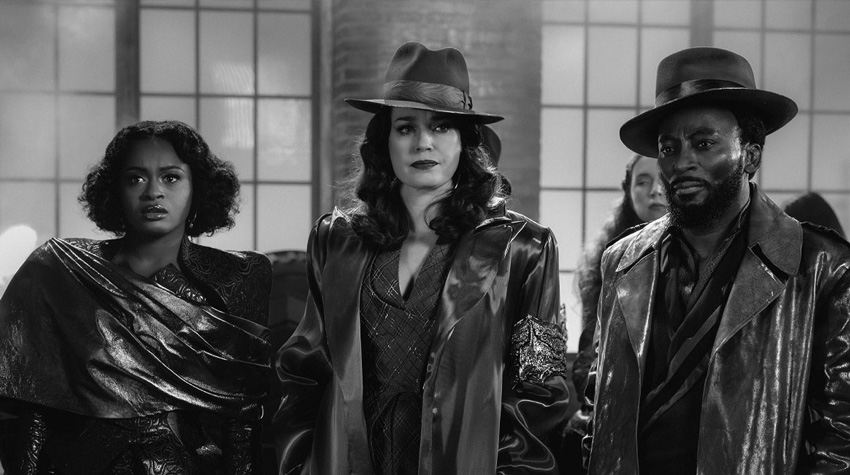
Before landing, M'Benga had paid Una a compliment regarding her "moral compass," thus telegraphing that she'd be faced with some sort of ethical pickle this episode, and as our trio of Starfleeters enter the city we see what that dilemma will involve. Una is recognized almost immediately as someone named "Navette," or as this person calls her, "boss," and is asked where she's been—apparently, Navette had gone missing not long before. Though confused, Una plays along as a stall tactic and we're then led to Rick's Café— er, I mean, the local watering hole, where we learn a few things.
First, that Navette is a fairly high-up operative collaborating with the Klingon occupation, and the guy from the street, Roman, has brought her here to help interrogate a prisoner. Una tries to talk to the prisoner one-on-one and maybe help her, but gets no useful info before the prisoner bites down on a poison capsule to avoid being taken to the Klingons. We do infer from the exchange that Navette is also the leader of the underground resistance movement against the Klingon occupation—she's a double-agent, pretending to work for the Klingons while working against them; meanwhile, the bartender here, Ja'lem, is essentially her deputy in the resistance. We also meet the apparent military governor of Mat'aar XII, a Klingon named Kor.
Kor, Kor, where have I heard that name before...
There is zero story reason to make the Klingon leader here the same character as the very first Klingon we ever meet in the original series ("Errand of Mercy"). This is using an original series character for the sake of using an original series character, and it invites criticism for a number of reasons. Firstly, his appearance—we'd gotten a fun in-universe explanation for why 1960s-era Klingons looked like humans in swarthy makeup while since 1979 Klingons had vertebrae up and around the skull and all that forehead bone structure, and here SNW is disregarding that bit of continuity by having Kor look like all the other Klingons, makeup-wise. That's forgivable, I guess, and the actor cast—Demore Barnes—does have a passing resemblance to the original Kor, John Colicos. But his demeanor doesn't track with either younger Kor of "Errand of Mercy" or the elderly Kor we see in Deep Space Nine. Had there been some reason to incorporate Kor, I might be fine with it, but there isn't. It's merely that Kor here has the same job description—military governor of a subject planet—as Kor in "Errand."
Anyway, our crew reassesses their circumstances and belatedly realizes that this was a bad plan. Better to just go back to the shuttle and hide out best they can until they can leave.
Except, oops, there's now a security checkpoint at the edge of town and they can't leave the city without going through it. They witness someone else try to go through without proper credentials and the Klingons do not react kindly; that's not a fate they want to tempt. Meantime, Uhura moves to perhaps aid the poor sap the Klingons just shot and that prompts the guards to ask for her papers, and since she has none they arrest her. So, new problem.
Back to the café, where Ja'lem agrees to help out and procure ID for Uhura that will get her out of Klingon custody. Una and M'Benga accept this much too readily, especially since M'Benga has plenty of Klingon war experience to inform him of the dangers Uhura might be in. But no matter, they leave the ensign's fate in Ja'lem's hands and go snooping in Navette's office, where they discover Navette's in-progress plan to disrupt the Klingons by means of an electromagnetic pulse, as well as blueprints for a processing plant and, oh yeah, Navette's dead body. She is indeed the spitting image of Una, could have been a twin. Navette had apparently been poisoned and as a last-ditch attempt to stay alive had tried to put herself in a cryo chamber. Didn't work. What Una and M'Benga did not find was the key to pulling off the EMP mission: the detonator that's programmed to trigger when scanned at a Klingon checkpoint. That, apparently, is at the processing plant.
Una's ethical dilemma, we are led to believe, is whether or not to act as Navette and carry out the EMP mission to give the resistance a fighting chance against the occupation. M'Benga advises her that it's not their fight, she's not Navette, and to leave it to the natives. Una feels too guilty about failing to fight against a wholly different sort of oppressors in her youth, something that really has no bearing here, and can't bring herself to ignore this mission. She empathizes too much with Navette.
Meanwhile, Uhura is being interrogated by Kor, who is quite happy to have an excuse to use his mind-scanner. Now, we were introduced to the mind-scanner, or mind-sifter, in "Errand of Mercy," wherein we are given to believe it to be a rather brutal means of extracting information that can leave its subject permanently brain-damaged to an extreme degree. (Spock is able to resist it thanks to a lifetime of mental discipline training from growing up on a world of touch-telepaths, but he warns Captain Kirk not to underestimate it.) So we the viewers should be afraid for Uhura, but turns out we needn't be as in this instance the device merely functions as a sort of unpleasant lie-detector. Still, Uhura does trip up a couple of times and we get the impression that Kor suspects her to be Starfleet, or at least alien to Mat'aar. That can't be good. I mean, that's what you'd think, but it turns out not to matter at all, because someone delivers her new ID card to the Klingons and they just let her go. So...what was the point of this whole sequence?
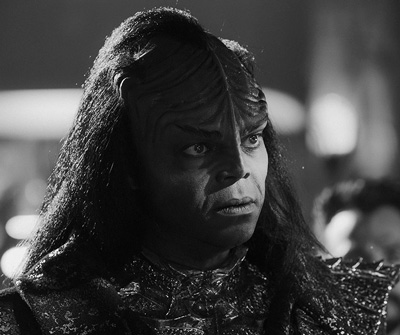
I am Kor. Why am I Kor? Shut up, that's why.
Back at the café, we learn the point of that whole sequence is that while being interrogated, Uhura overheard Kor and subordinates discussing their plans in Klingonese and, thankfully ignoring the very stupid scene from Star Trek VI: The Undiscovered Country, she understands the language quite well and has told Una what she heard: That the D7 had come delivering equipment to further fortify the planet, including a more elaborate defense shield that would vaporize any ship attempting to enter or leave the atmosphere anywhere other than in one Klingon-controlled portal. So, that's bad.
It also would seem to obviate Una's dilemma, because now the EMP is necessary if our crew is to escape back to the Enterprise. Except that bit of reality isn't ever mentioned. Apparently, it can't be, because this script is somehow supposed to be about a woman impersonating a film noir double-agent and wrestling with the morality of doing ugly things for noble reasons even though we actually feel very little to none of that watching it play out. It doesn't even seem to cross their minds that their freedom/survival depends on disabling the Klingon security net, it's still just should-we-help-the-natives-or-not. We don't even get an argument for why not other than M'Benga's this-isn't-our-fight remark. Is this a Prime Directive situation? Wouldn't seem to be, the Klingons are here and even though these are 1940s human-types that still smoke cigarettes, they do have spaceships. There is no weight to this alleged moral quandary whatsoever.
So, they steal the detonator from the processing plant, but Una is confronted by Roman again, who admits to being the guy that poisoned Navette in the first place. There are fisticuffs, Una wins the fight, and then she lets Roman go. Which is confusing until we learn that she planted the detonator on him, so when he goes running to the occupation forces to report what he knows about Una/Navette, he sets off the EMP.
Mission accomplished, the resistance can fight the good fight, many natives flee the planet, and our heroes take off in their shuttlecraft back to the Enterprise.
In parallel to all this is a B story aboard the Enterprise, where La'an suspects the probe's data has been tampered with. Since she has a through-line this season around her fears that her recessed augment genes might possibly be asserting themselves, she isn't sure whether to trust her suspicions. But Pike trusts her to do her job, so if something smells fishy, look into it. She discovers a hidden transmission, but then learns that it's something Scotty improvised to help keep an eye on the D7, which is hard to keep tabs on conventionally because of the same stellar radiation that is making everyone color-blind. Brilliant, but not at all nefarious. Still, there is something else, maybe? Scott isn't sure, so she takes her findings to Spock. Spock tells her he sees insufficient evidence to suggest any tampering. So La'an, giving up, goes to have another in what we learn is a series of, essentially, therapy sessions with Nurse Chapel; she is concerned about becoming paranoid, doesn't feel like she can trust her instincts, she was so sure there was something off with this probe data, but... Turns out, Chapel admits, there was tampering and she, Chapel, was the tamperer. Seems the probe had, in addition to collecting intel on the Klingons, spotted a Federation ship crossing into Klingon space against orders in order to render aid to a ship in distress. The captain of that ship knows Chapel, knows the Enterprise was recovering the probe, and asked for Chapel's help in covering up her transgression. Now Chapel asks La'an to be another participant in this cover-up.
Aha, the parallel storylines converge—both Una and La'an (and Chapel, I guess) are faced with tough moral decisions, navigating shades of grey in the face of black-and-white rules and regulations!
Except not really. Because Una's dilemma really wasn't one, and Chapel's thing is just a blatantly bad move that then puts La'an in the position of protecting her colleague with a lie rather than exposing her to justified disciplinary actions that might reach the captain of this other ship that wasn't secure enough in her choices to own them when reporting to Starfleet. When La'an reports to Pike that her investigation turned up nothing of concern, it seems clear that Pike knows she's leaving something out. He prompts her on it a bit, implying that whatever else there is, she can tell him safely, but she keeps it to herself.
So even though the closing scene is Una and M'Benga in the shuttle ruminating on whether or not Una did the right thing in aiding the resistance, the only real grey-area ethical plight was La'an's, and only in the final minutes of the episode. Not exactly what I presume the goal was in writing this story.
Sigh.
I don't know if there was enough here to be the foundation of a good episode. Maybe. If the shades-of-grey ethical dilemmas had more depth, and in La'an's case were present before the last couple of scenes. As it is, it's just more sloppy writing in a series that's been beset with sloppy writing for a season and a half now.
Star Trek has done really good ethical grey area episodes before, of course. Enterprise played with the concept for a whole season. DS9’s "In the Pale Moonlight" may be the best such script. Those worked because we understood the stakes, we understood the characters' motives and why they were reluctant to make the choices they made, and we were crystal clear on the norm of this universe. Starfleet, the Federation, our hero characters, they strive for ideals. And when they don't or can't meet those ideals, we see it affect them. Once again, some dialogue from the original comes to mind:
EVE: I read once that a commander has to act like a paragon of virtue. I've never met a pragon.
KIRK: Neither have I.
SPOCK: You've been most restrained since we left Organia.
KIRK: I'm embarrassed. I was furious with the Organians for stopping a war I didn't want. We think of ourselves as the most powerful beings in the universe. It's unsettling to discover that we're wrong.
In this episode, is Una striving for ideals? Maybe, in helping the locals overthrow their occupiers; but what's the conflict? The Prime Directive is never mentioned, but noninterference generally is the rule. We're never clued in really, though, to any hard choices. We see that Chapel isn't striving for ideals, and neither was her friend commanding the ship that disobeyed orders—Starfleet captains, as we've seen, disobey orders all the time when they have good reason to, but they stand by their decisions and own them; this commander instead chose to cover it up and make her crew accessories to her crime of omission, then implicated Chapel as well, who then implicated La'an. No ideal-striving there, just selfishness. La'an is the only one in that chain to have a real ethical problem, based entirely on keeping her colleague out of trouble, that is wrestled with. Personally, I'd have had her press Chapel to tell the captain herself, but again, we need to serve the script's attempt at a theme of making bad choices for good reasons. Or whatever they were going for.
Also, there's another gratuitous and unpalatable scene near the end. While shuttling back to the Enterprise, M'Benga tells Una of an event from his first Starfleet posting. This story is, I guess, supposed to give Una context to help her sort out her unease regarding whether she made the right calls here, but what it really does is paint M'Benga as a loose cannon. Or younger M'Benga, anyway. He tells her of being assigned to a hospital on a planet petitioning for UFP membership that had just overthrown a despotic ruler. A faction of the population remained loyal to the despot and surrounded the hospital, preventing entry. So M'Benga and his colleagues wiped all the loyalists out. I'm sorry, they did what, now?! Starfleet people killed a mess of natives on an alien world over political protest?! Just to get into a building?! Your phasers have stun settings, that's kind of the whole point of them; and you have transporter technology, you didn't need to use the door; and what sort of hospital has patients inside but all the doctors leave them unattended? Even if we shrug off all of the other sloppy writing issues in this episode, this bit should have been flagged instantly by someone in the writers' room, and if not there then by the showrunner, and if not there then by Alex Kurtzman, but nobody thought it was a problem. And that is entirely unacceptable.
Bits and pieces:
- It is nice to see Rebecca Romijn get to take the lead, her character has been underutilized for too long.
- M'Benga notes the poison used by the resistance members who choose to die to avoid capture is from the Borgia plant. This is another pointless TOS reference that shouldn't be there, the Borgia plant is native to planet M-113, far away from this system.
- Scotty assures La'an that his D7 detection signals have nothing to do with the probe data, "cross my heart and hope to get stuck in a pattern buffer." It's a funny line, as that's exactly what eventually happens to Scotty, but is it too much? I think this one's forgivable.
- There's a scene in the café where Klingons enter singing their warrior anthem and the native patrons drown them out by banging on tables and counters in tune with what's on the player-piano. This is a direct recreation of a scene in Casablanca done for no reason other that to draw a parallel to Casablanca. It serves no story purpose whatsoever.
- Cadet A'sha, introduced in the season premiere, shows up again here, assisting in La'an's detective subplot. She's rude, but I excuse it because she's young and doesn't want to be there.
- It's not just on the planet and in the Mat'aar system that everything is in black-and-white, everything on the Enterprise is, too. We're supposed to believe that the ship is close enough to be in the Mat'aar star's bad-science radiation field, but not only does that make no sense and stretch our already strained limits of disbelief, it just doesn't look good. The noir style on the planet, sure, fine. On board ship it just looks weird. And, it's contradicted by the very last scene that shows Una looking at her reflection in the shuttle window as they leave the Mat'aar system and sees the color return to her face. Sloppy. Writing.
Next time: More gimmickry and the SNW writers once again steal an idea from Joss Whedon and turn their lead into a puppet.
Tagged
Star Trek,
TV,
Posted on August 17, 2026 at 8:51PM | Permalink |  |
| 
Comments
Posted by Bill on August 18, 2026 (56 days ago)
Sigh. And I was so sure, as I professed to thee, that Years IV and V would return to form. Granted, I have as yet seen zero minutes, zero nanoseconds of the new season, and am a relative simpleton, easy to please... so perhaps I'll think it's great, or at least great entertainment (which I may unthinking-smiley-face think is jolly good enough!).
No one has commented on this page yet.
Post your comment
RSS feed for comments on this page | RSS feed for all comments