

Academy points
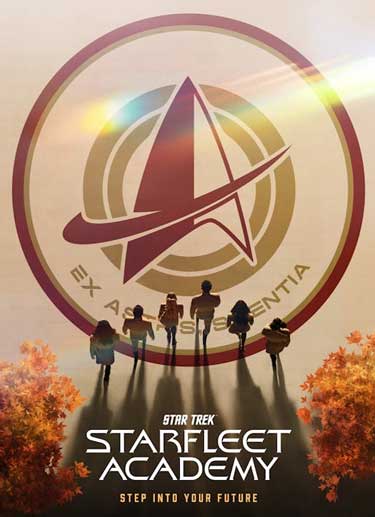
The latest Star Trek series premiered this week, and as will surprise no one, I have opinions.
What might surprise some is that generally my opinions are positive.
From the moment it was announced, this new show—Starfleet Academy—was met with cynicism, or at least trepidation. Some of that comes from previous projects centered around the titular institution that never got very far along in a production process before dying at the studio. Some just comes from the idea that by its nature, a series set at Starfleet Academy will largely revolve around youngsters, and the derisive nicknames began flying around social media: Star Trek: 90210, Dawson's Starship, Ten Things I Hate About Starfleet, Hogwarts in Space, you get the idea.
For myself, I wasn't concerned about the potentially YA-focused nature of an Academy show; Star Trek's universe is vast and can support all sorts of shows. Besides, some of my most favorite TV series have been YA-centric, from My So-Called Life to Buffy the Vampire Slayer to Freaks & Geeks. It's all about how its written.
Which is where my concern lay, because at its core Starfleet Academy is a spinoff from Star Trek: Discovery, a series that was... let's say problematic. I liked Discovery generally, but it suffered from writing issues throughout that annoyed me no end. As this new show was building off that one, and it was coming on the heels of the disappointing third season of Strange New Worlds, my expectations were low. But so far I'm pleasantly surprised. It's well done. At least, I think so; your mileage may vary.
Somewhat counter-intuitively, by placing the show in the far-future of Discovery's later seasons (the mid 3100s), thematically SFA can be about more contemporary 21st-Century issues—as established in Discovery, around the turn of the millennium an event colloquially known as The Burn happened, which effectively prevented interstellar travel for over a century and thus fractured the United Federation of Planets and plunged the various galactic civilizations into a kind of technologically varied dark age of isolationism and conflict. By the end of Discovery, the issues of The Burn had been solved and galactic society was beginning to interconnect again. So this new show exists in an era where the next generation has to clean up the messes of prior generations and where a regression in human (and alien) behavior has become something of an embarrassment in need of repair. So, climate change metaphors, political overtones recalling some of Felon47’s policies, things like that can be done in a way that would be impossible in other, more utopian Trek eras.
The characters, both the young cadets and the more mature adults, are all interesting in their own ways. The "legacy" characters imported from previous shows—Bob Picardo's holographic Doctor from Voyager and Jett Reno and Charlie Vance from Discovery—are delightful, series star Holly Hunter is as brilliant as one would expect Holly Hunter to be as Captain Ake, and the villain played by Paul Giamatti is fun in a completely over-the-top melodramatic sort of way. As for the young'uns, the main cadet, Caleb Mir, is played by Sandro Rosta, who thankfully has the acting chops to make him likeable and indentifiable while also being a young punk with a chip on his shoulder. With the rest there are some TV tropes used, but so far not to the point of being detrimental.
Mir and fellow cadet Darem Reymi suffer from too much machismo, both exuding the sort of manly-man competitive alpha-dog energy that I would hope would be extinct by the 23rd century, let alone the 32nd. They are clearly being set up to be the bully and headstrong tough guy types that initially hate each other but become buds, and the pilot episode (cleverly) contrived a scenario where they and their fellow core cadets have to work together in a crisis and learn to respect each other's skillsets. Then we have Cadet Genesis Lythe, the requisite nepo baby; daughter of a Starfleet admiral, she's lived her whole life in space and likes to verbally prank people. She's the one with natural leadership ability that takes charge. Our "outsider" character, a must in Star Trek casts, is Cadet SAM (short for Series Acclimation Mil, whatever that means), a "photonic" (read: hologram) that while programmed to feel 17 has only existed for four months. SAM is a delight, but I have many questions about her character that have yet to be addressed, not the least of which is, how does she exist and what sort of culture created her and why? We also have med student and oddly gentle Klingon Jay-den Klaag, who likes to birdwatch and has no desire to seek glory in battle. We've not seen much of him yet, but I like the concept.
The character I don't like much at this stage is Lura Thok, the "cadet master" and first officer of the Athena, which is both starship and, when docked on the Academy grounds, main campus facility. Thok is a Klingon/Jem'Hadar hybrid (something that also demands explanation at some point since the Jem'Hadar of the 24th century are all grown artificially), and thus has an overtly militaristic attitude and a hostile affectation. She behaves much like a drill sergeant, which I would also hope would be out of favor in the future but I might be able to headcanon as appropriate in a post-Burn society.
Most of these are supporting characters to the leads of Captain Ake and Cadet Mir, who have a relationship based in Ake's guilt for being part of a legal proceeding that separated Mir from his mother during the Burn times, an event that started Mir on a path of petty crimes in a lifelong quest to find his mom (played in a flashback sequence by the exquisite Tatiana Maslany, whom I hope we'll see more of). Ake is recruited to head up this new Starfleet Academy in part by Admiral Vance pulling strings to locate Mir and put Ake in position to free Mir from an alien prison, though the whereabouts of Mama Mir are still a mystery. The dynamic between the two is complex and it works very well, with Ake supporting and nurturing Mir while Mir works to balance his own agenda with being a cadet and learning to respect and forgive Ake for their past history.
So I like it. It's a strong pilot episode with a lot to work off of.
The one real problem I have, and I'm not sure how to mitigate it, is the use of contemporary language and slang in the scripts. One of the great jokes in Star Trek IV: The Voyage Home revolved around Kirk and Spock trying to fit in with 1980s Americans by using profanity and doing it poorly because it wasn't part of their contemporary culture. Yet here in 3100-whatever, people are using 2020s slang terms all the time. It's jarring and takes the viewer out of the scene. And yet, I understand using it; it's unreasonable to think young 20-somethings would not use slang, and the alternative is to go the Battlestar Galactica route and invent made-up slang and swears, but that would also be jarring. Still, I don't think anyone of any age would be saying things like, "I'm [fill in the blank], bitch" in a thousand years' time.
Episode two brings more characters into the mix amidst a story centered on Vance and company's attempt to being Betazed back into the Federation; two children of the Betazoid president end up enrolling at the Academy (well, one does, the other enrolls in the Starfleet "war college," a remnant from the Burn years that we've yet to learn much about). It's a classic Trek episode with diplomacy and politics and smart dialogue with none of the failings of Discovery anywhere to be seen. A strong and promising start to a series I didn't think I would care for.
What'd you all think, fellow nerds?
Nerdy observations
- In addition to the prominent "James T. Kirk pavilion" and "Sato Atrium," the Academy grounds has a "Boothby Gardens" and the Athena has a wall of heroes with prominent names from Star Trek history. Amusing to me was "Admiral Harry S.L. Kim," referencing the ensign from Voyager who appeared destined to never be promoted, a thing that was expertly parodied on Star Trek: Lower Decks; it would be hilarious if sometime later on we learn that that refers to someone else with the same name. Irritatingly, it also lists "Lt Julian Bashir," which, great, shoutout to Julian, but the dude never got a promotion? Come on. :) Oh, there's also "Cmdr Hugh Culber," which is nice but I presume all the names on the wall are memorials for deceased folk? Is Hugh dead (again)? He's still fine last we saw him in Discovery.
- Stephen Colbert voices the "digital dean of students," which means we hear his voice announcing various things in the halls. Sometimes funnyish, but is "hanger" also a term that will still be used in the 32nd century?
- Ake and her bridge officers are quick to consider and eventually implement lethal measures against the pirate crew that attacks the Athena in the pilot, and characters are seen to celebrate them (one joyfully declaring the casual obliteration of the pirates' ship "a teachable moment"). I'm hopeful that this sort of thing will be an ongoing sort of subplot of the show, a look at behavior that during the Burn era became acceptable and second-nature but will be recognized as something counter to what Starfleet and the UFP are supposed to be; this seems like a good area to utilize Tig Notaro's Jett Reno, someone who spent the majority of her life in the 23rd century, as a voice of conscience. I'm not confident in that, though, given that this is still an Alex Kurtzman-led show and he remains tainted in my head as a big part of the J.J. Abrams movies.
- A cover of the song "San Francisco (Be Sure to Wear Flowers in Your Hair)" by Rufus Wainwright is played during the sequence where the Athena docks at the Academy grounds. It's just score, it isn't something heard by the characters, but it's still an anachronism that I could have done without.
- At the end of episode two, Betazed agrees to return to the Federation when they are offered to host the new UFP capitol/seat of government. Cool. But I am now wondering about any Vulcan/Ni'Var officials having to live on Betazed surrounded by telepaths who are comparatively hedonistic. I imagine it might cause people to think twice about running for a Federation Council seat. Human politician: "You would be great on the Council, T’Zal, you should run for a seat." Vulcan: "Perhaps, though I am reluctant to commit to lengthy residences on Betazed; it would tax my psionic discipline." Human: "Well, you've got the figure for formal events. Besides, it could be worse, the capitol could have gone to Delta IV." Vulcan: [silence for several seconds, then turns and walks away]
- Captain Ake continues the tradition of Starfleet captains that prefer paper books to reading on PADDs. She also wears reading glasses, an anachronism that might be explained away the James T. Kirk way (allergies) or the Kovich way (stylistic affectation). Unlikely that it would be the Pelia way (hoarding things from her Lanthanite youth) as she's too young at 422 to have been around when eyeglasses were a common thing.
- The look of the show is largely appealing, but there's a bit too much J.J. Abrams/Discovery creep with things being shiny. Also, the bridge of the Athena is impractically ginormous, and what's with the sort of heatlamp-like overhead lights?
- It's going to be a sort of drinking game with this show whenever they need to include a line explaining why the instantly-jumping spore-drive-propelled USS Discovery can't come to the rescue. We got the excuse that's it's undergoing a refit in episode one.
- Sadly, the tradition of pointed sideburns did not survive the Burn, it seems. The 'burns were burned?
- I've seen/heard a few Californians nitpick that for all the talk of Starfleet Academy being in San Francisco, when the Athena lands and docks on campus it's across the Golden Gate in Marin County (consistent with where The Next Generation placed the Academy). I can easily explain that away by saying the boundaries of the city of San Francisco have had plenty of time to expand and subsume other Bay Area territory, just as Seattle has annexed huge swaths of land since its inception! By 3100 Berkeley, Petaluma, Oakland, and Palo Alto are probably just neighborhoods in San Francisco. :)
Tagged
Star Trek,
TV,
Posted on January 17, 2026 at 11:36PM | Permalink |  |
| 
Comments
No one has commented on this page yet.
Post your comment
RSS feed for comments on this page | RSS feed for all comments