


Lazy writing: SNW season 3 fails to meet high standard
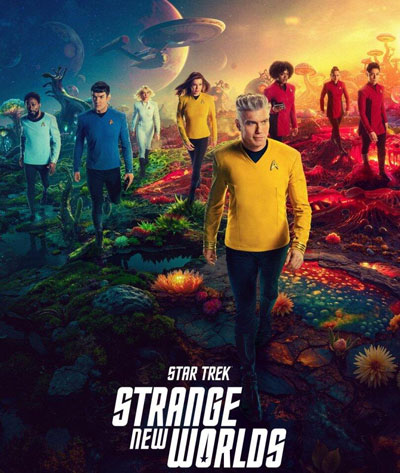
It will surprise no one that I have very high standards when it comes to Star Trek. The original series was, along with superhero comics, the biggest cultural touchstone of my youth; it informed my thinking, development, maturation, ethics, politics, and more. I was a nerd's nerd, if you will, while growing up and then reveled in the resurgence of Star Trek on television that began when I reached voting age.
It's important. It not only means something to me when it's done well, it also feels almost offensive to my soul when it's done badly.
The just-finished third season of Star Trek: Strange New Worlds, the prequel series that leads up to what we saw in the original 1966-69 series, had its moments, but by and large was done badly. Seasons one and two were consistently good, with a couple of caveats, but this one was just ... sloppy.
With one exception, no episode of SNW season three really stinks, and even that one has one or two brief moments of fun; there are no analogues to "Profit and Lace" from Deep Space Nine or "Code of Honor" from The Next Generation here. But the writing across the season is slapdash, like each script went into production as a first draft and at no time did anyone do any refinement on them or get a second set of eyes to see if things made sense or not, let alone run them by a science adviser.
There might be a reason for that—the season was delayed for a year thanks to the writers' and actors' strikes, and perhaps the studio rushed these episodes into production to get them out as soon as possible. But we already waited two years for it, I think everyone would agree that it would have been worth it to wait another few months if it meant the scripts were run through a better quality-control regimen. On the other hand, the people running this show—executives Alex Kurtzman, Henry Alonso Myers, and Akiva Goldsman—don't exactly have stellar track records when it comes to quality (I mean, they have Star Trek Into Darkness and Batman Forever on their résumés) and they may simply have thought these were all good to go. Despite being retreads of episodes from past Trek series and/or inconsistent within SNW, let alone all of Trekdom, and/or fundamentally misunderstanding why Star Trek (the shows) is Star Trek (the overall cultural phenomenon).
Star Trek is not space-fantasy, it's science-fiction. There are some less-realistic elements that we accept, concessions to television budgets and formats—transporters, a plethora of humanoid aliens, the universal translator, subspace radio—but we accept them within the overall worldbuilding established in the original and refined in the shows from the ’80s, ’90s, and ’00s. There are rules to be followed with the technology and anything outside of those few accepted conceits has to pass an at least rudimentary scientific smell test. Also, it's fundamentally about ideas and allegorical to the human society we're living in today; at its best, its stories have something to say, ideally through well-developed flawed but idealistic characters.
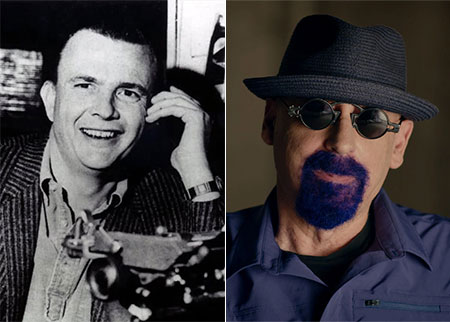
Gene L. Coon and Ira Steven Behr, the best of Trek's showrunners
The Genes—Roddenberry and Coon—famously either rewrote or rode herd on every script during their respective tenures as line producers on the original. Rick Berman may not have been all that good a writer, but he took it seriously when he was charged with safeguarding the franchise for Roddenberry after the latter's health became too poor for him to keep working on TNG. Ira Behr ran the best Trek writers' room as showrunner of DS9, insisting on a certain fidelity and depth of storytelling despite the demands of a 26-episode season. For the most part, these streaming series—with a new normal of first 13 and now merely 10 episodes per year—haven't had someone like that in charge, someone who knows what makes Star Trek work.
I don't know why it's apparently so hard for people who are by all accounts enthused to take on Star Trek as a property—J.J. Abrams (films), Kurtzman (all streaming series and the Abrams films), Gretchen Berg/Aaron Harberts (Discovery)—to comprehend what it is. Why it has had such staying power. Why it appeals to the people it appeals to. Abrams was and seems to remain completely clueless, he thinks it's a space-fantasy like Star Wars. The others seem to grasp only a surface-level understanding of it. Mike McMahon of Lower Decks and Terry Matalas of Picard season three get it. Michelle Paradise (Discovery season 3-5) fell somewhere in between getting it and just knowing the trappings, as did, I had thought, Goldsman and Myers. After seeing SNW season three, I have to reevaluate; Goldsman and Myers might be closer to the Abrams end of the scale.
In this admittedly lengthy and probably too-nerdy-for-most post, I want to break down the season episode by episode and look at what worked and what didn't.
First, a little backstory on SNW's "original sin," if you will:
Before the series got going, Myers wanted to revisit the Gorn, a reptilian bipedal species from the original series that we saw once in a famous sequence shot at Vazquez Rocks. Nobody in that episode had ever heard of the Gorn before, so including them in this new prequel series was going to be, at best, problematic. But Myers had the Gorn bug up his butt and wanted to see them done up in ways that were simply impossible to do in 1967 (when the Gorn was simply a guy in a green rubber suit) so he decided to ignore that bit of canon and make the Gorn recurring baddies in Strange New Worlds. He also changed what the Gorn were, making them irredeemable monsters and thus completely negating the message of that original series episode where we first met the Gorn. It's a choice that irritated a lot of us fans that respect the Trek canon, an irritation that could have been avoided by simply calling these new Gorn something else. Call them the Groob or the Zhegdach or something and it's all good, but no. So from an early scene in the first episode, Goldsman and Myers telegraphed to the audience that canon will not be respected, yet the execs insist that this is supposed to fit into the so-called "prime timeline" of Star Trek (as opposed to an alternate timeline, like was presented in the J.J. Abrams movies). Squaring that circle is going to be a challenge, but they insist it will be done.
Season three proves them wrong. And that they don't get why.
OK, onward: The ten episodes of SNW Season Three reviewed. Ratings on a five-star scale relative to Star Trek as a whole—and you'll note nothing here approaches ★★★★★.
Scroll through them all or skip to episodes:
- Hegemony II •
- Wedding Bell Blues •
- Shuttle to Kenfori •
- A Space Adventure Hour •
- Through the Lens of Time •
- The Sehlat Who Ate its Tail •
- What is Starfleet •
- Four-and-a-Half Vulcans •
- Terrarium •
- New Life and New Civilizations
Previously on Star Trek: Strange New Worlds...
Season two left off with a cliffhanger. The starship Cayuga was destroyed by a Gorn fleet invading a planet that, despite being full of human colonists, is not under Federation jurisdiction. The Cayuga's Captain Batel, along with several crew, was on the planet surface when the ship was attacked; that's good, because she's also Captain Pike's girlfriend. Sort of. Mostly. Anyway, she's important. Pike and the Enterprise skirt their orders and attempt a rescue of crew and colonists from Gorn invaders; in the attempt they meet another stranded Gorn attack survivor, the sole escapee of the poorly-named USS Stardiver, in Lieutenant j.g. Montgomery Scott. They also discover Captain Batel has been infected with Gorn eggs. But they also find a way to save everyone's bacon and are this close to pulling it off when four Enterprise officers and many many colonists are transported up to the Gorn ship at the same time Pike and the rest of his team are beamed back to the Enterprise. We leave off with Pike facing an overwhelming number of Gorn attackers and needing to somehow rescue the many captives of the Gorn while Batel is at death's door in sickbay.
Episode 301: "Hegemony Part II" | Written by Henry Alonso Myers & Davy Pérez | Directed by Chris Fisher
★★
Part two of a cliffhanger is almost always lesser than part one, and thus is the case with "Hegemony." We get everything resolved a bit too easily and aren't given anything to ponder afterward. It's entertaining; the characters are written true to themselves and what little development there is fits nicely. The sloppiness is with the plot and its details, which hinge on three things: How to save Batel in sickbay, how to rescue crew from the fleeing Gorn ship, and how to defeat/survive the Gorn attack fleet in space.
The first problem isn't too badly handled in the broad strokes, but we need some exposition or another scene or two for it to make sense. Why is it up to Nurse Chapel, who was rescued from the Cayuga in the previous episode, to save Captain Batel? Yes, Dr. M'Benga is among those who were taken by the Gorn, but are we to believe that the Enterprise carries only one MD? There's no other doctor aboard? Sure, Chapel is a fine nurse (practitioner, we assume) with some specialties in gene therapy, but she's a decade or so shy of getting her MD (sometime between the original series and Star Trek—The Motion Picture) and she has to do this by herself? The story requires that she only get help from Spock so we can have important character stuff happen with the two of them. OK, but provide a rationale for the circumstance. We're told at the end of the episode that there's an "overflow infirmary" aboard, so establish that early on and stipulate that (a) main sickbay needs to be cleared and everyone moved to the overflow infirmary because the situation with Captain Batel is extremely dangerous and if shit goes wrong we've got ravenous tiny Gorn aboard, so for security purposes no one else can be there; and (b) the other doctor(s) aboard have to deal with battle injuries from the pounding the ship has been taking, so no help is available for Chapel. Just clean that bit up some so we're not taken out of the flow by thinking, hey, wait a minute, there's no medical staff on board at all except the nurse that isn't even currently assigned to the ship? And sickbay is utterly empty during a space dogfight?
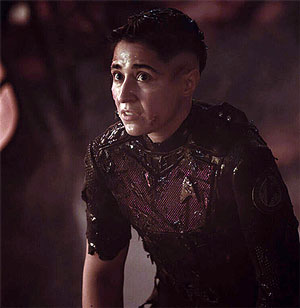
Escaping the Gorn
The solution to Batel's infection is creative, but not well explained; we get to the end and it's not at all clear how the Gorn infection is cleared. The Gorn eggs don't hatch because the embryonic monsters are being "fed" internally somehow, I got that part, but how does delaying/preventing their eruption make it so the infecting cells can be absorbed by Batel's body? Just the extra time allows it? Some sort of byproduct of the transfusion they did earlier? Huh? We just have to accept the macguffin we're given about how she can't be in stasis because of an allergy to "cryoserum" (say what, now?), but at least we're given a rationale for that. It seems like the writer had something in mind that solved this reabsorption problem but didn't put it in the script, which an editor might have flagged if given an opportunity to do so. My impression was that Chapel and Spock's efforts just bought them some extra time, not solved the problem entirely, but then we're told otherwise (with a caveat that this is all uncharted territory and shit could still go down later).
The second issue has our captured Enterprise foursome escaping the Gorn ship in a Gorn fighter craft after first getting themselves free of these gross digestion pods before Gorn bile breaks them down for food. They also want to save the 200 or so colonists similarly entombed, but they figure there'll be better odds of doing that if they can get the Enterprise to just beam them out. An unnecessary complication is introduced in the form of something called "transport codes," which we've never heard of before but which are apparently necessary to beam anyone away from the Gorn because reasons. No matter, La'an can find them by somehow accessing a computer interface, knowing how to navigate it, and downloading these codes to some sort of media. Not remotely believable, but also only required to solve a problem that didn't need to be there, so ... why? (Also, a pet peeve trope is used in this sequence: When La'an frees herself from the digestion pod she slips and falls over a ledge and has to grasp onto some sort of tendril and haul herself back up to the floor, which—just as it did when this trope of slipping off a ledge with a long fall threatening inside a spaceship was used in Star Trek: Nemesis, Star Trek (2009), and lots of other non-Trek shows and films—makes me yell, "what genius installed gravity plating on only the bottom of a multi-level chasm, especially in a service area that isn't generally crewed at all??! Surely that violates OSHA standards or something.") But they escape in the Gorn fighter craft, get to where the Enterprise can beam them home, and likewise use the "transport codes" to save the colonists (well-established Trek convention would allow sensors to find and lock onto the only humans aboard a ship; I can head-canon some sort of security scrambler device used by the Gorn, but if I have to invent that myself it just means this bit was overcomplicated to begin with).
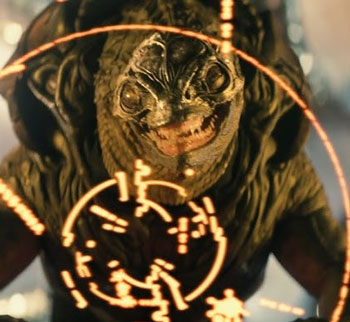
Gorn in pursuit
Point three's resolution is basically stolen from the first time Star Trek did a season-bridging cliffhanger, "The Best of Both Worlds" from The Next Generation. In "BOBW" part two, the villainous Borg are "put to sleep" by a digital command implanted in their cybernetic collective consciousness; it works there and fits understood parameters of sci-fi and the worldbuilding previously established. Here, the Gorn are tricked into hibernation by reasons that initially sound sci-fi impressive but don't stand up to scrutiny—it seems the Gorn's behavior is keyed to stellar flare activity around their homeworld; some types of coronal mass ejections wake them up and send them into a rampage, other types compel them to go home and hibernate, so Pelia, Scott, and the crew use the ship to simulate the proper CMEs and manipulate an incredibly unrealistic binary star pair that defies physics but is presumably near the Gorn's planet. Like the Borg, the Gorn are put to sleep and the bad-guy invasion is thus halted. Unlike the Borg, with the Gorn it doesn't make any sense. (It reminded me of the pilot episode of Star Trek Discovery, wherein a Klingon faction signaled across parsecs of space to other Klingon factions by way of a nova-bright beacon—you know, light. Across light-years. Which are units of distance that measure the distance light travels in a year, and yet the signal is received in all of these disparate places almost immediately.)
Things I nevertheless liked in the episode:
- Pike quickly absorbing, rejecting, and accepting rapid-fire suggestions from the bridge crew; I like that command dynamic, involving the subordinates in a crisis, taking what works and discarding what doesn't.
- Portraying young Scotty in his pre-"miracle worker" state of mind. Pelia basically tricks him into working his genius mojo, laying groundwork for a nice backstory for how he becomes the capable Scotty we know.
- Music cues reminiscent of the original series.
- Callbacks to Pike's religious upbringing and his antipathy to it while he finds himself considering prayer.
- The Chapel/Spock interplay was done well and moves that series thread along nicely.
- The containment suits Spock and Chapel wear—outstanding retcons of the cheaply made shower-curtain hazmat outfits from the original series episode "The Naked Time."
- Anson Mount was awesome as always, giving Pike emotional depth and range with all the chaos going on while his girlfriend is in critical condition and then afterward as she's in recovery. It's a good relationship, well-played and with a realistic dynamic.
So... resolved the cliffhanger, but needed to rip off "Best of Both Worlds II" to do it and had other plot points that needed refinement. Suspense story was OK, but there's no message; we learned nothing and have nothing new to think about. Bad science regarding the binary stars and why/how an entire spacefaring species is affected by stellar flares at one specific point in space.
Do better.
Episode 302: "Wedding Bell Blues" | Written by Kirsten Beyer and David Reed | Directed by Jordan Canning
★★★½
When this silly story played for laughs and goofiness dropped at the beginning of the season, I had no reason to think it would be the best episode of the year. But it is.
We open with a small time jump, allowing for plot points: Chapel has finished her three-month archeological medicine fellowship with Dr. Roger Korby and is due to return to duty on the Enterprise; the ship is finishing up a stint docked at Starbase 1 for repairs after the mess of the last episode; and enough time has passed for Dr. M'Benga to realize Captain Batel isn't really cured after all. Also, it's the eve of the Federation Centennial celebrations, and there's going to be a big party for that on the Starbase.
Young Spock is a tremendous source of story potential, and he's put to good use here. After he was told in the prior couple of episodes in very human and indirect terms that Chapel was ending their experiment with romance, Spock has unsurprisingly missed the nuances of that and is looking forward to Chapel's return. La'an is aiding him in an effort to learn to dance as part of a romantic gesture to spring on Chapel, though La'an finds the wisdom of the idea suspect; the gesture is promptly sent crashing and burning when Chapel returns with a date for the Centennial—Dr. Korby (who does not need separate quarters assigned, thanks anyway).
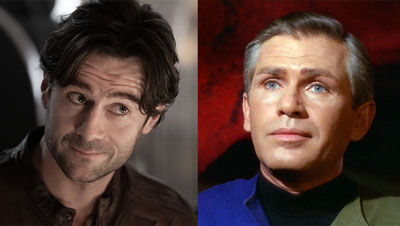
The Rogers Korby:
Cillian O'Sullivan (SNW), Michael Strong (TOS)
Korby's name had been dropped a few times in prior seasons, but his appearance was inevitable in order to satisfy canon and the knowledge from the original series episode "What Are Little Girls Made Of?" that Chapel was involved with him at this point in her life. The actor cast in the part, Cillian O'Sullivan, doesn't evoke Michael Strong's performance in "WALGMO" but it's nevertheless a good choice. O'Sullivan is good here and sure, Korby can be Irish even though Michael Strong's Korby didn't have that accent, why not. It's good to mix it up some.
Anyway, now the stage is set for the main story, which has a mysterious stranger that appears to the crew as different personas (but always to the audience as actor Rhys Darby, hamming it up with glee) while monkeying with reality. We first encounter him in the role of a bartender attempting to console Spock, who has just witnessed Chapel and Korby recounting their courtship; he teases out an admission from Spock that he (Spock) wished things could have been different. And just like with Anya the vengeance demon in Buffy the Vampire Slayer, the wish is granted and reality changes—Spock awakens in bed with Chapel on the eve of their wedding.
Though not ever named in dialogue, the mysterious alien stranger is named in the script—and telegraphed by dialogue context clues—as being Trelane, the super-powerful "little boy" from the original series' "The Squire of Gothos." He's similarly played here, though a bit more mirthful and less cranky; it doesn't make temporal sense, as Trelane's encounter with Captain Kirk is still years off in the future and in that story Trelane knew nothing of contemporary Earth and clearly had not ever met Spock before. But we can easily head-canon that problem away as there's no reason to think Trelane has to exist in linear time, this easily could be an older Trelane that already experienced that future story. In fact, if that Trelane was a little boy, this one reads more as a tween.
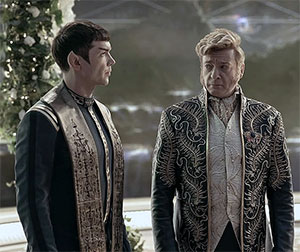
Spock regards the wedding planner / Trelane / Q
Trelane then adopts the persona of an Andorian hired to be Spock and Chapel's wedding planner and orchestrates the story in that capacity. Oddly, Dr. Korby still remembers the proper reality but Trelane effectively sidelines him at every opportunity until Korby decides to go to Spock for help. Which, you know, awkward. When Korby makes Spock angry enough to lash out at him, the veil is lifted from Spock's eyes—also something we've seen before, e.g. "This Side of Paradise"—and the two then become unlikely allies in trying to figure out what happened and set things right. Ultimately, Spock succeeds in breaking the spell over Chapel in a bittersweet and moving manner that reminds her how she feels about Korby; along the way there are a number of funny bits and the comedy is played well without abandoning the character beats.
When Chapel recalls proper reality and thus ruins the wedding, Trelane starts throwing a tantrum; he turns Korby into a bulldog, threatens to kill everyone except one alien he thinks is cool, and mayhem is imminent until, as in "Squire," Trelane's dad shows up to intervene. This time Trelane's dad is voiced by John de Lancie, giving credence to the longtime fan theory that Trelane is a juvenile member of the Q Continuum, the race of nigh-omnipotent beings from The Next Generation. Trelene's dad explains that Trelane is just a child of 8,000—"Eight thousand and twenty, Dad!!"—and makes his wayward son turn Korby back into a human, bring everyone else's perception of reality back to normal, and apologizes before the two disappear into the ether with a "tallyho!" from Trelane. Before they leave, though, Spock asks Trelane what his motivation was, and it's funny—he was annoyed at Korby and wanted to humiliate him. "I spotted him digging in the dirt in the old homeworld. He's so handsome and smart and perfect. It's just annoying!" To which Spock replies, deadpan, "Yes, that makes perfect sense."
I don't necessarily mind going to the Original Series well yet again, but every time they do they end up putting themselves in the position of being the lesser half of a comparison. "Squire" is a great episode. "Blues" is, you know, fun, but kind of forgettable in that there's no real substance to it. That kind of episode is fine as a diversion—the original had "Tribbles" and "A Piece of the Action," TNG had "Qpid" and "Manhunt," DS9 had "Little Green Men" and "The Magnificent Ferengi," Voyager did "Tinker Tenor Doctor Spy" and "Bride of Chaotica." Even Enterprise had one in "Acquisition." But those were each one of 26; if you're going to do an empty-calorie tasty junk food episode when you only have ten in your season, the rest better have nutrients.
Kirsten Beyer is one of the better writers this show has, maybe the best, and she delivered a fun romp that was ultimately inoffensive (in stark contrast to another played-strictly-for-comedy episode later in the season) and moved things forward some. But nothing more.
Episode 303: "Shuttle to Kenfori" | Written by Onitra Johnson & Bill Wolkoff | Directed by Dan Liu
★★★
Pike and M'Benga take, well, a shuttle to Kenfori—which is a world designated off-limits due to some jurisdictional issue resulting from the Klingon war of a few years back—in search of some "chimera blossoms." The plant is native only to this planet, where a Federation research station was active before the war, and is apparently necessary to treat Captain Batel.
Wait, you say, wasn't Captian Batel basically cured already? "Yes, well, don't bother us with such things," say the writers, "we gave ourselves an out with vague language and we are exercising it because we screwed up in 301. She can't be cured, it would wreck our whole throughline. If only we'd had someone in charge, a writer at the head of things, someone who runs the show...like a 'head writer,' or a 'showrunner,' if you will, who would have noticed that earlier."
So Pike and M'Benga go off to find the magic flower on the forbidden world and discover that Klingons have left a warning buoy in orbit exhorting all to "turn back or die." Nothing's going to stop them, though, so they land, find the old research facility, and quickly discover some chimera blossoms. Mission accomplished! Except then their shuttle is blown up by Klingons. Then Klingons land their own craft and attempt to capture our guys, but before they can the whole lot of them is beset by zombies.
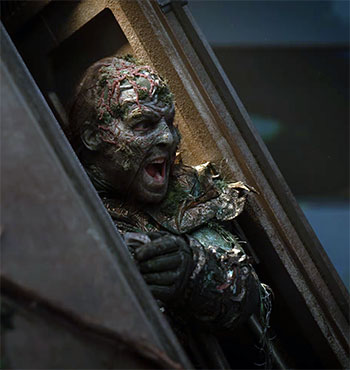
Beware the Klingon zombies
Zombies?! Well, M'Benga doesn't want to use "the Z word," but, you know, they're reanimated corpses trying to consume everybody, so...
There's a fight, there's fleeing, then a brief respite wherein M'Benga can look up old research data and determine why the zombies exist; it's interesting and satisfies the need for explanation, but it also serves as a conduit for Pike to glean that the chimera treatment M'Benga wants for Batel isn't so much a cure as a transformation. The chimera's function is to hybridize things. The records show that the researchers tried to use it to make better food crops by hybridizing different plants, but science-run-amok ended up making a pathogen that consumes life and creates zombies instead. M'Benga wants to use the chimera to hybridize Batel with... the Gorn remnants in her system? Pike is displeased. No time to ruminate on that, though, more zombies attack, more fleeing, and then capture by the few Klingons that hadn't been killed/zombified/both.
The leader of the Klingons, Bytha, turns out to be the daughter of Dak'rah, the Klingon defector we met last season and whom M'Benga killed—officially in self-defense, but under suspicious circumstances. Bytha hated her father as his defection brought disgrace and dishonor on her whole house, and his death deprived her of the opportunity to reclaim her status by killing him herself. Klingons, man. But there's a loophole that says Bytha can still reclaim her status if she offs the one who killed Dak'rah instead, and she's been chasing M'Benga for some time.
They find a far too convenient, somehow still functional force-field cage on the roof of the facility and put themselves inside it to keep the zombies at bay after the rest of Bytha's flunkies fall victim to zombie attack. It makes for a suitable place for a one-on-one battle for honor between Bytha and M'Benga, who admits to having killed Dak'rah on purpose to Pike's surprise. M'Benga wins the fight but refuses to kill Bytha, who is outraged at the further dishonor of it all and in a final attempt to cleanse her soul launches herself at the zombie horde in order to give Pike and M'Benga time to escape to the Klingon shuttlecraft. (Hey, it makes sense within Klingon context. Really, it does work.)
There's a whole other subplot on the Enterprise, which discovers a Klingon ship going to the planet and has to be ready to come to Pike's aid if his party is found by the Klingons. But they can't let the Klingons know they're there, lest they create more danger. This plotline seems important because Lt. Ortegas and Number One differ on how to proceed, then Ortegas effectively mutinies by accidentally-on-purpose causing the Klingons to notice the Enterprise and forcing Number One to abandon her plan of stealth and use Ortegas' plan of urgency, which is risky as hell but does bring the Enterprise to the planet quickly. The ship can then beam the shuttle party aboard (which they do); due to the carnage on the surface, the Klingons are in no shape to fight, so our guys are safely back (with chimera blossoms) and the ship safely departs. But Ortegas is still in deep trouble, especially as her risky moves weren't necessary since Pike and M'Benga were already on their way to escaping in the Klingon craft. Consequences from Ortegas' insubordination should be something that carries over into future episodes.
It's actually not a bad episode, even though I'm not keen on zombies as a concept (plus, Enterprise did a much better zombie episode). The stuff on the planet and the stuff with Ortegas on the ship are all good, it holds together well, it picks up on a loose thread from last season and gives us a new one to pick up on later. It has good character beats, especially with M'Benga and Pike. But it suffers from two things.
First, the macguffin of the chimera blossom feels a bit thin. We need an object for the quest, as it were, and we need to further the season-long arc for Batel; fine, and in the end we get some pretty good exposition about it in between zombie fights, but at the outset it sounds kind of silly. I'm not sure how to fix that, maybe it's just a minor nit that we can overlook. Second, and this isn't really about this episode but what came before, the whole Captain Batel infection throughline is to this point really convoluted and haphazard which isn't helped here.
Also, at one point mid-episode Batel is in distress and is aided in coping with it by a mind-meld from Spock. I have a couple issues with this—one, Spock claims in the original series episode "Dagger of the Mind" that he's never melded with a human before, and this just ignores that bit of canon (they'd already broken this one in season one, when Spock melds with La'an, but given how that relationship evolved I can head-canon a reason Spock would keep that to himself); and two, the reason this mind-meld is in the story at all is to tease something scary about Batel's condition when inside the meld Spock and Batel "see" a screaming maw of some kind in her mind.
The writers are super cavalier about melds in this series. It doesn't track. Spock should not be willing to undertake one, let alone suggest one, without greater motivation, and we need to respect the never-melded-with-a-human thing, so come up with a different way to tease Batel's scary vision/premonition/mind-maw. Do it with Nurse Chapel scanning Batel's brain in an attempt to determine why she's freaking out, intercut her off-the-charts readings while trying to contain a thrashing patient with some quick cuts from Batel's POV where the scary maw appears. It doesn't matter if Spock sees the scary maw, just that the audience does so it's known there's more coming to this arc. It's just sloppy.
Other good things about this one:
- Babs Olusanmokun (M'Benga) is one of the few post-original series actors who correctly pronounces "Klingon," which I greatly appreciate (Ethan Peck does as well). It's KLIN-gon, not KLING-on. The syllable break is before the G.
- The Klingon shuttle was in the weird style of the Klingon ships in Star Trek Discovery. I didn't like those designs, but I do like consistency within this universe.
- M'Benga's revelation that he did in fact murder Dak'rah is a thread I hope will be picked up again. If we are to believe that this Dr. M'Benga is the same character as the Dr. M'Benga seen in two episodes of the original series, then there needs to be some reason that he's the CMO under Pike but a subordinate lieutenant by the time McCoy takes over as CMO. Maybe he gets busted for this. Or, maybe Joseph M'Benga is a different guy and the M'Benga working under McCoy is his brother or something.
- The insubordinate Ortegas subplot had a lot of potential to be something going forward and I looked forward to that being realized. Spoiler alert: they just dropped it, making this a wasted opportunity used for a one-off without any resolution.
Episode 304: "A Space Adventure Hour" | Written by Dana Horgan and Kathryn Lyn | Directed by Jonathan Frakes
★★½
Two and a half stars might be pushing it for this one, but I confess, I like some of the meta-humor.
The opening teaser immediately lets us know this is going to be a silly episode. It shows a clunky-looking, clearly fake-set bridge of a ship, captained by Paul Wesley, this series' James T. Kirk, but as someone else. Basically as a parody of William Shatner. The scene proceeds to set up some ridiculously-dialogued jeopardy for this not-Kirk and his crew, then we cut to opening credits—for the fake show, "The Last Frontier," in the style of the original Star Trek.
Post-opening credits we see our normal starship Enterprise and get the setup for the episode: Starfleet is experimenting with holographic environments as a potential recreation option for ships on long-term missions and has tasked the Enterprise with installing one and giving it a shakedown.
It's way too early in the timeline for holodeck technology, but the writers wanted to do a holodeck episode and the way to do it was to say, "well, this is a beta-version holodeck, plus it's a one-off because it uses too much of the ship's resource capacity and is removed after the episode ends." (Is it basically absurd that at some off-screen moment before the episode a section of the ship was retrofitted with this beta-holodeck? Yes. Do we care? Apparently not. Oh well, I can head-canon it as having been done during the three months the Enterprise was at Starbase 1 between 301 and 302 and they just procrastinated doing anything with it until now.)
Sigh. Is every episode of the season going to be derived from something they've done already? Spoiler alert: yes, basically.
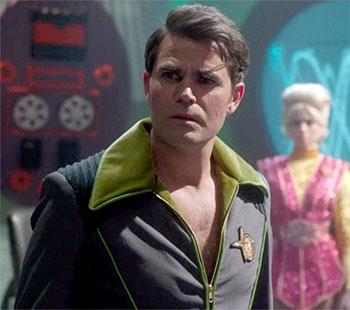
"Maxwell Saint" as the captain
OK, since they've committed to the holodeck bit, can they at least do something interesting with it? Well...sort of?
La'an is given the job of putting the holodeck through its paces, and she borrows from The Next Generation's "The Big Goodbye" and "Elementary, Dear Data" episodes by (a) programming a mystery based on a beloved old-timey mystery novelist's work and characters (the fictional Dixon Hill books in "The Big Goodbye"; A. Conan Doyle's Sherlock Holmes in "Elementary, Dear Data"; the fictional Amelia Moon mystery novels in this case), and (b) giving the parameter that it be challenging to solve for herself, La'an—not for Amelia Moon, the fictional character she'll be playing. In a scene prior to the holodeck story kicking off in full, we see La'an and Spock continuing their dance practice, begun two episodes ago, and learn that La'an has been wearing a monitoring device that is synced up to the holodeck computer to better prepare her scenario.
When she actually enters the holodeck and begins her test program, the setting is revealed to be a murder at the home of a Hollywood television mogul in the year 1969, where the cast and creators of a show called "The Last Frontier" are meeting to discuss the fact that their science-fiction series has been cancelled by the network. The mogul's ex-husband has been murdered, and La'an has to identify the killer and solve the mystery. Thanks to a good explanation from Lt. Scott about recource needs, the physical appearances of the fictional characters in the holodeck are based on our regular heroes as their patterns were recently in the transporter buffer, so we get Anson Mount playing television writer/producer T.K. Bellows, Rebecca Romijn as Sunny Lupino, Paul Wesley as Maxwell Saint, etc. "The Last Frontier" is an obvious analogue to the original Star Trek; Bellows is a caricatured Gene Roddenberry; Lupino a redheaded famous-star-turned-studio-exec ala Lucille Ball (her murdered ex-husband therefore Desi Arnaz and their studio Desilu Studios); Saint a very exaggerated Bill Shatner. Also present are other cast members, their agent, and a hanger-on groupie-type boyfriend, all suspects for La'an's mystery murderer.
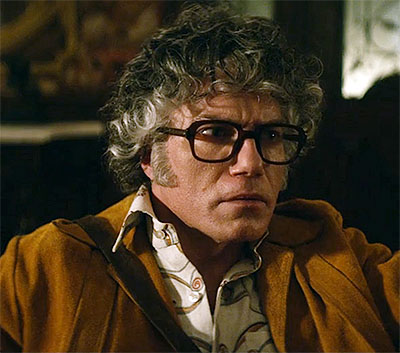
Anson Mount as T.K. Bellows
The meta aspects of this story are both cheesy and funny, though the comically bad sets and dialogue we were shown as part of an episode of "Last Frontier" were maybe too camp; parodying the original is a tough needle to thread for the audience of Strange New Worlds, but I think most of us took it in stride and had a laugh. The murder mystery itself is sadly by-the-numbers, with the twist coming very late revealing none of the "Last Frontier" people is the murderer after all; instead the culprit is Moon's assistant, a holographic Spock that we and La'an mistook for the real Spock for most of the show.
While all this is going on, Lt. Scott is trying to manage the ship's functions as the holodeck continues to draw more and more power and resources away from everything else, thus giving the real crew real jeopardy to contend with; in the end, La'an and Scott's report is that the holodeck is an intriguing project but unsuitable for starship use simply because it needs its own dedicated power and is too intensive to integrate with the rest of the ship. Captain Pike wants it buried in a deep hole and never spoken of again.
"A Space Adventure Hour" hits all of the holodeck episode tropes from TNG and Deep Space Nine: the protagonist is an established in-universe fictional character (Dixon Hill, Sherlock Holmes, the unnamed but obvious James Bond), the safeties don't work, a holographic character is mistaken for an actual crew member, characters are trapped inside it, the only way out is through... If it was done in a prior holodeck episode, odds are good it's done here too. Maybe that was on purpose, to make this as homagey an homage as has ever been homaged, but I still think if you were going to bend over backwards to do a holodeck story in an era that didn't have holodecks, you should at least do something we haven't seen before.
The saving grace of the episode is Jonathan Frakes. As with any Frakes-directed episode, it looks great, the humor lands, we get some nice angles for the camera, all is technically well done and performances are spot-on. I'm just back to quibbling with the writing—again, it feels like a first draft.
I do like the portrayal of Bellows, though I wish there was more there; he embodied a lot of Roddenberry in demeanor, appearance, tone, and ego, but was somehow short on depth. The best of the holo-characters was the agent, Joni Gloss (Celia Rose Gooding), who made the passionate case for "The Last Frontier" as more than just a TV show to sell commercials for, but as something inspiring and visionary—even if that was completely absent in the "clips" we saw from the show inside the show. Also, Gloss' point still appears to be lost on SNW's co-showrunners Henry Alonso Myers and Akiva Goldsman, who have done very little in this season, now almost half-done, in the way of thoughtful storytelling.
Stray photons:
- Wesley as cartoon-Shatner is brilliant.
- This proto-holodeck was too slick. When Riker and company first use the technology in TNG, it's brand-new, a marvel of machinery, and that's a century down the road. This beta model should have been glitchy, should have been limited in its capability. I don't mean it should have been rendered in 8-bit, but aside from the fact that the ship couldn't power it without crippling the Enterprise's core functions, this was essentially a fully-developed holodeck and that doesn't track.
- The stuff outside the holodeck was quite fun—both the furtherence of Spock and La'an's flirtation and the problem-solving teamwork of Scott and Uhura while the ship's systems kept crapping out were solid character bits.
- The closing credits were over "outtakes" from "The Last Frontier," and those were really funny. Frakes FTW on those.
Overall, this ep is enjoyable in a meta/parody way, gives some furtherence of a season arc with Spock and La'an, and otherwise has nothing to offer. It needed some substance infused into it, even if that substance was to be a meta-commentary on Star Trek's ability to comment. Instead it's another mostly-empty-calorie episode.
Episode 305: "Through the Lens of Time" | Written by Onitra Johnson & Davy Pérez | Directed by Andi Armaganian
★★★
The season arc, such as it is, takes a turn in this one. It's very plot-heavy with little in the way of character beats, but it does have more coherence than the prior non-comedic episodes of the season do.
The Enterprise is assisting Dr. Korby in his archeological dig project on Vadia IX, where he's determined that the remnants of an advanced civilization are buried deep beneath the planet's surface. The locals are reluctant to have a bunch of gaijin tromping around their world, so only a small landing party accompanies Korby and Nurse Chapel, who is acting as Korby's assistant and liaison rather than as Starfleet personnel here. Via some confusing technical means requiring the ship's deflectors, Korby's efforts reveal a huge structure marked with ancient symbology Korby has previously seen on other worlds. The landing party, with a local guide, enters and investigates.
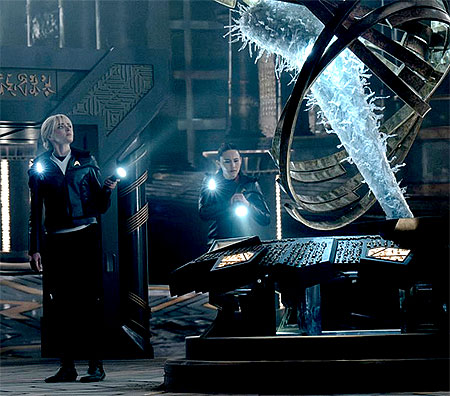
It's...alive?
They find a body and some creepy artifacts, and then one of the Enterprise party—Ensign Gamble, who'd been introduced a few episodes ago—touches something he shouldn't have and an artifact explodes in his face. He is returned to the ship, but the creepy vibes of the structure keep on creeping on to the point that the local guide freaks out and tries to flee the structure; before he can leave, he's vaporized by some sort of security system and the place locks down, trapping the landing party inside. Exploring further into the building, the party is separated and has to reunite by solving a sort of puzzle with the artifacts involving cause-and-effect paradoxes, an odd multilingual display, and a large statue that is somehow alive? As they proceed, the crew determines that the structure is actually a prison containing multitudes of barely-contained entities that give everyone the heebie-jeebies. One of these had assaulted Gamble, they deduce, when he inadvertently breached one of the containment boxes when checking out artifacts. Eventually they escape the structure, make sure it's re-sealed, and return to the ship.
Meantime, Dr. M'Benga is trying to treat Ensign Gamble, who it turns out has been inhabited by the entity that attacked him. Called Vezda, these entities are ancient and menacing in a not-at-all subtle fashion. At one point Captain Batel enters sickbay seeking help with her continuing treatments (see prior episodes) and upon seeing Gamble instantly turns into some sort of ninja and she and Gamble fight. Something in Batel recognized the Vezda in Gamble as an enemy to be taken down and took her over; the fight ends with Gamble escaping sickbay and Batel becalmed by the timely arrival of Captain Pike once Gamble/Vezda is out of sight. Gamble/Vezda tries to take control of the ship from an engineering lab via threatening Pelia and Scotty, but M'Benga arrives and confronts him, still believing Gamble can be rescued. While distracted with M'Benga, Gamble/Vezda is phasered by Pelia, who is (correctly) convinced that Gamble was killed as soon as the Vezda attacked him and nothing remained but the evil creature possessing him. The entity is separated from Gamble's body and Scott somehow captures it in a container and somehow beams it into the transporter buffer.
This one is more fully formed than most of the previous season three episodes, but there are still some things that feel like placeholders in the script that were never addressed—the method of revealing the prison structure and the means of capturing the Vezda at the end. Those bits made zero sense. But the plot needed something to move it along and apparently everyone thought nonsense reasons were fine. Those things bug me more than they do other people, I know, but they're sloppy. On The Next Generation, the writers often went too far in explaining things with "technobabble" in a different form of sloppiness; here they're being more J.J. Abrams-like in just presuming future tech can be wielded like magic, and that takes me right out of the story.
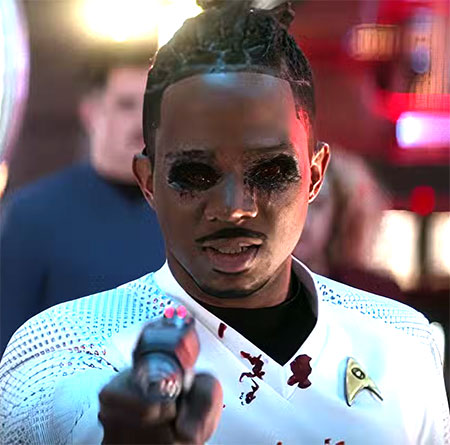
RIP Ensign Gamble. We hardly knew ye.
More importantly, the whole concept of the Vezda as presented here—and as explicitly described by Pelia—is very much not Star Trek. The Vezda are supposed to be wholly malevolent ancient creatures that have touched every race in the galaxy, directly or indirectly, and are the inspiration for many cultures' myths surrounding evil. It's clear from the end of the episode that we'll see some follow-up with the Vezda, and with different folks in charge I might be confident that when we see them again we'll get some more nuance and thoughtful development of them. But not with these guys, not after their retcon of the Gorn into horror-movie monsters.
Bits and pieces:
- Ensign/Nurse Gamble was clearly created to serve this purpose, to be the conduit for the escaped Vezda, and I applaud the decision to introduce him beforehand and give him time to be seen and recognized by the audience as someone we and the characters, especially M'Benga, would care about. He's also played very well by actor Chris Myers and I'm a little sad he won't be part of the sickbay crowd anymore. Too bad they essentially telegraphed his doom by giving him the introductory voiceover log entry.
- One character bit that was present here involves Dr. Korby and his quest for longevity/immortality. Without making him into a mad scientist type, it nevertheless gives more substance to the motives that we know eventually will lead him to what we see in the original series ep "What are Little Girls Made Of?"
- The possession of Gamble by the Vezda reminded me quite a lot of "Power Play," an episode from The Next Generation in which a landing party is possessed by malevolent noncorporeal entities.
- There is some humor in this one, mostly involving Beto Ortegas, the little brother of our helmswoman Erica that we met back in 302, shooting video for a documentary. Pelia asking him if he wants "one for the camera," after delivering a doom-and-gloom speech about the evil Vezda, is especially good and almost makes up for the problem of Pelia being kind of over the top with her "evil is real and really evil" attitude in this episode.
- The technological nonsense with the Enterprise deflectors shooting down through "signal amplifiers" was supposed to do what, now? Move a lot of ground and rock to reveal the buried structure? But the structure is revealed to be right there above ground. And what happened to the moved rock? Vaporized? No wonder the locals didn't want people mucking about. I know they needed an excuse to justify Chapel's insistence that a starship was necessary to do the dig, but it just looked like something that could have been accomplished with a hand phaser. Or some pickaxes.
- And the bit with Scotty beaming the Vezda into the buffer...that was some real foresight on Scott's part, preprogramming some kind of remote control to energize the transporter that is nowhere near that room to capture that incorporeal energy at those particular coordinates. That's what he would have had to do for that move to work, yet what we're shown is that he spur-of-the-moment slapped a container over the Vezda energy and quickly hit a button that beamed it away. MAGIC.
- I appreciated Spock quoting "Alice in Wonderland" with "curiouser and curiouser"; it's a deep cut, back to the 1970s animated series where it was established that Spock and his mom read that book repeatedly when he was a tot. (The cut is made a bit shallower by the fact that Star Trek Discovery also referenced this.)
My complaints on this one are mostly in the nerd-quibble category, and it is a decent ep, but like the others draws on a lot of other stuff. Not just "Power Play," but there's a lot of "Indiana Jones" too. I'll forgive it here, though. The real issue with it for me is that this idea of evil disembodied entities with no nuance is just boring. And not Star Trek.
Episode 306: "The Sehlat Who Ate its Tail" | Written by David Reed & Bill Wolkoff | Directed by Valerie Weiss
★★½
On the one hand, this is a great premise for an episode. On the other hand, the premise for this episode is dumb and contrived.
The first hand refers to the threat in the story: a mysterious vessel is wreaking havoc on a planetary system about to be explored by a Starfleet crew, a vessel about which legends have arisen across the frontier—"The Destroyer of Worlds." And destroy a world it does, right in front of the USS Farragut, which is the posting of one Lieutenant Commander James T. Kirk. The second hand concerns the plot that places select members of the Enterprise crew—Spock, Scott, Uhura, and Chapel, all part of future-Captain Kirk's crew—on the Farragut when the bulk of its own crew is incapacitated/dead from attack by the World Destroyer.
A social-media meme from season two that applies even more in season three
Initially, this one looks and feels like another retread from the Original Series, the classic Norman Spinrad-authored "The Doomsday Machine." It largely is just that, insofar as the jeopardy facing the crews of both Enterprise and Farragut as well as untold planets goes. So more laziness with pulling from what's been done before, but at least this time there's a great twist at the end: As the World Destroyer is defeated, it is discovered that it was crewed by humans. Descendants of an early-21st Century expedition intended to give humanity a foothold away from Earth in a time when Earth's recovery from environmental disaster was anything but certain. That gives the episode some real gravitas and depth that Pike, Kirk, and the crew(s) have to wrestle with. An outstanding Star Trek story element worthy of heaps of praise.
Unfortunately, that greatness is offset by the compulsion by this writing staff to give us unnecessary backstory for James T. Kirk and to force a history on Kirk's relationships with his future subordinates. With the exception of Paul Wesley's first two appearances as Kirk, in which he wasn't "our" Kirk but an alternate-timeline version of him, the inclusion of the character has thus far been contrived at best. A hinderance at worst. And not just because it once again defies established canon, which had Kirk and Pike meeting only once before Kirk took command of the Enterprise, but because there's no need for it. Kirk's relationships with this crew in the original are organic and don't need any filling in of any blanks. (If there's an exception to that, it's Kirk's history with Dr. McCoy, who—so far, anyway—isn't part of Strange New Worlds at all.) Shoehorning Kirk into this series only serves to detract from this show's main characters.
This episode is tightly focused on the younger Kirk and his immaturity as a commander, and how the influence of his future crew shapes his development into a better officer. We don't need it, and it in fact takes away from, particularly, the Kirk-Spock relationship by putting them together when both are too young/inexperienced/immature. If I was on the staff and presented with this story, faced with an insistence from above that doing the raw Commander Kirk script was mandatory, I'd say at least limit his interactions with his future subordinates to one character, not four. If more familiar connections to the original were "necessary," and more than just, say, Scotty had to give him some tough-love schooling on command, place a less important character in the Farragut crew. Gary Mitchell, say. It's established in the second pilot that introduced Kirk ("Where No Man Has Gone Before") that Kirk and Mitchell have been friends and presumably crewmates since their academy days but he's a one-off character in the original series. This would be a good place to use him and it wouldn't detract from what we know comes to pass with Spock, Uhura, et.al. But that's not necessary either, you could have Ortegas there in place of Uhura or even Spock and the story wouldn't suffer. Or give that one Farragut crewperson more to do instead; it's ridiculous to think Kirk had no influence from anyone other than his future command crew. Except to these guys, the whole point was probably to give that unnecessary backstory to the Kirk-Spock dynamic.
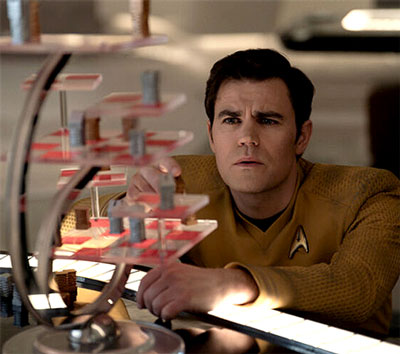
Kirk contemplates an unfinished game
Showing immature Lt. Commander Kirk being impulsive and reckless is both appropriate and not; we see a proto/beta version of the "risk is our business" attitude untempered by situational contexts and an illustration of Kirk needing to learn things the hard way seems to fit. But seems is the operative word there, it's far more befitting of the Chris Pine version of Kirk from the J.J. Abrams movies that had no business being put in command. It's fitting for the caricature of Kirk that developed over time from the exaggerated spoofs of William Shatner at his hammiest, the observation by Leonard Nimoy that a Shatner production has more jumping and punching, the silly memes of "Kirk-fu" and the use in the ’60s scripts of "cowboy diplomacy." The actual characterization on screen of James T. Kirk is that he was a bookworm, overly studious as a cadet and almost worshipful of an early captain of the Farragut. Indecisive young Kirk works; in-over-his-head young Kirk works; recklessly arrogant young Kirk not so much.
Spock is also misused. When Kirk's recklessness prompts his crew-of-necessity to consider removing him from command, Spock goes to confront him in a get-the-measure-of-the-man sort of way and ends up being empathetic and actually recommends Kirk rely on his intuition. This flies in the face of Kirk-Spock interactions in the original, particularly early ones. Even if you want to allow for this being young, experimental Spock, I simply do not buy that he would give command advice that redounds to "go with your gut" to anyone, especially someone he barely knows (at least, not before his V'Ger encounter). That's the writers trying to skip years of relationship-building between these two very different men for no reason.
Also, Kirk is the Executive Officer of the Farragut. Yes, it's a recent promotion, but he presumably earned it, right? It wasn't some sort of emergency battlefield commission when no one more experienced was available. So why is this starship XO such a raw and thoughtless guy? I don't buy it.
Aboard the Enterprise there's a secondary plotline going with that ship needing to escape the clutches of the World Destroyer, which has swallowed the Enterprise up into a big garage bay and is draining it of resources. With no communications working, Chief Engineer Pelia's neurotic hoarderism pays off because she still has old-style telephones from the 1980s among the junk in her cabin. (As a centuries-old Lanthanite that can't seem to ever throw anything away, she has a lot of junk.) So she has the brilliant idea to strip the ship for copper wire to lay cable for a few landline handsets so a manual escape with no computer control can be affected. OK, fine, I guess, but copper wire? And they find and strip all this wire without any problem and in no time at all and having done it everything still works without it once they get away from the Destroyer? Eh, I guess I'll allow it, but it's silly and the solution would still have worked with radio-frequency walkie talkies if the technical obstacles had been written just slightly differently. It's yet another example of a minor technological plot element that takes me out of the story because it's not logical, only this time it's not future tech but old-fashioned tech they're taking liberty with. (Well, I guess it is the future tech, in that unspecified future tech uses old tech but then doesn't require it after it's removed.)
Other notes:
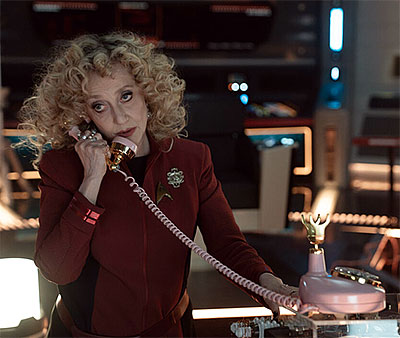
Carol Kane's Chief Pelia finds a use for some hoarded junk from the 1980s
- An additional sloppy plot point is that as soon as the Farragut is attacked, the Enterprise shows up out of nowhere, right after we're told that Farragut couldn't get a distress call out. Even if a blip of a distress call did reach the Enterprise, showing up immediately is another takes-me-out-of-the-story-flow impossibility.
- At one point Kirk calls Lt. Scott "Scotty." Kirk and Scott have never met before. At no point did Scott introduce himself and say "call me Scotty." (He wouldn't have said as much given the opportunity because for most of the episode Scott doesn't like Kirk, with good reason.) All Kirk knows of this man is that he's a junior engineer with impressive skill—that Kirk initially disregards—with the rank of lieutenant j.g. and whose surname is Scott. Nothing else. He doesn't even hear someone else refer to Scott as "Scotty," it just comes out of nowhere.
- A couple of great lines: When presented with an old landline handset, Ortegas wonders if it's some sort of "personal massager"; when Kirk expresses his unease at being the acting captain, Spock says, "I promise to demote you at the earliest opportunity."
- The ultimate defeat and destruction of the Destroyer is way too easy. We're told and shown all through the episode that this is a scary-tough vessel and it's brought down by a couple of torpedoes shot into the open maw of the garage bay. I guess it's been made weaker by Kirk's gambit from the Farragut of striking it with a jettisoned warp nacelle, but that seemed to just short out some components. I guess it disabled their shields? Wasn't clear how that made the behemoth so vulnerable.
- The best part of the story is in the denouement, a conversation between Kirk and Pike about the revelation that the scavengers were humans and how that changed the way Kirk feels about the whole encounter. Kirk recognizes he didn't really care when they were faceless aliens but is profoundly affected by the loss of life when he knows they were human. Pike lays down the real truth: "Empathy isn't conditional."
- The title of the episode comes from what Spock describes as the Vulcan analogy to the human idiom of the dog that caught the car, which Kirk feels applies to him now that he's in command of something with stakes. Too bad Ethan Peck mispronounces "sehlat." (Jane Wyatt's Amanda Grayson first spoke the word in "Journey to Babel" as "SAY-laht," a pronunciation continued in Enterprise by Jolene Blalock's T'Pol. Peck instead said "se-LAHT.")
Looked at in isolation, forgetting about the greater context of what we know from the original, the episode works pretty well. Might even be excellent. Lots of folks consider this the best entry of the season. But since the obvious point of it was to force us to plug in that greater context, looking at it as its own thing is impossible to maintain. It's the other part of the plot, the Destroyer of Worlds scavenger/pirate ship and its twist and the shock our heroes get when its revealed, that's what makes this a pretty good story.
Episode 307: "What is Starfleet" | Written by Kathryn Lyn & Alan B. McElroy | Directed by Sharon Lewis
★★½
Yet again, the writers and producers of SNW go for another gimmick-of-the-week script. Already we've had the hard-boiled murder mystery, the zombie film, the romantic farce, and Indiana Jones in Space; this time it's the documentary. M*A*S*H did this a few times—break format and do an episode of interviews into the camera intercut with "footage" of life at the 4077th—as did Battlestar Galactica and several other shows, and for Strange New Worlds it could have been really interesting.
It's not, though. Not in that way, anyhow. This is the final product of the film project that Beto Ortegas has been shooting video for in a couple of prior episodes (though nothing from those eps made the cut, it seems), and before we get too far into it, we the audience can tell it's a flawed piece of work.
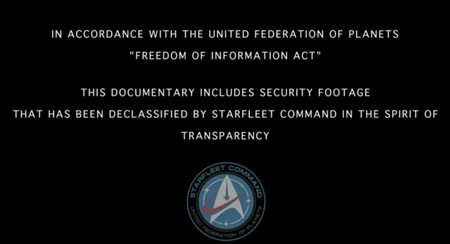
Beto opens the doc with his overriding question: Is Starfleet truly an exploratory organization representing a Federation of Planets, or is it a collection of battleships out to impose military might on whoever's out there? Valid question, and a prompt for what could be a really interesting episode. He presents it as a binary choice, though, allowing for no nuance, and proceeds to make a case that it is the latter. Of course, we the audience, who have observed Starfleet for a very long time and in several different eras, both as an Earth-only organization and as a service of the Federation, can tell pretty quickly that Beto is slanting his presentation with a clear bias. After a while it even gives off James O'Keefe/Project Veritas-like vibes, as if it's part of a disinformation campaign.
The story that's happening as a backdrop for the documentary is actually pretty cool, but because of this episode's structure we only get maybe half of that story. Beto's interviews are juxtaposed along scenes from a mission the Enterprise is on to aid the government of Lutani VII, a planet that's at war with its neighbor. For reasons we never get to learn (it's classified, sorry, Beto), the Federation has agreed to help the Lutani despite some checkered history from the Klingon war, and the nature of that help revolves around transporting a creature called a Jikaru to them. Classified as "livestock," the Jikaru, it turns out, is a huge spacefaring creature with the ability to project huge amounts of energy and the Lutani have devised ways to control the creatures and use them as weapons against their enemy. We the audience, who have followed these characters and have context for Starfleet, can see that Captain Pike and Number One have serious reservations about this and seem to be convinced that their superiors issuing their orders don't properly understand the situation.
We see little of that, though, because Beto's interest is in demonstrating that the Enterprise crew are soldiers carrying out military orders without question, ready to deal death to one side in a war they're not otherwise involved in. We see the doubts between the lines, as it were, while Beto shows a callous mission of violence being undertaken.
Eventually, Ensign Uhura, who has had a flirtatious relationship with Beto for a few episodes now, recognizes that Beto is producing a hit piece and calls him out on it; he is made to realize that his documentary thesis is not only flawed, it's a manifestation of misdirected fear and anger at his sister, Enterprise helmswoman Erica Ortegas, who not only left home to join the fleet but nearly got herself killed in the season opener by the Gorn. When this is made clear, two things change: One, Beto's doc takes a striking turn in its tone; and two, the audience's curiosity about the thesis question of "what is Starfleet" is utterly disposed of.
The final parts of the doc show how the crew learns to communicate with the Jikaru and discover how it and its brethren have been abused by the Lutani, then the actions taken by Pike and company to resist their orders and convince their superiors (offscreen, natch) that they were wrong before freeing the Jikaru from its enslavement and allowing it to end its own life rather than continue to be used as a weapon. Finally, we see scenes with a voiceover showing the crew off duty socializing and doing things like strumming a guitar, plus more interview bits with crew talking up the virtues of Starfleet and how it has helped them personally in their own growth. The doc's ultimate conclusion: Starfleet is "its people." Great. You know what else is "its people?" Every organization ever.
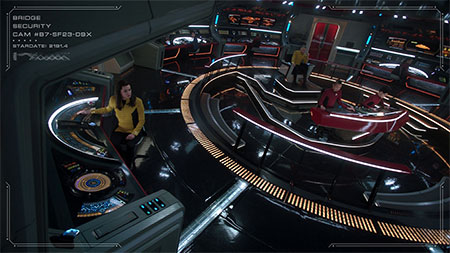
It's a tough episode to rate. The question of what Starfleet is is valid, as Starfleet's nature has been subject to some speculation and interpretation by viewers since the original series. Its "combined service" complexity makes it a ripe topic for such a documentary and the Jikaru/Lutani war storyline is well-used as the background mission. But making Beto's bias so strong and then revealing it to be based on something so shallow and arguably petty ruins the premise. We see from almost the get-go that we're not going to get any real analysis of "what is Starfleet," and then there's no payoff to that element. Beto is simply made to realize he's making a film that's full of shit and then does a 180 midway through it to assuage his guilt, I guess?
That could still be an effective story if it were to be focused on Beto as a character, or on Erica Ortegas, maybe, as she's a regular. But that doesn't happen. Everything we see is in the documentary, we see nothing that happens when Beto's camera isn't rolling; we know that Beto's viewpoint has shifted, but he never uses his voiceover to explain himself or admit his bias or anything of the kind.
The best parts of the show to me are some of the straight-to-the-camera crew interviews. There's one with Pike gently and effectively making the point to Beto that he's asking questions that are not only inappropriate but offensive. Another has Spock revealing some of his childhood trauma, specifics we didn't know before but that completely fit with what we do know and work very well for this younger Spock. One bit that's not a one-on-one interview clip but a "captured conversation" snippet has Spock and Uhura and Chapel discussing his telepathic talents (this becomes relevant to the story) and how the Vulcan students of the way of Surak cultivate their esper abilities despite the species' telepathic practices having been "abandoned" for centuries until relatively recently (which we know because we watched the series Enterprise, but it's nice to have it referred to).
Bits and pieces:
- Plenty of prior stuff borrowed from for this one—there's a lot of resemblance to the Battlestar Galactica episode "Final Cut," for instance—but at least Star Trek hadn't done a documentary episode before.
- Kudos to Captain Pike for his extraordinary patience. He allows Beto to be truly annoying with obtrusive camera drones for much longer than I would.
- Interviews with Erica are in her cabin so we can see that she likes to play mechanic and tinker with old motorbikes.
- Beto tries to get Dr. M'Benga, whom he (and we) knows was a special ops type in the Klingon war, to admit to doing violent things in the service of Starfleet, but M'Benga won't play and pretends he's being grilled by the House of Representatives by answering "I don't recall" repeatedly.
- The plotline with the Lutani people and their war is an unresolved thread that deserves a follow-up. The Federation ended up reneging on their promise to help (because the Lutani kept important information from them, but still), leaving the Lutani on the brink of massive defeat. What's their fate now? Would they really have been a side the Federation would support, given what we learn about them? Was there a follow-up attempt to mediate the conflict, or did the Federation decide, "screw it, you guys are on your own, hope you survive. Or not, whatever."
- In one of her interview clips, Number One says, "Someone once said space is dark and cold and full of death. Our job is to bring light, bring warmth, bring life, to wherever we go. That's our mission." The someone she quotes is none other than William Shatner, after his trip into low orbit on the Blue Origin.
I see this episode as a missed opportunity. A really good foundation for a story that, as is true throughout the season, isn't ever solidified and developed into a finished script. It asks a poignant question at the beginning, "what is Starfleet," and then delivers essentially no answer after no serious interrogation of it. All we know at the end is that Beto Ortegas is a shitty filmmaker.
Episode 308: "Four-and-a-Half Vulcans" | Written by Dana Horgan & Henry Alonso Myers | Directed by Jordan Canning
★½
(I wrote about this one when it first dropped, so there'll undoubtedly be some repetition here, but it's such a big swing-and-a-miss story that I hope you'll forgive the redundant remarks.)
There are seeds here for something really great. Instead we got something stupid and offensive. Just as The Next Generation's "Code of Honor" was derisively called "Planet of the Africans" by my late friend Scott, this episode should be remembered not by its title, but as "the minstrel show episode."
I imagine the pitch line for this episode was: "Pike and some of his human crew are transformed into Vulcans. Hilarity ensues."
Hilarity did not ensue.
To be fair, there are a couple of amusing bits along the way, but once again this writers' room didn't think things through and shot a script that desperately needed refinement.
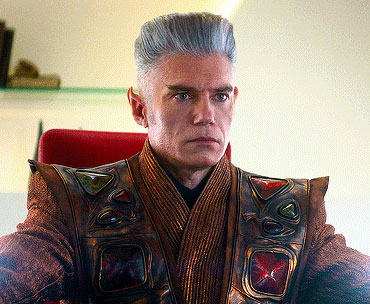
He is not from France, he just talks like he is
The episode begins with the Enterprise on the way to take some shore leave when they receive word that the people of the planet Tezaar have reached out to the Vulcans for help. It seems the Tezaar had been visited by Vulcans a couple of centuries back and thus they know about Vulcans, but as a pre-warp civilization, they also are subject to the Prime Directive and thus the crew can't just go there and help them openly without opening a whole can of worms about alien contact. Anyway, the Vulcans back then gifted the Tezaar atomic reactors to solve a problem of the moment and now those reactors are failing. The planet is facing a global meltdown and a Vulcan-only ship cannot be dispatched in time to help. But the Enterprise is nearby, so Captain Pike needs to find a solution.
We're already into areas that don't withstand scrutiny and we haven't even gotten into the plot yet. The Vulcans gave a primitive society nuclear fission technology? The Vulcans of 200ish years ago, who were just making contact with Earth, who maintained that humans were too immature to be given technological advancements? Were they some sort of renegade Vulcans? V'tosh Ka'tur? What mature society would say to a primitive people, here, this is how you split the atom. Just be careful with it and oh, by the way, it generates a waste product that will contaminate for thousands of years. Quite logical.
Anyway, Pike has to prevent the meltdown while not revealing the existence of non-Vulcan aliens, so rather than just send Spock to handle it he decides that a landing party will have to go down as Vulcans. But just looking like Vulcans won't cut it, the Tezaar have security scanning tech at the failing power plants that will out them as not-Vulcans, so they have to be Vulcans. This is ridiculous, but we need an excuse to actually transform them in order to get to our hilarious story. Also ridiculous, Nurse Chapel has whipped up a serum that will turn our humans into Vulcans. This is building on her expertise in gene therapies, which we learned about in the series pilot episode and was used to help a landing party bend in with the locals. Also on the second season episode "Charades," in which Spock was critically injured and restored to health by super-advanced aliens who only had a human genome as a reference, so he was turned into a full human until they were given proper information on Spock's hybrid DNA. The aliens were then able to provide a serum to turn Spock back to his old self, and now Chapel has somehow extrapolated from that previously unfathomable serum a way to transform humans to Vulcans and back again.
Sure.
Even though it took several hours at least for Spock to return to normal in "Charades," Pike, La'an, Uhura, and Chapel herself are Vulcanized in seconds. OK, fine, I don't buy it but we need to get the story rolling, so OK.
But then we get to the first of the many other, more serious problems with this episode. Not only have the four humans been physiologically transformed, they have also been culturally transformed—they immediately adopt the emotionless, logically stoic demeanor typical of a 23rd-century Vulcan. As if lack of emotion is a physiological trait of the species. Which we know it is not.
In fact, we know that Vulcan emotions are far stronger and more intense than those of humans and that the repression of emotion is a learned behavior borne of a need to restrain an innately volatile nature. What should have happened upon such an abrupt transformation is for our four humans to become over-emotional and in need of a crash course in rational control, but Henry Alonso Myers and Dana Horgan don't know this very basic thing about the people they have written this show to make fun of. Someone evidently pointed this out before post-production was finalized, so we do get a voiceover log entry intended to hand-wave this problem away by saying the alien serum contained Spock's years of education and training, but that's beyond absurd and just makes this all even dumber.
The Vulcanized humans, and Spock, beam down to the planet and restore functionality to the Tezaar infrastructure in less than a minute, apparently owing to the fact that, as Vulcans, they are all so smart and efficient that a job thought to take hours and hours is now solvable in no time flat. They beam back and are given the reverse-serum to change them back into humans, only it doesn't work and they're stuck in their Vulcan form.
That's all in the teaser, by the way. Now we get the opening credits.
The bulk of the episode then goes on to show Pike and company as Vulcans causing problems and insulting Spock and generally being assholes. Which is supposed to be funny.

RomuLa'an
The title, "Four-and-a-half Vulcans," is referenced repeatedly when Pike especially, but all four Vulcanized officers, refer to Spock as merely half-Vulcan and therefore inferior. Each of the four transformed humans starts offending people in different ways, but no one sees this as anything other than expected Vulcan behavior. It's all basically just endured until the return-to-human serum is perfected, and then the twist is that the four refuse to switch back. It's apparently not logical to be human when you have the option of remaining Vulcan. Now people are concerned, not because they're off-the-rails Vulcans, just because they're Vulcans and thus annoying.
The problem is resolved by bringing in another Vulcan, who is conveniently nearby and inconveniently the ex-boyfriend of Una (Number One). Oddly named Doug, this character is the silver lining in this cloud of an episode. Played to perfection by Patton Oswalt, Doug is an expert on katras, i.e. the Vulcan soul/identity/spirit of the mind. With Doug's help, the crew are convinced to revert to their natural human states. All except La'an, whose transformation has made her more Romulan than Vulcan; she needs Spock to convince her via a rather intrusive mind-meld that is just way too casually undertaken. Once everyone is back to normal, they are embarrassed by their behavior and everyone is relieved and we move along as the episode ends.
This could have been a classic. This could have been a thought-provoking, insightful, difficult examination of our characters individually and the abstract concept of unconscious racism. This could have been on par with the true greats of the franchise, up with "City on the Edge of Forever," "Far Beyond the Stars," "The Measure of a Man." Instead we put four of our heroes in metaphorical Blackface (Vulcanface) and have them mock a founding race of the Federation ala Jim Crow.
The initial problems setting up the story might be too tricky to overcome—we'd need a whole different reason to transform our people since the one we got was so dumb (though the idea of coming across a planet that had met the Vulcans or Andorians or Tellarites or someone before the Federation but was still pre-warp is intriguing for its own story), and then a method of transforming the four humans that didn't stretch suspension-of-disbelief to the breaking point—but even if they just hand-waved those problems away again something real could be done. Instead of playing it solely for laughs, really dig into how our characters manifest Vulcanness and what that says about them as humans.
There is a little of this in the episode—each of the four Vulcanized humans express their Vulcanness with a focus unique to them, but it doesn't get examined much beyond La'an's new thirst for conquest; that's there to (a) provide some humor, (b) generate some jeopardy for the plot, and (c) remind the audience that nobody knows about Romulans yet.
There is a scene in the middle of the episode wherein Number One, Spock, Dr. M’Benga, Pelia, Batel, and Lt. Ortegas convene and discuss what to do about the Vulcanized officers. It's essentially an opportunity for them to all vent about the frustrating things the new Vulcans are doing and they rightly dismiss the idea of forcing them to take the rehuman serum. But what if that scene continued with an exchange like this:
INT. PELIA’S QUARTERS
UNA, SPOCK, PELIA, M’BENGA, BATEL, AND ORTEGAS SIT AROUND AN ANTIQUE COFFEE TABLE AMONG THE DISORGANIZED CHAOS OF HOARDED OLD-TIMEY ITEMS IN PELIA’S POSSESSION.
UNA: It would help if we knew WHY they were behaving this way. I mean, I’ve known a fair number of Vulcans in my day, none of them were quite so...
ORTEGAS: Robotic?
BATEL: Insensitive?
PELIA: Mean?
UNA: ... Sure, but also ... Spock, correct me if I’m wrong, but Vulcans don’t come out of the womb spouting logic and denying emotions, it’s not genetic, right?
SPOCK: Correct. It is most assuredly a learned behavior based on the need to suppress the otherwise overwhelming nature of the Vulcan emotional spectrum. We are trained and educated from a very young age to prioritize our rational faculties.
UNA: So why—?
M’BENGA: Mr. Spock and I have discussed this and we have some thoughts.
SPOCK: Indeed. The closest I have to a working theory is that the captain and the others, having abruptly had that Vulcan emotional spectrum thrust upon them, instinctually adopted what they have perceived in their experience of Vulcan demeanors as a coping mechanism. And while I have been principally focused on the group as a whole, Dr. M’Benga has observed them on a more individual basis.
M’BENGA (THOUGHFULLY): They are not really behaving like Vulcans behave. They’re behaving as a sort of caricature of Vulcans, and if you look closely you’ll see that they aren’t behaving identically—each of them has latched onto their individual preconception of Vulcan behavior.
ORTEGAS: Like La’an’s obsession with arming the ship?
M’BENGA: La’an’s psyche is rooted in her childhood traumas, losing her family in her capture and escape from the Gorn, so for her, logic would demand defending the ship and eliminating threats; she is motivated by her perception of Vulcans as powerful and strong. Uhura has focused on communication efficiency to the extreme length of abusing the meld. Nurse Chapel, meanwhile, has been career-driven with her research and so is using her perception of Vulcans as unfeeling overachievers to focus entirely on multitasking research and experiments to the exclusion of all else.
BATEL: And Chris is, what, just subconsciously the most extreme micro-manager of all time?
M’BENGA: No, I think the captain is more complicated... I think underneath it all he actually thinks poorly of Vulcans.
UNA (SURPRISED): What?
SPOCK (RAISES EYEBROW): That does not appear to be the case given his continual remarks about my merely half-Vulcan biology.
M’BENGA: That’s actually the principal reason I think this is true, Mr. Spock. It’s clear to me that the captain has adopted arrogance as his Vulcan “north star,” if you will. That’s his ultimate perception of Vulcan behavior, his sense that they think they’re better than everyone else. And, as a Vulcan, such arrogance would extend to you perhaps more than others.
SPOCK (GLANCES AWAY): That would not be a unique behavior among my species.
M’BENGA: Yes, and the captain knows it, but more to the point, it suggests to me that the Captain Pike we know sees you as an exception to his concept of Vulcans. That your human half mitigates the nature he perceives as arrogant and troublesome.
UNA (LOOKING DOWN AT THE TABLE, SLIGHTLY FROWNING): You’re one of the “good ones,” Spock.
SEVERAL BEATS OF SILENCE AS THE ASSEMBLED GROUP CONSIDERS THIS.
END SCENE.
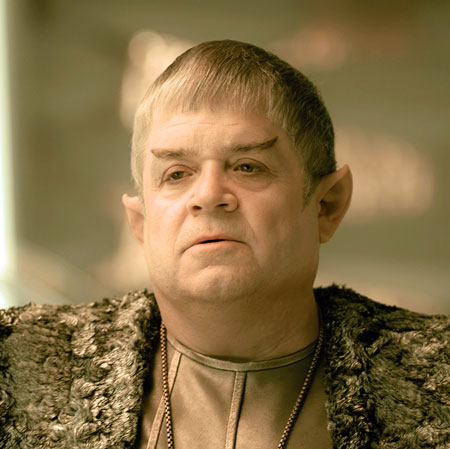
Doug
Now we have changed the tone of the episode away form pure comic farce to thoughtful examination of unconscious racism. This could be a tool for Doug (and the rest of the team, frankly) to use in convincing Pike and company to restore their humanity. They'd essentially be shamed into it.
We'd get some hard realizations in our characters that they carry preconceptions and prejudgments about other species. We'd pull hidden things out into the open that we in the audience don't want to recognize in ourselves just as Pike and Uhura and Chapel and La'an are embarrassed at what was revealed about them. A perfect Star Trek concept to explore.
Instead we get jokes and mockery. What a waste.
Isolated atoms:
- Kirk is in this one. Why? No one knows. The excuse is that he was at loose ends while his ship is undergoing repairs and wanted to drop in on his brother, but Sam has already left on shore leave. So he hangs out with Scotty, the guy he met once and initially didn't get along with and at the end Kirk introduces Scott to the joys of drinking scotch. Um...sure.
- In the teaser sequence, as the Vulcanized landing party prepares to beam down Pike is carrying a lirpa, the Vulcan weapon first seen in the original series' "Amok Time." Why? Because someone (Myers? Akiva Goldsman? Alex Kurtzman?) thought it looked cool. It certainly served zero purpose on a mission to repair a nuclear reactor. Illogical.
- Pike's Vulcan persona is more Remulak than Vulcan. Anson Mount is playing Vulcan-Pike as a Conehead. It's kind of amusing until one remembers the whole minstrel show element.
- The repeated bigotry shown to Spock by the Vulcanized officers recalls what we know of Spock's childhood, when his peers shunned him for being half-human, but here it serves to reinforce the problem with the premise that turning our characters into physiological Vulcans also changes their basic identities. Are we to understand that these people, friends of Spock all, have always been secretly thinking of him as a lesser being? No, we're not, we're meant to think that Vulcan "logic" prompted them to become ignorant of their past experiences with Spock and to rely on their knowledge of his genetics to define him. It's stupid and it's insulting to these characters more than it's insulting to Spock. And, not insignificantly, it's insulting to every mixed-race member of the audience watching the show.
- Other than Doug, the best thing about this episode is how Spock reacts to his treatment by the others. His visible frustration while still maintaining his cool Vulcan demeanor is extremely well-played. What is missing—critically—is a scene between Spock and Pike at the end. I need to see Pike confronted not only with his overall actions (he sums it all up with the line "I did not make good choices"), but specifically with his dismissive words to Spock. An awkward apology from Pike to Spock was required, but to do that we would have to acknowledge the more serious aspect of the story that the writers don't want anything to do with. Jim Crow doesn't apologize, I guess.
- Speaking of Doug, he's a character people are going to love or hate, there doesn't seem to be room for any middle ground. I love him—the idea of a Vulcan who finds humanity fascinating, who comes from a family unit that has such great fondness for human culture that they named their children Doug and Susan is not only humorous but relatable. Doug readily admits he finds humans admirable and even enviable; he's a comfortable manifestation of the unease articulated in the series Enterprise by Gary Graham's character of Ambassador Soval. Soval admits to the human Admiral Forrest that Vulcans are disquieted by human nature not because they are overly emotional or technologically backward but because humans are a mystery to them. How this relatively short-lived race could have developed so quickly, gone from global war to planetary governance to warp drive in a matter of a few decades, demonstrated abilities and competences in alien relations that were beyond the Vulcan understanding, it all upended Vulcan norms and beliefs regarding other sapient races. Doug recognizes that disquiet and dives headfirst into it, making understanding humans his hobby. It's a fun idea and Oswalt is perfect for the role.
- Once again this writing staff is much, much too cavalier with mind-melding. We don't see Spock initiate a meld with La'an, but he's there in her mindspace, trying and ultimately succeeding (with dance) to convince her to become human again. She allowed this? Spock was OK with it? He's dating La'an, for Christ's sake, he has a respect and affection for her beyond the basic respect for a person's autonomy, yet he just invaded her mind? I call bullshit.
- One of Vulcan Pike's scenes is a dinner with Batel and Admiral Pasalk, who is Batel's boss in the JAG division. The minstrel jokes here revolve around humans smelling bad and Vulcans being sort of anal-retentive in their fastidiousness, but there's value in the scene when Batel tells off both Vulcans for being hypocrites and reveals Pasalk's tendency to refer to Pike behind his back as "the human with inappropriate hair."
- One funny bit that doesn't offend is when Vulcan Pike and Vulcan La'an reveal to each other that they both know secret things about Vulcans that most Vulcans don't know (e.g. they know about Romulans thanks to their individual experiences in prior timey-wimey episodes). It's clever in a sitcommish way.
- The planet the Enterprise visits for shore leave is called Purmantee III, apparently named for Pittsburgh's famous Primanti Brothers restaurant and bar. The connection is articulated when Ortegas lauds the fact that on Purmantee III you can get a sandwich that has "fries in the sandwich," something Primanti Bros. is known for. Sounds unappealing to me.
- There's a post-credits scene in this one, a first for Star Trek, in which Spock attempts to explain some human mannerisms and humor to Doug. It's... uneven. Could've been funnier.
- Doug and Una's past relationship is played for laughs as well. Some folks seem to hate it, but I found it fun; the idea that this squat, chunky, not-conventionally-attractive dude gets Una's motor running like no one else possibly could is cool. Maybe it does diminish Una's character a bit? I don't know. The sitcom farce of Una pretending to be married to Spock in order to fend off the inevitable advances to/by Doug is a bit trite, but Ethan Peck played it well and Doug saw through it anyway, so I enjoyed it.
- Doug's necessary help in getting our heroes back to normal happens entirely off screen, which is a failure. Show us why we needed him, don't merely relegate him to comic relief in an episode that is intended to be entirely comic relief.
- Chapel tried to apologize to both Spock and Korby, whom she broke up with while Vulcanized, with an offering of homemade plomeek soup. Nice callback (call-forward?) to "Amok Time" and amusing as Spock lets her know her soup "is unsatisfactory."
Overall, this episode should prompt the showrunner to call the writing staff to HR for sensitivity training. Except the co-showrunner wrote this, so I fear no one will learn from this mistake.
Episode 309: "Terrarium" | Written by Alan B. McElroy | Directed by Andrew Coutts
★★
In a season of unoriginal scripts, this one is the champion of derivation. "Terrarium" borrows liberally from the original series' "The Galileo Seven" and "Arena"; The Next Generation's "Darmok"; and both TNG's "The Enemy" and Enterprise's "Dawn," both of which are riffs on the film Enemy Mine, which itself is a riff on the Lee Marvin movie Hell in the Pacific, which shares much with the Frank Sinatra movie None But the Brave, which has antecedents going back to at least Gilgamesh. And when I say "borrows" I'm being generous. There is almost nothing original here, no matter how far you're willing to stretch the term.
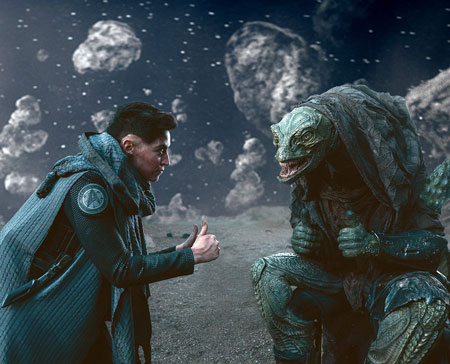
Ortegas teaching a Gorn the thumbs-up gesture
Here's the plot: Lt. Ortegas is sent out alone in a shuttlecraft to study some anomalous gravitational phenomena in space, a setup laid out in an almost interminable exposition scene. Once into the gravitational phenomenon, Ortegas' shuttle—the Archimedes, nice addition to the shuttle canon that already included the Galileo, Columbus, and Copernicus—is forced into a mysterious wormhole that just appears out of nowhere. On the other side, Archimedes crash-lands on one of several hundred moons orbiting a gas giant, one that conveniently has air that is breathable(ish). Food stores having been destroyed in the crash, Ortegas must survive until she can be rescued. Meantime, the Enteprise has lost contact with her and is initially at a loss to find a way to ascertain her status, plus we are belatedly given new information: we're on the clock because Enterprise has to meet up with the USS Constellation and deliver a supply of vaccine needed on a colony world before said vaccine goes bad. Back on the alien moon, Ortegas finds she's not alone there—also marooned is a Gorn pilot, who has already been there for some time. After her initial assumption that the Gorn would be hostile (understandable), Ortegas realizes that this is a friendly (or at least disinterested) Gorn and the two team up to survive and engineer a rescue.
Now, Star Trek has done riffs on other stories before—lots of them, in fact—so I'm not bothered by another Trek take on Enemy Mine; "Dawn" was their best version of it, but this one does offer an opportunity to finally portray a Gorn as something other than a one-dimensional monster. That makes this a refreshing idea, except for the fact that it makes a mess of what came before—everything we've been told and shown throughout Strange New Worlds precludes the idea of the Gorn being creatures one can empathize with. In fact, that was Henry Alonso Myers' deliberate choice, to obliterate the message of "Arena" by making the Gorn irredeemable baddies. That was a terrible choice and I'm all for trying to fix it, but we're given no context for such a turn here. If you're going to retcon your retcon, give it some weight, don't just pretend you never retconned in the first place.
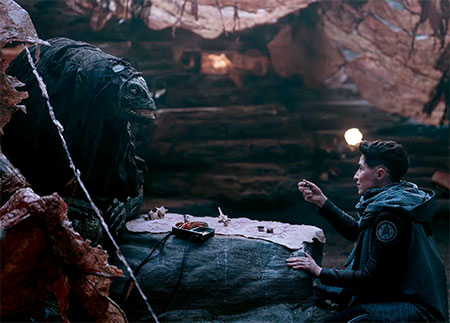
The Gorn teaching Ortegas her version of a dice game
That's what they do here, make no mistake; they could have given some context to the stranded Gorn who befriends Ortegas that lets us know that she's, I don't know, of a different segment of Gorn society than the soldiers we've seen, or that she's some sort of dissident that isn't on board with the typical practice of capturing people in space and using them as food. Something to say, yeah, the Gorn we've seen before are vicious and violent bastards from the moment they're hatched, but somehow they evolved enough to make spaceships, so here's an indication that they're not what Myers insisted in season one that they were going to be.
No, they just ignore all that except by implication at the very end—when La'an beams down to rescue Ortegas, she kills the Gorn on sight, which is justifiable by previous Gorn encounters but obviously not at all justifiable to Ortegas or to this story in isolation. I'd say they can build upon this later to make it work better, but we already know from the writers and producers that this is the last use of the Gorn for SNW.
All that said, the stranded Gorn is the best thing in this episode. She's great, and you really share Ortegas' outrage when she's killed at the end. The scenes showing the two of them bond over cooked-versus-raw food, piloting, and board games(!) are sweet.
In the penultimate scene we get one more kick in the face when it's revealed that both characters, Ortegas and the Gorn, were made to crash on this moon by the mysterious Metrons to see what would happen and if the two species could get along. Yes, the Metrons, the same folks that put Captain Kirk and his Gorn adversary on Vazquez Rocks world to fight it out in "Arena." But in "Arena," the Metrons weren't conducting any experiments, they were just annoyed that these aliens were having a spat in their back yard and wanted to put a stop to it. They were even ready to just destroy the combatants' ships in order to be rid of the nuisance/threat. Now we're supposed to understand that, not only were those Metrons actually engineering the conflict between Kirk's Enterprise and those later Gorn purposefully, but these Metrons will, at some point between this episode and the events of "Arena," just somehow monkey with the memory and history and life experiences of every person in the universe to "reset" their perceptions of the Gorn.
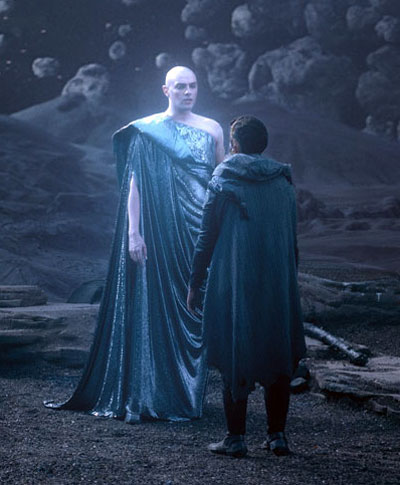
Ortegas confronts a Metron
Yeah, I'm not good with that. This is the writers' room belatedly realizing that they painted themselves into a corner and just deciding to gaslight everyone into thinking there was never any paint at all.
Other notes:
- The jeopardy on the Enterprise is entirely lifted from "The Galileo Seven," wherein Federation Commissioner Ferris demands Captain Kirk abandon a mission to rescue a shuttle party in order to deliver vital medicines to a colony world.
- Ortegas' very questionable solution to use a temporary overlap of the moon's orbit with the gas giant planet's atmosphere (what, now?) to ignite the upper layer of said gas giant to set off a huge flare in hopes that it would attract the Enterprise's attention is also lifted from "The Galileo Seven," only in that one it was Spock igniting his shuttlecraft's fuel reserves.
- Ortegas jury-rigs a stripped-down universal translator out of tricorder parts (and presumably a communicator) that immediately allows for the Gorn to communicate yes/no responses without any sort of database or linguistic input. Stretches things to the limit, but because this is an extension of one of those few unrealistic conceits we accept—the UT—I can let it go.
- In an obvious money-saving move, Ortegas' shuttle mission has to be conducted via "non-visual control," with the viewports shuttered. No explanation, but we all know it's because open windows mean bigger expenses for the effects department.
- At one point on the bridge we see a background actor wearing double-full stripes on his sleeves. No matter, but it does remind me that if there's any rhyme or reason to the rank insignia used on this show I've yet to figure it out. Captain's stripes seem consistent with the original series (narrow stripe replacing broken/dashed stripe), but nothing else is. Number One is often referred to as a Lieutenant Commander and she's got double-full stripes, which in the original series is a full Commander; James Kirk is also a Lieutenant Commander this season, and he's got one-full-one-narrow, as does Pelia, but then so does every Lieutenant character (Spock, La'an, Ortegas, Mitchell, etc.). Scott has a single full stripe and he's a Lieutenant j.g. Chapel has double-full stripes and she's supposedly an affiliated civilian! Make it make sense, costume department! I know, I know, "shut up, nerd."
- In persuading Pike to approve her plan to attempt a rescue, Uhura lies to him, fudging the numbers on how effective systems will be when the ship is taken into the mystery wormhole. She later goes to admit this and Pike says he already knows she lied to him and is letting it go because her motive was to save Ortegas. Sorry, what now? If he knew he was being lied to, the time to mention it is when it happens. This way of doing things seems...problematic, and again something that an editor would have flagged for attention before finalizing the script.
- Ortegas makes a paper airplane to try communicating something to the Gorn. Where did she get the paper?!
- I will be highly disappointed if future episodes do not follow up on Ortegas' anger with La'an over the killing of the friendly Gorn. Just because it's understandable doesn't mean there shouldn't be emotional baggage attached to it. Her friend shot and killed her other friend when there was no danger for anyone, and that kind of thing is traumatic and doesn't just go away.
On the whole we do get some potentially lasting character development with Ortegas and a glossed over character beat with Uhura lying to Pike, and I really do like the nameless stranded Gorn character. Otherwise... eh. Too bad it was rushed into production. I'd have been really interested to see the final version of this first-draft script.
Episode 310: "New Life and New Civilizations" | Written by Dana Horgan & Davy Pérez | Directed by Maja Vrvelo
★
What the bloody hell is this mess?
There were a couple of things that needed to be addressed in this season finale, and they were, but without a lick of sense given to either of them. First, we have the season-long Captain Batel storyline. She's infected by the Gorn! Give her a transfusion of Illyrian blood! She's cured! Not really! Use an exotic hybridizing plant to do...something! It worked! We think? She's got weird super-ninja powers that kick in sometimes! What? She's fine now! Or not? Then we've got the evil Vezda entity that was trapped in the transporter buffer back in 305. They telegraphed in the most obvious way they could think of that it wouldn't stay trapped for long, so...
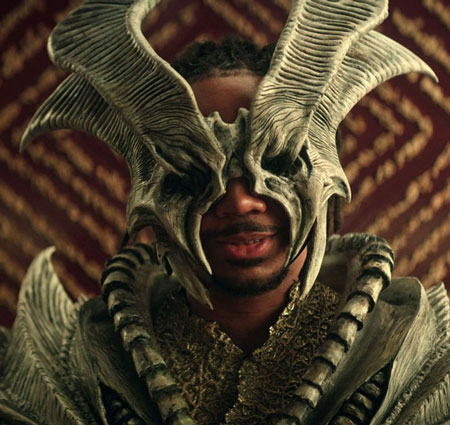
Evil entities evidently need evil accoutrements
These two plot points are interdependent, as we knew they would be as soon as Captain Ninja-Batel started speaking in tongues and fighting Ensign Gamble/Vezda creature in 305. In this episode, we learn that, uh-oh, the Vezda has escaped the transporter buffer somehow and had left the ship sometime between 305 and now. Where did it go? No idea. How did it go? It apparently reconstituted Ensign Gamble's body from the transport logs and beamed itself away in that form. (Now, that's a neat trick that shouldn't cause anyone to go, hey, wow, we can do that? Think of the medical possibilities, or the potential abuses of such reconstituted bodies!)
Parallel to this, Dr. Korby is on the planet Skygowan, looking into some relics that have similarities to what he and the crew discovered on Vadia IX in 305, and has transmitted some sort of distress call. Skygowan is nowhere near where the Enterprise was when Ensign Gamble's reconstituted form beamed out (they have at least figured out when that happened), but everyone immediately concludes that Korby's trouble is the appearance of Gamble/Vezda. Bit of a stretch, but hey, we need to get the story moving, so the Enterprise warps to Skygowan posthaste.
Skygowan is an oddly advanced place for a pre-warp culture that appears to be a theocracy—their cities utilize enormous double-pyramid structures that appear to float off the ground and transporters are used to move between the levels of these structures—which I guess can be explained by the idea that, though they themselves are comparatively primitive, they do trade with many species and function as a commerce port. Korby's local guide tells him the indigenous folks there worship the Vezda as deities—because of course they do—and are awaiting the prophesied return of one of their gods to lead them. Cue Gamble/Vezda, who is, naturally, right there with his back turned as Korby is told of this. Gamble/Vezda revels in being adored by weak-minded idiots and apparently suggests that they all poke their own eyes out, because they do. We get it, he's an asshole.
Apparently, Gamble/Vezda is just sort of biding his time until he can get someone to open a magic doorway for him. This old relic—on display like a museum piece or public art or something—is, like the relics on Vadia IX, inscribed with multiple languages that seem to shift. An Enterprise landing party meets Korby there (after some silliness in getting through the guarded entrance to the transporter/elevator) and one of the languages on the magic door thing shifts to Swahili, readable by both Uhura and M'Benga. Further, it describes a fable pulled directly from M'Benga's personal experience, leading him to conclude, as one does, that this relic refers specifically to him, because this story is about destiny! At this point the magic door opens and Gamble/Vezda appears out of nowhere—he had been down below, but he's up here now—and pushes M'Benga through the open portal, which closes up again as soon as they're through. The portal leads to the prison on Vadia IX, where Gamble/Vezda wants to free his fellow evil creatures so they can all wreak havoc on the universe.

♫ She's got Gary Miiiitchell eyes ♫
Back on the ship, the crew determines that Gamble/Vezda traveled on space "ley lines" connecting various Vezda-associated points. "They're a real thing," Sam Kirk tells us. Sure, Sam. Whatever you say. Because nothing has to make sense in this episode, nobody argues with him. The next order of business for Pike and company is to somehow force open the magic door/ley line portal so they can follow Gamble/Vezda and hopefully find Dr. M'Benga as well. To do this they'll need an amount of electricity equal to the power of the sun. They will? How do you figure? Why? Shut up, that's why.
Meanwhile, in the Vadia IX prison, Gamble/Vezda is tussling with M'Benga but they get separated. Watching it, it appears that M'Benga is thrown into a different room and locked away, but then later we see the opposite happened, which ... you know what, I'm just going to stop wondering how and why when something makes no sense in this one. Anyway, Gamble/Vezda starts throwing energy bolts and zaps the statue—remember the statue?—which affects Captain Batel many light-years away on the Enterprise, both injuring her and giving her glowy eyes ala Mitchell and Dehner in "Where No Man Has Gone Before."
Now we get to the dumbest/most offensive part of this story: To come up with the power of a sun, the crew hatches a plan to use the ship's phasers. But the phaser banks can only generate half the power of the sun (say WHAT, now?). Two ships' phaser banks, though... Enter the USS Farragut and Lieutenant Commander James T. Kirk, because sure, why not throw Kirk into this one too. But, because reasons, pairing the two ships' systems by computer control can't be done, and the phaser strikes have to be perfectly in sync or else they'll wipe out the city. Because... right, not worrying about stuff not making any sense. Moving on. How to get such precise coordination from the two vessels? Why, by use of the favorite trick of the SNW writers' room, a Vulcan mind-meld. I suppose given the context of this bananas script there are at least sufficient stakes for Spock to suggest a meld, unlike prior times when it was much, much too casually undertaken, but it's to serve a stupid plot point that only exists to provide an excuse for Spock and Kirk to mind-meld, yet another way for the writers to force more history on Kirk and Spock, which is stupid. They do the meld, and then operate their respective ships in perfect tandem, and behold the power of a sun! Phasers strike the magic portal artifact and neither it nor anything around it suffers any kind of damage, but the portal does open and Pike and Batel walk through it and into the prison on Vadia IX.
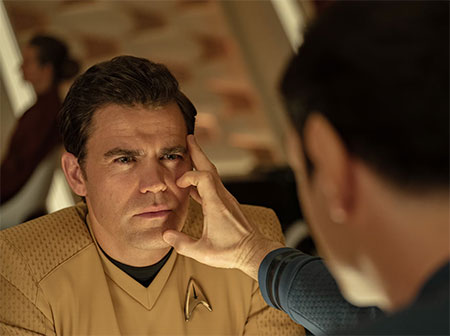
Let us skip many steps in forming our relationship
Batel and Gamble/Vezda face off, and as they prepare for what promises to be some sort of battle royale, Batel looks at Pike and the scene abruptly shifts to Batel and Pike at home living their domestic bliss. We see several vignettes of their life from post-wedding to raising a daughter (and a dog) to Pike somehow surviving the accident we all know he's destined to experience to the daughter getting engaged (to Admiral April's son) to Batel on her deathbed when they're elderly. It's a lengthy and, admittedly, sweet sequence that just as abruptly comes to an end and we're back in the prison, where Batel makes extremely short work of Gamble/Vezda and all the other Vezda are reimprisoned and Batel becomes the statue that stands guard over the Vezda for all time, which she was destined to become.
Crisis over, we go back to the ship and Pike is understandably sad. But life goes on, and we end on the crew warping away to go find a strange, new world to explore.
This utterly terrible script would be more at home as an episode of Doctor Who than Star Trek. (In fact, there's an oblique reference to Doctor Who made by Pelia early on as a throwaway line.) No shade to the good Doctor, but Doctor Who's overall sensibility doesn't require science in its science-fiction and the notions of predestination paradoxes, living statues, and ancient evil entities that have nothing more to them beyond "they're evil" is more appropriate there. For Star Trek, the very idea of ancient evil is counter to the show's ethos.
I'm hard-pressed to find anything good in this one aside from maybe a couple of isolated bits that don't relate to the overall story. It's an ugly example of the laziest writing the franchise has ever seen. It's been a while since I revisited Voyager's dregs, but even those I think had more cohesion. I imagine the story break meeting going something like, "OK, so Captain Batel is the Vezda prison statue, right, so we put her in place by recapturing the Vezda, which escapes somehow. And he's evil, like, really evil, so make him poke out some primitive villagers' eyes or something. And for no reason at all, let's have Spock mind-meld with Kirk so they can be instant best buds without having to go through any of the organic bonding real people would do. It'll be neat and not at all insulting to the characters and the fact that it cheapens everything about that relationship is just a bonus! Don't worry about any of it making sense, we don't care about that. Treat it more like one of those stupid J.J. movies where stuff just happens because magic."
The whole Captain Batel throughline this year is dumb. The Vezda villain is dumb. The "ley line" portal is dumb. Adding M'Benga to the predestination destiny woo-woo bunk is dumb. This whole episode is just dumb.
Stray particles:
- Like the rest of season three, this one borrows extensively from what's been done before. The long sequence of Pike and Batel living their domestic bliss, which presumably was a fantasy sequence somehow projected from Batel to Pike, is lifted from the classic Next Generation episode "The Inner Light." The Vezda, meanwhile, are a lot like the pah-wraiths from Deep Space Nine, creatures that were the adversaries of the Bajoran prophets; in that show, the prophets and pah-wraiths were analogs to religious angels and devils.
- So, Captain Batel is on board with the idea that she's destined to become this living statue thing that stands guard over a bunch of imprisoned evil entities for all time, past and future? That doesn't give her any pause? She's essentially another prisoner there now, just one that keeps the rest from escaping. As destinies go, that one sucks. This was the best idea they had for separating Pike and Batel? Did someone just decide, hey, we should do an "Inner Light" thing with them, how can we do that? and somehow walked backward into "living statue?" Good grief, where's Gene Coon when you need him?
- Two things I laughed at in a good way: First, there's a party scene in Pike's cabin early in the episode and we get a fun callback to the first season, wherein Uhura was hazed by the junior officers by being told that an event in the captain's cabin was formal-dress and she showed up in full dress uniform. Here, Scotty shows up in full-dress having undergone the same hazing. Second, when getting past the guards blocking the way to the Skygowan structure's upper level, La'an Vulcan-nerve-pinches the guards and Chapel, aghast, blurts, "that's what you guys do?!" referring to La'an's, let's say, private time with Spock. La'an simply responds with "Jealous?"
- In the fantasy-domestic-bliss sequence, Batel gives Pike a wedding present, an apron with "Chef Pike" emblazoned on it. I haven't checked, but you just know Chef Pike aprons are now on sale at various outlets for the low low price of just a few quatloos.
- That whole fantasy sequence is a little weird given that we the audience know that Pike's ultimate fate is to live out his days in a world of illusion on Talos IV. You think while he's enjoying fantasy life with Vina that he's reflecting longingly on his fantasy life with Batel?
- Pike has a sculpture on the wall of his quarters that I want for my living room.
- According to Henry Alonso Myers and Akiva Goldsman, this episode was written as a possible series finale, as when they were working on it the series had yet to be picked up for season four. Thank the higher power of your choice that this wasn't the last episode, ’cause man, would this be a crappy way to bow out.
It's difficult to quantify the degree of disappointment this season generates. SNW had been, despite some flaws, the best and most worthy of the streaming Star Treks in its first two seasons, and then we get this year. Season four is already in the can, the abbreviated final season five is already in production. So all future episodes of SNW will have been done without any feedback on this season; we have no reason to think Myers, Goldsman, and company have any understanding of this season's failures or any reason to believe season four will be better. Except one—there was no time crunch imposed on producing season four as was the case in season three thanks to the Hollywood strikes. I guess that allows for some hope.
But this writers' room will have to really deliver the goods next year if they're going to regain my respect.
Tagged
Star Trek,
TV,
Culture,
Posted on October 30, 2025 at 5:09PM | Permalink |  |
| 
Comments
No one has commented on this page yet.
Post your comment
RSS feed for comments on this page | RSS feed for all comments