


Strange New Worldview
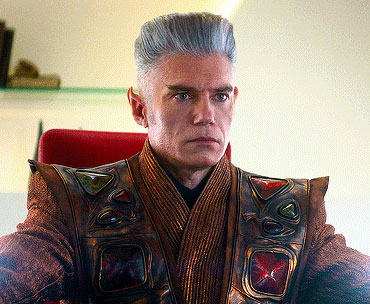 Anson Mount as Captain Pike as a Vulcan/Conehead
WARNING: This post delves into extreme geek territory and may ironically support conscious or unconscious biases regarding the intellectual and social priorities of the so-called "Sci-fi or Star Trek Nerd." Proceed at your own risk.
For the most part, I have been pleased and impressed with the efforts by the writers and production staff of Star Trek: Strange New Worlds. The prequel series hasn't been perfect by any stretch, but its first season came pretty close and its second was also solid. The current third season, though, has been ... iffy.
After viewing each of the nine episodes to have dropped thus far in season three, my opinions have all been tinged with at least some level of "there's something here that bothers me." Usually not something I can immediately put my finger on, more of a sense that if I were to really dig in I would find a troubling bit of sloppy writing or hack shortcut or character misrepresentation or canon violation or whatever. It's been disappointing; ever since J.J. Abrams made his two alleged Star Trek films—Star Trek (2009), which was meh, and Star Trek Into Darkness (2013), which was awful, and neither respected the core of the Trek concept—I've been leery of people taking on this franchise that I hold so dear and fucking it up. But by and large the recent streaming series—Discovery, Lower Decks, Picard, and now SNW—have honored their ancestry relatively well (despite some issues with lazy writing in each season of Disco and the first two seasons of Picard).
SNW season three, while not as good as seasons one and two, still hadn't crossed into fuckup territory until last week's episode eight.
On first viewing, 308 struck me like the rest of season three has: Something I can't quite put my finger on bothers me about this. Additionally, there were things I identified immediately that bothered me, but they were to the "get over it, nerd" side of the I-have-issues spectrum—sci-fi plot elements that didn't hold up to in-universe scientific scrutiny. (I mean, fairly major ones, to be sure, but still things that, if you really wanted to make the episode work, you could manage to solve with some more creative thinking.) On subsequent viewing, though, I realized why this one annoyed me so much.
Titled "Four-and-a-Half Vulcans," the episode opens with an intriguing setup: An alien planetary culture has reached out to the Vulcans for help, but as they are still primitive by Federation standards—and have never encountered aliens other than Vulcans, who encountered them many decades before the Federation existed and who gave the society the nuclear infrastructure that is now failing—only Vulcans can help them, otherwise our heroes will run afoul of the Prime Directive of noninterference by revealing themselves to a pre-warp society. No Vulcan-only ship is able to render assistance in time to avert disaster, to it's up to the Enterprise crew to find a solution. The solution is to (somehow) transform a few of the crew into Vulcans—merely disguising them on a surface level would not fool the native technology—to aid the natives and keep their equipment from melting down while still upholding the Prime Directive. As Chief Engineer Pelia (Carol Kane) put it, "a prime loophole!"
Then we arrive at the first of the "get over it, nerd" problems: Deriving a serum from an elaborate solution to a prior episode's plot—wherein an injectable was concocted by exotic aliens and that far exceeded known Federation science to remedy their own mistake that stripped Spock of his Vulcan DNA—Nurse Chapel doses five of the crew with it and within seconds four of them—it has no effect on Pelia, who is not human—are physiologically transformed into Vulcans. This happens quickly and, aside from some sort-of convulsions and evident momentary pain, easily; we soon see the surface-level change to their ears, eyebrows, and, for some reason, hairstyles. What we don't see, and what is the plot's entire reason for doing this, is the massive internal restructuring that raises the suspension-of-disbelief level unattainably high. But OK, the story needs to move along, so get over it, nerd.
Almost immediately, though, we get the second of the "get over it, nerd" problems: In addition to their physiology, their attitudes and behavior also shift into what appears to be the current cultural and philosophical norm for Vulcans. That is, they somehow adopt learned behaviors that they have no experience learning. There is a voiceover log entry to handwave this problem away, but it's so nonsensical as to be worthless (and I am fairly convinced that it was added after-the-fact when, too late, someone brought up this problem and demanded something fix it).
But that's what's needed for the story—the whole point is for us to see Captain Pike, La'an, Chapel, and Uhura go against character and behave as Vulcans in order for silliness and comic mayhem to commence.
So for the rest of the episode we get silly confrontational behavior from our transformed characters, all played for laughs. One of the principal elements of the "humor" (reflected in the title) is that the transformed Captain Pike continually references the fact that Spock is only half-Vulcan and thus, by implication, inferior. The dilemma with the aliens in need of help is resolved almost immediately, mere minutes after the party beams down to the surface at Pike's order to transport "four and a half Vulcans," the implication being that as Vulcans they were smart enough and efficient enough to conduct a repair thought to take many hours in a small fraction of the time. Upon return, the "un-Vulcanizing" version of the serum fails. With the excuse to get to the point of things disposed of—and perhaps wasted, it had potential to be interesting—let more hilarity ensue.
Here's the real problem: the behavior of our transformed characters is offensive by design, that's the reason we get the allegedly comic scenes. (To be fair, in isolation some of them are funny.) But it's just accepted that they were just being Vulcan. Vulcan does as Vulcan is, or something. Which is more than simply offensive to a character in a scene played for laughs, it's offensive to the audience, it's offensive to the in-universe culture, it's offensive to the core of what makes Trek Trek. When watching this one again it occurred to me exactly why I was having trouble beyond the pseudo-science—this episode is essentially a minstrel show.
What really, truly bugs me about this episode is that (apparently) at no point during preproduction or production itself did anyone say, "whoa, what are we doing here, let's think this through." No one objected to doing this script as is, it occurred to (apparently) nobody in the writers room or on set that they were offending a large chunk of their audience with this episode. Nobody sat back and said, "wait a second, are we basically putting Anson and Christine and Jess and Celia into metaphorical blackface and having them parade around like Jim Crow?" Because that's what they did.
Beyond that, the studio seemed to think so highly of "Four and a Half Vulcans" that when they put together promotional material for the season they led with clips and teases from this installment above all the others. I really think they expected this one to be the fan-favorite of the season. (Also, there were visuals that served no purpose other than for use as promotional images; why the hell would Pike—or anyone—beam down to repair nuclear infrastructure carrying a lirpa? That's only for the photo of Vulcan-Pike carrying the ancient Vulcan weapon, it served no other purpose. They knew before production that this was the one they'd hype up most.)
How did this get made? How obtusely anti-Star Trek can you get in a Star Trek writers' room, J.J. Abrams notwithstanding?
When Discovery was first announced, I noted that one of the top execs in charge was Alex Kurtzman, who was a credited co-writer and highly involved with the making of both Abrams films. That screamed "red alert" to me, those films were so antithetical to what Star Trek really is that I wanted no one from those productions anywhere near any new series. He remains a big cheese in the production of all of the newer series including SNW, but until now the sort of ignorant cluelessness of those films has been minimal at most. Now I'm back to blaming Kurtzman, rightly or wrongly, for bastardizing this thing that has been so much a part of my identity since I was single-digits years old. (More accurately, in this case I blame him for aiding and abetting as the credited writers were Dana Horgan and Henry Alonso Myers, not Kurtzman himself.)
The thing is, this still could have been an exceptionally good episode.
I mean, the serum thing would still be a problem, but with a little more thought and care, we could eliminate the instant-logic problem and we could turn the whole thing into something special.
There is a scene in the middle of the episode wherein Number One, Spock, Dr. M'Benga, Pelia, Batel, and Lt. Ortegas convene and discuss what to do about the Vulcanized officers. The return-to-human serum has been fixed, but the four new Vulcans are refusing to change back. As is, it's not a bad scene, we get some good Spock stuff in particular, but it could have been expanded to include something meatier. It's a streaming show, so if they went over time it's not a problem; length shouldn't matter so much, so we could add something like this:
INT. PELIA'S QUARTERS
UNA, SPOCK, PELIA, M'BENGA, BATEL, AND ORTEGAS SIT AROUND AN ANTIQUE COFFEE TABLE AMONG THE DISORGANIZED CHAOS OF HOARDED OLD-TIMEY ITEMS IN PELIA'S POSSESSION.
UNA: It would help if we knew WHY they were behaving this way. I mean, I've known a fair number of Vulcans in my day, none of them were quite so...
PELIA: Robotic?
BATEL: Insensitive?
ORTEGAS: Mean?
UNA: ... Sure, but also ... Spock, correct me if I'm wrong, but Vulcans don't come out of the womb spouting logic and denying emotions, it's not genetic, right?
SPOCK: Correct. It is most assuredly a learned behavior based on the need to suppress the otherwise overwhelming nature of the Vulcan emotional spectrum. We are trained and educated from a very young age to prioritize our rational faculties.
UNA: So why—?
M'BENGA: Mr. Spock and I have discussed this and we have some thoughts.
SPOCK: Indeed. The closest I have to a working theory is that the captain and the others, having abruptly had that Vulcan emotional spectrum thrust upon them, instinctually adopted what they have perceived in their experience of Vulcan demeanors as a coping mechanism. And while I have been principally focused on the group as a whole, Dr. M'Benga has observed them on a more individual basis.
M'BENGA (THOUGHFULLY): They are not really behaving like Vulcans behave. They're behaving as a sort of caricature of Vulcans, and if you look closely you'll see that they aren't behaving identically—each of them has latched onto their individual preconception of Vulcan behavior.
ORTEGAS: Like La'an's obsession with arming the ship?
M'BENGA: La'an's psyche is rooted in her childhood traumas, losing her family in her capture and escape from the Gorn, so for her, logic would demand defending the ship and eliminating threats; she is motivated by her perception of Vulcans as powerful and strong. Nurse Chapel, meanwhile, has been career-driven with her research and so is using her perception of Vulcans as unfeeling overachievers to focus entirely on multitasking research and experiments to the exclusion of all else.
BATEL: And Chris is, what, just subconsciously the most extreme micro-manager of all time?
M'BENGA: No, I think the captain is more complicated... I think underneath it all he actually thinks poorly of Vulcans.
UNA (SURPRISED): What?
SPOCK (RAISES EYEBROW): That does not appear to be the case given his continual remarks about my merely half-Vulcan biology.
M'BENGA: That's actually the principal reason I think this is true, Mr. Spock. It's clear to me that the captain has adopted arrogance as his Vulcan "north star," if you will. That's his ultimate perception of Vulcan behavior, his sense that they think they're better than everyone else. And, as a Vulcan, such arrogance would extend to you perhaps more than others.
SPOCK (GLANCES AWAY): That would not be a unique behavior among my species.
M'BENGA: Yes, and the captain knows it, but more to the point, it suggests to me that the Captain Pike we know sees you as an exception to his concept of Vulcans. That your human half mitigates the nature he perceives as arrogant and troublesome.
UNA (LOOKING DOWN AT THE TABLE, SLIGHTLY FROWNING): You're one of the "good ones," Spock.
SEVERAL BEATS OF SILENCE AS THE ASSEMBLED GROUP CONSIDERS THIS.
END SCENE.
Now we have changed the tone of the episode away form pure comic farce to thoughtful examination of unconscious and institutional racism.
This also gives more weight to the ultimate solution to the problem. Instead of what we actually get in the episode—a wonderful appearance by Patton Oswalt as the delightful Vulcan katra expert named Doug simply convincing all but La'an to go back to being human, all offscreen and with no explanation, while Spock unconscionably invades La'an's mindspace to bring her back to humanity through their emotional connection (and dance)—we would instead know, whether shown onscreen or not, that Doug's ministrations reveal their behavior to themselves as being distastefully bigoted; there would be a far more believable rationale for the until-then intransigent Vulcanized crew to change their minds and realize that (a) they preferred their old selves, and (b) they were making a mockery of a species they claimed they wished to emulate. The shame would be more than enough to make them demand the re-humaning serum. This, of course, would also demand a different coda scene showing Pike, at least, if not all of them, acknowledging their subconscious prejudicial attitudes. And Spock, along with every biracial member of the audience, deserved an apology.
Oswalt, by the way, is easily a highlight of the season. I loved Doug. I even appreciated the farcical scene with Una and Spock trying to convince Doug that Una was off the market, as it were. I would like to see, if not future appearances from Oswalt/Doug, then future references to him. Perhaps Una receives a message that we hear start to play for her in the background that begins "Heeey, it's Doug," ala Kamala Harris' infamous first voicemail form her husband. I only wish Oswalt appeared in support of a better and less offensive script. Same goes for Anson Mount's brilliant face-acting and comic timing. (My imagined added scene above would also give some credence to Mount's choice to play Vulcan-Pike as a Conehead from Saturday Night Live instead of an actual Vulcan.)
There's been much discussion of this episode elsewhere on the Internet, but I've refrained from looking at most of it and I haven't heard any of the review podcasts about it yet. But I have gleaned that the trans community is particularly upset about it; I can't claim to fully understand that, as I don't see the parallels as being, well, really parallel, but I do get the underlying gist. Frankly, I would expect any minority group to be, if not offended, then disappointed by the obtuseness of the writers and producers in a more visceral way than I'm articulating here.
I can't help but imagine the script as produced being proposed with previous Trek showrunners in place. Neither Gene—Roddenberry or Coon—would permit it, even though Gene Coon would appreciate going for silliness if there was more substance. Ira Steven Behr would have stopped it at an early stage and demanded rewrite after rewrite until it was suitably focused on something about racism. Even the two-headed beast I came to think of as Bermaga—the team of Rick Berman and Brannon Braga that was responsible for the first three years of the series Enterprise and whom I've been highly critical of for juvenile and nonsensical elements in their scripts—might well have recognized this as too flawed to produce.
In the end, this is a similar problem to several scripts in Discovery and Picard—it went into production before it was ready; writing issues were overlooked, unrecognized, or simply ignored. This time, though, the issues were more than just sloppy execution or a dumb lack of coherence with the rest of the story. This time it was really upsetting.
Tagged
Star Trek,
Culture,
Society,
Racism,
Posted on September 5, 2025 at 10:45PM | Permalink |  |
| 
Comments
No one has commented on this page yet.
Post your comment
RSS feed for comments on this page | RSS feed for all comments