



Tag: Culture
SNW 403: Human Best Friend
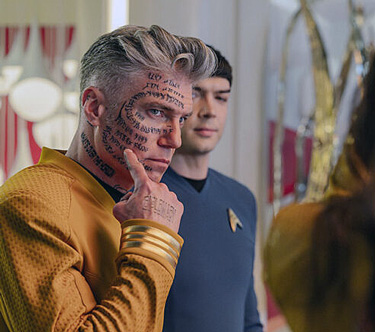 Does anyone know what I had tattooed on my face?
This week's episode of Strange New Worlds actually isn't terrible. Part of me does hate it, but it's the part that has been disappointed by the writing in so many streaming era and 21st century film installments of the Star Trek franchise; here we again have an episode that has little to no depth to it, another junk food meal of empty calories. On the other hand, I did find it entertaining despite my qualms. It's very much like last season's "Wedding Bell Blues" in that regard, though not as steeped in the series mythology and a whole lot more derivative.
Had I known in advance what they were going for with this one—it's a stoner comedy that borrows heavily from lowbrow films The Hangover and Harold & Kumar Go Wherever They Went; it could be titled "Dude, Where's My Shuttlecraft?"—expectations would have been lower than low given what came last season, in which case this post would be about how I was pleasantly surprised by the not-terribleness of it. But even though I kind of liked it, it does nothing to assuage my fears that the rest of the series is going to be frustrating. Especially knowing that both this season and the abbreviated next season was all either in production or the can before any of the flawed and troubling season three had aired (dropped? What is the proper terminology for the release of streaming internet TV?). I suspect that no one in this writers' room ever came to any realizations that last year had real problems before it was too late and all was completed. Thematic depth? Nah. Ethical quandaries? Meh, we might touch on them vaguely. Dumb humor? Oh, yeah, that's our jam, and if we can cheapen what comes later in the timeline, so much the better.
There is plenty of dumb humor and cheapening what comes later in this one, to be sure, but in large part—not entirely—I am choosing to overlook it because there's some fun to be had.
Let's get into it.
See full post: "SNW 403: Human Best Friend"...
Tagged
Star Trek,
TV,
Culture,
Posted on August 8, 2026 at 8:32PM | Permalink |  |
| 
SNW 401: Valles Marineris
 Can you stun a T. Rex? Let's find out.
Star Trek: Strange New Worlds returned last week for its fourth season premiere, and, wouldn't you know, I have thoughts.
After the painfully flawed mess of the third season, I was prepared to be disappointed. However, I was also hopeful that, without the rush-job environment that produced the season three scripts, we'd get back to at least the level of quality we saw in SNW's first two seasons. The premiere landed smack in the middle of those poles—there's stuff that doesn't make sense, there's some lazy shortcut writing, there's avoidable science mistakes; but there are also really funny moments, a clever premise, and good character stuff that almost makes me give them a pass on the bad character stuff.
Let's get into it (spoilers ahead):
See full post: "SNW 401: Valles Marineris"...
Tagged
Star Trek,
TV,
Culture,
Posted on July 30, 2026 at 3:20AM | Permalink | |
Numb to incivility
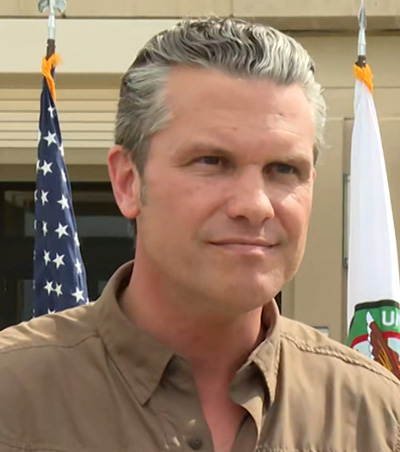 If a G.I.Joe action-figure were brain-damanged, had Nazi tattoos, and came to life to get blackout drunk, you'd have this guy
Every now and then I am reminded of how truly inured our culture has become to a lack of civility and decorum in this, the age of Felon47.
Sometimes it happens just in my daily life encountering people "in the wild," like a couple of Sundays ago with the road rager and the overly-macho softball player, but more often it happens when I'm watching/reading/listening to the news. People, sometimes high-level officials even, think nothing of just oozing hostility and contempt to whomever they're speaking to. With no provocation at all, it's just the default—be belligerent.
What brings this up today is the recent questioning of the idiotic caricature of machismo masquerading as the Secretary of Defense. A reporter asked him quite reasonable questions about the indefensible, pointless, illegal, and wholly counterproductive war with Iran (though the reporter did not use those descriptors), and Secretary Kegstand responded with insults and dismissive doubletalk and ridiculous propaganda. The reporters, sadly, let him do so without pushback.
REPORTER: You've just mentioned you plan to strike [Iran] hard tonight. If [that includes] hitting bridges and electrical infrastructure, how is that not a war crime? Targeting civilian infrastructure?
HEGSETH: That's precisely the kind of disingenuous question I'm used to from the media, impugning the motives of the folks on our side who are incredibly professional and incredibly effective.
Hegseth goes on to blather about how Iran's military sucks and how they need to "negotiate" with Felon47 and his staff of criminals, but he never addresses the question at all. And the reporter let's him get away with it! The reporter does not say, when Hegseth is done with his word-vomit, "sir, none of that addresses the issue of hitting civilian targets and war crimes," nor anything else of value. He does not say, "there is nothing disingenuous about my question, the US has already bombed water facilities and you've given no indication that you think that was anything other than good targeting." He does not say, "my question has nothing to do with 'folks on our side,' it has to do with decision-making by the Defense Department. You know, the agency you are in charge of."
Hegseth is utterly worthless as a government official. Worse than worthless, he produces negative worth. But this sort of reportage is also worthless. Why the media just parrots this guy and allows him to spout bullshit and hurl insults at them is, to say the least, counterproductive.
Of course, it starts at the top—the alleged President of the United States does exactly the same thing and thus people in positions like SecDef emulate his uncivil behavior, but unacknowledged alcoholic Pete Hegseth seems like the kind of guy who is just this way in every aspect of his life. I can imagine domestic interactions at home, with Mrs. Hegseth asking where he'd like to go for dinner and getting a sneering reply along the lines of "that's exactly the kind of counterfactual question I've come to expect from my wives" (he's on number three).
It's easy to blame the Felon47 regime for this new normal of belligerence. It's accurate to do so, sure, but as with many other aspects of our increasingly dystopian reality, I assign a sizeable share of blame to the American news media. They have accepted and even encouraged the normalizing of this incivility by not calling out the officials who behave in ways that not long ago would have been near-universally unacceptable.
Felon47 has the demeanor of a spoiled toddler, he whines and gripes about anything and everything that doesn't feed his ego, and yet when he abruptly walked out of an interview for Meet the Press last week, hurling insults and demeaning comments to the reporter (female, of course, his favorite sort to insult) and crushing the microphone as he went, that reporter's reaction was to declare that she had since spoken to "the President," excuse his behavior as related to the weather, and come to an agreement to do another interview later on. Epic fail, Meet the Press. Instead, a responsible journalistic follow-up would have been to point out that the things he was upset about being questioned on were more than legitimate topics and that his whiny replies were lies when they were relevant to the topic at all. Treating this sort of thing like it's perfectly acceptable behavior from anyone, let alone someone claiming to be President of the United States, only serves to exacerbate the greater cultural decline into hostility-as-default.
None of this is new info, we've all been living it, it just felt like something I needed to rant about for a few minutes.
Tagged
Politics,
Pete Hegseth,
Culture,
Republicans,
President VonClownstick,
Media,
Posted on June 13, 2026 at 9:02PM | Permalink | |
If you use technology, read this book

Because I am not made of money, when I buy a book to give someone as a Christmas present (presuming it's one I haven't read yet), if there's enough time I'll read it myself before wrapping it up and sending it off. Thus was the case with one I picked up the other night, the latest nonfic from the great Cory Doctorow.
Doctorow is a longtime tech consumer advocate, with the Electronic Frontier Foundation and just on his own, and his new volume explains how the evolution of the Internet has unfortunately coincided with some truly terrible governance to create what he calls the Enshittocene Era, which we are now living trough.
Digital services in particular and the Internet in general are in dire need of regulation, as evidenced by the continually worsening transitions from software being sold to you on a disc or as a download to what we see more and more of today, software that you "subscribe to"—which is to say, rent from a remote server. Further, some of the tech companies like to tweak their user agreements now and then to try and take ownership of not just the physical software, but your work that you create with it in order to "train AI." As more commodities become digital, you as a consumer own less of what you pay for. When once you owned music you bought on a disc, these days if you purchase an album on iTunes, you didn't really buy it—you're renting it for the duration your iTunes account and device is active and paid up. Even physical goods now use Internet connectivity, the so-called "Internet of Things," to try and prevent consumers from actually owning the products they buy.
You've undoubtedly encountered this sort of thing in your everyday lives, but Doctorow details how its done and why in all its greedy glory, and in quite accessible language, in this book, Enshittification: Why Everything Suddenly Got Worse and What to Do About It.
All the tech outfits are abusing us; bad enough they all spy on us to an extreme degree to facilitate their algorithms and their advertising sales. But over time they've also graduated to just blatantly ripping us off whenever they can and abusing anyone that gets between them and a dollar. Amazon, unsurprisingly, is and always has been the worst offender, but Apple grates my cheese almost as much with the way they insist on control of everything related to any of their products. (Recall my note in the post on the Android app that there was no iOS app; this is because Apple wants total control and wants you to pay for the privilege of giving it to them.) Everyone is in on it. Google, Meta, Microsoft, Adobe, everyone. And a lot fewer companies make up "everyone" after so many mergers and acquisitions and blind-eye-turning on antitrust laws.
Dearth of competition. Dearth of regulation. Diminishing power of tech-industry labor. Binding arbitration of conflicts when the offending company employs the arbitrators. Choices made by companies and governments to gouge consumers without much pushback (but what little there has been is worth paying attention to and replicating). Thus does enshittification metastasize.
Suffice to say, this is a very important book for everyone to read. Especially Americans, since our regulatory system is the most influential (so far) on these businesses.
Some choice quotes:
"Apple didn't treat its customers well because it loved them. It treated them well to lure them into its walled garden, which was then revealed to be a prison."
"Google could spend billions of dollars every year making sure that even someone who's tried every other search engine would still prefer Google. Or it could spend a lot fewer billions of dollars making sure that no one ever tried a search engine other than Google. It chose the latter. ... Apple's single largest source of revenue is a check for more than $20 billion that Google writes it every year to buy the default search box in Safari and on the iPhone."
"The instant Adobe moved its software to the cloud and eliminated the non-subscription versions of its apps, it put a gun on the mantelpiece. It was only a matter of time until someone opened fire on Adobe's customers with that gun."
"If you operate a cloud-based app, you can monitor your customers' every click and keystroke to discover which features are most valuable to your deepest-pocketed users, and then you can remove that feature from the product's basic tier and reclassify it as an upcharged add-on. The CEOs who do this got their MBAs at Darth Vader University, where the first lesson is, 'I am altering the deal. Pray I don't alter it any further.'"
"Here's how perverse [the Digital Millennium Copyright Act of 1998, section 1201] is: ... If I, as the author, narrator, and investor in an audiobook, allow Amazon to sell you that book and later want to provide you with a tool so you can take your book to a rival platform, I will be committing a felony punishable by a five-year prison sentence and a $500,000 fine.... If you were to visit a truckstop and shoplift my audiobook on CD from a spinner rack, you would face a significantly lighter penalty for stealing a physical item that I would for providing you with the means to take a copyrighted work that I created and financed our of the Amazon ecosystem. If you were to hijack the truck that delivers that CD and steal an entire fifty-three-foot trailer full of audiobooks, you would likely face a shorter prison sentence that I would for helping you break the DRM on a title I own."
Doctorow notes some positive changes in recent years and lays out a plan to fix things, but it depends on public and governmental actions that seem unlikely to happen in the near future in this country, at least so long as Republicans are in power. It may be up to the Europeans for now.
Tagged
The Internet,
Culture,
Republicans,
Technology,
Cory Doctorow,
Books,
Posted on December 15, 2025 at 2:36PM | Permalink | |
Lazy writing: SNW season 3 fails to meet high standard
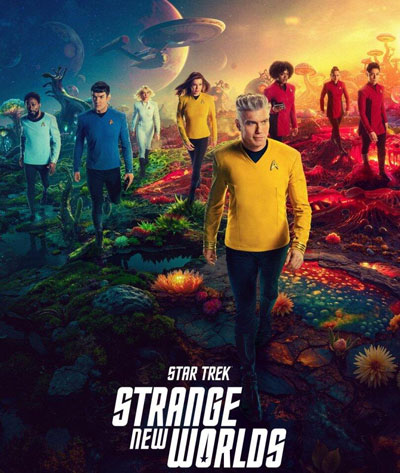
It will surprise no one that I have very high standards when it comes to Star Trek. The original series was, along with superhero comics, the biggest cultural touchstone of my youth; it informed my thinking, development, maturation, ethics, politics, and more. I was a nerd's nerd, if you will, while growing up and then reveled in the resurgence of Star Trek on television that began when I reached voting age.
It's important. It not only means something to me when it's done well, it also feels almost offensive to my soul when it's done badly.
The just-finished third season of Star Trek: Strange New Worlds, the prequel series that leads up to what we saw in the original 1966-69 series, had its moments, but by and large was done badly. Seasons one and two were consistently good, with a couple of caveats, but this one was just ... sloppy.
With one exception, no episode of SNW season three really stinks, and even that one has one or two brief moments of fun; there are no analogues to "Profit and Lace" from Deep Space Nine or "Code of Honor" from The Next Generation here. But the writing across the season is slapdash, like each script went into production as a first draft and at no time did anyone do any refinement on them or get a second set of eyes to see if things made sense or not, let alone run them by a science adviser.
There might be a reason for that—the season was delayed for a year thanks to the writers' and actors' strikes, and perhaps the studio rushed these episodes into production to get them out as soon as possible. But we already waited two years for it, I think everyone would agree that it would have been worth it to wait another few months if it meant the scripts were run through a better quality-control regimen. On the other hand, the people running this show—executives Alex Kurtzman, Henry Alonso Myers, and Akiva Goldsman—don't exactly have stellar track records when it comes to quality (I mean, they have Star Trek Into Darkness and Batman Forever on their résumés) and they may simply have thought these were all good to go. Despite being retreads of episodes from past Trek series and/or inconsistent within SNW, let alone all of Trekdom, and/or fundamentally misunderstanding why Star Trek (the shows) is Star Trek (the overall cultural phenomenon).
Star Trek is not space-fantasy, it's science-fiction. There are some less-realistic elements that we accept, concessions to television budgets and formats—transporters, a plethora of humanoid aliens, the universal translator, subspace radio—but we accept them within the overall worldbuilding established in the original and refined in the shows from the ’80s, ’90s, and ’00s. There are rules to be followed with the technology and anything outside of those few accepted conceits has to pass an at least rudimentary scientific smell test. Also, it's fundamentally about ideas and allegorical to the human society we're living in today; at its best, its stories have something to say, ideally through well-developed flawed but idealistic characters.
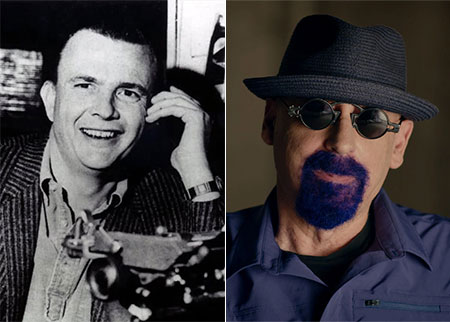
Gene L. Coon and Ira Steven Behr, the best of Trek's showrunners
The Genes—Roddenberry and Coon—famously either rewrote or rode herd on every script during their respective tenures as line producers on the original. Rick Berman may not have been all that good a writer, but he took it seriously when he was charged with safeguarding the franchise for Roddenberry after the latter's health became too poor for him to keep working on TNG. Ira Behr ran the best Trek writers' room as showrunner of DS9, insisting on a certain fidelity and depth of storytelling despite the demands of a 26-episode season. For the most part, these streaming series—with a new normal of first 13 and now merely 10 episodes per year—haven't had someone like that in charge, someone who knows what makes Star Trek work.
I don't know why it's apparently so hard for people who are by all accounts enthused to take on Star Trek as a property—J.J. Abrams (films), Kurtzman (all streaming series and the Abrams films), Gretchen Berg/Aaron Harberts (Discovery)—to comprehend what it is. Why it has had such staying power. Why it appeals to the people it appeals to. Abrams was and seems to remain completely clueless, he thinks it's a space-fantasy like Star Wars. The others seem to grasp only a surface-level understanding of it. Mike McMahon of Lower Decks and Terry Matalas of Picard season three get it. Michelle Paradise (Discovery season 3-5) fell somewhere in between getting it and just knowing the trappings, as did, I had thought, Goldsman and Myers. After seeing SNW season three, I have to reevaluate; Goldsman and Myers might be closer to the Abrams end of the scale.
In this admittedly lengthy and probably too-nerdy-for-most post, I want to break down the season episode by episode and look at what worked and what didn't. To prevent this one nerd-post from overwhelming the home page, I'll shunt the bulk of it to its own page, so follow the link below to read on.
See full post: "Lazy writing: SNW season 3 fails to meet high standard"...
Tagged
Star Trek,
TV,
Culture,
Posted on October 30, 2025 at 5:09PM | Permalink | |
Strange New Worldview
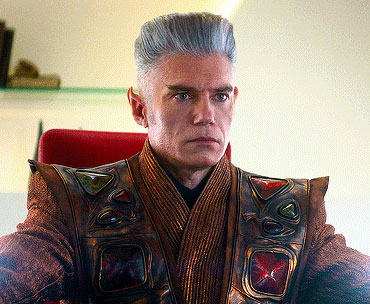 Anson Mount as Captain Pike as a Vulcan/Conehead
WARNING: This post delves into extreme geek territory and may ironically support conscious or unconscious biases regarding the intellectual and social priorities of the so-called "Sci-fi or Star Trek Nerd." Proceed at your own risk.
For the most part, I have been pleased and impressed with the efforts by the writers and production staff of Star Trek: Strange New Worlds. The prequel series hasn't been perfect by any stretch, but its first season came pretty close and its second was also solid. The current third season, though, has been ... iffy.
After viewing each of the nine episodes to have dropped thus far in season three, my opinions have all been tinged with at least some level of "there's something here that bothers me." Usually not something I can immediately put my finger on, more of a sense that if I were to really dig in I would find a troubling bit of sloppy writing or hack shortcut or character misrepresentation or canon violation or whatever. It's been disappointing; ever since J.J. Abrams made his two alleged Star Trek films—Star Trek (2009), which was meh, and Star Trek Into Darkness (2013), which was awful, and neither respected the core of the Trek concept—I've been leery of people taking on this franchise that I hold so dear and fucking it up. But by and large the recent streaming series—Discovery, Lower Decks, Picard, and now SNW—have honored their ancestry relatively well (despite some issues with lazy writing in each season of Disco and the first two seasons of Picard).
SNW season three, while not as good as seasons one and two, still hadn't crossed into fuckup territory until last week's episode eight.
On first viewing, 308 struck me like the rest of season three has: Something I can't quite put my finger on bothers me about this. Additionally, there were things I identified immediately that bothered me, but they were to the "get over it, nerd" side of the I-have-issues spectrum—sci-fi plot elements that didn't hold up to in-universe scientific scrutiny. (I mean, fairly major ones, to be sure, but still things that, if you really wanted to make the episode work, you could manage to solve with some more creative thinking.) On subsequent viewing, though, I realized why this one annoyed me so much.
Titled "Four-and-a-Half Vulcans," the episode opens with an intriguing setup: An alien planetary culture has reached out to the Vulcans for help, but as they are still primitive by Federation standards—and have never encountered aliens other than Vulcans, who encountered them many decades before the Federation existed and who gave the society the nuclear infrastructure that is now failing—only Vulcans can help them, otherwise our heroes will run afoul of the Prime Directive of noninterference by revealing themselves to a pre-warp society. No Vulcan-only ship is able to render assistance in time to avert disaster, to it's up to the Enterprise crew to find a solution. The solution is to (somehow) transform a few of the crew into Vulcans—merely disguising them on a surface level would not fool the native technology—to aid the natives and keep their equipment from melting down while still upholding the Prime Directive. As Chief Engineer Pelia (Carol Kane) put it, "a prime loophole!"
Then we arrive at the first of the "get over it, nerd" problems: Deriving a serum from an elaborate solution to a prior episode's plot—wherein an injectable was concocted by exotic aliens and that far exceeded known Federation science to remedy their own mistake that stripped Spock of his Vulcan DNA—Nurse Chapel doses five of the crew with it and within seconds four of them—it has no effect on Pelia, who is not human—are physiologically transformed into Vulcans. This happens quickly and, aside from some sort-of convulsions and evident momentary pain, easily; we soon see the surface-level change to their ears, eyebrows, and, for some reason, hairstyles. What we don't see, and what is the plot's entire reason for doing this, is the massive internal restructuring that raises the suspension-of-disbelief level unattainably high. But OK, the story needs to move along, so get over it, nerd.
Almost immediately, though, we get the second of the "get over it, nerd" problems: In addition to their physiology, their attitudes and behavior also shift into what appears to be the current cultural and philosophical norm for Vulcans. That is, they somehow adopt learned behaviors that they have no experience learning. There is a voiceover log entry to handwave this problem away, but it's so nonsensical as to be worthless (and I am fairly convinced that it was added after-the-fact when, too late, someone brought up this problem and demanded something fix it).
But that's what's needed for the story—the whole point is for us to see Captain Pike, La'an, Chapel, and Uhura go against character and behave as Vulcans in order for silliness and comic mayhem to commence.
So for the rest of the episode we get silly confrontational behavior from our transformed characters, all played for laughs. One of the principal elements of the "humor" (reflected in the title) is that the transformed Captain Pike continually references the fact that Spock is only half-Vulcan and thus, by implication, inferior. The dilemma with the aliens in need of help is resolved almost immediately, mere minutes after the party beams down to the surface at Pike's order to transport "four and a half Vulcans," the implication being that as Vulcans they were smart enough and efficient enough to conduct a repair thought to take many hours in a small fraction of the time. Upon return, the "un-Vulcanizing" version of the serum fails. With the excuse to get to the point of things disposed of—and perhaps wasted, it had potential to be interesting—let more hilarity ensue.
Here's the real problem: the behavior of our transformed characters is offensive by design, that's the reason we get the allegedly comic scenes. (To be fair, in isolation some of them are funny.) But it's just accepted that they were just being Vulcan. Vulcan does as Vulcan is, or something. Which is more than simply offensive to a character in a scene played for laughs, it's offensive to the audience, it's offensive to the in-universe culture, it's offensive to the core of what makes Trek Trek. When watching this one again it occurred to me exactly why I was having trouble beyond the pseudo-science—this episode is essentially a minstrel show.
What really, truly bugs me about this episode is that (apparently) at no point during preproduction or production itself did anyone say, "whoa, what are we doing here, let's think this through." No one objected to doing this script as is, it occurred to (apparently) nobody in the writers room or on set that they were offending a large chunk of their audience with this episode. Nobody sat back and said, "wait a second, are we basically putting Anson and Christine and Jess and Celia into metaphorical blackface and having them parade around like Jim Crow?" Because that's what they did.
Beyond that, the studio seemed to think so highly of "Four and a Half Vulcans" that when they put together promotional material for the season they led with clips and teases from this installment above all the others. I really think they expected this one to be the fan-favorite of the season. (Also, there were visuals that served no purpose other than for use as promotional images; why the hell would Pike—or anyone—beam down to repair nuclear infrastructure carrying a lirpa? That's only for the photo of Vulcan-Pike carrying the ancient Vulcan weapon, it served no other purpose. They knew before production that this was the one they'd hype up most.)
How did this get made? How obtusely anti-Star Trek can you get in a Star Trek writers' room, J.J. Abrams notwithstanding?
When Discovery was first announced, I noted that one of the top execs in charge was Alex Kurtzman, who was a credited co-writer and highly involved with the making of both Abrams films. That screamed "red alert" to me, those films were so antithetical to what Star Trek really is that I wanted no one from those productions anywhere near any new series. He remains a big cheese in the production of all of the newer series including SNW, but until now the sort of ignorant cluelessness of those films has been minimal at most. Now I'm back to blaming Kurtzman, rightly or wrongly, for bastardizing this thing that has been so much a part of my identity since I was single-digits years old. (More accurately, in this case I blame him for aiding and abetting as the credited writers were Dana Horgan and Henry Alonso Myers, not Kurtzman himself.)
The thing is, this still could have been an exceptionally good episode.
I mean, the serum thing would still be a problem, but with a little more thought and care, we could eliminate the instant-logic problem and we could turn the whole thing into something special.
There is a scene in the middle of the episode wherein Number One, Spock, Dr. M'Benga, Pelia, Batel, and Lt. Ortegas convene and discuss what to do about the Vulcanized officers. The return-to-human serum has been fixed, but the four new Vulcans are refusing to change back. As is, it's not a bad scene, we get some good Spock stuff in particular, but it could have been expanded to include something meatier. It's a streaming show, so if they went over time it's not a problem; length shouldn't matter so much, so we could add something like this:
INT. PELIA'S QUARTERS
UNA, SPOCK, PELIA, M'BENGA, BATEL, AND ORTEGAS SIT AROUND AN ANTIQUE COFFEE TABLE AMONG THE DISORGANIZED CHAOS OF HOARDED OLD-TIMEY ITEMS IN PELIA'S POSSESSION.
UNA: It would help if we knew WHY they were behaving this way. I mean, I've known a fair number of Vulcans in my day, none of them were quite so...
PELIA: Robotic?
BATEL: Insensitive?
ORTEGAS: Mean?
UNA: ... Sure, but also ... Spock, correct me if I'm wrong, but Vulcans don't come out of the womb spouting logic and denying emotions, it's not genetic, right?
SPOCK: Correct. It is most assuredly a learned behavior based on the need to suppress the otherwise overwhelming nature of the Vulcan emotional spectrum. We are trained and educated from a very young age to prioritize our rational faculties.
UNA: So why—?
M'BENGA: Mr. Spock and I have discussed this and we have some thoughts.
SPOCK: Indeed. The closest I have to a working theory is that the captain and the others, having abruptly had that Vulcan emotional spectrum thrust upon them, instinctually adopted what they have perceived in their experience of Vulcan demeanors as a coping mechanism. And while I have been principally focused on the group as a whole, Dr. M'Benga has observed them on a more individual basis.
M'BENGA (THOUGHFULLY): They are not really behaving like Vulcans behave. They're behaving as a sort of caricature of Vulcans, and if you look closely you'll see that they aren't behaving identically—each of them has latched onto their individual preconception of Vulcan behavior.
ORTEGAS: Like La'an's obsession with arming the ship?
M'BENGA: La'an's psyche is rooted in her childhood traumas, losing her family in her capture and escape from the Gorn, so for her, logic would demand defending the ship and eliminating threats; she is motivated by her perception of Vulcans as powerful and strong. Nurse Chapel, meanwhile, has been career-driven with her research and so is using her perception of Vulcans as unfeeling overachievers to focus entirely on multitasking research and experiments to the exclusion of all else.
BATEL: And Chris is, what, just subconsciously the most extreme micro-manager of all time?
M'BENGA: No, I think the captain is more complicated... I think underneath it all he actually thinks poorly of Vulcans.
UNA (SURPRISED): What?
SPOCK (RAISES EYEBROW): That does not appear to be the case given his continual remarks about my merely half-Vulcan biology.
M'BENGA: That's actually the principal reason I think this is true, Mr. Spock. It's clear to me that the captain has adopted arrogance as his Vulcan "north star," if you will. That's his ultimate perception of Vulcan behavior, his sense that they think they're better than everyone else. And, as a Vulcan, such arrogance would extend to you perhaps more than others.
SPOCK (GLANCES AWAY): That would not be a unique behavior among my species.
M'BENGA: Yes, and the captain knows it, but more to the point, it suggests to me that the Captain Pike we know sees you as an exception to his concept of Vulcans. That your human half mitigates the nature he perceives as arrogant and troublesome.
UNA (LOOKING DOWN AT THE TABLE, SLIGHTLY FROWNING): You're one of the "good ones," Spock.
SEVERAL BEATS OF SILENCE AS THE ASSEMBLED GROUP CONSIDERS THIS.
END SCENE.
Now we have changed the tone of the episode away form pure comic farce to thoughtful examination of unconscious and institutional racism.
This also gives more weight to the ultimate solution to the problem. Instead of what we actually get in the episode—a wonderful appearance by Patton Oswalt as the delightful Vulcan katra expert named Doug simply convincing all but La'an to go back to being human, all offscreen and with no explanation, while Spock unconscionably invades La'an's mindspace to bring her back to humanity through their emotional connection (and dance)—we would instead know, whether shown onscreen or not, that Doug's ministrations reveal their behavior to themselves as being distastefully bigoted; there would be a far more believable rationale for the until-then intransigent Vulcanized crew to change their minds and realize that (a) they preferred their old selves, and (b) they were making a mockery of a species they claimed they wished to emulate. The shame would be more than enough to make them demand the re-humaning serum. This, of course, would also demand a different coda scene showing Pike, at least, if not all of them, acknowledging their subconscious prejudicial attitudes. And Spock, along with every biracial member of the audience, deserved an apology.
Oswalt, by the way, is easily a highlight of the season. I loved Doug. I even appreciated the farcical scene with Una and Spock trying to convince Doug that Una was off the market, as it were. I would like to see, if not future appearances from Oswalt/Doug, then future references to him. Perhaps Una receives a message that we hear start to play for her in the background that begins "Heeey, it's Doug," ala Kamala Harris' infamous first voicemail form her husband. I only wish Oswalt appeared in support of a better and less offensive script. Same goes for Anson Mount's brilliant face-acting and comic timing. (My imagined added scene above would also give some credence to Mount's choice to play Vulcan-Pike as a Conehead from Saturday Night Live instead of an actual Vulcan.)
There's been much discussion of this episode elsewhere on the Internet, but I've refrained from looking at most of it and I haven't heard any of the review podcasts about it yet. But I have gleaned that the trans community is particularly upset about it; I can't claim to fully understand that, as I don't see the parallels as being, well, really parallel, but I do get the underlying gist. Frankly, I would expect any minority group to be, if not offended, then disappointed by the obtuseness of the writers and producers in a more visceral way than I'm articulating here.
I can't help but imagine the script as produced being proposed with previous Trek showrunners in place. Neither Gene—Roddenberry or Coon—would permit it, even though Gene Coon would appreciate going for silliness if there was more substance. Ira Steven Behr would have stopped it at an early stage and demanded rewrite after rewrite until it was suitably focused on something about racism. Even the two-headed beast I came to think of as Bermaga—the team of Rick Berman and Brannon Braga that was responsible for the first three years of the series Enterprise and whom I've been highly critical of for juvenile and nonsensical elements in their scripts—might well have recognized this as too flawed to produce.
In the end, this is a similar problem to several scripts in Discovery and Picard—it went into production before it was ready; writing issues were overlooked, unrecognized, or simply ignored. This time, though, the issues were more than just sloppy execution or a dumb lack of coherence with the rest of the story. This time it was really upsetting.
Tagged
Star Trek,
Culture,
Society,
Racism,
Posted on September 5, 2025 at 10:45PM | Permalink | |
The Neverending Battle
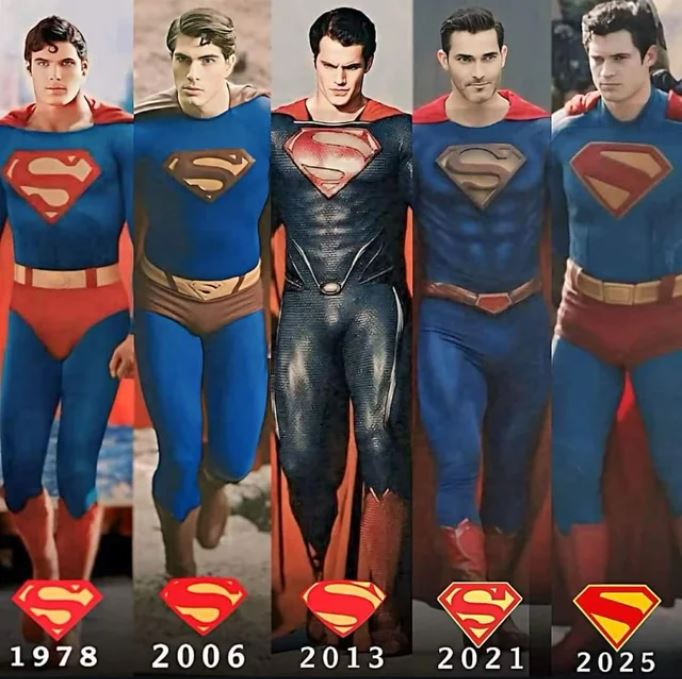
I haven't seen the new Superman film yet, but I will later tonight. I have avoided spoilers on the film itself, wanting to go in cold; will it be good? Could be, I have faith in director James Gunn to treat the character well. But maybe not, I mean, the recent history with DC comics properties on film has been a mixed bag, to put it charitably.
But I am amused by the prerelease backlash the movie has gotten from right-wing blowhards. Republicans, evidently, hate Superman. Not the movie—though they claim to hate that without even seeing it—the character.
Most of the nonsense I've seen relates to the fact that Gunn apparently (again, I have yet to see the movie) celebrates the fact that Superman is an immigrant to America. Immigrants Good! is sure to make 21st Century Republicans blow their tops. Right-wing actor Dean Cain, who once played Superman himself in the 1990s ABC TV series "Lois and Clark: The New Adventures of Superman," reacted to a comment from Gunn about Superman being an immigrant and the character and film embodying "basic human kindness" by spouting off with incredulity, "How woke is Hollywood going to make this character?"
Putting aside the fact that "woke" is a term originally referring to awareness of one's surroundings and a measure of empathy for others and therefore those railing against it by definition mark themselves as preferring unconsciousness and disdain for others, it's remarkable that even someone like Dean Cain goes immediately to outrage over someone championing kindness.
Right-wing podcasters jumped on the immigrant angle to claim that Gunn's use of this very basic element to the character's origins and almost-90-year history would deter people from seeing the movie. “[Gunn]'s not going to get any more viewers saying this, and he might chase some people away," said podcaster Christian Toto while stoking his anti-immigrant fires. Podcaster Ben Shapiro is offended that, in his view, Gunn has tried to "separate Superman off from America" while podcaster Tim Pool went the other way and said Superman would be "denied birthright citizenship" as an illegal alien.
Fox TV personality Jesse Waters said that, because the phrase "truth, justice, and the American way"—something used only in radio and 1950s TV incarnations of Superman during and after World War II until said satirically in the 1978 Superman film, wherein Lois Lane responds to it by telling Superman "you're going to end up fighting every elected official in this country"—is not used in this movie that therefore Gunn's Superman "fights for truth, justice, and your preferred pronouns," as if everything has to come back to picking on trans folks. Not satisfied with that, Waters went on to say "You know what it says on his cape? 'MS-13.'"
Yes, Jesse Waters equates not overtly espousing support for "The American Way" to being a member of a violent criminal gang of bogeymen.
On the same show as Waters, everyone's favorite advocate for "alternative facts," Kellyanne Conway, complained of the film that, "We don't go to the movie theater to be lectured to and to have somebody throw their ideology on to us." No, people go to Fox News for that, obviously. Kellyanne is jealous that someone might be working her corner on the throwing ideology front.
All of this I find entertaining, because it illustrates how threatened the modern Republican party is by anything in popular culture that doesn't reflect their brand of cruelty, preferably wrapped in jingoism. Oh no, people like this thing that shows value in empathy and tolerance and decency! We must demonize it immediately so those same people come to think it's all some sort of psy-op. But not like our propaganda ops, never reveal those.
As for the folks who made the movie, they've responded to the backlash properly. "Somebody needs a hug," said actor Nathon Fillion, who appears in the film. When asked what he thought of the right-wing critics, Gunn himself was succinct: "Screw ’em."
Our pal Craig Calcaterra mentioned this in his newsletter too, and he pointed out how much these modern Republicans would relate to the villains in Superman movies. Noting the Christopher Reeve Superman movies, Craig says, "The first one featured a scheme to nuke California as part of a real estate play; the second one centered on the desecration of the White House and the destruction of the American way of life by an evil whack job who constantly demands fealty from others; and the third one featured a bad guy billionaire fixated on financial domination via technology and the final boss of the movie was some insane, sentient A.I. computer monster thing. The shit's relatable."
Superman, of course, foiled all of those villainous schemes. "No wonder Republicans hate him."
Tagged
Politics,
Republicans,
Superman,
Culture,
Posted on July 12, 2025 at 8:12PM | Permalink | |
Jill Sobule

Earlier this month, folk singer Jill Sobule unexpectedly died in a house fire. I saw a post breaking the news on BlueSky and was immediately bummed; Jill's songs were often delightfully satirical and ranged from rockin' to mellow to almost countryish.
I've talked about how I don't generally enjoy live bands because of the insistence of deafening volume from the amps, but I'd have liked to see Jill at a live show. I think she'd have been a lot of fun.
Best known for "I Kissed a Girl" (not the Katy Perry tune), my favorite of her tracks include "Happy Town" (about taking anti-depressants), "Rapture" (about religious interpretations of afterlife), "Youthful Indiscretions" (about George W. Bush getting favorable treatment for his hijinks while others get the book thrown at them), "Manhattan in January" (about climate change), and, of course, "Put Him in the Hall of Fame" (about George W. Bush's career decisions and their consequences).
I'm going to miss getting those emails from Jill (or her publicist?) touting a new song and hearing how she processes the chaos of the day into music.
The world is a darker place without Jill Sobule. Safe journey to this creative soul.
Tagged
Music,
Culture,
Posted on May 27, 2025 at 3:42PM | Permalink | |
Plastic Pollution Pandemic
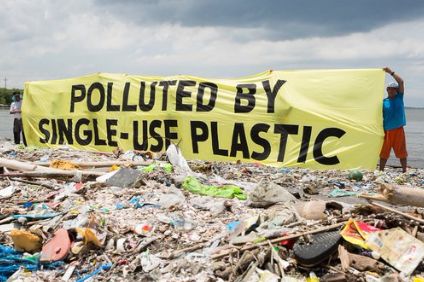
One of my clients is a beachcomber. He writes about the myriad flotsam that makes its way from the oceans to our beaches, where that flotsam comes from, how it flows around the world. (Buy his book, if you like, or subscribe to his newsletter.) It's interesting generally, but since I took over the layout duties on his quarterly newsletter a few months ago (and thus reading all the articles more closely) I've been paying more attention to how our trash, specifically plastic trash, is not only dumped into our waterways but is essentially not disposable at all.
We've all been taught that we can recycle plastic, but it turns out that's not really true. A minority of the plastics we buy can be recycled (sort of), but the rest can't really be recycled at all under current technological limitations. When it is recycled, plastics can only go through the process between one and ten times depending on specifics, degrading each time and requiring more "fresh" material to mix in; in our current reality, it's usually not recycling at all but downcycling, a one-time-only re-use that turns, say, soda bottles into something like fleece or shoe parts.
The downcycling is useful, sure, and it'd be great if we could turn all of our plastic packaging and such into sweaters and sandals. But that has no effect at all on the production of new plastic, so no matter how many bottles become sneakers we're still piling up more and more and more plastic waste. And for now, anyway, even a downcycle is impossible for most things given the limitations of sorting facilities, mixed or contaminated plastic products, and poor-to-nonexistent market for crappy degraded materials.
And then there's the melting-down of plastics if they are recycled; great, they get repurposed, but we're burning fuels and creating different kinds of pollution to do it.
So, no matter how diligent we are about our recycling bin maintenance, most of our plastic trash ends up (a) in a landfill, (b) in the ocean, or (c) incinerated for fuel and adding to toxic air pollution. (Maybe all three, given enough time.)
Naturally, this has led me to want to consume less plastic. Which in modern American society is a lot harder than you might think. Really the only practical thing one can do is cut down on single-use plastics, i.e. stuff intended for short-term use that you can't repurpose yourself—basically packaging of various types. And straws, I guess. But so damn many things sold in your average supermarket come with plastic packaging. I avoid produce bags, I buy my Coca-Cola in cans instead of bottles, milk in paper cartons instead of plastic jugs. But single-use plastic is everywhere. Shrinkwrap. Packing foam. Bags for everything from tortilla chips to bread to hardware. Jars and bottles that once were glass are now plastic for condiments and salad dressings. You can't practically avoid it. So we buy it, we throw it away, it gets into the water, the ground, the air, our food, us. It never biodegrades.
Thus, like so many environmental concerns, the onus needs to be on manufacturers and governments to address this. Regulations, incentives, taxes, things that can prompt companies to reduce/eliminate plastic packaging and/or to use only types that can be handled by the limited recycling options available, as well as R & D for true recycling methods for plastics. "We are beyond the crisis point on plastic waste," says Senator Tom Udall (D, NM). Udall is quoted in this excellent piece from the latest Rolling Stone that gets pretty deeply into the history and scope of the problem; developments like bio-plastics and plant-based packaging are welcome advances, but meantime we're drowning in saran-wrap and take-out trays. We need more Udalls to lead. “We’re trying to turn the industry around,” he says, “to do this in a more environmentally sustainable way.”
I recommend reading the Rolling Stone article. And, somehow, buying less plastic.
Tagged
Culture,
Life on Earth,
Posted on March 4, 2020 at 9:40PM | Permalink | |
Motives, Madness, and Male Behavior
 Al Franken
The current cultural focus on sexual harassment and assaults is largely a good thing. Fostering an environment where (a) victims feel that reporting the crime is a viable option with an expectation of being taken seriously, and (b) exposing the prevalence with which that sort of behavior still goes on in modern America (and elsewhere, but we get into other elements with other cultures) can and should go a long way toward changing our cultural acceptances and minimizing, if not eliminating, such behavior in the future.
It's fascinating to see this all going down now; I've written two posts on the subject already, about Cosby and Spacey, and lo and behold here's a third. One of the reasons it's a fascinating topic is its inherent mystery—I really don't get it. I mean, I understand the theory and intellectual analysis of men abusing their power over people they see as lesser; it's an ego and psychology and/or pathology issue, OK. But I don't get it, intuitively. It defies easy understanding. In some cases, the public response also defies easy understanding.
Now, I'm a straight dude who hasn't ever been on the receiving end of this sort of thing, unlike basically every woman I know, so my perspective is limited. There are things I will not know from firsthand experience and things I can only grasp as intellectual concepts. So, with that established, I have a question about Al Franken's case.
I've seen a lot of reaction to Franken's situation on television and social media, heard plenty of people discuss it on podcasts and news shows. People I know and people I don't have declared with vehemence that Franken should resign his Senate seat. Others have said with equal vehemence that he absolutely should not. Some uncertainty exists as to the veracity of the accusations against him—his security escort from the USO tour maintains there was never a moment that Franken and his accuser were alone, for example—but enough of it is accurate enough for Franken to own up to, if not the exact behavior alleged, inappropriate and offensive actions that shouldn't have a place in civilized society. (And really, Franken himself has reacted quite well, showing an awareness and repentance that none of the other men accused of such during this time have shown.)
My question to those that demand his resignation, though, is this: Why?
That's not a snarky question, it's intended to be taken at face value. Why do you want him to resign? What purpose will it serve for you? What is the hoped for consequence of a resignation? I'm not advocating one position or the other here, I just want to know the reasoning.
Is it to teach him a lesson, show him that behavior like that is unacceptable and not to be repeated? Unnecessary, Franken is already there and, unlike the other high-profile culprits, has not evidenced a predatory pathology; in fact, plenty of women who have worked with him have made a point of declaring the opposite, that Franken has only been a respectful professional in this regard. He's pre-reformed.
Is it to enforce a kind of no-tolerance policy that demands ostracization of anyone to ever have such an accusation levied on them? If so, be prepared to prosecute scores of other officials and public figures, not to mention everyday men who once pledged a fraternity or made lewd jokes at a bachelor party. (I would not defend such jokes, fraternity practices, pledging fraternities, or even the traditional bachelor party, I'm just pointing out the ubiquity of these attitudes in our culture to date.)
Is it in support of the accuser? She doesn't want his resignation, she in fact seems kind of blasé about any fallout for him.
If none of these things, then what? What big-picture result of a repentant, diligent ally of women's rights and positive public policy leaving his position and abdicating his ability to help influence this and other important issues am I not seeing?
Maybe a zero-tolerance take is valid. I tend to think not, as there are degrees to this and, as Franken has shown, people can grow and learn on the issue and become champions for the cause, and men who have been guilty of one or two relatively minor offenses in years past should not be looked at in the same way as those with pathological issues (Anthony Weiner, Cosby, Spacey, C.K.) and/or who fail to acknowledge the humanity of their victims (Roy Moore, Donald Trump, Harvey Weinstein).
The cultural problem is finally being addressed, and hopefully it will continue to be until such time as we look back on it as distastefully as we do "separate-but-equal" and treating abrasions with mercury. The pathological problems will need an additional vector to combat; a cultural shame/fear factor will no doubt help greatly, but some people will always be predators. It seems important to make a distinction.
Tagged
Politics,
Culture,
Posted on November 21, 2017 at 9:05PM | Permalink | |