
Tag: Star Trek
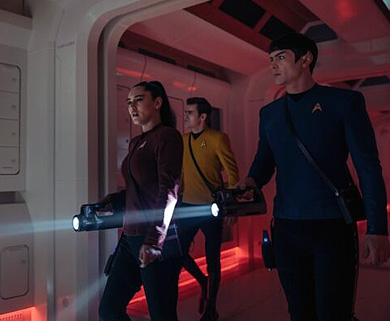
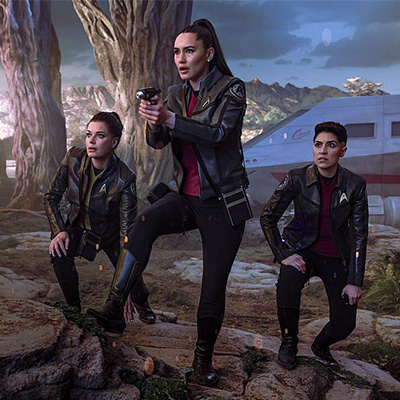
SNW 403: Human Best Friend
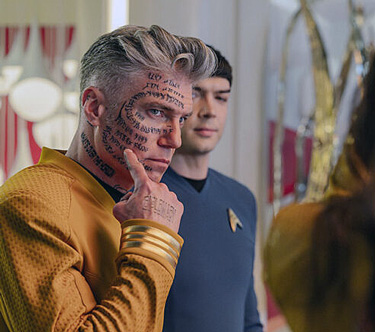
Does anyone know what I had tattooed on my face?
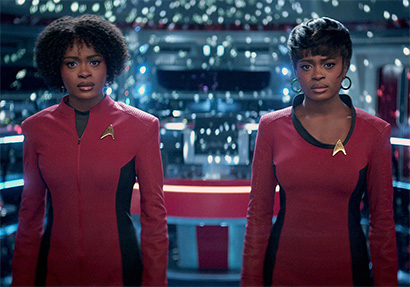
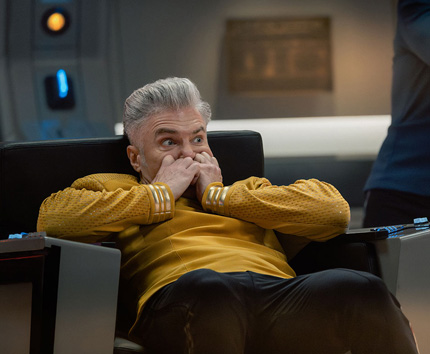
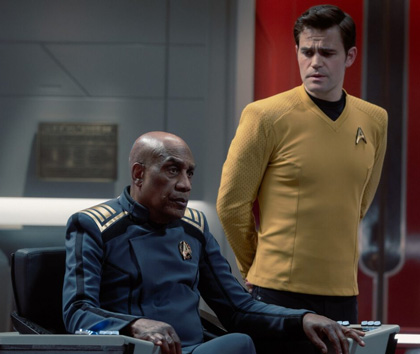
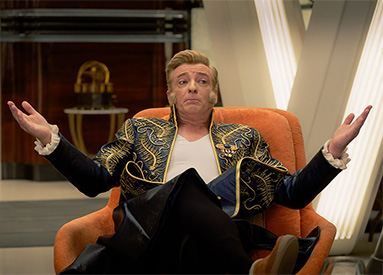
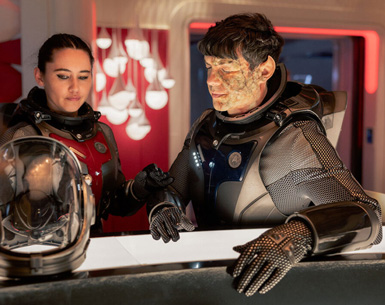
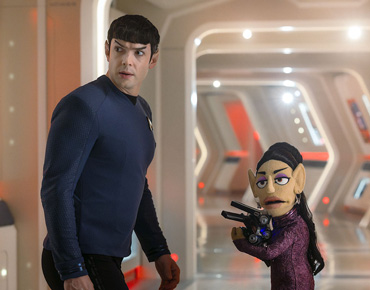
This week's episode of Strange New Worlds actually isn't terrible. Part of me does hate it, but it's the part that has been disappointed by the writing in so many streaming era and 21st century film installments of the Star Trek franchise; here we again have an episode that has little to no depth to it, another junk food meal of empty calories. On the other hand, I did find it entertaining despite my qualms. It's very much like last season's "Wedding Bell Blues" in that regard, though not as steeped in the series mythology and a whole lot more derivative.
Had I known in advance what they were going for with this one—it's a stoner comedy that borrows heavily from lowbrow films The Hangover and Harold & Kumar Go Wherever They Went; it could be titled "Dude, Where's My Shuttlecraft?"—expectations would have been lower than low given what came last season, in which case this post would be about how I was pleasantly surprised by the not-terribleness of it. But even though I kind of liked it, it does nothing to assuage my fears that the rest of the series is going to be frustrating. Especially knowing that both this season and the abbreviated next season was all either in production or the can before any of the flawed and troubling season three had aired (dropped? What is the proper terminology for the release of streaming internet TV?). I suspect that no one in this writers' room ever came to any realizations that last year had real problems before it was too late and all was completed. Thematic depth? Nah. Ethical quandaries? Meh, we might touch on them vaguely. Dumb humor? Oh, yeah, that's our jam, and if we can cheapen what comes later in the timeline, so much the better.
There is plenty of dumb humor and cheapening what comes later in this one, to be sure, but in large part—not entirely—I am choosing to overlook it because there's some fun to be had.
Let's get into it.
See full post: "SNW 403: Human Best Friend"...
SNW 402: The Griffin Incident
The latest episode of Strange New Worlds is another "genre of the week" installment, this time the genre is "horror flick." It's not the first time Star Trek has gone this route, exactly, but it is more overtly in-your-face in terms of horror tropes and scenes of mutilation. Generally, I am most definitely not a fan of such things, and while I don't exactly hate it here, it's not good, either.
Which isn't to say the episode itself isn't good taken as a whole. It's...well, it's hit-and-miss, like most SNW efforts. There are some semi-interesting character bits, and some things that may or may not move a season arc along, but once again we have a script that wouldn't have been deemed ready for production under Gene Coon or Ira Behr.
Let’s get into it (spoilers and very nerdy nitpicks ahead):
See full post: "SNW 402: The Griffin Incident"...
SNW 401: Valles Marineris
Can you stun a T. Rex? Let's find out.
Star Trek: Strange New Worlds returned last week for its fourth season premiere, and, wouldn't you know, I have thoughts.
After the painfully flawed mess of the third season, I was prepared to be disappointed. However, I was also hopeful that, without the rush-job environment that produced the season three scripts, we'd get back to at least the level of quality we saw in SNW's first two seasons. The premiere landed smack in the middle of those poles—there's stuff that doesn't make sense, there's some lazy shortcut writing, there's avoidable science mistakes; but there are also really funny moments, a clever premise, and good character stuff that almost makes me give them a pass on the bad character stuff.
Let's get into it (spoilers ahead):
See full post: "SNW 401: Valles Marineris"...
What not to do
I'm heading out to ump three games tonight at Cap Hill in a bit, but last night I was on the other side of things as a player in a softball game. My team, the Smiling Potatoes of Death, took on the oh-so-cleverly named Sea-Men, the team in our league (Seattle P&R softball, Ballard division) that nobody likes. To be fair, their rep is from years past and it seems like they've had some turnover and are perhaps not so annoying anymore, but still. Anyway, we held our own and had, in Deep Space Niner terms, a manufactured triumph by playing an entire seven-inning game without being mercy-ruled into an early finish.
So not bad. Fun. Ish.
The game was marred not by the team with the not-as-clever-as-they-think-it-is name, but by the umpire. As a fellow umpire, I had trouble keeping my opinions to myself on the subject but did refrain from making any comments directly to the ump working our game. I did not say to him, for example, "home plate is 17 inches wide, you can't only count ten inches of it," or "you are interpreting that rule wrong," or "that call may or may not have been technically within the bounds of the rulebook, but it violates the spirit of the rules and is just petty." The missed calls on the bases I wouldn't have complained about anyway, those will happen with anyone on occasion, and even if they're the norm with this guy that's a can of worms you don't want to open.
When I'm umping in the league I work in, there will sometimes be occasion to ask players why they're not coming back the next season or why they returned after an absence or something like that. It's pretty expensive, I get why teams might look for alternatives. But aside from the considerably lesser fees, no one yet has voiced a positive opinion on the Seattle Parks & Rec league when comparing. The rules are different and inferior, for one thing; SPR doesn't have a say in some of them because they contract with USA softball for umpires and they have certain mandates, but not one of the special rules is favored. But the main reason I hear from players returning to my work league is the officials. We're independent, not subject to anyone else's rule mandates, and even the worst of us is a better umpire than the best one you'll see at an SP&R game.
So, last night being an especially egregious example of how a bad umpire can taint everyone's enjoyment of a game and threaten to ruin a good time is something of an object lesson for me. Nothing I didn't already know, but an effective reminder that it pays to know what you're doing, it pays to acknowledge and own up to mistakes, and it pays to be clear and communicative. (Also, it reminds me once more that my employer league's best asset is its field staff and they really ought to step up when it comes to how they treat us; or, more accurately, take better care not to be insulting/reductive when dealing with us. But that's another topic.)
Oh, I went 1-for-3 (lineout, infield single, fielder's choice) and pitched six frames, giving up 17 runs; I'm guessing six earned, but I've yet to compile the numbers. Walked two, both umpire-aided and one was awarded on ball three because see above. Struck out one.
My three games tonight are a welcome return to a fuller shift after having a few one-gamers the last couple of weeks. Those hardly seem worth the trouble of going out there, especially in the age of $6 gasoline. Next week I've got two on Sunday, three Monday, two Thursday, and two Friday. That's a pretty decent week.
No Comments yet
New sketch, the WBC, SFA, and cabinet chaos
Masataka Yoshida homers against Korea, demonstrating that the Red Sox have criminally underused him the last two years
A few disparate things today...
- ITEM: I've Just Seen a Face! The sketch I was working on the other day is now finished and can be seen in the sketchbook.
- ITEM: Dig It! Kristi Noem got taken to the metaphorical gravel pit! May she be but the first of many to fall. Meanwhile, the nominee to replace her is quite possibly the dumbest person in either house of Congress.
- ITEM: I'm Only Sleeping! This week saw the start of the 2026 World Baseball Classic, which opened with games held in Puerto Rico, Miami, Houston, and Tokyo. Naturally, the ones I'm most interested in are being played in Tokyo and they start at 2:00am PST. So I've been even more nocturnal than usual, staying up to watch Team Japan live rather than wait and watch a recording of the game during normal waking hours like a sane person would do. And they've been really fun games, too! In the opener, Japan clobbered Taiwan in a fashion that was reminiscent of some softball games I've both played in and umpired in recent years: the 13-0 drubbing ended early by WBC mercy rule, and one 6th-inning single is all that kept Taiwan from being no-hit by the loaded Japanese squad. Last night/this morning was more of a fair fight, with the Koreans nearly matching Japan play-for-play until the home 7th, when Korea brought in Young Kyu Kim (one of their many Kims) to pitch with one on and two out and poor Kim couldn't find the strike zone. Which, to be fair, was rather variable. The home plate ump in that game—Todd Tichenor, who is generally well regarded as an MLB ump—was truly bad, not remotely consistent with high strikes, low strikes, edge strikes, pretty much nothing was certain unless it was down the middle. Even so, Kim was wild and walked Kensuke Kondoh and Seya Suzuki after intentionally walking Shohei Ohtani, forcing in the go-ahead run, then Masataka Yoshida delivered a 2-RBI hit to put Japan up by three. That was enough for closer Taisei Ota to seal the deal in the 9th with help from Ukyo Shuto, just into the game in center field after pinch-running in the home 8th, who made a leaping catch against the wall for the second out.
- ITEM: She Came in Through the Bathroom Window! Once again, the eligibility rules in the WBC are a little too lax for my taste, though I get the rationale. Players can be on a nation-team's roster not only if they're citizens or permanent residents of the country, but if one or both of their parents are/were citizens or were born in the country or if they would be granted citizenship if desired under the country's laws. That last one is mostly for Team Israel, basically if you're Jewish you can play for the land of King David. So we have, for example, three Americans playing for Korea (named Dunning, O'Brien, and Whitcomb) who have never lived in Korea but have Korean-born moms; a Great Britain team with only two British players; a Team Italy with only three Italians; 13 Americans playing for Mexico; and an entirely American Israeli team. The Latin American teams have no trouble filling out their squads (you'd think Mexico would be fine under stricter rules too), of course Japan is a baseball powerhouse, the Netherlands is well-stocked because of that kingdom's Caribbean territories, Canada has plenty of Canadians, Taiwan is stocked with their own pros, and, kind of a surprise, Team Australia is almost entirely Australian, save for a couple of guys born in South Africa to Australians. So it's improving, but between Team USA, Team Puerto Rico, Team Israel, Team Italy, and Team Great Britain, the tournament has basically five American squads out of 20. I'd say it feels like stacking the deck, but only USA and Puerto Rico have a prayer of moving on.
- ITEM: It's All Too Much! On a less pleasant topic, Kristi Noem may be out of a job, but ICE hasn't changed its ways. The new American Gestapo have a betting pool going at their El Paso area detention camp, but instead of picking winners of football games they're betting on which of the incarcerated will kill themselves. In addition to being unconscionable and cruel and spot-on emblematic of our current presidential regime, this is encouragement for these thugs to treat their prisoners—you can call them "detainees" if you want, but they're prisoners—even worse than they otherwise would. It's a low bar to begin with, but this is insane. More insane, I mean.
- ITEM: Everybody's Got Something to Hide Except for Me and My Monkey! Alleged attorney general Pam Bondi has been subpoenaed to testify in Congress and there have been articles of impeachment filed against her over her coverup of the Epstein files. About fucking time. Bounce her ass out, then bring her up on charges. (I know it isn't likely to get anywhere real, but we've got to try anyway, repeatedly, and with many other Cabinet officials, preparatory to when we have a majority and can impeach Felon47 and his bearded bootlicker.)
- ITEM: Don't Let Me Down! Starfleet Academy has been surprisingly good, and dropped it's ninth episode this week. The season finale streams Wednesday night, and I'm looking forward to it—when the series started, I had no idea what to expect; could be good, could suck. But it's been largely excellent considering its target audience as a YA show. It's improved on the other streaming-era Star Trek series by having an apparent quality control process with scripts. The writing is better structured and when there are holes in the stories they're forgivable. Like in this week's penultimate episode, the villain's dastardly plan is revealed to be, essentially, a blockade of the reborn Federation of Planets; how this was accomplished stretches my suspension of disbelief, that's an enormous area of space to cover even with this post-Burn mini-Federation. But the twist worked, the story that plot point is in service of is valuable, the situation it sets up for next week's finale is compelling, so I forgive the implausibility. It helped that this week's ep was a Jonathan Frakes episode, Frakes in the director's chair always elevates the material. But, the real make-or-break for this new show will be episode ten. Will it continue to be solidly written and character-focused and maintain its themes, or will it take a page from Discovery or the first two seasons of Picard and completely drop the ball at the end of the season, wrapping things up in a sort of, "shit, we're out of time, I guess just shrug off what we did earlier and invent some deus ex machina that we can forget later?" I'd be more optimistic if Alex Kurtzman wasn't a credited writer on episode ten. At least he's just the co-scripter of the teleplay. (Am I too hard on Kurtzman? Is my bias against anyone involved with writing the JJ movies too strong? I guess we'll see next week.)
- ITEM: Get Back! Or, more accurately, go forward—we begin our annual 8-month-long social engineering trickery tonight, turning the clocks ahead an hour for no good reason. The tyranny of morning people continues, and we night owls are shoved to the ground in our grogginess and given the finger. Tonight's WBC game in Tokyo will now start at 3:00am, which is so much worse than 2:00am, because the Japanese are smarter than we are and don't do stupid Daylight Saving Time.
That's all I have for now. Umping this week was good, no highlights/lowlights to speak of. Back out there Monday evening.
1 Comment
SFA honors The Sisko
SAM taking in the exhibits of the Sisko Museum
The newest Star Trek show, Starfleet Academy, dropped its fifth episode this week. Titled "Series Acclimation Mil," which is the full name of the holographic alien character known as SAM, it does everything right that much of Strange New Worlds season three did wrong. It's offbeat but true to theme, character-driven in ways that are wholly satisfying, and honors what came before—specifically, major aspects of the third Trek series, Deep Space Nine—with reverent fealty.
SAM is a character that we knew nothing about other than that she's a delightful mystery. This episode, as she tells us directly in the first minute, is all about her. We learn about her background, but we also learn a lot about who she is—and so does she, which is precisely the sort of writing a show like this, with a YA focus, absolutely needs.
We learn that SAM is an emissary from the planet Kasq, created to learn about the species and cultures of the Federation and determine if they, as organic beings, are basically trustworthy or are they likely to behave as the organic beings that created the Kasqians long ago did and attempt to oppress artificially-created beings like the people of Kasq into servitude. SAM refers to the Kasqians as her "makers," and the makers are really impatient. They've given SAM a task and want results; they're not interested in SAM's experiences on a personal level or what she thinks about music, just find out if it's safe to leave isolation and present copious evidence why or why not.
So when SAM learns that there was an historic figure named Benjamin Sisko that was not only a great Starfleet wartime captain but also a mythological figure in the planet Bajor's culture as the emissary of the alien beings known as the Bajoran prophets, she immediately feels a kinship and wants to learn more. When it seems that Sisko's reluctant acceptance of being the emissary and his ultimate disappearance—believed by the Bajorans, at least, to be a transition from living as a human being to living among the prophets themselves—meant that he was not able to live the life he wanted to live, she really identifies.
It's brilliant. It uses both in-universe history and a writers' room expertise and respect for DS9 to tell a story all about this new character of SAM, one that parallels a lot of people's experience as a youngster gone off to college to fulfill a parent's desire for them—become a doctor, a lawyer, a business mogul—only to discover for themselves that they want to be something else, or at least to find their own way to a path. As with the best of DS9, we also get mysteries of spiritualism versus provable facts, ponderings of what traits are really the important ones in a personality, and questions of free will and destiny and whether they can co-exist.
There's other goofy stuff in this one too, small bits furthering the stories of other characters and a B-story developing Holly Hunter's Chancellor Ake and her War College counterpart Commander Kelrec's odd relationship and giving Bob Picardo and Tig Notaro scenes to show off their comic chops (my favorite line in the episode might well be when Tig's Commander Reno just says "No" through a mini-bullhorn to Picardo's Doctor). But really this is SAM's journey, and I'm loving it.
There's still a lot of ambivalence about Starfleet Academy as a project; it is a YA-oriented show and as such isn't as interesting to some in the demographic that has long enjoyed this now-60-year-old franchise. But this episode, written with reverence by Tawny Newsome and Kirsten Beyer, two women who both know their Trek backwards and forwards and know how to handle story structure and character development, shows how appealing to a YA audience doesn't have to mean dumbing down your material.
No Comments yetAcademy points
The latest Star Trek series premiered this week, and as will surprise no one, I have opinions.
What might surprise some is that generally my opinions are positive.
From the moment it was announced, this new show—Starfleet Academy—was met with cynicism, or at least trepidation. Some of that comes from previous projects centered around the titular institution that never got very far along in a production process before dying at the studio. Some just comes from the idea that by its nature, a series set at Starfleet Academy will largely revolve around youngsters, and the derisive nicknames began flying around social media: Star Trek: 90210, Dawson's Starship, Ten Things I Hate About Starfleet, Hogwarts in Space, you get the idea.
For myself, I wasn't concerned about the potentially YA-focused nature of an Academy show; Star Trek's universe is vast and can support all sorts of shows. Besides, some of my most favorite TV series have been YA-centric, from My So-Called Life to Buffy the Vampire Slayer to Freaks & Geeks. It's all about how its written.
Which is where my concern lay, because at its core Starfleet Academy is a spinoff from Star Trek: Discovery, a series that was... let's say problematic. I liked Discovery generally, but it suffered from writing issues throughout that annoyed me no end. As this new show was building off that one, and it was coming on the heels of the disappointing third season of Strange New Worlds, my expectations were low. But so far I'm pleasantly surprised. It's well done. At least, I think so; your mileage may vary.
Somewhat counter-intuitively, by placing the show in the far-future of Discovery's later seasons (the mid 3100s), thematically SFA can be about more contemporary 21st-Century issues—as established in Discovery, around the turn of the millennium an event colloquially known as The Burn happened, which effectively prevented interstellar travel for over a century and thus fractured the United Federation of Planets and plunged the various galactic civilizations into a kind of technologically varied dark age of isolationism and conflict. By the end of Discovery, the issues of The Burn had been solved and galactic society was beginning to interconnect again. So this new show exists in an era where the next generation has to clean up the messes of prior generations and where a regression in human (and alien) behavior has become something of an embarrassment in need of repair. So, climate change metaphors, political overtones recalling some of Felon47’s policies, things like that can be done in a way that would be impossible in other, more utopian Trek eras.
The characters, both the young cadets and the more mature adults, are all interesting in their own ways. The "legacy" characters imported from previous shows—Bob Picardo's holographic Doctor from Voyager and Jett Reno and Charlie Vance from Discovery—are delightful, series star Holly Hunter is as brilliant as one would expect Holly Hunter to be as Captain Ake, and the villain played by Paul Giamatti is fun in a completely over-the-top melodramatic sort of way. As for the young'uns, the main cadet, Caleb Mir, is played by Sandro Rosta, who thankfully has the acting chops to make him likeable and indentifiable while also being a young punk with a chip on his shoulder. With the rest there are some TV tropes used, but so far not to the point of being detrimental.
Mir and fellow cadet Darem Reymi suffer from too much machismo, both exuding the sort of manly-man competitive alpha-dog energy that I would hope would be extinct by the 23rd century, let alone the 32nd. They are clearly being set up to be the bully and headstrong tough guy types that initially hate each other but become buds, and the pilot episode (cleverly) contrived a scenario where they and their fellow core cadets have to work together in a crisis and learn to respect each other's skillsets. Then we have Cadet Genesis Lythe, the requisite nepo baby; daughter of a Starfleet admiral, she's lived her whole life in space and likes to verbally prank people. She's the one with natural leadership ability that takes charge. Our "outsider" character, a must in Star Trek casts, is Cadet SAM (short for Series Acclimation Mil, whatever that means), a "photonic" (read: hologram) that while programmed to feel 17 has only existed for four months. SAM is a delight, but I have many questions about her character that have yet to be addressed, not the least of which is, how does she exist and what sort of culture created her and why? We also have med student and oddly gentle Klingon Jay-den Klaag, who likes to birdwatch and has no desire to seek glory in battle. We've not seen much of him yet, but I like the concept.
The character I don't like much at this stage is Lura Thok, the "cadet master" and first officer of the Athena, which is both starship and, when docked on the Academy grounds, main campus facility. Thok is a Klingon/Jem'Hadar hybrid (something that also demands explanation at some point since the Jem'Hadar of the 24th century are all grown artificially), and thus has an overtly militaristic attitude and a hostile affectation. She behaves much like a drill sergeant, which I would also hope would be out of favor in the future but I might be able to headcanon as appropriate in a post-Burn society.
Most of these are supporting characters to the leads of Captain Ake and Cadet Mir, who have a relationship based in Ake's guilt for being part of a legal proceeding that separated Mir from his mother during the Burn times, an event that started Mir on a path of petty crimes in a lifelong quest to find his mom (played in a flashback sequence by the exquisite Tatiana Maslany, whom I hope we'll see more of). Ake is recruited to head up this new Starfleet Academy in part by Admiral Vance pulling strings to locate Mir and put Ake in position to free Mir from an alien prison, though the whereabouts of Mama Mir are still a mystery. The dynamic between the two is complex and it works very well, with Ake supporting and nurturing Mir while Mir works to balance his own agenda with being a cadet and learning to respect and forgive Ake for their past history.
So I like it. It's a strong pilot episode with a lot to work off of.
The one real problem I have, and I'm not sure how to mitigate it, is the use of contemporary language and slang in the scripts. One of the great jokes in Star Trek IV: The Voyage Home revolved around Kirk and Spock trying to fit in with 1980s Americans by using profanity and doing it poorly because it wasn't part of their contemporary culture. Yet here in 3100-whatever, people are using 2020s slang terms all the time. It's jarring and takes the viewer out of the scene. And yet, I understand using it; it's unreasonable to think young 20-somethings would not use slang, and the alternative is to go the Battlestar Galactica route and invent made-up slang and swears, but that would also be jarring. Still, I don't think anyone of any age would be saying things like, "I'm [fill in the blank], bitch" in a thousand years' time.
Episode two brings more characters into the mix amidst a story centered on Vance and company's attempt to being Betazed back into the Federation; two children of the Betazoid president end up enrolling at the Academy (well, one does, the other enrolls in the Starfleet "war college," a remnant from the Burn years that we've yet to learn much about). It's a classic Trek episode with diplomacy and politics and smart dialogue with none of the failings of Discovery anywhere to be seen. A strong and promising start to a series I didn't think I would care for.
What'd you all think, fellow nerds?
Nerdy observations
- In addition to the prominent "James T. Kirk pavilion" and "Sato Atrium," the Academy grounds has a "Boothby Gardens" and the Athena has a wall of heroes with prominent names from Star Trek history. Amusing to me was "Admiral Harry S.L. Kim," referencing the ensign from Voyager who appeared destined to never be promoted, a thing that was expertly parodied on Star Trek: Lower Decks; it would be hilarious if sometime later on we learn that that refers to someone else with the same name. Irritatingly, it also lists "Lt Julian Bashir," which, great, shoutout to Julian, but the dude never got a promotion? Come on. :) Oh, there's also "Cmdr Hugh Culber," which is nice but I presume all the names on the wall are memorials for deceased folk? Is Hugh dead (again)? He's still fine last we saw him in Discovery.
- Stephen Colbert voices the "digital dean of students," which means we hear his voice announcing various things in the halls. Sometimes funnyish, but is "hanger" also a term that will still be used in the 32nd century?
- Ake and her bridge officers are quick to consider and eventually implement lethal measures against the pirate crew that attacks the Athena in the pilot, and characters are seen to celebrate them (one joyfully declaring the casual obliteration of the pirates' ship "a teachable moment"). I'm hopeful that this sort of thing will be an ongoing sort of subplot of the show, a look at behavior that during the Burn era became acceptable and second-nature but will be recognized as something counter to what Starfleet and the UFP are supposed to be; this seems like a good area to utilize Tig Notaro's Jett Reno, someone who spent the majority of her life in the 23rd century, as a voice of conscience. I'm not confident in that, though, given that this is still an Alex Kurtzman-led show and he remains tainted in my head as a big part of the J.J. Abrams movies.
- A cover of the song "San Francisco (Be Sure to Wear Flowers in Your Hair)" by Rufus Wainwright is played during the sequence where the Athena docks at the Academy grounds. It's just score, it isn't something heard by the characters, but it's still an anachronism that I could have done without.
- At the end of episode two, Betazed agrees to return to the Federation when they are offered to host the new UFP capitol/seat of government. Cool. But I am now wondering about any Vulcan/Ni'Var officials having to live on Betazed surrounded by telepaths who are comparatively hedonistic. I imagine it might cause people to think twice about running for a Federation Council seat. Human politician: "You would be great on the Council, T’Zal, you should run for a seat." Vulcan: "Perhaps, though I am reluctant to commit to lengthy residences on Betazed; it would tax my psionic discipline." Human: "Well, you've got the figure for formal events. Besides, it could be worse, the capitol could have gone to Delta IV." Vulcan: [silence for several seconds, then turns and walks away]
- Captain Ake continues the tradition of Starfleet captains that prefer paper books to reading on PADDs. She also wears reading glasses, an anachronism that might be explained away the James T. Kirk way (allergies) or the Kovich way (stylistic affectation). Unlikely that it would be the Pelia way (hoarding things from her Lanthanite youth) as she's too young at 422 to have been around when eyeglasses were a common thing.
- The look of the show is largely appealing, but there's a bit too much J.J. Abrams/Discovery creep with things being shiny. Also, the bridge of the Athena is impractically ginormous, and what's with the sort of heatlamp-like overhead lights?
- It's going to be a sort of drinking game with this show whenever they need to include a line explaining why the instantly-jumping spore-drive-propelled USS Discovery can't come to the rescue. We got the excuse that's it's undergoing a refit in episode one.
- Sadly, the tradition of pointed sideburns did not survive the Burn, it seems. The 'burns were burned?
- I've seen/heard a few Californians nitpick that for all the talk of Starfleet Academy being in San Francisco, when the Athena lands and docks on campus it's across the Golden Gate in Marin County (consistent with where The Next Generation placed the Academy). I can easily explain that away by saying the boundaries of the city of San Francisco have had plenty of time to expand and subsume other Bay Area territory, just as Seattle has annexed huge swaths of land since its inception! By 3100 Berkeley, Petaluma, Oakland, and Palo Alto are probably just neighborhoods in San Francisco. :)
Lazy writing: SNW season 3 fails to meet high standard
It will surprise no one that I have very high standards when it comes to Star Trek. The original series was, along with superhero comics, the biggest cultural touchstone of my youth; it informed my thinking, development, maturation, ethics, politics, and more. I was a nerd's nerd, if you will, while growing up and then reveled in the resurgence of Star Trek on television that began when I reached voting age.
It's important. It not only means something to me when it's done well, it also feels almost offensive to my soul when it's done badly.
The just-finished third season of Star Trek: Strange New Worlds, the prequel series that leads up to what we saw in the original 1966-69 series, had its moments, but by and large was done badly. Seasons one and two were consistently good, with a couple of caveats, but this one was just ... sloppy.
With one exception, no episode of SNW season three really stinks, and even that one has one or two brief moments of fun; there are no analogues to "Profit and Lace" from Deep Space Nine or "Code of Honor" from The Next Generation here. But the writing across the season is slapdash, like each script went into production as a first draft and at no time did anyone do any refinement on them or get a second set of eyes to see if things made sense or not, let alone run them by a science adviser.
There might be a reason for that—the season was delayed for a year thanks to the writers' and actors' strikes, and perhaps the studio rushed these episodes into production to get them out as soon as possible. But we already waited two years for it, I think everyone would agree that it would have been worth it to wait another few months if it meant the scripts were run through a better quality-control regimen. On the other hand, the people running this show—executives Alex Kurtzman, Henry Alonso Myers, and Akiva Goldsman—don't exactly have stellar track records when it comes to quality (I mean, they have Star Trek Into Darkness and Batman Forever on their résumés) and they may simply have thought these were all good to go. Despite being retreads of episodes from past Trek series and/or inconsistent within SNW, let alone all of Trekdom, and/or fundamentally misunderstanding why Star Trek (the shows) is Star Trek (the overall cultural phenomenon).
Star Trek is not space-fantasy, it's science-fiction. There are some less-realistic elements that we accept, concessions to television budgets and formats—transporters, a plethora of humanoid aliens, the universal translator, subspace radio—but we accept them within the overall worldbuilding established in the original and refined in the shows from the ’80s, ’90s, and ’00s. There are rules to be followed with the technology and anything outside of those few accepted conceits has to pass an at least rudimentary scientific smell test. Also, it's fundamentally about ideas and allegorical to the human society we're living in today; at its best, its stories have something to say, ideally through well-developed flawed but idealistic characters.

Gene L. Coon and Ira Steven Behr, the best of Trek's showrunners
The Genes—Roddenberry and Coon—famously either rewrote or rode herd on every script during their respective tenures as line producers on the original. Rick Berman may not have been all that good a writer, but he took it seriously when he was charged with safeguarding the franchise for Roddenberry after the latter's health became too poor for him to keep working on TNG. Ira Behr ran the best Trek writers' room as showrunner of DS9, insisting on a certain fidelity and depth of storytelling despite the demands of a 26-episode season. For the most part, these streaming series—with a new normal of first 13 and now merely 10 episodes per year—haven't had someone like that in charge, someone who knows what makes Star Trek work.
I don't know why it's apparently so hard for people who are by all accounts enthused to take on Star Trek as a property—J.J. Abrams (films), Kurtzman (all streaming series and the Abrams films), Gretchen Berg/Aaron Harberts (Discovery)—to comprehend what it is. Why it has had such staying power. Why it appeals to the people it appeals to. Abrams was and seems to remain completely clueless, he thinks it's a space-fantasy like Star Wars. The others seem to grasp only a surface-level understanding of it. Mike McMahon of Lower Decks and Terry Matalas of Picard season three get it. Michelle Paradise (Discovery season 3-5) fell somewhere in between getting it and just knowing the trappings, as did, I had thought, Goldsman and Myers. After seeing SNW season three, I have to reevaluate; Goldsman and Myers might be closer to the Abrams end of the scale.
In this admittedly lengthy and probably too-nerdy-for-most post, I want to break down the season episode by episode and look at what worked and what didn't. To prevent this one nerd-post from overwhelming the home page, I'll shunt the bulk of it to its own page, so follow the link below to read on.
See full post: "Lazy writing: SNW season 3 fails to meet high standard"...
Civil War II: The Wrath of Steve
White House Deputy Chief of Staff Stephen Miller
This isn't quite how I though this would go. I figured that our nation's second civil war (it's canon, Captain Pike said so) would start as a slow burn initially fought by essentially guerilla forces, terrorist attacks by the same kind of cultists that stormed the Capitol on Jan. 6, 2021, rubes that follow the tyrant-in-chief's mob-boss-like instruction; those attacks would then escalate to conflicts with authorities that escalate to conflicts between authorities that escalate to federal crackdowns.
Instead, the regime is skipping all those preliminary steps and just diving in with federal oppression. Why warm up?
The assault by ICE agents in Chicago, along with other factors of note—POTUS47's unexplained absence from view for several days at a time; the illegal murders of Venezuelans on the open sea; multiple claims by the tyrant that Portland, Oregon, is "burning to the ground" and "war-torn" when the real circumstance involves a small protest outside an ICE building by a guy in a chicken suit and a preacher (who was shot by an ICE agent with a non-lethal round after he told the agents they could still repent their sins); and myriad other actions taken under the auspices of DHS—lend considerable credence to the theory that Deputy Chief of Staff Stephen Miller is really in charge of the regime, at least so far as non-economic policy goes.
We all know that the alleged president is too stupid to orchestrate anything himself—not effectively, anyway; when he tries we get tariffs that cripple the whole economy. He is instead manipulated by his puppeteers to authorize what they want to do and then they do it without interference. Miller is the chief puppeteer, the architect of the most Nazi-esque policies of the regime, and he isn't subtle. He's a blunt instrument. His only warmup moves for his remake of DHS into a fascist secret police force were building/expanding DHS detention facilities and putting out the call that ICE would hire anyone who could pass a sort of inverse background check. Do you have a history of antisocial behavior? Violent outbursts? Have you ever been fired from a job for your racist attitudes? Are you well-versed in a variety of slurs and hate speech? Did you beat up smaller kids in elementary school? If so, you are the ideal candidate for a career in the new ICE Thug Force. With his secret police all staffed up, he can just exploit the boss' ignorance to get authorization for terror campaigns in cities across the country.
It's possible that Miller is so tunnel-visioned in his racism that he doesn't realize that commando raids on minority-majority neighborhoods will have blowback, but I think it more likely that it's part of the plan. He wants the blowback, he wants the escalation, he wants to rain hellfire on anyone that reminds him of people he hated as a child.
Once again, I note that a person like this would never be allowed near the halls of power if the majority in Congress respected their oaths of office. I mean, no one in this regime would be, it's entirely staffed by authoritarians and idiots. But Miller seems a special case. He has no redeemable quality. If there is a fictional metaphor for Miller, an actual Jewish Nazi, it's Armus, the "skin of evil" from Star Trek: The Next Generation. Armus was the sludge making up all of the hatred, animus, and cruelty of an alien race, expunged from them and abandoned on a barren unpopulated world.
The tyrant-in-chief is the most dangerous person in the world because he wields power, but he's stupid and, I would bet, demented and dying. Miller is nearly as dangerous because he pulls the strings and wants to cement his place in power before the alleged president kicks the bucket.
Ruled by a skin of evil.
No Comments yetTurning the page
The last couple of weeks haven't been great here in the confines of my chemistry-addled brain, but it's a new week now and the world keeps on turning.
Last night I had an umpiring shift, one of the final ones of the year as things wind down (I may get two or three more at most) and the final one that will involve some of my favorite players in the league. Bonus, I got to chat a little bit with Stephen, a guy that had been one of my favorite players to ump until he moved away last year, but who has now returned. Welcome back, dude! Hope to see you on the field next year. Also good to see Megan, Joel, Pat, Wyatt, Ray, and the rest of those folks yesterday for one final time until we convene again after New Year's. And Megan, thank you as always for the baked good samples. (Hey, I heard that, and they're not "special" baked goods. C'mon.)
I'm going to miss umping in the fall, but there'll be plenty of chaos to keep me occupied. Which is good, because the continual meltdown of the nation will undoubtedly pummel my psyche some more.
Meanwhile, there's three weeks of baseball left before the postseason and I've got tickets for three more Seattle Mariner games with the ever-present possibility of an extra or two. Despite their crappy last three weeks or so in which the M's went 6-15, they've decided to put some effort into it here at the end and have won their last three with 18 games to go. They're somehow only two games worse off in the standings since starting that 6-15 would-be collapse, going from tied for first place to, well, two behind, and two games is plenty surmountable with 18 left, especially since three of those 18 are against the team they're chasing. I say that, but I've also been a fan of Your Seattle Mariners for long enough to know that the most likely outcome is yet another missed-it-by-that-much end to the season.
This week also will see the season finale of Strange New Worlds, which has been really uneven in this third season of the series. After I have a chance to process Wednesday night's episode, I think a season recap/analysis post will be necessary since this show has been so frustrating to me—it has been so good in prior years, has the potential to be really great, and has shortchanged itself this season in some annoying ways.
Also, I watched Thunderbolts* the other night, having skipped it in the theaters. You know what? Pretty good. Certainly by the standard of recent efforts from Marvel Studios. I'd been forewarned by Erik's review that I probably ought to be in a decent headspace when I saw it, and I was. It is an interesting way to go, making depression the actual Big Bad of the film. Wielded by The Sentry, a character I was aware of in comicdom (a would-be Superman type created on purpose by nefarious experiments but that ends up being unstable) but never paid much attention to, I appreciate the way the depression was depicted, with Sentry's victims just poofing away leaving an ashy shadow behind; later we see what happens to them post-poof, they're trapped in a mindspace of sorts, reliving their traumatic or hurtful memories over and over. It's not a perfect representation, but damned if it isn't at least in the ballpark. The solution is for our reluctant (except for gung-ho Red Star, played to perfection by David Harbour) would-be heroes to coax Sentry out of his depressive episode and then after that restores everyone to normal keep working with him to manage his moods. There's also some absolute-power-corrupts-absolutely messaging here, which is good, but it is entirely unsatisfying to have the film end with Julia Louis-Dreyfuss' character Allegra de Fontaine slither out of trouble and manipulate things to her advantage again. Maybe that's appropriate given the real world we're living in, but that's also the main reason it's so irritating. Can't these criminal asshats even face justice in our comic-book movies??
Anyway, new week, new turn of the page, life goes on.
No Comments yet
Strange New Worldview
Anson Mount as Captain Pike as a Vulcan/Conehead
WARNING: This post delves into extreme geek territory and may ironically support conscious or unconscious biases regarding the intellectual and social priorities of the so-called "Sci-fi or Star Trek Nerd." Proceed at your own risk.
For the most part, I have been pleased and impressed with the efforts by the writers and production staff of Star Trek: Strange New Worlds. The prequel series hasn't been perfect by any stretch, but its first season came pretty close and its second was also solid. The current third season, though, has been ... iffy.
After viewing each of the nine episodes to have dropped thus far in season three, my opinions have all been tinged with at least some level of "there's something here that bothers me." Usually not something I can immediately put my finger on, more of a sense that if I were to really dig in I would find a troubling bit of sloppy writing or hack shortcut or character misrepresentation or canon violation or whatever. It's been disappointing; ever since J.J. Abrams made his two alleged Star Trek films—Star Trek (2009), which was meh, and Star Trek Into Darkness (2013), which was awful, and neither respected the core of the Trek concept—I've been leery of people taking on this franchise that I hold so dear and fucking it up. But by and large the recent streaming series—Discovery, Lower Decks, Picard, and now SNW—have honored their ancestry relatively well (despite some issues with lazy writing in each season of Disco and the first two seasons of Picard).
SNW season three, while not as good as seasons one and two, still hadn't crossed into fuckup territory until last week's episode eight.
On first viewing, 308 struck me like the rest of season three has: Something I can't quite put my finger on bothers me about this. Additionally, there were things I identified immediately that bothered me, but they were to the "get over it, nerd" side of the I-have-issues spectrum—sci-fi plot elements that didn't hold up to in-universe scientific scrutiny. (I mean, fairly major ones, to be sure, but still things that, if you really wanted to make the episode work, you could manage to solve with some more creative thinking.) On subsequent viewing, though, I realized why this one annoyed me so much.
Titled "Four-and-a-Half Vulcans," the episode opens with an intriguing setup: An alien planetary culture has reached out to the Vulcans for help, but as they are still primitive by Federation standards—and have never encountered aliens other than Vulcans, who encountered them many decades before the Federation existed and who gave the society the nuclear infrastructure that is now failing—only Vulcans can help them, otherwise our heroes will run afoul of the Prime Directive of noninterference by revealing themselves to a pre-warp society. No Vulcan-only ship is able to render assistance in time to avert disaster, to it's up to the Enterprise crew to find a solution. The solution is to (somehow) transform a few of the crew into Vulcans—merely disguising them on a surface level would not fool the native technology—to aid the natives and keep their equipment from melting down while still upholding the Prime Directive. As Chief Engineer Pelia (Carol Kane) put it, "a prime loophole!"
Then we arrive at the first of the "get over it, nerd" problems: Deriving a serum from an elaborate solution to a prior episode's plot—wherein an injectable was concocted by exotic aliens and that far exceeded known Federation science to remedy their own mistake that stripped Spock of his Vulcan DNA—Nurse Chapel doses five of the crew with it and within seconds four of them—it has no effect on Pelia, who is not human—are physiologically transformed into Vulcans. This happens quickly and, aside from some sort-of convulsions and evident momentary pain, easily; we soon see the surface-level change to their ears, eyebrows, and, for some reason, hairstyles. What we don't see, and what is the plot's entire reason for doing this, is the massive internal restructuring that raises the suspension-of-disbelief level unattainably high. But OK, the story needs to move along, so get over it, nerd.
Almost immediately, though, we get the second of the "get over it, nerd" problems: In addition to their physiology, their attitudes and behavior also shift into what appears to be the current cultural and philosophical norm for Vulcans. That is, they somehow adopt learned behaviors that they have no experience learning. There is a voiceover log entry to handwave this problem away, but it's so nonsensical as to be worthless (and I am fairly convinced that it was added after-the-fact when, too late, someone brought up this problem and demanded something fix it).
But that's what's needed for the story—the whole point is for us to see Captain Pike, La'an, Chapel, and Uhura go against character and behave as Vulcans in order for silliness and comic mayhem to commence.
So for the rest of the episode we get silly confrontational behavior from our transformed characters, all played for laughs. One of the principal elements of the "humor" (reflected in the title) is that the transformed Captain Pike continually references the fact that Spock is only half-Vulcan and thus, by implication, inferior. The dilemma with the aliens in need of help is resolved almost immediately, mere minutes after the party beams down to the surface at Pike's order to transport "four and a half Vulcans," the implication being that as Vulcans they were smart enough and efficient enough to conduct a repair thought to take many hours in a small fraction of the time. Upon return, the "un-Vulcanizing" version of the serum fails. With the excuse to get to the point of things disposed of—and perhaps wasted, it had potential to be interesting—let more hilarity ensue.
Here's the real problem: the behavior of our transformed characters is offensive by design, that's the reason we get the allegedly comic scenes. (To be fair, in isolation some of them are funny.) But it's just accepted that they were just being Vulcan. Vulcan does as Vulcan is, or something. Which is more than simply offensive to a character in a scene played for laughs, it's offensive to the audience, it's offensive to the in-universe culture, it's offensive to the core of what makes Trek Trek. When watching this one again it occurred to me exactly why I was having trouble beyond the pseudo-science—this episode is essentially a minstrel show.
What really, truly bugs me about this episode is that (apparently) at no point during preproduction or production itself did anyone say, "whoa, what are we doing here, let's think this through." No one objected to doing this script as is, it occurred to (apparently) nobody in the writers room or on set that they were offending a large chunk of their audience with this episode. Nobody sat back and said, "wait a second, are we basically putting Anson and Christine and Jess and Celia into metaphorical blackface and having them parade around like Jim Crow?" Because that's what they did.
Beyond that, the studio seemed to think so highly of "Four and a Half Vulcans" that when they put together promotional material for the season they led with clips and teases from this installment above all the others. I really think they expected this one to be the fan-favorite of the season. (Also, there were visuals that served no purpose other than for use as promotional images; why the hell would Pike—or anyone—beam down to repair nuclear infrastructure carrying a lirpa? That's only for the photo of Vulcan-Pike carrying the ancient Vulcan weapon, it served no other purpose. They knew before production that this was the one they'd hype up most.)
How did this get made? How obtusely anti-Star Trek can you get in a Star Trek writers' room, J.J. Abrams notwithstanding?
When Discovery was first announced, I noted that one of the top execs in charge was Alex Kurtzman, who was a credited co-writer and highly involved with the making of both Abrams films. That screamed "red alert" to me, those films were so antithetical to what Star Trek really is that I wanted no one from those productions anywhere near any new series. He remains a big cheese in the production of all of the newer series including SNW, but until now the sort of ignorant cluelessness of those films has been minimal at most. Now I'm back to blaming Kurtzman, rightly or wrongly, for bastardizing this thing that has been so much a part of my identity since I was single-digits years old. (More accurately, in this case I blame him for aiding and abetting as the credited writers were Dana Horgan and Henry Alonso Myers, not Kurtzman himself.)
The thing is, this still could have been an exceptionally good episode.
I mean, the serum thing would still be a problem, but with a little more thought and care, we could eliminate the instant-logic problem and we could turn the whole thing into something special.
There is a scene in the middle of the episode wherein Number One, Spock, Dr. M'Benga, Pelia, Batel, and Lt. Ortegas convene and discuss what to do about the Vulcanized officers. The return-to-human serum has been fixed, but the four new Vulcans are refusing to change back. As is, it's not a bad scene, we get some good Spock stuff in particular, but it could have been expanded to include something meatier. It's a streaming show, so if they went over time it's not a problem; length shouldn't matter so much, so we could add something like this:
INT. PELIA'S QUARTERS
UNA, SPOCK, PELIA, M'BENGA, BATEL, AND ORTEGAS SIT AROUND AN ANTIQUE COFFEE TABLE AMONG THE DISORGANIZED CHAOS OF HOARDED OLD-TIMEY ITEMS IN PELIA'S POSSESSION.
UNA: It would help if we knew WHY they were behaving this way. I mean, I've known a fair number of Vulcans in my day, none of them were quite so...
PELIA: Robotic?
BATEL: Insensitive?
ORTEGAS: Mean?
UNA: ... Sure, but also ... Spock, correct me if I'm wrong, but Vulcans don't come out of the womb spouting logic and denying emotions, it's not genetic, right?
SPOCK: Correct. It is most assuredly a learned behavior based on the need to suppress the otherwise overwhelming nature of the Vulcan emotional spectrum. We are trained and educated from a very young age to prioritize our rational faculties.
UNA: So why—?
M'BENGA: Mr. Spock and I have discussed this and we have some thoughts.
SPOCK: Indeed. The closest I have to a working theory is that the captain and the others, having abruptly had that Vulcan emotional spectrum thrust upon them, instinctually adopted what they have perceived in their experience of Vulcan demeanors as a coping mechanism. And while I have been principally focused on the group as a whole, Dr. M'Benga has observed them on a more individual basis.
M'BENGA (THOUGHFULLY): They are not really behaving like Vulcans behave. They're behaving as a sort of caricature of Vulcans, and if you look closely you'll see that they aren't behaving identically—each of them has latched onto their individual preconception of Vulcan behavior.
ORTEGAS: Like La'an's obsession with arming the ship?
M'BENGA: La'an's psyche is rooted in her childhood traumas, losing her family in her capture and escape from the Gorn, so for her, logic would demand defending the ship and eliminating threats; she is motivated by her perception of Vulcans as powerful and strong. Nurse Chapel, meanwhile, has been career-driven with her research and so is using her perception of Vulcans as unfeeling overachievers to focus entirely on multitasking research and experiments to the exclusion of all else.
BATEL: And Chris is, what, just subconsciously the most extreme micro-manager of all time?
M'BENGA: No, I think the captain is more complicated... I think underneath it all he actually thinks poorly of Vulcans.
UNA (SURPRISED): What?
SPOCK (RAISES EYEBROW): That does not appear to be the case given his continual remarks about my merely half-Vulcan biology.
M'BENGA: That's actually the principal reason I think this is true, Mr. Spock. It's clear to me that the captain has adopted arrogance as his Vulcan "north star," if you will. That's his ultimate perception of Vulcan behavior, his sense that they think they're better than everyone else. And, as a Vulcan, such arrogance would extend to you perhaps more than others.
SPOCK (GLANCES AWAY): That would not be a unique behavior among my species.
M'BENGA: Yes, and the captain knows it, but more to the point, it suggests to me that the Captain Pike we know sees you as an exception to his concept of Vulcans. That your human half mitigates the nature he perceives as arrogant and troublesome.
UNA (LOOKING DOWN AT THE TABLE, SLIGHTLY FROWNING): You're one of the "good ones," Spock.
SEVERAL BEATS OF SILENCE AS THE ASSEMBLED GROUP CONSIDERS THIS.
END SCENE.
Now we have changed the tone of the episode away form pure comic farce to thoughtful examination of unconscious and institutional racism.
This also gives more weight to the ultimate solution to the problem. Instead of what we actually get in the episode—a wonderful appearance by Patton Oswalt as the delightful Vulcan katra expert named Doug simply convincing all but La'an to go back to being human, all offscreen and with no explanation, while Spock unconscionably invades La'an's mindspace to bring her back to humanity through their emotional connection (and dance)—we would instead know, whether shown onscreen or not, that Doug's ministrations reveal their behavior to themselves as being distastefully bigoted; there would be a far more believable rationale for the until-then intransigent Vulcanized crew to change their minds and realize that (a) they preferred their old selves, and (b) they were making a mockery of a species they claimed they wished to emulate. The shame would be more than enough to make them demand the re-humaning serum. This, of course, would also demand a different coda scene showing Pike, at least, if not all of them, acknowledging their subconscious prejudicial attitudes. And Spock, along with every biracial member of the audience, deserved an apology.
Oswalt, by the way, is easily a highlight of the season. I loved Doug. I even appreciated the farcical scene with Una and Spock trying to convince Doug that Una was off the market, as it were. I would like to see, if not future appearances from Oswalt/Doug, then future references to him. Perhaps Una receives a message that we hear start to play for her in the background that begins "Heeey, it's Doug," ala Kamala Harris' infamous first voicemail form her husband. I only wish Oswalt appeared in support of a better and less offensive script. Same goes for Anson Mount's brilliant face-acting and comic timing. (My imagined added scene above would also give some credence to Mount's choice to play Vulcan-Pike as a Conehead from Saturday Night Live instead of an actual Vulcan.)
There's been much discussion of this episode elsewhere on the Internet, but I've refrained from looking at most of it and I haven't heard any of the review podcasts about it yet. But I have gleaned that the trans community is particularly upset about it; I can't claim to fully understand that, as I don't see the parallels as being, well, really parallel, but I do get the underlying gist. Frankly, I would expect any minority group to be, if not offended, then disappointed by the obtuseness of the writers and producers in a more visceral way than I'm articulating here.
I can't help but imagine the script as produced being proposed with previous Trek showrunners in place. Neither Gene—Roddenberry or Coon—would permit it, even though Gene Coon would appreciate going for silliness if there was more substance. Ira Steven Behr would have stopped it at an early stage and demanded rewrite after rewrite until it was suitably focused on something about racism. Even the two-headed beast I came to think of as Bermaga—the team of Rick Berman and Brannon Braga that was responsible for the first three years of the series Enterprise and whom I've been highly critical of for juvenile and nonsensical elements in their scripts—might well have recognized this as too flawed to produce.
In the end, this is a similar problem to several scripts in Discovery and Picard—it went into production before it was ready; writing issues were overlooked, unrecognized, or simply ignored. This time, though, the issues were more than just sloppy execution or a dumb lack of coherence with the rest of the story. This time it was really upsetting.
No Comments yetStrange new world order
Tom Tomorrow jabs both the current state of affairs and the tendency of Strange New Worlds to rely on gimmickry. Kudos.