


Lennon & McCartney
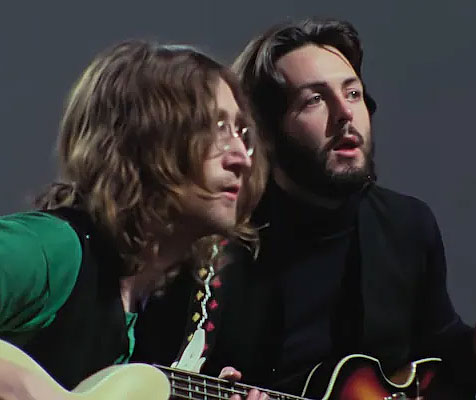
I recently watched the three-part Peter Jackson-helmed documentary series "Get Back," a compilation of footage from rehearsal and recording sessions the Beatles had that eventually led to their final public appearance, the rooftop session in London. It's a great film if you're a Beatle fan, getting a look behind the scenes, as it were, of the band at the beginning of the end.
Watching it you can see things fray apart in real time, more or less, then come back together for a bit, then fray again, and the doc ends with things in a sort of limbo. We know that they go on to record and release another album ("Abbey Road") before the one they're making here ("Let it Be") is released, but we also know that the guy they break to meet with at one point, Allen Klein, is going to screw them over and ratchet up the conflicts that break them.
I'm not as well-read on the subject as plenty of other Beatle scholars out there, I lack some of the details in my understanding of what broke the fab four apart in the end, but I have a general sense of it and have occasionally wondered what the world would be like, or at least what pop culture would be like, had Brian Epstein survived. Losing their manager to a drug overdose—barbiturates and alcohol in a self-medicated attempt to deal with chronic insomnia—in 1967 put the band in new territory. Deciding to manage themselves was probably a mistake, and the frictions of a few years later when they were looking for a new business manager, the machinations pulled by Klein (the guy ultimately hired by three of the band), Paul's prescient refusal to sign on with Klein (John, George, and Ringo would later sue Klein for breach of fiduciary duty and misrepresentation), and so forth would not have occurred if Brian Epstein was still handling the band. The smaller issues of personal conflict had to do with their self-managing as well, with Paul as the most responsible of the four assuming a "boss" role he did not want that irritated the others. Much is made of the Yoko Factor, but as Paul himself says in the "Get Back" footage, frustrated at John's distractions they were really feeling the absence of a grown-up figure to tell them to focus. They missed Brain a lot more than they were annoyed about Yoko.
I always have loved The Beatles, and in particular I've always found John Lennon to be fascinating. Not in a "favorite Beatle" kind of way, but because he was such a complicated person. Coming out of a horrendous childhood with absentee parents and a mom with mental health issues, when he meets Paul McCartney John's a thoughtful but very angry, tremendously insecure 16-year-old kid with a wealth of talent and on the road to trouble. Paul comes from a much different background, he's from a stable family of relative means (relative to John, anyway) but equally talented, and becoming fast friends gives them both a needed balance. John was one of those kids that either had to grow up too fast or never had a real childhood, depending on how you look at it, and had to grow up in his 20s while being one of the most famous people in the world; eventually he got to a point of internal peace and happiness, but only after going through Beatlemania, a failed and unhappy shotgun marriage, loss of important intimates (Stu Sutcliffe, Brian Epstein), an overly-intense nearly all-consuming new romance that alienated people (including his young son whom he became an absentee dad to himself), heroin addiction, all the end-stage Beatle drama, estrangement from Yoko, and a year-long largely drunken "lost weekend" first. Associations with the other Beatles makes him more worldly, he explores cultures. Between that and meeting Yoko he gets overtly political. Ideologically he goes from writing the misogynistic "Run For Your Life" to writing the feminist "Woman is the Nigger of the World" seven years later. Ultimately, he finds his place as a stay-at-home dad to a new son he's determined not to be absent from. The evolution of John Lennon is rather profound and very human.
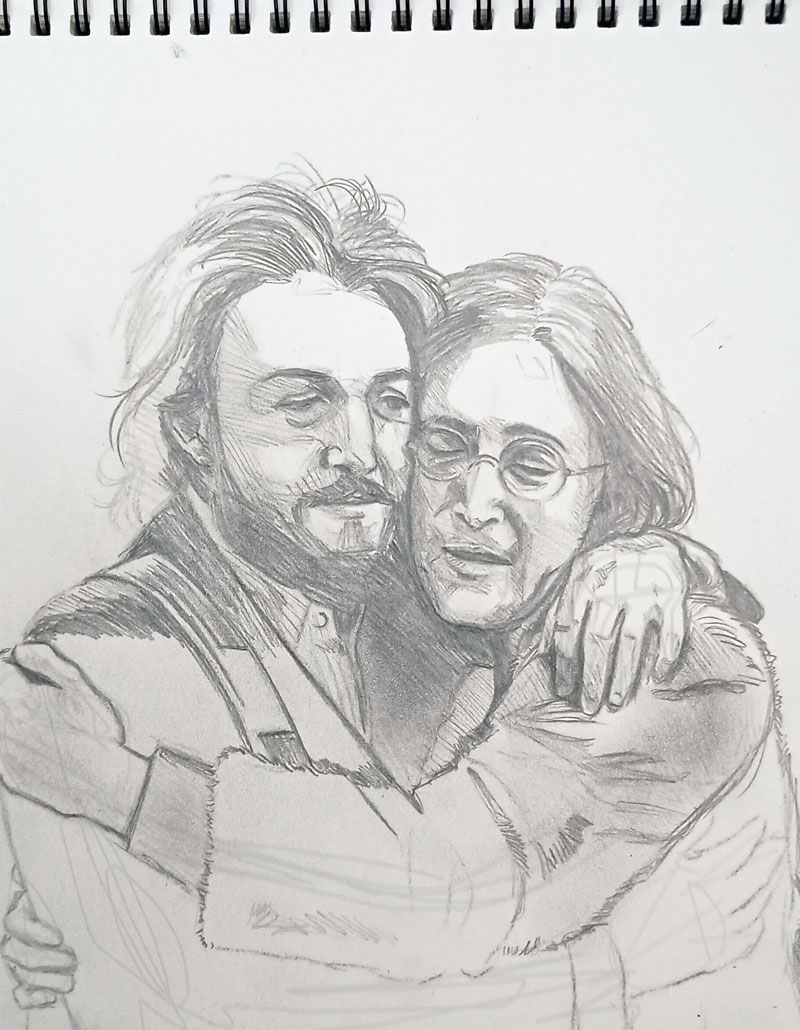
Anyway, the bulk of the third installment of "Get Back" is around the rooftop concert, for which there's a lot of video out there. There's a brief moment in one of the clips where John goes to hug Paul, and John grips Paul in a bear hug with an intense expression, very emotional, while Paul embraces John back in a more relaxed manner with a tender expression that appears more tired than anything else. It's fleeting, but it struck me as such a distillation of the bond between them as the end of the band neared. A moment that's so at odds with the public feud they'd have in the early ’70s, that really shows how that feud to come was based in pain and resentment at the other parties and outside factors that their conflicts were based in, because these guys really, deeply missed each other.
It was an image I wanted to capture, so I'm now trying to draw it. Here's an in progress snapshot of it, with the first two layers (6H and 2B pencils) only; it's going to require several more gradations, probably from 8H to 6B, maybe 8B, before it's done. Paul's still raw, it's not him yet, and I'm not getting John's expression right—he looks too calm. It needs something more around the eyes, I think.
Tagged
The Beatles,
Sketches,
Posted on March 2, 2026 at 10:04PM | Permalink |  |
| 
Comments
Posted by Bill on March 3, 2026 (7 months ago)
Perhaps it's best they broke up in 1970. Amazing as they were, artistic decline appears inevitable to even the greatest artists. Dylan made only one LP in the 70's that matched the greatness of virtually all his '60s work ("Blood on the Tracks"). The Stones made four great LP's in a row, 1968-'72, and while they've made a couple excellent albums since (and a slew of good ones), have never remotely matched that stretch. The Byrds' last great album was in 1970. And on and on and on.......
Posted by Bill on March 3, 2026 (7 months ago)
Your JohnPaul snapshot is lovely even now, Tim.
No one has commented on this page yet.
Post your comment
RSS feed for comments on this page | RSS feed for all comments