


High-wage jobs
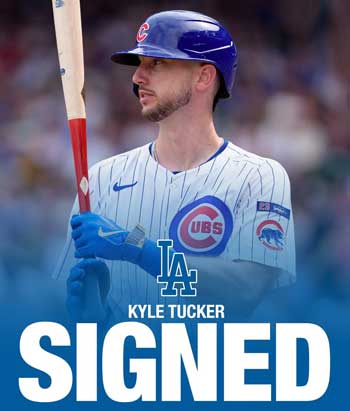 The rich get richer, with the Dodgers adding Kyle Tucker
Pro sports has been, at least since free agency became a thing, an industry that pays well. For the big leaguers, I mean. Minor league players toil in poverty, for the most part, excepting highly-touted prospects that got big signing bonuses or whatnot. But if you could make the Majors (or your sport's equivalent high rung), you'd get paid. And if you were a star player, well, then you could get seriously rich.
But such things are relative, and with today's announcement of some new Major League Baseball free agent contracts it got me going down a bit of an historical rabbit hole.
Outfielder Kyle Tucker, late of the Houston Astros and Chicago Cubs, is a really good baseball player. Any team would love to have him. Is he the best baseball player? No, I don't think anyone could credibly make that argument, though he is more well-rounded than most, good at several things rather than elite at one or two (looking at you, Aaron Judge). Nonetheless, the Los Angeles Dodgers just made him the highest-paid player in the game not named Shohei Ohtani (who is a special case and cannot be used as a comparison with anybody, not just for what he does on the field but because he is responsible for so much of his team's income). The annual average value of Tucker's new contract is a staggering $60,000,000. There's some creative structuring of when he'll be paid how much over time, but bottom line, it's $240 million for four years playing as a Dodger. The previous record-holder is the similarly-aged and similarly-skilled Juan Soto, who set the mark just a year ago when the New York Mets (who shelled out another high-dollar contract today for shortstop Bo Bichette) gave him $51,000,000 per annum. Before that it was Aaron Judge breaking the mark in 2023, getting $40,000,000 a year from the Yankees.
Don't get me wrong, I don't begrudge elite athletes getting paid. It's a comparable amount to what the star of a hit TV series would make (at least back in the days of 22-episode TV seasons), and it's all ultimately in the entertainment field. I'm just stunned at the rate of player-salary inflation versus the general rate. When Kirby Puckett got $5M in 1993, he was the top dog; adjusted for inflation, he was getting less than a fifth of Tucker's new paycheck, and no way is Kyle Tucker five times the player Kirby Puckett was.
Nolan Ryan got the first $1,000,000 per year contract in 1979. I remember clearly when Orel Hershiser became baseball's first $3,000,000 per year player ten years after that. I recall Ken Griffey Jr. breaking the $8,000,000 per year mark in 1996, and that his figure was eclipsed by Albert Belle's $11,000,000 annual contract later that year. Not too many years after, Manny Ramirez would top $20M and A-Fraud would top $30M and Mike Trout would top $35M. Then Judge, Soto, and now $60M with Tucker.
At first I assumed the sports fan was taking more of a hit every time the big contracts got way bigger. Though it's true that ticket prices have gone up more than the general rate of inflation would indicate, they haven't risen to the same degree, not even close. We pay about three times as much for a ticket today than we did back when Griffey signed his $8M-per-season deal, not the sixfold jump Soto sees over Junior's pay. (Though there's also the matter of having to pay for TV broadcasts we didn't used to have to pay for and ever-increasing cable fees—which, thankfully, are finally dying off in favor of more a la carte streaming options—so it's not quite apples-to-apples.)
What I haven't been able to research is how much increase there's been in the revenue the league and its teams bring in. It's likely that individual clubs have always been far more profitable than they've publicly acknowledged, and especially in the Rob Manfred era they sell ad space and naming rights on/for anything they can and have soaked television providers so heavily that some of them have gone bankrupt. Almost every team now has a stadium with luxury seating options that didn't exist in 20th century ballparks and that now account for most of the gameday revenues.
So in terms of percentage of the employer's income, these huge contracts probably have kept fairly consistent over the years? Maybe? At least through Trout's record-breaking 2019 deal?
Nevertheless, I remain stunned to consider these guys getting $50 and $60 million a year when I'd just gotten used to the top guys making $35M. It's psychologically jarring when the vast majority of us are seeing our buying power get smaller and smaller even though the scales and circumstances don't equate.
Also, it makes me nervous because Manfred and his bosses, the MLB club owners, are notoriously dishonest about their finances and unwilling to share anything even with each other, and the collective bargaining agreement MLB has with the players' union expires next December 1st. With the fat-cat teams like the Dodgers and Mets and Yankees and even the Cubs shelling out contracts like this, the rest of the owners are going to cry poor and Manfred will saber-rattle and we'll have a lockout come Spring Training time 2027. My faith in Manfred's ability to keep the peace is not quite absolute zero, but it's close.
Tagged
Baseball,
Rob Manfred,
Posted on January 16, 2026 at 10:04PM | Permalink |  |
| 
Comments
No one has commented on this page yet.
Post your comment
RSS feed for comments on this page | RSS feed for all comments