



Tag: Rob Manfred
High-wage jobs
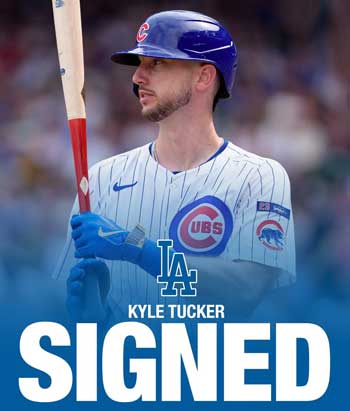 The rich get richer, with the Dodgers adding Kyle Tucker
Pro sports has been, at least since free agency became a thing, an industry that pays well. For the big leaguers, I mean. Minor league players toil in poverty, for the most part, excepting highly-touted prospects that got big signing bonuses or whatnot. But if you could make the Majors (or your sport's equivalent high rung), you'd get paid. And if you were a star player, well, then you could get seriously rich.
But such things are relative, and with today's announcement of some new Major League Baseball free agent contracts it got me going down a bit of an historical rabbit hole.
Outfielder Kyle Tucker, late of the Houston Astros and Chicago Cubs, is a really good baseball player. Any team would love to have him. Is he the best baseball player? No, I don't think anyone could credibly make that argument, though he is more well-rounded than most, good at several things rather than elite at one or two (looking at you, Aaron Judge). Nonetheless, the Los Angeles Dodgers just made him the highest-paid player in the game not named Shohei Ohtani (who is a special case and cannot be used as a comparison with anybody, not just for what he does on the field but because he is responsible for so much of his team's income). The annual average value of Tucker's new contract is a staggering $60,000,000. There's some creative structuring of when he'll be paid how much over time, but bottom line, it's $240 million for four years playing as a Dodger. The previous record-holder is the similarly-aged and similarly-skilled Juan Soto, who set the mark just a year ago when the New York Mets (who shelled out another high-dollar contract today for shortstop Bo Bichette) gave him $51,000,000 per annum. Before that it was Aaron Judge breaking the mark in 2023, getting $40,000,000 a year from the Yankees.
Don't get me wrong, I don't begrudge elite athletes getting paid. It's a comparable amount to what the star of a hit TV series would make (at least back in the days of 22-episode TV seasons), and it's all ultimately in the entertainment field. I'm just stunned at the rate of player-salary inflation versus the general rate. When Kirby Puckett got $5M in 1993, he was the top dog; adjusted for inflation, he was getting less than a fifth of Tucker's new paycheck, and no way is Kyle Tucker five times the player Kirby Puckett was.
Nolan Ryan got the first $1,000,000 per year contract in 1979. I remember clearly when Orel Hershiser became baseball's first $3,000,000 per year player ten years after that. I recall Ken Griffey Jr. breaking the $8,000,000 per year mark in 1996, and that his figure was eclipsed by Albert Belle's $11,000,000 annual contract later that year. Not too many years after, Manny Ramirez would top $20M and A-Fraud would top $30M and Mike Trout would top $35M. Then Judge, Soto, and now $60M with Tucker.
At first I assumed the sports fan was taking more of a hit every time the big contracts got way bigger. Though it's true that ticket prices have gone up more than the general rate of inflation would indicate, they haven't risen to the same degree, not even close. We pay about three times as much for a ticket today than we did back when Griffey signed his $8M-per-season deal, not the sixfold jump Soto sees over Junior's pay. (Though there's also the matter of having to pay for TV broadcasts we didn't used to have to pay for and ever-increasing cable fees—which, thankfully, are finally dying off in favor of more a la carte streaming options—so it's not quite apples-to-apples.)
What I haven't been able to research is how much increase there's been in the revenue the league and its teams bring in. It's likely that individual clubs have always been far more profitable than they've publicly acknowledged, and especially in the Rob Manfred era they sell ad space and naming rights on/for anything they can and have soaked television providers so heavily that some of them have gone bankrupt. Almost every team now has a stadium with luxury seating options that didn't exist in 20th century ballparks and that now account for most of the gameday revenues.
So in terms of percentage of the employer's income, these huge contracts probably have kept fairly consistent over the years? Maybe? At least through Trout's record-breaking 2019 deal?
Nevertheless, I remain stunned to consider these guys getting $50 and $60 million a year when I'd just gotten used to the top guys making $35M. It's psychologically jarring when the vast majority of us are seeing our buying power get smaller and smaller even though the scales and circumstances don't equate.
Also, it makes me nervous because Manfred and his bosses, the MLB club owners, are notoriously dishonest about their finances and unwilling to share anything even with each other, and the collective bargaining agreement MLB has with the players' union expires next December 1st. With the fat-cat teams like the Dodgers and Mets and Yankees and even the Cubs shelling out contracts like this, the rest of the owners are going to cry poor and Manfred will saber-rattle and we'll have a lockout come Spring Training time 2027. My faith in Manfred's ability to keep the peace is not quite absolute zero, but it's close.
Tagged
Baseball,
Rob Manfred,
Posted on January 16, 2026 at 10:04PM | Permalink |  |
| 
All-Star circus
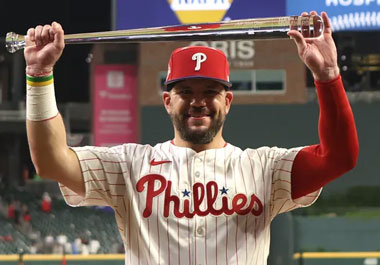 All-Star Game so-called MVP
The baseball All-Star Game has been a shadow of its former self for a long time now. For several years running the games themselves have been dull, assisted in their dullness by a circus atmosphere generated by the tandem producers of Bud Selig/Rob Manfred (commissioners) and Fox Sports (broadcasters).
There are several reasons why they've been dull, most of them not related to the generally low scores; low scores can be great under other circumstances (see below, 1987). They've been dull because the game itself has become kind of a sideshow. No one is trying to win beyond a perfunctory measure, strategy is limited to things like "when should so-and-so be put in to replace starter X" and "how can we generate a fake applause moment for a guy by taking him out of the game mid-inning." The powers-that-be (i.e. Selig/Manfred and Fox) have made it a regular thing to interrupt the game more than once for some sort of ceremony that would be better done pregame. Managers care more about using all/nearly all of their rosters than scoring runs. Broadcasters care more about having inane banter with players actively in the game than actually, you know, covering the game.
(The principal mid-game interruption this time was for a tribute to the late Hank Aaron, which was a fine subject, but Manfred/Fox blew it anyway. As Craig Calcaterra put it:
In an otherwise nifty tribute to Henry Aaron's 715th home run, they played the audio of Vin Scully calling the shot from back in 1974, but cut it off the last bit. Here was Scully's whole call back in the day:
"What a marvelous moment for baseball. What a marvelous moment for Atlanta and the state of Georgia. What a marvelous moment for the country and the world. A Black man is getting a standing ovation in the Deep South for breaking a record of an all-time baseball idol.”
Except, during the Aaron tribute last night, MLB decided to cut it off after “. . . for the country and the world." Which is awful, because when you omit "A Black man is getting a standing ovation in the Deep South for breaking a record of an all-time baseball idol" from Scully's call you completely alter what he was describing as "marvelous." Scully was NOT just broadly marveling. He was marveling at a very specific, very important thing.
But MLB didn't care about that. They no doubt cut off that sentence specifically because they didn't want to anger the white supremacists who run our country and of whom Rob Manfred is an ardent supporter by making note of an important moment in the racial history of the United States. It's the same reason MLB nuked its diversity and inclusion initiatives earlier this year and why so many other businesses and institutions have done the same.
It was an utter disgrace and everyone involved in that decision, be they with Major League Baseball or the Fox network, should be absolutely ashamed of themselves.
Craig noticed this in real time while I did not, as I was too busy talking with friends to pay strict attention to a clip I'd seen many times before.)
I'm not saying the players and even the TV crew shouldn't have fun with the ASG. It's an exhibition game, after all. But instead of the game itself being the showcase focus of a break in the regular season, Home Run Derby has become the thing that gets most of the attention, so much so that, for the first time since Manfred instituted yet another stupid change to the game, the ASG itself was decided by a home-run-hitting contest.
People seemed to like it. Social media posts on it were largely favorable.
I hated it.
Up until the farce of home-run-derby, last night's All-Star Game was easily the most interesting one to take place in at least 15 years. In fact, I'd take it back to 2008, another time when the game was tied after nine innings. But that just meant you kept playing, so the game went on, with drama in ensuing innings and an eventual win for the American League in the 15th. And managers were prepared for extras thanks to the debacle of 2002, when the game was tied after nine, continued for two relatively quick innings, and then abruptly halted because both teams were on their last pitcher (both starters in their regular jobs) and didn't want to make them throw a third inning. That was the game that gave us the iconic image of Commissioner Bud Selig just throwing his hands up in the air in a "well, I guess there's nothing to be done about it" show of utter impotence.
Subsequent to 2002, more pitchers were required (minimum 12 now) and managers re-learned to keep two or so pitchers capable of more than one inning in reserve in case of extras. No need for that now.
Because now any tied ASG is 2002 with a mini-derby to cap thigs off, completely erasing anything from the game itself from memory.
When thinking back on the 2025 ASG will anyone remember Ketel Marte's first-inning double off of Tarik Skubal to plate two? Or Pete Alonso's three-run blast that was a real home run off a real pitch from a real All-Star pitcher? Or Steven Kwan running out an infield chopper to plate the tying run with two out in the ninth? Eh, not many.
What people will recall is Kyle Schwarber hitting three balls over the fence in the "tiebreaker" that were lobbed to him from 35 feet away by a third-base coach.
Tied All-Star Games were the best in my mind because in extra innings they became more real. Rosters had been pared down to normal size, there weren't wholesale substitutions going on any more, strategy came back. My favorite ASG is probably 1987’s, played in Oakland for the first and only time. That game was a pitchers' duel, scoreless through 12 innings with pitchers going multiple frames; of 15 pitchers used, only five of them pitched one inning or less and Lee Smith—closer for the Cubs, used to stints of one-frame-and-done—pitched three innings before giving way to Sid Fernandez, who usually started games, for the 13th. The National League won after one of my favorites, Tim Raines, in his third at-bat since coming up for the first time in the 9th, tripled in two for his third hit of the game with two out in the top of the 13th after Willie McGee lined out in what appeared to be a rally-killing running catch by Dave Winfield. Fernandez would walk his first batter (current Mariner batting coach Kevin Seitzer) and then shut down the next three to lock up a 2-0 NL victory.
1994 was also good, a ten-inning affair that saw the NL come from behind to tie it at 7-7 in the ninth, survive a 2-on, 1-out threat in the 10th, and win it in the next half when Moises Alou doubled on Pittsburgh's then-Astroturf to drive in Tony Gwynn from first base.
Before 2002, there was some emphasis on actually winning the game; it was minor, but there. Prior to that, through the early 1990s, it was a really big deal who won, at least for many. Back then, of course, the leagues were separate entities. They had their own presidents, their own rules, and were in a loose affiliation with each other as "the major leagues." There was no interleague play except for the World Series and ASG, which contributed to the ASG's specialness.
Now it's just a party that no one remembers any details of the next day, still in a home-run-derby hangover.
Alas.
This concludes today's Grumpy Old Man post.
Tagged
Baseball,
Rob Manfred,
Posted on July 16, 2025 at 6:11PM | Permalink | |
Civil disobedience (baseball edition)
I have new respect for Jorge Polanco.
The infielder/DH of this year's Seattle Mariners has had a Jeckyll-and-Hyde kind of season, with a scalding-hot .395/.434/.816 line in the first five weeks or so, then .173/.236/.240 over the next two months, then .333/.375/.733 in the last week. He's been a questionable presence in the lineup, to say the least.
But in today's game against the Pittsburgh Pirates, Jorge showed me something.
Not with the bat, though he did notch his 1,000th career hit today (congrats). But with his sleeve.
One of Commissioner of Baseball Rob Manfred's goals in life, apparently, is to put advertising on as much space as he can within the game of baseball. It's truly disgusting how much ad space has proliferated since he assumed the role of Commissioner from the previous guy to hold the title of Worst Commissioner Ever. Ads on the outfield walls are as old as outfield walls, ads on stadium deck facings are somehow not terribly obtrusive. But since Manfred they're everywhere, including on the field itself and the ballplayers' uniforms.
The Mariners were slow to adopt the sleeve ads—this is the first year we've been subject to them—but there they are, bright orange to make them difficult to ignore, on the sleeve facing the center-field camera when one is up to bat (right sleeve for left-hand batters, left sleeve for righty batters).
Today Jorge rolled up his sleeve, obscuring the ad from view.
And why not? I don't know for sure that Polanco was defying the practice for philosophical or political reasons, or indeed making a statement of any kind, but I assume he was. He likely doesn't have anything against the sponsor company, which I will not name because, among other reasons, they aren't paying me anything.
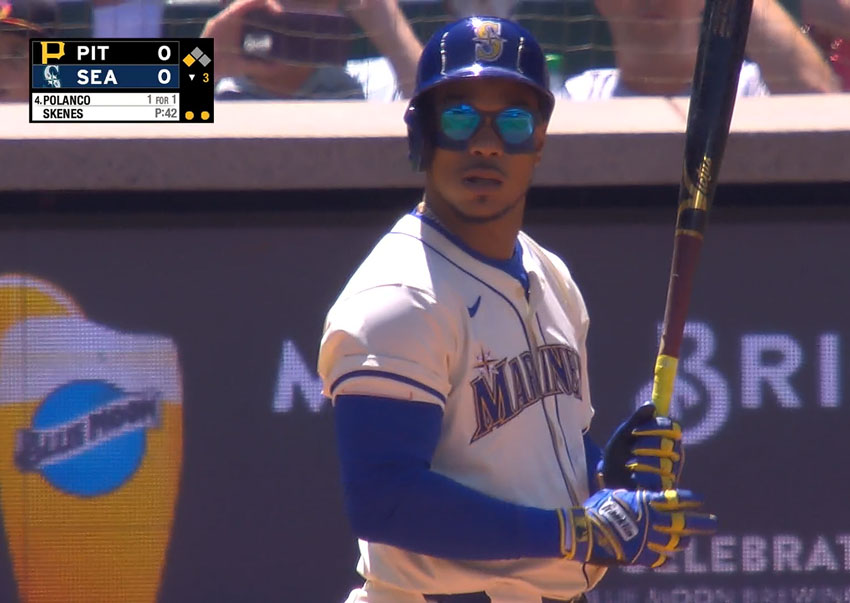
Maybe Polanco figured they weren't paying him anything either, so why show the logo? Except they are paying him something indirectly, sort of, as his employer pays him out of revenue they collect from whatever sources, including sleeve ads. Which is perhaps why he rolled the sleeve down later in the game. Someone probably told him he was going to get in trouble with the team or the Commissioner or something.
What the Mariners get from the sponsor company for this defacement isn't widely known, but it's likely similar to the fee [other sponsor] paid for the naming rights to the ballpark, which is less than the typical salary of a middle reliever. (Most are undisclosed, but the top payment for a team is evidently the $25 million paid annually to the Yankees by their sleeve sponsor. The Cincinnati Reds and Miami Marlins each get $5 million a year for theirs. The average is reportedly around $8 million.) It's peanuts in the grand scheme of things for a Major League club's revenue, making the whole endeavor seem even pettier. Not even counting ad sponsorships, merchandise sales, or any other revenue, the Mariners—a middle-tier club in this regard—reportedly took in $70 million last year in ticket sales + TV and broadcast fees – player payroll. (What do you want to bet Manfred and the team owners start crying poor despite this when it's time to negotiate with the players' union again next year.)
I don't know what Polanco's thinking was either way, on rolling up the sleeve or rolling it down again later, but I was both amused and supportive when I saw the blocking of the ad.
Good on you, Jorge Polanco. Stick it to the Man(fred).
Tagged
Baseball,
Rob Manfred,
Seattle Mariners,
Posted on July 6, 2025 at 9:02PM | Permalink | |
Worst. Commissioner. Ever.
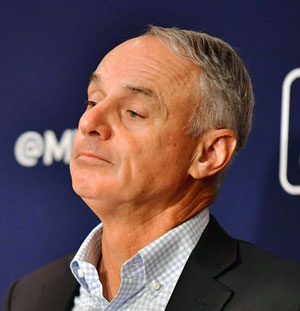 The baseball commissioner is a corporate right-wing toady who doesn't give a damn about baseball
As if we needed more reasons to despise Commissioner of Baseball Robert D. Manfred Jr.—and former Commissioner Bud Selig, for that matter—he provided us with one by reinstating Pete Rose and all other permanently-banned-from-the-game individuals under the fig leaf excuse of, "well, they're dead, so let's say permanent bans end at death."
This action pulls the neat trick of both being wholly about Pete Rose and not really being about Pete Rose at all. It's about Rose because a comment about Rose was the impetus for this, it's not about Rose because of who the comment came from. It came from the cruel, corrupt, and incompetent fascist now occupying the office of President of the United States.
POTUS47 wants Pete Rose in the Hall of Fame for some reason. Why? Far as I know, POTUS47 is not particularly fond of baseball or versed in its history. But he does know the name Pete Rose, knows that Pete Rose was a supporter of his in 2016 and 2020, and he very likely knows that Pete Rose was the kind of man he likes best: selfish, criminal, and in love with his own "greatness."
I don't know if Rose and POTUS47 ever met personally or not, but since they're totally birds of a feather—well, except for one of them being a professional athlete with a standout career and the other being a failure in every business venture he ever undertook—it totally tracks that President Convicted Felon would stick his nose into this comparatively trivial matter.
There are a lot of horrible things among the autocratic agenda of the present administration, many of them shared by the Republican party as a whole, many of which have been on display over the past couple of weeks, many of which deserve far more attention than they're getting. But one of the underlying foundational elements of the POTUS47 mindset is not just racism and misogyny, but their corollary: glorification of despicable behavior by white dudes.
POTUS47 is himself a despicable white dude guilty of some of the worst behavior humanity has to offer, so he needs society to approve of other despicable white dudes guilty of terrible behavior so he doesn't stand out as the festering boil on America's face that he is. So all the January 6 insurrectionists get pardons (and perhaps get called upon to be thugs for him again), Jeffrey Epstein was "a terrific guy," Pete Hegseth gets to be Secretary of Defense, neo-Nazis are "very fine people," RFK Jr. and Elon Musk are "genius" level specimens, and Pete Rose should be idolized on and off the field.
Pete Rose was banned form baseball in 1989 by then-commissioner A. Bartlett Giamatti (otherwise known as the last commissioner worth the title, apologies to Fay Vincent who let himself get steamrolled by Selig and company). Not for general assholishness (or for being a statutory rapist or for tax crimes, both of which were still not widely known about), but for specific affronts to the integrity of the game by way of gambling. Rose denied at the time but later admitted that he not only bet on big-league baseball games regularly, but that he also bet on his own team, the Cincinnati Reds, for whom he was player-manager. This violated baseball's Rule 21(d), misconduct through gambling, which mandates a year's suspension for betting on games the bettor has no part in and a permanent ban for betting on games he participates in.
There have been arguments ever since over whether or not Rose's punishment was appropriate; of late, the arguments favoring his reinstatement center around how gambling has become normalized to the point of offensiveness, with sponsorships galore from gambling enterprises throughout the game. There have also been debates about others that are now, thanks to Rob Manfred's capitulation to one of the most heinous people on Earth, also re-eligible for the Hall, particularly Shoeless Joe Jackson, who was swept up in the Black Sox scandal of 1919 that ended up creating the position of commissioner in the first place (those unfamiliar should immediately go see the fine John Sayles film Eight Men Out). At first I sided with the pro-reinstate Jackson crowd, but upon reflection I will instead side with Bart Giamatti.
Giamatti was asked about reinstating Jackson shortly before he died later in ’89, and his reply was that the 1919 Series "and its aftermath cannot be recreated . . . I, for one, do not wish to play God with history. The Jackson case is now best given to historical analysis and debate as opposed to a present-day review with an eye to reinstatement." In other words, applying present-day judgments to events that occurred within their own historical contexts will inevitably miss key nuances and/or taint or sanitize history in ways that can't be predicted.
I would apply the same to Pete Rose now, particularly since we now know about some of his other gross behavior. I expect Giamatti would too, despite the idiotic remark by the guy who previously held the title of Worst Commissioner Ever, Bud Selig, who said, "I believe Bart would understand and respect the decision [to reinstate Rose] as well." Fuck you, Bud, Giamatti said he would only consider reinstating Rose if Rose worked toward living "a redirected, reconfigured, rehabilitated life," which he never did; Rose was unrepentant until the day he died last September. As Stephanie Apstein wrote in Sports Illustrated, "It’s hard to imagine a less savory character to whom to extend this grace. Rose agreed to the ban in the first place, then spent the rest of his life insisting he'd been wronged. He lied about betting on baseball until it became profitable to tell the truth."
Manfred, of course, isn't fit to lick Giamatti's loafers. The Rob Manfred era has been a nightmare of rule fuckery and greed and labor strife and greed and scandals and greed and, yes, more greed. Integrity of the game doesn't even make the top 20 in Manfred's list of priorities, all he wants to do is make more and more surfaces available for ad space (we now have ads on uniforms, ads on pitcher's mounds, ads on the grass in foul ground...), bully TV providers, and, yes, mingle with gamblers. When asked about Rose and gambling and the changes in baseball's attitude, Manfred tried to defend his office's relationship with gambling by saying "we sell data and/or sponsorships, which is essentially all we do, to sports betting enterprises." I leave it to the reader to decide if he meant, "we don't do any betting, we just encourage others to bet," or if he meant, "my job is first and foremost to sell data and ads to gambling outfits." No reason it can't be both, I guess.
But his job also, apparently, includes kowtowing to wannabe autocrats. I've seen one take that actually reflects well on Manfred, relatively speaking—that he reinstated Pete Rose as a sop to POTUS47 in hopes that it would get MLB some goodwill when it comes to immigration/deportations/renditioning of foreigners, that Major and minor-league ballplayers would be spared from ICE and HSI gestapo goons kidnapping them off the street or arresting them at airports. Maybe. I kind of doubt it, though. Even if that was the calculus it just means Manfred is as stupid as we all think he is, since you cannot appease the Bully-in-Chief, if you give him an inch he will take a parsec. Just ask Columbia U or the law firm of Paul, Weiss.
Pete Rose may or may not be bad for the Hall, depending on your metrics, but Rob Manfred is surely bad for baseball. Just as POTUS47 is bad for America and the world. All three deserve plaques in the Hall of Human Stains and Horrors.
Tagged
Baseball,
Politics,
President VonClownstick,
Rob Manfred,
Posted on May 15, 2025 at 9:31PM | Permalink | |
Baseball notes

Prior to last year, when I chose to abandon it mid-season, I was running a website all about Your Seattle Mariners baseball club. If it was still up and running, this would have been a full couple of weeks of posting there thanks to the annual Major League Baseball trade "season" that came to a close on August 1st. A lot of movement there to cover.
For better or worse—mostly better, as the work-to-benefit ratio at that site was pretty sad—I didn't pay as close attention to such things this year since I didn't feel a need to cover it online, but I have been involved in conversations as well as observed other comments regarding the trades made and not made by the Mariners.
Since July 1st, the M's traded away outfielder A.J. Pollock, pitchers Chris Flexen and Trevor Gott, and five minor leaguers of little impact (the most highly regarded of which is OF Jack Larsen, traded to San Francisco for a Player to be Named Later or other compensation to be determined); no one, including me, seems to think those deals are particularly notable. Pollock was a bust on a one-year contract, Flexen had pitched himself out of a job, Gott was expendable to get Flexen's contract off the books, and no real depth was lost from the minors.
They also released second baseman Kolten Wong and traded reliever Paul Sewald to Arizona. Those are the ones people talk about.
Wong was a disappointment with the M's after coming over in an offseason trade with Milwaukee, but to be fair, he was only given one chance, right at the beginning of the year. He started out slow, hit his high-water mark on May 10th (.195, .287 OBP), and then was given an average of 1.7 PAs per game the rest of the way. He might have fought his way out of the slump, he might not have. We'll never know. He hasn't caught on with another team yet, but I'm sure he will before long, and I'd bet he bats better than .250 with that new club. Still, his departure doesn't hurt the Mariners at all.
The Sewald trade is the one people question. Some think it was throwing in the towel on making the ’23 postseason. I disagree, I think it was a great move, selling high on a player who'll never be more in demand and improving the team long- and short-term.
The return for the M's in these deals was two minor-league pitchers of little consequence, a big-league reliever in Trent Thornton, two PTBNL or cash, and the three guys from the Sewald deal with the Diamondbacks: IF Josh Rojas, OF Dominic Canzone, and Triple-A 2B Ryan Bliss.
Rojas is no help. He basically replaces Wong with worse defense. He's versatile, can play four or five positions adequately, but the M's already have a better player like that in Sam Haggerty, currently toiling in Triple-A with a .321/.406/.580 slash line that makes me shake my head—why is he still down there while the M's keep trotting out Dylan Moore and Rojas? Even José Caballero hasn't been that productive, batting just .188/.275/.250 with a near-30% K rate since the middle of June. I'd much rather have Haggs on the roster than any of those three.
Anyway, though Rojas is meh at best, Canzone and Bliss are good players that just need a chance to prove themselves, and they play positions of need for the Mariners. The Seattle outfield is a mess, with last year's Rookie of the Year Julio Rodríguez the only solid everyday guy in the mix. Teoscar Hernández has been disappointing—though he's shown signs of being his old self of late (batting .302 over his last 10 games)—and Jarred Kelenic got mad and broke his foot while having a tantrum after striking out a while back. Canzone had a traditional development period in the minors, not skipping levels like the Mariners tend to do, and tore it up in Triple-A the last couple of seasons (.939 OPS in 588 ABs) before his recent callup and just needs an adjustment period to find his way in the bigs. Bliss needs a full year at Triple-A to gauge his readiness; he mashed at Double-A, which is promising, but skipping Triple-A is usually a bad move. Still, there's upside to the guy and he should either be a 2B candidate in ’25 or mid-’24 or a good trade chip.
More to the point, relievers in general and closers in particular are, in my view, tremendously overvalued. The number of truly dominant, sustainably effective closers in baseball since the save became a thing is small. There have been maybe a dozen. Half that if you're really strict in your metrics. Every team would like to have Mariano Rivera or Dennis Eckersley at the back end of the ’pen, but plenty of very good teams get by with the sort of effective late-inning relief that lasts for a year or two and/or that is found on some other club's scrap heap. Lots of guys can rack up saves. You know who's 21st on the all-time saves list? José Mesa. Yes, that José Mesa. There are 17 guys that have had 50+ saves in a season and I bet you can't name them all.
The list of relievers the Mariners have used as closers—effectively!—includes names like David Aardsma, J.J. Putz, Brandon League, Tom Wilhelmsen, Steve Cishek, and Mike Schooler. Even Bobby Ayala was decent at it in 1994. Paul Sewald is not out of place on that list, guys that were good for a while then flamed out or just had a couple of fine years in otherwise average careers. Point being, closers are easily replaced and Canzone/Bliss/Rojas is a more than solid return for a name from that list in general and Canzone is more important to the team right now by himself than was Sewald.
Sewald himself was a scrap-heap find. Picked up off the Mets' discard pile, he'd been a middling to poor relief option in New York, 14 losses and a 5.50 ERA over 147 innings. In his first opportunity with the Diamondbacks, Sewald blew the save while surrendering a pair of homers. The Mariners will plug someone else into the role—likely Andres Muñoz, who fits the classic closer "profile"—two-pitch type with fastball near or at 100mph and a favored breaking pitch—a lot more than Sewald did, but scrap-heap pickups like Justin Topa or Thornton might do just as well.
Seattle is now eight games above .500 and a better bet to make the playoffs now than they were a week ago. Good job.
Elsewhere in the baseball world, I happened on a section of baseball-reference.com that attempts to track the effects of Commissioner Rob Manfred's rule changes that went into effect this year. To my great non-surprise, so far the results are not such that it makes me change my opinion on them—on the whole, I still think they do more harm than good.
The pitch clock has shortened the overall time of games. To date in 2023, the average time of game is two hours and thirty-eight minutes. To my mind that's an overcorrection—2:45-2:50 seems about right for an average to me, and that was the norm from 1998, when MLB expanded to its current 30 team structure, through about 2011. From 2012 through last year it hovered around the three-hour mark. So Manfred has cut 22 minutes or so from the typical game, the most significant effect of his changes, mostly by reducing the time between the start of one plate appearance and the start of the next by 15-20 seconds. (The most striking number might appear to be the percentage of games over 3.5 hours—a minuscule 0.3% this year—but some of that is because of the inane, detestable zombie-runner-in-extra-innings rule that should be excised from the game immediately if not sooner, along with the at-least-equally detestable designated hitter rule. The zombie runners were a thing in 2020-2022 also, and there were a lot of 3:30-plus games in those years, so one could infer the pitch clock to be the primary factor, but I'd need to see data on the number of extra-inning games in each year.) I submit that this can be tweaked to make the change less severe by making the pitch clock a standard 20 seconds, not 20 seconds with runners on and 15 without.
The larger bases and the restriction on pitchers keeping runners close to the base has resulted in an uptick in stolen base attempts to roughly 0.9 attempts per game, or about what it was in 2012. The big difference is in the success rate: 80%, or about 10% higher than used to be the norm when attempts were that frequent. (Even my favorite team of all time, the 1985 Cardinals, which has that honor in part because they stole tons of bases, had a then-elite success rate of 77%.) This I attribute to the bigger bases and I feel like it cheapens the play. (Although, it may also be attributable to the newish more-common practice of catchers resting on one knee; the traditional catcher crouch is faster when it comes to getting a throw off to second base.) I love me a stolen base, don't get me wrong, but it loses something when it's not just the speedy guys that can get them.
The change that netted almost zero change is the ban on defensive shifts. Maybe a few individual players have benefitted form this, but overall it's been a big nothing:
| Yr | Gms | BA | BAbip | H/9 | 1B/9 | HR/9 | K/9 | R/9 | Ground Ball BA | LHB Ground Ball BA | RHB Ground Ball BA | Line Drive BA | LHB Line Drive BA | RHB Line Drive BA |
|---|---|---|---|---|---|---|---|---|---|---|---|---|---|---|
| 2023 | 3364 | .248 | .297 | 8.52 | 5.44 | 1.21 | 8.73 | 4.66 | .248 | .240 | .253 | .642 | .648 | .638 |
| 2022 | 4860 | .243 | .290 | 8.29 | 5.41 | 1.09 | 8.53 | 4.35 | .241 | .226 | .250 | .631 | .628 | .633 |
| 2021 | 4858 | .244 | .292 | 8.34 | 5.28 | 1.26 | 8.90 | 4.65 | .241 | .232 | .248 | .637 | .636 | .637 |
| 2020 | 1796 | .245 | .292 | 8.40 | 5.28 | 1.34 | 9.07 | 4.85 | .237 | .215 | .255 | .643 | .637 | .647 |
| 2019 | 4858 | .252 | .298 | 8.71 | 5.38 | 1.40 | 8.88 | 4.86 | .242 | .233 | .247 | .632 | .633 | .632 |
| 2018 | 4862 | .248 | .296 | 8.49 | 5.45 | 1.16 | 8.53 | 4.48 | .246 | .235 | .253 | .626 | .627 | .624 |
| 2017 | 4860 | .255 | .300 | 8.78 | 5.60 | 1.27 | 8.34 | 4.70 | .249 | .241 | .254 | .632 | .632 | .632 |
| 2016 | 4856 | .255 | .300 | 8.79 | 5.72 | 1.17 | 8.10 | 4.52 | .249 | .238 | .257 | .659 | .654 | .662 |
| 2015 | 4858 | .254 | .299 | 8.73 | 5.81 | 1.02 | 7.76 | 4.28 | .249 | .241 | .255 | .644 | .643 | .645 |
| 2014 | 4860 | .251 | .299 | 8.58 | 5.87 | 0.86 | 7.73 | 4.08 | .252 | .244 | .258 | .657 | .648 | .664 |
| 2013 | 4862 | .253 | .297 | 8.68 | 5.86 | 0.96 | 7.57 | 4.18 | .244 | .238 | .248 | .674 | .674 | .673 |
The ’23 numbers are more than ’22's, sure, but you only have to go back to 2016-2017 for higher ones across most columns (or lower in the case of Ks per 9 innings). Was the shift really that big a factor from 2017-2022 or is that dip within a statistical expectation?
Obviously, less than one full season's worth of stats isn't going to be definitive of anything, we'd need to see a few years' accumulation to really see if anything really changes much.
Tagged
Baseball,
Seattle Mariners,
Rob Manfred,
Posted on August 7, 2023 at 7:16PM | Permalink | |
Get off my lawn, pitch clock
As I have previously mentioned, I am, shall we say, not a fan of baseball commissioner Rob Manfred. He's terrible. And his new rules imposed on the game, both prior to this year and the new batch in 2023, rankle me. Well, OK, the three-batter minimum for pitchers is fine. But about most of the rest, I am rankled.
Still, this year's batch of changes—the pitch clock, the shift ban, the pickoff limitations—are being met with overwhelmingly positive reaction from people who choose to opine on such things. This also rankles me, but the reasons are more amorphous and vague.
Take Pos and Schur's effusive praise of the new normal. Joe Posnanski and Michael Schur have a podcast ("The Poscast") I find very entertaining (except when they go too long on about non-baseball sports). This week's Poscast was mostly about the new rules and, as Schur put it, he finds them "an unmitigated success." Pos calls the new setup "so awesome" and thinks criticism of it is "insanity." I generally love these guys, but this is…excessive.
They illustrate their position by comparing the pitch-clock setup to the extreme of the previous norm, referring to a side-by-side video someone posted of an entire half-inning of a spring training game from this year alongside a clip of Pedro Baez facing the Cubs in the postseason a few years ago that encompassed a single pitch over the same span of time. Yes, that Pedro Baez example is excessive. That wasn't good and making such an extreme sequence impossible isn't bad in and of itself. But it wasn't a representative AB, it was very much an outlier.
They further cite comparisons to other sports to justify the pitch clock. "Imagine basketball without a shot clock," Schur says. Well, Michael, I don't know or give a damn about basketball. Or football or hockey or any of the other examples he cites. A more frenetic pace might well be appropriate for those games, I don't know. Those sports are not baseball. Baseball is unique. Those arguments mean nothing to me. Eventually he gets back to baseball and makes arguments that mean something, and I respect those, though I disagree with the idea that eliminating the ability of the pitcher to effectively hold a runner is a net good.
Posnanski reminds us that these new rules are a correction, the idea is to return the game to what it was 35, 40, 50 years ago when batters did not step out of the batters' box all the time and pitchers didn't consider his next delivery for a minute before getting into the stretch. And defenses didn't move around the field because of a batter's spray chart that says he never hits to the opposite field. And that, he says, is what we want.
That point I agree with. I do want the game to be played more like it was in the ’80s and ’90s. I just don't like this methodology.
Maybe I'm just a grumpy old man and once I give this a chance I'll be fine with it. Entirely possible. I freely admit that my resistance to accepting the pitch clock and shift ban is tied inextricably to everything else Rob Manfred has done since he took over as commissioner—ads on the field; ads on the uniforms; proscribing who can pitch and who can't; devaluing the season with extra Wild Card playoff slots that are just as good as winning a division; the fucking "zombie runner" in extra innings; and the worst of the worst, the "universal DH"—and giving him even indirect credit for anything feels like having to eat a bowl of moldy nutraloaf. Had Manfred not screwed around so much with these awful things already, I'd likely be closer to Pos and Schur's position.
Yet, having watched some spring training action this year, it does feel rushed. Not frenetic, necessarily, but maybe a little too fast. There is value in having a moment to ponder the next pitch selection for those of us who, you know, pay attention. 15 seconds might be too short a span. When a runner is aboard and the clock extends to 20 seconds it's not bad, that feels proper. It's early days, of course, and it's spring training, but part of the goal for these changes is to create more offense and what I'm seeing is actually more striking out. Batters aren't ready when they swing. That'll change as we move forward, the adjustment period is going to be at least a few weeks of in-game at-bats, but I think 15 might need to be, say, 18 or 20.
Practically speaking, I will not miss the infield shift. I do not like banning it, but batters have unequivocally refused to combat it. In the early days of infield shifts being common, Ken Griffey Jr. would take advantage of it once in a while and bunt to the empty side of the field for an easy hit. Skilled contact hitters could beat it. But that went away, analytics decreed that batters should just keep on trying to pull the ball and hit for power, so defenses started shifting on nearly everybody.
Schur describes the shifting-for-everybody as an "overcorrection" to the steroid era. I see what he means, but I don't like that description at all, because the underlying problem is so many more batters swinging for homers and that hasn't been corrected for at all. Emphasis on power hitting is the underlying problem as regards the infield shift. That plus emphasis on power pitching is the underlying problem behind excessive strikeouts.
Move fences back. Make homers harder to hit and make the outfielders cover more ground—which is also more like things were in the ’80s—and you'll see fewer homers but more singles, doubles, and triples. And when batters (one would hope) stop swinging for the fences all the time, fewer Ks. And less incentive for infield shifts.
The shift ban makes that last bit moot, there's no way that rule is ever going away now that it's in place. We're likely stuck with the pitch clock forever too, and with luck over time it'll fade into the background and not be such a distraction.
But I will campaign until the end of time to do away with the Manfred Man zombie runner and the worst rule of all, the designated hitter.
Tagged
Baseball,
Rob Manfred,
Poscast,
Posted on March 5, 2023 at 11:27PM | Permalink | |
Another rant about Rob Manfred
Hey Rob, you're bad at your job and nobody likes you.
We're getting close to baseball season 2023. Which is, for some of us, all kinds of fun and cool. However, because we live in the Rob Manfred Era of Major League Baseball, it also means we need to prepare for what is now an annual period of adjustment to the new ways Commissioner Manfred has decided to screw with the game and piss us all off.
I've written plenty about Rob Manfred's penchant for damaging the game of baseball over at that-other-site-I-used-to-run-that-is-now-defunct-and-one-day-I-will-put-selected-posts-up-here-as-a-form-of-archiving. He is without a doubt the worst person to ever occupy the office of Commissioner of Baseball. He doesn't appear to even like baseball. He's all about incessantly tweaking anything he can think of if there's the slightest possibility it might mean more money for team owners in the short term. (Fuck the long term. Compared to Manfred, even Mr. Magoo has telescopic HD x-ray vision.)
Ever since Manfred took over the job, he's been altering the game in both large and small ways. To date it hasn't gone so far as to make the game unrecognizable, but give the guy a few more years and we'll be watching blernsball or Calvinball.
A lot of the alterations are "behind the scenes," dealing with money stuff and organizational rules about how long a stint on the injured list is, how the amateur draft is conducted, how many times a player can be shuttled back and forth to the minor leagues, that sort of thing, and those might be good or bad but they don't actually affect the game as it's played on the field from first pitch to last out. It's the on-field stuff that grates my cheese the most.
2023's new rules include:
- A pitch clock
- Bigger bases (18" square rather than the traditional 15")
- Restrictions on where defenders may position themselves
- Severely limiting what a pitcher may do to hold a runner close to a base
This, of course, is on top of other rules that were implemented since 2019, which include:
- The automatic intentional walk
- Three-batter minimum for pitchers
- A limit on how often catchers can go to the pitcher's mound
- Proscriptions on what players may and may not pitch and when
- The "zombie runner" in extra innings, which was supposed to be a temporary COVID-era measure that has, as of last Monday, been made "permanent."
- The metastasization of the cancer known as the designated hitter rule
- Diluting the season with added Wild Card teams in the playoffs
The only new rules I don't detest are the mound-visit limit and the three-batter minimum. Those actually add an element of strategy while addressing Manfred's complaint, which was so-called "dead time" while pitcher and catcher discussed tactics and too many pitching changes. Otherwise, these changes all completely suck. I could go into why for each of them, but I'll spare you that for now.
Manfred's stated goal with all these tweaks and changes is to "increase the pace of play," by which I think he really means "make the game more accessible for those with attention-deficit disorder." (Come to think of it, Manfred himself may well have ADHD, which would explain some of this nuttery.) His actual goals are open to speculation, but you would not be out of line to think dumbing things down is high on the list.
Unquestionably the experience of the game has slowed, for lack of a more accurate shorthand, over the past couple of decades. Relief pitching has become far, far more prevalent and that brought along the "dead time" of more pitching changes during games; existing rules regulating batters stepping out of the batter's box were not enforced and more and more players developed Nomar Garciaparra-like habits; the steroid-era created so much more emphasis on home-run power that more and more and more players adopted approaches to hitting that made "This misnomer of a phrase refers to a plate appearance resulting in a strikeout, a walk, or a home run. A “three-true-outcome hitter” is statistically unlikely to do anything else in any given time at bat.three-true-outcome" players common rather than rare; certain matchups like Yankees-Red Sox came to have so many mound meetings that if you worked it right you could time a trip to the concession stand during one and not miss a pitch. And, of course, TV demanded more commercial time, about which there's only so much anyone would be willing to change.
Imposing some sort of "correction" on the game to address this slowing isn't in and of itself something I would oppose categorically. On the contrary, I would very much like to see the obsession with home runs fade away and contact-hitting return to favor. That would reduce the number of pitches per at-bat, reduce the incentive for defenses to employ position shifts, even cut down on relief usage by allowing starting pitchers to go deeper into games before tiring. But you don't accomplish that by imposing a pitch clock; or, if you do, it's a side effect rather than the plan.
The pitch clock might work out OK in the end, but it sure seems problematic. It's pretty brief—not so much for the pitcher as for the batter; pitchers will have 15 seconds to start their throwing motion (20 if there are runners aboard), batters must be in their stance and “alert to the pitcher” within eight seconds. The problems come in when the time is exceeded and a ball or strike is added to the count to penalize whichever player wasn't ready in time. Imagine that happening during a tense moment in the late innings of a tight game. One effect might be that pitchers don't throw as hard, which would be welcome. Another might be that pitchers get hurt more often, which would not.
Larger bases...eh, they look weird, but this will quickly become "normal" and not be much of a thing. It's just a way to increase offense, get more safe calls, but it might make for fewer collisions and injuries to first basemen. I can live with it.
The restriction on pick-off attempts is the worst of these new changes, it's a naked tipping of the scale away from the defense in favor of baserunners. It'll turn every pitcher into Jon Lester, except he won't even be able to step off the pitching rubber or hold before the pitch to keep a runner close to the base. It's a much more significant change to the game than I think anyone realizes at this point. Don't get me wrong, I love stolen bases—my favorite team of all time is the 1985 Cardinals, after all—but don't cheapen them. Cat-and-mouse between a pitcher and a Lou Brock or a Vince Coleman on first was part of the tension, part of the thrill of getting a steal. Now it's gone.
Manfred has done away with the pitcher-runner tension, eliminated all strategy related to pitchers batting and worsened the existing DH rule to favor Shohei Ohtani alone while enacting rules that make future Ohtani-like "two-way" players nearly impossible, imposed radical restrictions on who can play where and in what circumstance, destroyed the potential for epic extra-inning games, cheapened the meaning of the long season schedule with almost participation-trophy tiers of playoffs, and that doesn't even get into his penchant for negotiating in bad faith, his pathetic response to cheating teams, his dishonest remarks to the press, basic stupidity about the game, and utter disregard for fans and consumers of the sport—his ostensible constituency as commissioner of baseball.
Or is it even ostensible? The fact of the matter is that ever since Bud Selig, then the owner of the Milwaukee Brewers (and thief of the Seattle Pilots), succeeded in his coup d'etat to overthrow Commissioner Fay Vincent to install himself in the position in 1992, there has been no figure in the MLB hierarchy that represents the baseball consumer. Selig made the job into a mouthpiece for ownership, an autocratic office firmly entrenched with championing the interests of club owners and club owners only. Calling the position "Commissioner of Baseball" is improper. Needs a new title, like "Agent of Greedy Asshats." I mean, there isn't a "commission" anymore. There aren't even league presidents to mediate.
The Commissioner position was created (well, technically reformed, but for all practical purposes created) in the wake of the Black Sox scandal and ensuing threats by National League officials to effectively destroy the American League by absorbing big-city AL teams into its own circuit. To contend with the public relations nightmare, an outsider was brought in to safeguard the national pastime as chair of the reimagined National Baseball Commission, which was to be made up of, by design and specific intent, people not otherwise affiliated with the business of professional baseball. That chairperson was Kennesaw Mountain Landis, who insisted on being a commission of one and, as he knew the lords of the Majors needed him more than the other way around, negotiated himself ultimate authority as the commissioner to act "in the best interests of baseball" as a whole, not of club owners or ballplayers or media figures or any other isolated group. Essentially, to represent the consumers, the public, as well as mediate disputes, regulate conflict, and be a check on ownership (players of the time didn't have any power to check). Subsequent commissioners had the same authority, purview, and requirement to be otherwise unaffiliated with the business of the leagues. Until Bud Selig's coup, which almost immediately begat the 1994-95 strike. (The revisionist history of Selig's reign reminds me a lot of how people talk about George W. Bush—"he kept us safe." You know, except for that one time. "Selig presided over great growth of the game," you know, except for that one time.)
Manfred claims to have the fans' interests at heart. “I think that the concern about our fans is at the very top of our consideration list,” he actually said with a straight face during the last collective bargaining sessions with the players' union, after which he imposed a lockout and canceled the beginning of the 2022 season.
Baseball doesn't have a commissioner, it has an agent of greed, and in this case one that doesn't like the sport and wants to make it something else.
Alas.
I'm trying to keep an open mind on the pitch clock. But I suspect the law of unintended consequences will rear its ugly head and it'll be bad.
Tagged
Baseball,
Rob Manfred,
Posted on February 16, 2023 at 1:23AM | Permalink | |
New Rules
 Commissioner of Baseball Rob Manfred, laughing maniacally as he continues to mold the game of baseball like a toddler pounding a lump of play-doh into an unrecognizable blob
He's at it again.
The Commissioner of Baseball, one Robert D. Manfred, has made it his mission to turn the game he is the current custodian of into something all of its previous custodians would not recognize. So far, he has instituted a swarm of smallish rule changes as well as a few huge ones to Major League Baseball and he's got more coming next year.
If I may paraphrase J. Jonah Jameson, the man is a menace.
Manfred simply does not like baseball, at least not in the sense of the game as a whole, balanced concept that requires strategic thinking and intellectual trade-offs to navigating the game. Nor does he value competitive integrity or the richness of detail. He likes simple. He likes not to have to think. He likes short attention spans.
Thus far, the Manfred regime has given us:
- The no-pitch intentional walk
- The "universal" designated hitter (ugh)
- Requiring teams to declare in advance who is a pitcher and who is not and imposing a limit on how many pitchers a team can carry
- The "zombie runner" in extra innings (which some of a certain age have humorously taken to calling the "Manfred Man")
- An entirely avoidable and self-inflicted labor stoppage that delayed the opening of this season
- Expanded playoffs, the first taste of which we'll get next month, which now allows nearly half the teams in the Majors into the postseason and devalues both the season as a whole and the winning of a division title
- Advertising on the fields, not just on stadium walls and scoreboard signage, but on the fields themselves (in foul territory and on the pitcher's mound)
- Advertising on uniforms, which we'll start to see in this year's playoffs and will be an everyday thing starting next year
- The three-batter minimum for pitchers (this one I actually don't have a problem with, though the reason it came into being is no better than the rest of this)
- Ugly unis for the All-Star Games
- Effective acceptance of the Houston Astros' cheating scandal with virtually no repercussions for the perpetrators
Starting in 2023 we will also now have:
- A pitch clock. No longer will baseball be the game with no clock, there will be one to mandate that pitchers and batters move things along regardless of circumstance. Well, not quite regardless—the clock will have 15 seconds on it when the bases are empty, 20 when a runner is on base. If a pitcher takes too long before delivering a pitch, a ball will be added to the count; likewise, if a batter steps out or isn't ready to go within eight seconds (he will be permitted to request a time out once per plate appearance) a strike will be added. Further, only 30 seconds will be permitted between batters; if the next batter in the lineup isn't ready to go 30 seconds after the previous play, he starts with a count of strike one. Despite this having been experimented with in the minor leagues in recent seasons, it remains to be seen how this will play out; it might be OK. Used to be that the players that were slower to deliver a pitch or who took "excessive" time at the batter's box between pitches were relatively rare, but today they're more commonplace and it will at least be interesting to see if this cuts down on so-called dead time without disrupting anything else. But the law of unintended consequences pretty much guarantees there will be issues.
- A limit on how often a pitcher can try to pick off a baserunner. This is a clear and blatant declaration that pitchers should not care about runners; Manfred has openly said he wants to "create more action," which apparently means preventing a defense from trying to get runners out. I love the stolen base, it's one of my favorite plays, but all this does is cheapen it.
- A restriction on where defenders can play. For the history of the game, only the pitcher and catcher were required to be at any specific point on the field. No longer. Two infielders must begin each play on either side of second base and forward of the outfield grass. No more shifting three infielders to one side, no more moving your second baseman into the outfield, no more four-outfielder defenses. This also is based on Manfred's desire for "more action," and because batters as a whole have chosen not to combat defensive shifts over the years, it probably will result in more base hits as fielders will be prevented form playing where they should be allowed to play. The language of the rule is vague enough that someone will at some point cause it to be clarified; it's intention is to maintain the restriction until "the pitcher releases the ball," but it also says the infielders "may not switch sides during the game." So when J.P. Crawford makes a great play running from his shortstop position to flag down a hard grounder on the outfield grass at the right side of second base, is he in violation of the rule? I think not, but someone will exploit the language to challenge such a play.
- Larger bases. The bases on the field will grow from 12" square to 15" square. This will be odd at first but quickly folded into expected norm, I think. Again, this is to give offenses a boost by making it that much harder to get baserunners out. The one positive to this is the extra area will give first basemen a little more of a safety margin on potential collisions on close plays at first, but this could have been accomplished simply by extending the base an inch or two into foul territory instead.
- The completion of the destruction of the American and National Leagues as anything more than labels. Manfred's predecessor started this process in the ’90s, but with this year's adoption of the designated hitter rule (pause for dry heaves) by the National League and next year's change in the schedule that has every team play every other team in both leagues during the regular season, the merger from two distinct entities into one is concluded.
Not one of these changes was made with the good of the game in mind. Every one has been with an eye toward getting bigger short-term profits for a business that already rakes in $10 billion in annual revenue.
Manfred believes that the game needs to be dumbed down and sped up in order to attract younger viewers with short attention spans. He thinks that making the game into something else will get him bigger television ratings. He things more playoff games will mean more TV money overall. He thinks that the baseball audience likes hitting and doesn't care about fielding and by making these changes to unbalance things a bit that people who do not watch baseball will decide they now will watch baseball.
Which is just dumb.
You don't say, "hey, non-fans, I know my game is slow and boring because it requires thinking and thus doesn't appeal to you, so I've dumbed it down closer to your level and made it a little bit more frenetic! You like that, right?" and expect to convert everyone. People who come to baseball come to it because it's different. Because if you know what's going on, that so-called dead time isn't usually so, there's actually tension and stuff going on strategically.
A pitcher worried about a stolen base threat on first was actually valuable to both sides if you understood the situation. Having the pitcher in the lineup made for decisions during the game and a thought process about building your team and planning a game that are just wiped out now. Having the option to dare a batter to hit the other way by leaving a whole third of the field undefended was an opportunity for both teams to exploit. Gone. Sure, few if any people will miss the Nomar Garciaparra-like ritual of stepping out of the box, re-fastening the batting gloves, and taking three practice swings like a mini-hokey-pokey before every pitch, but not many guys did that.
Frankly, the 2023 changes aren't going to be as big a deal as the ones we're already seeing now (or have known are coming, like the jersey ads), which are far more damaging. The pitch clock, the shift ban, sure, I object to them on principle, but in the old days shifts were rare and few players took a lot of time between pitches anyway, so it won't seem too bad. The step-off rule, that I hate and can't figure why any pitcher would approve of it.
Still, I'd accept it all gladly if Manfred would use his new, negotiated ultimate power to impose changes without union approval to abolish the DH and consign it to a fiery death.
Tagged
Baseball,
Rob Manfred,
Posted on September 13, 2022 at 6:30PM | Permalink | |