



Archive: May 2026
What not to do
I'm heading out to ump three games tonight at Cap Hill in a bit, but last night I was on the other side of things as a player in a softball game. My team, the Smiling Potatoes of Death, took on the oh-so-cleverly named Sea-Men, the team in our league (Seattle P&R softball, Ballard division) that nobody likes. To be fair, their rep is from years past and it seems like they've had some turnover and are perhaps not so annoying anymore, but still. Anyway, we held our own and had, in Deep Space Niner terms, a manufactured triumph by playing an entire seven-inning game without being mercy-ruled into an early finish.
So not bad. Fun. Ish.
The game was marred not by the team with the not-as-clever-as-they-think-it-is name, but by the umpire. As a fellow umpire, I had trouble keeping my opinions to myself on the subject but did refrain from making any comments directly to the ump working our game. I did not say to him, for example, "home plate is 17 inches wide, you can't only count ten inches of it," or "you are interpreting that rule wrong," or "that call may or may not have been technically within the bounds of the rulebook, but it violates the spirit of the rules and is just petty." The missed calls on the bases I wouldn't have complained about anyway, those will happen with anyone on occasion, and even if they're the norm with this guy that's a can of worms you don't want to open.
When I'm umping in the league I work in, there will sometimes be occasion to ask players why they're not coming back the next season or why they returned after an absence or something like that. It's pretty expensive, I get why teams might look for alternatives. But aside from the considerably lesser fees, no one yet has voiced a positive opinion on the Seattle Parks & Rec league when comparing. The rules are different and inferior, for one thing; SPR doesn't have a say in some of them because they contract with USA softball for umpires and they have certain mandates, but not one of the special rules is favored. But the main reason I hear from players returning to my work league is the officials. We're independent, not subject to anyone else's rule mandates, and even the worst of us is a better umpire than the best one you'll see at an SP&R game.
So, last night being an especially egregious example of how a bad umpire can taint everyone's enjoyment of a game and threaten to ruin a good time is something of an object lesson for me. Nothing I didn't already know, but an effective reminder that it pays to know what you're doing, it pays to acknowledge and own up to mistakes, and it pays to be clear and communicative. (Also, it reminds me once more that my employer league's best asset is its field staff and they really ought to step up when it comes to how they treat us; or, more accurately, take better care not to be insulting/reductive when dealing with us. But that's another topic.)
Oh, I went 1-for-3 (lineout, infield single, fielder's choice) and pitched six frames, giving up 17 runs; I'm guessing six earned, but I've yet to compile the numbers. Walked two, both umpire-aided and one was awarded on ball three because see above. Struck out one.
My three games tonight are a welcome return to a fuller shift after having a few one-gamers the last couple of weeks. Those hardly seem worth the trouble of going out there, especially in the age of $6 gasoline. Next week I've got two on Sunday, three Monday, two Thursday, and two Friday. That's a pretty decent week.
Tagged
Umping,
Softball,
Star Trek,
Posted on May 28, 2026 at 5:40PM | Permalink |  |
| 
What a drag it is getting old
Middle age sucks.
On the other hand, it is vastly preferable to the alternative.
So, though I am currently complaining in a way, I'm congnizant of the fact that I live in an era when life expectancies are longer than ever and we benefit from modern medicine, sanitation, etc., and am overall doing pretty well. Your 50s ain't what they used to be. Average age of demise is in one's 80s now, while back when my grandfather was born, the average male that survived infancy in the US only lived to be 62 (of course, Grandpa beat that mark by 30 years despite decades-long addictions to tobacco and alcohol, so hopefully I've got his constitution).
At any rate, I'm at that age when I'm getting mystery injuries. Like, right now my right hand hurts along the pinky side as if it were bruised, but I have no recollection of doing anything to bruise my hand, nor is there an actual, you know, bruise. I did play softball last night, so maybe it has some connection with swinging a bat, but I don't quite buy that. I've had other little pains that I couldn't account for too, like I'm in that episode of The Next Generation where Riker and company are experimented on in their sleep.
Also, I have this damned floater thing in my right eye that has now been there for going on two years and I was told by the reliable source that is WebMD that it would have resolved itself by now. But it's still there being annoying. Add to that, when I wake up now my vision needs time to focus that it never needed before, which isn't a big deal but noticeable, and things that used to heal up quickly now take longer.
Anyway, such is the price of life.
Oh, and in my game I went 0-for-2, grounding into two forceouts; committed a throwing error and failed to hang onto a pop fly for a second error; and gave up three home runs while pitching. We lost 24-10 and were mercy-ruled after four innings.
Huzzah!
Tagged
Softball,
Aging,
Posted on May 21, 2026 at 5:22PM | Permalink | |
Game of oddities
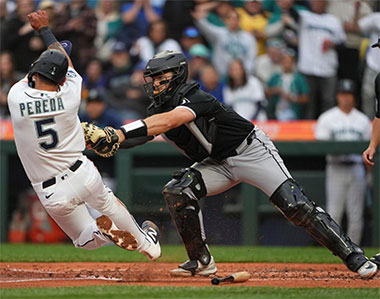 One of the outs that wasn't
Last night my friend Dave and I attended the game at TMP, as Dave's hometown Chicago White Sox are in town for a series against Your Seattle Mariners. It was a good time all around, but it was also one of the weirder games I've been privileged to see in person—not one, not two, but three things I'd never before seen in a baseball game happened last night.
First, in the opening frame a White Sox baserunner—Sam Antonacci, who had singled—tried to go first-to-third on a walk. As soon as "ball four" was announced on batter Munetaka Murakami, Antonacci sprinted to second base and just kept going, trying to steal third before the Mariners realized what was going on. It did not work, as pitcher Bryan Woo casually tossed the ball to third baseman Colt Emerson who easily tagged Antonacci out.
I get the thinking. I mean, on a walk the defensive team is usually just waiting for the batter to take off his elbow guard or whatever and make his way to first base, so if you're the runner at first it may seem like a cunning strategy to take them unawares. But dude, you're not that fast. Woo threw you out by 15 feet. Fun moment, though.
Then the real weirdness occurred in the bottom of the 3rd inning. Seattle catcher Jhonny Pereda was aboard at first base after being hit by a pitch. With one out, Julio Rodríguez then lined a laser beam to second baseman Antonacci, who appeared to allow the ball to hit the inside of his glove and fall to the ground, thus allowing him to attempt a double play. It seemed to work, the relay throw from the shortstop to first baseman was in plenty of time to double up the jogging Rodríguez; the inning was over and the White Sox began moving toward their dugout. But second-base umpire Mike Muchlinski waved his arms and pointed to second base and disallowed the double play, returning Pereda to first base and ruling Rodríguez's liner as caught, apparently retroactively.
Now, there is nothing illegal about deliberately allowing a would-be catch to bounce out of your glove; Antonacci, from what we could see anyway, was being a dick but not breaking the rules. Thus, my interpretation is that Muchlinski must have signaled catch/out prematurely, causing Rodríguez to give up his run to first base, and realizing his mistake was making a corrective ruling. His premature out call prevented Julio from running out the ball and thus the double play was unfair. I might be wrong in that assessment, perhaps Muchlinski saw the catch as a legitimate catch that Antonacci then dropped to fool the runners, but it seemed to us that it happened much too fast for that to be the case. And, as a softball umpire that has a bad habit of making calls a split second too soon, I empathize with the idea of having to correct a mistake.
But that was never-seen-it thing number two, never seen a double play disallowed before.
Then on the very next play, Randy Arozarena hit a drive into the left-field corner. As Pereda was rounding second base, he collided with shortstop Colson Montgomery, who was watching the ball with his back to the infield. This is what umpires refer to as "type-2 obstruction." Unlike with type-2 diabetes, you don't do anything to mitigate a type-2 obstruction, you just note it with a call/gesture and let the play continue, then when the play is over determine whether or not the obstruction actually made a difference in the result of the play. It is entirely up to the umpire's judgment whether or not to impose a penalty for the obstruction, which would be allowing the runner to achieve a base he didn't achieve during the play as it happened. Anyway, Pereda was delayed for perhaps half a second by the collision, continued around third base, and was thrown out by the left fielder by maybe 20 feet. It was not close, Pareda is not fast, and sending him past third was a mistake on the part of the Mariners' third-base coach. Nevertheless, after a lengthy conference between the four umpires, Pareda was awarded home due to the obstruction.
Because the conference took so long, Dave and I suspect there was disagreement between them and eventually the crew chief's opinion prevailed. Both of us thought that the delay was inconsequential. That half-second was not enough time for Pareda to have made up the 20 feet or so between him and the catcher when the catcher received the ball from left field. Thus, while Pareda being returned to first base on the previous play we adjudicated as proper given the interpretation of remedying an ump's mistake, we deemed awarding the run to the Mariners here as unreasonable.
Regardless, I had never seen an obstruction call play out like that before, let alone one called, in my opinion, erroneously.
Fortunately, that run didn't matter in the end. Josh Naylor lined out to end the frame in the next at-bat, and the M's had put up another run by the time Chicago had scored even once (on a solo homer in the 7th). The M's capped the scoring in the bottom of the 8th when 20-year-old rookie Colt Emerson barely cleared the right-field wall with his first big-league hit, a three-run homer over the head of White Sox RF Jarred Kelenic, who himself was a highly-regarded Mariner rookie whose first hit was a home run a few years back. Kelenic ended up being a flop (though I suppose he could still redeem himself somewhat). Emerson will have to wait and see, it was only his second game.
So, good game to have chosen, fun was had, and even though Dave was disappointed in the outcome, his team is still over .500 while the M's are still under. Go figure.
Tagged
Baseball,
Seattle Mariners,
Umping,
Posted on May 19, 2026 at 5:03PM | Permalink | |
New amendments

Having recently read through Melissa Murray's excellent The US Constitution: A Comprehensive and Annotated Guide for the Modern Reader, I've found myself considering the need for reforms. Post-Trump reforms, I mean, as it's been made crystal clear by the largely unchecked criminality and corruption of Felon47 and his regime that solid protections against corruption and politically-based jurisprudence don't exist. Or rather, to the extent that they do exist, they depend on a Congressional membership that is not itself corrupt and willing to throw away its collective oath of office.
Assuming we survive the current presidential term as a nation governed by the US Constitution—by no means a sure thing, and something very much dependent on the upcoming midterm elections and the integrity thereof—we need to do what we failed to do in 2021-2024 and enact reforms to safeguard against the sort of destruction and sabotage being inflicted on the United States right now by its own president, aided and abetted by a compliant Congress.
I don't know precisely what these reforms should be, but it does appear that the most effective, most ironclad way to achieve them would be amending the Constitution. That is, of course, a high bar to clear, but I think it's necessary.
So, though I remain uncertain as to what these amendments should be, I have been workshopping a couple in my head and present them here for comment and revision. What do you all think? What's missing? What's overreach? What would be better?
Here goes.
Proposed AMENDMENT XXVIII
Section 1
No elected officer of the Federal government—including the President, Vice-President, Senators, and Representatives—nor appointed heads or deputies of executive branch departments, shall operate, oversee, or have direct influence on any for-profit business ventures during his or her term of office. Any preexisting such business ventures must be dissolved or transferred to others for the duration of the term served. This prohibition shall also apply to the spouses of the elected or appointed officers.
Section 2
No elected officer of the Federal government—including the President, Vice-President, Senators, and Representatives—nor appointed heads or deputies of executive branch departments, may engage in the trading of market stocks or securities during his or her term of office. Any operation of investment funds owned by such officers must be handled by others without any involvement from the official for the duration of the term served. This prohibition shall also apply to the spouses of the elected or appointed officers.
Section 3
No for-profit business venture operated by, overseen by, or directly influenced by a member or members of the immediate family of any officer covered in Section 1 shall be permitted to do business with the Federal government unless specifically authorized to do so by an Act of Congress that is approved by a supermajority (60%) of both Houses and singed into law by the President.
Section 4
No properties owned by any official in the Executive Branch, including the President, Vice President, and heads or deputies of executive branch departments, shall be used to host government functions, house state visitors or Federal employees associated with government functions, or otherwise accommodate logistical needs of a government function, unless it does so at no cost to the Federal government. Any such free-of-charge accommodations shall be counted as in-kind donations under law where applicable.
Section 5
The Congress shall have power to enforce this article by appropriate legislation.
Proposed AMENDMENT XXIX
Section 1
Justices of the United States Supreme Court shall be subject to ethical and legal review and evaluation, at regular intervals no less frequent than every two years, by a body of no fewer than five individuals commissioned for the purpose by Congress. The Commission shall be comprised of accredited and recognized experts in Constitutional law, secular ethics, and/or sociological evolution. The Commission shall review the conduct of Justices in and out of court as well as their opinions in Supreme Court rulings, noting any conflicts of interest, inconsistencies regarding Supreme Court precedents, or deviations from Constitutional scholarship, as well as any other ethical issues deemed relevant in determining good behavior as required in Article III Section 1 of this Constitution. The findings shall be published in a report to be issued no more than three months following the close of the Supreme Court session in the operative year of interval, and may include recommendations to Congress regarding potential censures or impeachments of Justices for violating the good behavior clause. The Commission shall have no other punitive powers.
Section 2
Upon receipt of recommendations given by the Commission for censure or impeachment of a Justice or Justices, the Speaker of the House shall be compelled to offer a motion to censure or impeach said Justice or Justices for a vote of the full House of Representatives. A negative vote on censure or impeachment shall not preclude the recommendation be given again by subsequent Commission reports and taken up again by the House.
XXVIII is obviously the attempt at an anti-corruption amendment. The emoluments clause of Article II, which states that the President will be paid a salary and "shall not receive within [the term of office] any other Emolument from the United States, or any of them," of course already exists and in general has been enough from presidents one through forty-four and forty-six. But since the emoluments clause uses relatively obscure language (when's the last time you heard the word "emolument" in a context outside of the Constitution?), and since it likely would be interpreted by the Supreme Court as only applying to money coming directly from the federal or state treasuries, we now see that the clause is vastly insufficient.
Felon47 seems to have become belatedly aware of the emoluments clause with his attempted shakedown of the IRS; having been apparently convinced that him suing the IRS for $10B would not work, he pivoted to using the suit as a vehicle to create the slush fund recently announced as a "settlement" of the lawsuit (not a settlement, lawsuit is no more, this is a legally separate thing); then the slush fund had to be reconfigured to fit into an existing "settlement fund" structure with meaningless language saying Felon47 himself would not receive any money even though the loopholes around that are parsecs wide. But most of Felon47’s grift and theft and other corruption has been via the stock market, conning his supporters, cryptocurrency scams, manipulation of government contracts to suit his portfolio, and so on, things that don't come directly from the government treasury. Things that are also largely illegal already, but given that this Supreme Court has decreed that the president can commit crime at will so long as its cloaked in "official action"—and since, even absent that ruling, waiting until a president leaves office to prosecute him for crimes opens a huge window for destruction in the meantime—solidifying the prohibitions in the Constitution is more than appropriate.
XXIX is a more of a work in progress. Clearly, there needs to be some sort of enforcement mechanism for the Supreme Court as there are currently between two and six, depending on your metric, outright corrupt and/or politically driven and/or anti-Constitutional Justices on the bench. The problem is in what form that mechanism should take, and I don't have a clear idea for that. An oversight/ethical review commission seems like a good idea, but maybe it isn't? Maybe it is but isn't enough? Punitive power over the Court rests exclusively with Congress and I don't think we can change that; maybe there's a method of creating some enforcement entity that I haven't thought of, but so far I'm at a loss for anything other than an advisory commission.
I'm not sure I like the idea of imposing term limits on Justices, so I didn't include that. I don't like the concept of term limits generally, but in other cases they apply to elected officials that face being voted out at regular intervals. With the Court there's only impeachment, retirement, or death to remove a Justice. Lifetime appointments theoretically prevent Justices from being vulnerable to political pressures, which is good, but the "job security," if you will, appears, with this crowd anyway, to invite other corruptions. So I'm open to the concept, but it doesn't sit well as a solution to anything.
What's interesting to me as a starting point is the language of Article III establishing the Court, which states that "Judges, both of the supreme and inferior Courts, shall hold their Offices during good Behaviour." So we need a standard, or at least a barometer, for "good behavior" and a clarification that if Justices are not evidencing "good behavior" then they can no longer hold their offices.
I don't know if this is a practical train of thought at all right now; I mean, we have to survive the current regime first, or at least retake a commanding majority of Congress, before anything like this can even be put in motion, so there may be more pressing areas to focus on. But assuming we do make it through to the other side, being ready to go with reform is a good idea. Why not work out the details now?
Tagged
Politics,
President VonClownstick,
Congress,
Civics,
Posted on May 19, 2026 at 3:57PM | Permalink | |
Lost day, online surveillance, corruption run amok, and lost Canadians

A few scattered items for this afternoon...
-
Gravitational forces: The Black Hole of depression is sometimes hard to measure/identify because its effects are often gradual. One's orbit falls just slightly when you start to tire, but just a tad, it's not really noticeable. But a lower orbit means the gravity is stronger, so the next gradual shift comes a little bit faster, putting you under slightly heavier gravity again, but you still haven't really noticed, and on and on until you realize, hey, it's really hard to stand up now.
Well, yesterday it was really hard to stand up. It was basically a lost day. Then last night/this morning I had grief dreams, my subconscious apparently looking for ways to bum me out by creating a dream-movie wherein my grandpa dies all over again and Pixel goes missing. Sometimes my subconscious is a real asshole.
In retrospect I can see that over the last week-plus I'd been slipping in my orbit. More easily distracted, unfocused, slower to process. Much more irritable. Whether that realization means that now I can blast myself back into high orbit remains to be seen, but usually it's not so much a blast off as a hard climb. One good thing about my lost day yesterday is that I slept a lot, so maybe banking more rest will help. We'll see.
- You're being watched: There's a website called Since You Arrived that does nothing but inform you of what information is being given by your browser/computer to sites you visit online. It's interesting, might be surprising if you're not into the workings of the interwebs. Check it out, if you dare.
-
Worse before better: Even the relatively utopian universe of Star Trek postulated that we as humans would have to go through some nightmares before we achieved the dream. So I'm actually hopeful that Preznitwit Felon47’s latest scheme of blatant corruption, settling a $10 billion "lawsuit" between himself and the IRS that he controls—which should be thrown out and deemed not subject to any settlement for any amount of money or "damages" (he sustained zero injury)—for over a billion dollars to be allegedly-but-not-really used in a "weaponization fund" to aid those prosecuted by the Biden DOJ (e.g. January 6 rioters, among others) and thus amount to a payment scheme for his private militia of MAGA goonsquad will be seen for what it is: the alleged President of the United States backing an armored truck up to the U.S. treasury and stealing for himself, whether he uses it to pay people to do violence for him or not. And with that recognition, tip the scales such that the career of Felon47 starts crashing down in earnest. (I mean, you'd think the illegal war and DHS murdering people would be plenty, but it wasn't enough.)
Of course, I was also hopeful that people would see the destruction of the East Wing and the blatantly corrupt ballroom project for the scam that it is too, and the Qatari jet bribe for what it is, and the cryptocurrency frauds for what they are, and the myriad other thefts and frauds perpetrated on the American public be recognized as the actions of a criminal. So far, bupkis, so maybe people won't care about having a billion dollars-plus of their money just outright stolen from them in a literally criminal abuse of the legal system. But I think they will, I think most care about all of it, it's only Mike Johnson and his GOP caucus that don't give a damn. The question is, will it get bad enough that even some of them start to see the light or will it take defying the attempts to rig the midterms and retaking control of Congress to see any action?
I heard some former Republican wonk on a podcast the other day say that if even a few Republican Congresspeople were smart—ha!—they'd join the Democrats to impeach Felon47 now, before the midterms, as any future in politics they want to have after he's gone will be severely damaged by their record of aiding and abetting. I doubt that will happen, though, because they aren't smart or they're so cowed that they just won't defy Dear Leader. They'd need to be inundated with communications from their constituents demanding why they are even tacitly approving of all this blatant corruption for that scenario to have even the slimmest chance of playing out.
Because Americans en masse only seem to care about politics when their personal finances are affected, maybe the combination of a president personally stealing money from them and $6 gasoline and everything at the grocery store costing $5 or more (I just did some shopping today—bag of chips, $5; jar of mayo, $5; box of Grape Nuts, $5; tub of salsa, $5; brick of cheese, 2-for-$5; bottle of fruit juice, $5....) and the repeated playing of Felon47 saying out loud into microphones that "I don't think about Americans' financial situations, I don't think about anybody" will finally be enough. Maybe.
- Know your lineage: If the decline of the USA is getting to be too much and you want to leave, maybe look into your family tree for Canadians. The Canadian Supreme Court recently ruled that there was a flaw in that nation's citizen-by-parentage laws, so Parliament passed Bill C-3, which says that any individuals with a documented, traceable direct ancestor who was a Canadian citizen are themselves eligible to be Canadian citizens. So far as I know, I have none in my background, at least on my mom's side—my grandfather was an amateur genealogist of sorts and traced his tree back to Civil War-era USA, and I know my mom's mom's parents came over from the UK. But if you do, and if you can prove it (government birth records should exist going back a ways), you too may be a Canuck-in-waiting.
Off now to watch baseball.
Tagged
The Black Hole,
Politics,
The Internet,
President VonClownstick,
Posted on May 15, 2026 at 7:08PM | Permalink | |
2-for-3 is good at the plate, but it sucks in the field
Cal Raleigh broke an 0-for-30-something slump earlier tonight in Your Seattle Mariners' win in Houston. I'm hoping that I break out of my own slump of sorts next time I'm out on the field umpiring.
On the heels of last Wednesday's mistakes, Monday night at Cap Hill there was other weirdness. I had three games, and the first two were fine. They featured some of my favored teams and included a couple of firsts for me, including umping my first shutout, which in rec league softball is a rarity indeed. The Superstars beat the Pancake Batters (Capitol Hill edition) 24-0. Freaky. I also had to have a team adjust their lineup for having too many women bat in a row. Too many dudes in a row happens all the time, but it was a welcome first to have a team with so many women on it that they had to stagger them more than every third batter.
Anyway, first two were fine, even though I continued to have issues with being quick on the draw. You'd think after eight years of this I'd be better at that, but not yet. The only time it resulted in a wrong call I was able to reverse it right away, so it was just embarrassing, but it's a bad habit I have to break.
Game three, though.
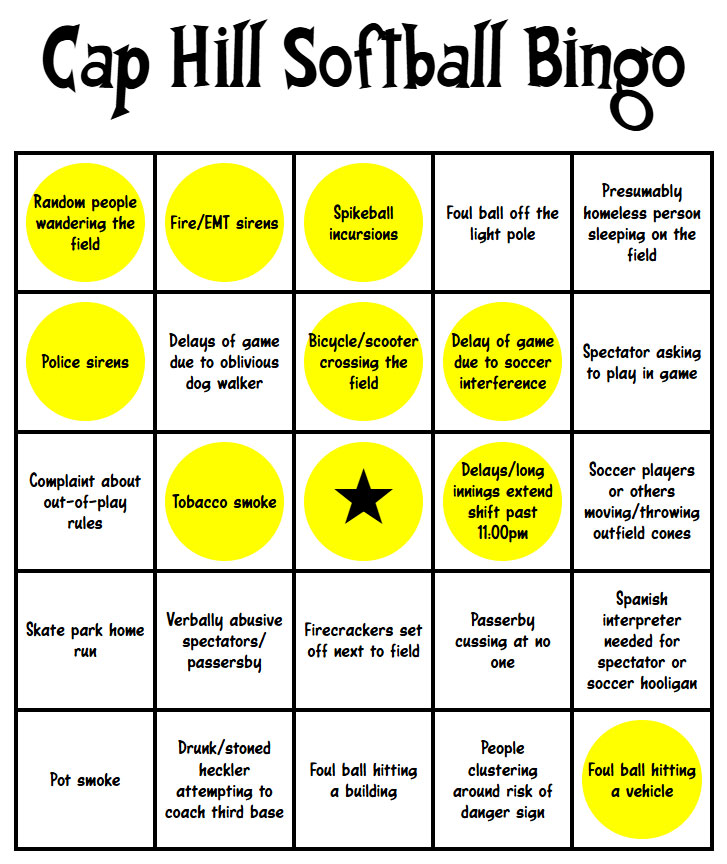
That one pitted Pitch Slap (a not-as-clever-as-they-think team name) against the Chop Zone Outlaws (a truly inspired team name). The Outlaws I like a lot, I've gotten to be friendly with a few of them and they're always fun and trouble-free. The other guys have been around for years and I'm reasonably acquainted with them, too, but just as they've never been a favorite, nor have they ever been a problem for me. Never got any flak from them. Until Monday, when I heard not one complaint out of them, not two, but several—on dumb stuff, too. A close call at first went against them and I got an earful about how it wasn't remotely close (say what?) and the outrage was outsized even if the call had been wrong (and we don't have replay and there's just one of me, so on close ones like that we'll never know). At the other team's suggestion, I overturned that one in the name of keeping the peace (it helped that the score was lopsided). I got flak for calling a down-the-middle pitch a strike, with claims that it was over the batter's head when it crossed the plate at stomach level. I got flak for resisting those complaints. I got flak for something else they didn't like that I never conclusively identified. I suspect PS was cranky because they were getting the tar beat out of them, but it befuddled me nonetheless.
Anyway, all that got in my head to the point where I really did screw up later in the game. It's a minor thing that didn't affect the score in the slightest, but I found myself being way late on calling a ball out of play—because the catcher was still talking to me about the prior dustup—and then having to make a call on where to place runners when I hadn't paid a lick of attention to where they had been (and thus what they were then entitled to). I made a guess, PS got cranky and yelled at me again, and I owned it that I screwed up and didn't see and went to reverse the call, but damage was done and there was no restoring confidence.
We finished the game, PS made a valiant attempt at a comeback in the 7th but still lost handily, and nobody from their dugout offered to help me pack up. Unsurprisingly.
For what it's worth, the Outlaws thought I'd gotten nothing wrong at all, but whether any of the calls were incorrect or not, I still failed in my mind because (a) I let grousing get to me, and (b) as such I wasn't watching what I should have been on a later play and exacerbated a bad situation.
I left the field feeling quite annoyed with myself and grateful that I don't have another shift until Sunday. Give me time to reclaim my damaged calm, to paraphrase Jayne from Firefly.
Also, because we were running late all evening (hazards of a nice day, clearing people off the field takes a while), I barely had any opportunity to say hi to a couple of favorite players before or after the middle game and after we were done I only had the chance to vent a bit with Meg, a fave from the Outlaws, but missed nerding out some with Jared, who was wearing a Punisher T-shirt; The Punisher is probably my very least favorite Marvel property, but the character does feature in the Daredevil TV show that just wrapped its season and I wanted to ask Jared's opinion. First-world problems, am I right?
Anyhow, Sunday I have another brutal five-gamer to do, but at least it isn't at Green Lake so I'll have some shade at least part of the day. Then a three-gamer Tuesday and a one-gamer (barely worth it!) on Thursday and nothing next weekend because of Memorial Day. Monday I have M's tickets with Dave, so I miss out on a potential three other games, but right now that's just fine with me. I feel like I'm worthy of being benched for a few days.
Tagged
Umping,
Posted on May 13, 2026 at 3:08AM | Permalink | |
Civics class
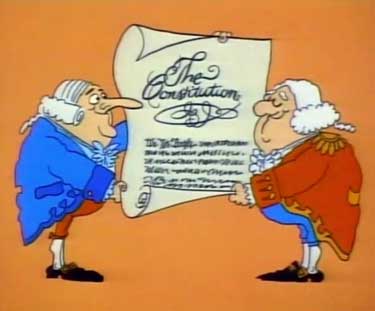
I am of the generation that got to experience the greatness of Schoolhouse Rock in its original run. They were short (three- or four-minute-long) cartoons that aired during the Saturday morning cartoon block, I think on CBS, but I might be misremembering the network. The Schoolhouse Rock shorts were exceptionally effective educational tools, priming American kids from coast to coast on basic math principles, the weirdness of the English language, and, most importantly, civics.
I'm reminded of those now because I've been reading The US Constitution: A Comprehensive and Annotated Guide for the Modern Reader, newly published. The book, by legal scholar Melissa Murray, might be called Schoolhouse Rock for grown-ups, at least as concerns American civics. Murray breaks down the text of the Constitution and gives each section an easily-digestable summary before providing historical context and analytical commentary on how the section has been applied over time and what ambiguities did at one time or still today exist.
It couldn't be a more timely publication, really. I don't know exactly what is being taught in elementary schools these days re: American civics; I asked a friend who is a Bellevue public school teacher about it a few years ago, and though she herself doesn't teach it she says others do. I can't imagine it's a very robust course, though, given how woefully ignorant most Americans appear to be on the subject. Perhaps her district, being a suburban one with decent resources, relatively speaking, does better. But I'd be curious to know what the typical elementary school—hell, even up to high school—curriculum has in the way of American government/civic education requirements. People seem to know little.
I know, it appears that people are ignoramouses because 77 million of them voted for a fascist con man (again). That skews the perceptions. But an even greater number of eligible Americans don't bother to vote at all, so maybe I'm actually underestimating how many of us are civic dunces. Hard to say.
In any event, Murray's book is highly accessible, which is helpful since the verbiage in the Constitution, having been written in the 1780s, can be both dense and, to modern eyes, oddly formed (the original text is included, complete with spellings of the day and original punctuation that would get you red-penned in English class today).
For me, having learned from "I'm Just a Bill," "The Preamble," "No More Kings," and "Shot Heard Around the World" as well as, you know, civics and history courses and just being an attentive citizen, the value of the book isn't so much in the explanations of what is in the Constitution so much as the material describing the debates of the day that led to its particular language; how it had to differ from the earlier Articles of Confederation and why, the disputes among the 13 states of the day that gave us compromises that we still live with the failings of, the oversights that required remedy shortly after ratification. Also what areas have been relevant for the Supreme Court over the decades; how clarifications have been made and, in infamous historical cases as well as under the Roberts Court of today, how the Court has sometimes twisted Constitutional language (that's my interpretation, Murray doesn't ever use language like "twisting the words of the Constitution" here) and ruled in ways contradictory to precedents they claim to respect (as with the Roberts Court's 2020 ruling that language included by Congress stipulating that the head of the Consumer Financial Protection Bureau can only be fired by the president for cause was not permissible even though in 1935 the Court upheld the law requiring the president to show cause—that is, “inefficiency, neglect of duty, or malfeasance in office”—in order to remove a member of the Federal Trade Commission, a body established by Congress in similar fashion).
To say I highly recommend this is underselling it. Anyone interested in American ideals of democracy and government; the principles behind the concept of checks and balances; why we have two houses of Congress instead of just one; the historical reasons we have, for example, an Electoral College; how and why states are engaging in redistricting mania now and how come the Supreme Court allows it; how we are still today saddled with legal flaws in our system that are rooted in slavery; really, anyone curious about how the government works in any way would find this book useful. (If nothing else, reading the details of Constitutional principles and requirements should help you understand how so very many of Felon47’s actions as president have been unconstitutional violations of the separation of powers.)
Check it out. The eBook version is only $15.
Tagged
Politics,
Civics,
Schoolhouse Rock,
Posted on May 11, 2026 at 1:16AM | Permalink | |
Blood on the field
Another Capitol Hill umpiring shift, another player bloodied.
Last night's three games were largely unremarkable, save for (a) me blowing more calls than I find acceptable and (b) someone getting hurt. In the first game, the guy catching for one team was chatting with me about the umping gig, asking about its pitfalls, and I said that generally it's fun; the exceptions come when players get too obnoxious or riled up and I have to threaten ejections or when someone gets hurt (I left out the office politics shit that's been more of an issue this year), but that thankfully neither of those things has happened in a while. Jinx. Because (b) came in the second game of the night, when a batter for Thunderhanded fouled a pitch straight back into the catcher's face. As I was crouching down to call the pitch—I tend to get a better angle on pitches I think will be strikes by getting my eye level to the middle of the strike zone—I had a great view of the swing, the foul, and the impact to the bridge of the catcher's nose.
I immediately fetched the first-aid kit, but there's not much in there for this sort of thing, just some gauze. I also grabbed a couple of faux-ice packs. In short order the catcher's teammates were surrounding her at the plate and took her off the field, but she declined my offer to call EMTs and said it was just bloody, not serious. She sat out a couple of innings and then came back to the game. Having seen a few broken noses on such plays in my time, not to mention the seriously damaging play that happened in my first shift of the year back in January, I was glad she didn't feel like it was more than a nuisance, but at the same time I wonder if I wouldn't have gone to urgent care anyway if it had been me.
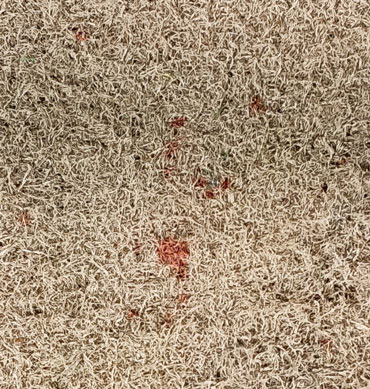
Not quite Curt Schilling's bloody sock, but blood on the turf. Which, come to think of it, would be a good title for a pulp detective mystery.
Anyway, with that occupying part of my brain we resumed play, and perhaps due to that distraction or perhaps not I botched a couple of things. Nothing that made a difference in the outcome of the games, but as a perfectionist it still rankles me.
I'd already made a questionable call in the first game—a close tag play at third base that also involved a slide that might have been illegal—but it was at the end of a blowout game and thus harmless and just a matter of it being a close call. The second game's botches were the kind that annoy me: One was a misapplication of rules, the others a result of me being too quick to make a call. Fortunately, the mistakes didn't just favor one team, so at least there was parity...
Anyway, the rules-based call involved a runner being hit by a batted ball while standing on the base. I ruled fair ball in play, nothing further, when the correct call would be runner out, batter to first, dead ball. There is an exception to runner-out-when-hit-by-batted-ball, the runner is safe if on the base when hit, but only in an instance of the infield fly rule. Knowing that exception confused me. This was a liner down the first-base line, not an infield-fly, so the exception doesn't apply. The team benefitting from my mistake got a couple of runs out of it (but they still lost handily). The too-quick call was on a close play at first, the batter-runner was clearly going to be safe had she continued in a straight line to the safety base and in my head I had already "seen" it happen as extrapolation and was preparing the safe call. Except she didn't keep on on a straight line, for some reason she veered away from the base and had to reach back, just enough time for the throw to beat her there. But I was already calling safe. I suppose I could have reversed myself, but it had been a rather emphatic call and it was super close, so I let it go. Later there was an opposite call, I called out on a close play at first and immediately thought, "um, was that right?" and replayed it in my head; I can't be sure, but I think I was wrong there too. Players in the first-base dugout were razzing me about it, doing the headset gesture that big-league managers do when they want to invoke an instant-replay challenge, but thankfully all involved were in good spirits and not taking it seriously. Helps that the score was pretty lopsided. Oh, I also signaled a deep fly was a home run but the baserunner stopped at second base figuring it had actually bounced first on the turf. I let that be, figuring if they didn't want the homer that was fine and I wasn't 100% sure it had cleared the turf line anyway, and besides I knew those runs were going to score anyway (they did, next batter singled them in).
It's a lot for one shift. Too many wrong for my standards. I can't blame foggy-head depression symptoms or anything like that, I just had a bad night. I guess these things happen, I'm just glad it happened when I had completely agreeable players all having a good time.
Tagged
Umping,
Posted on May 7, 2026 at 3:41PM | Permalink | |
Diamond notes
I haven't had a lot to report about my umpiring of late, which you can usually take to mean things have been fine. No drama, no troubles, nothing weird going on.
I mean, aside from the usual Capitol Hill weirdness during my shifts there, one of which I had the other night. Games were all good, but there were some people hanging out in left field that not only refused to move out of the way, but were highly offended that we were in their way. Their right to sit wherever they want in a park, permits and field reservations and fees be damned. They were giving outfielders so much grief that I felt it necessary to intervene and explain that we had exclusive use of the field for the night, and if they chose not to move then they were choosing to be in the way of batted balls and running fielders and risking injury to all involved. Sadly, they kept yelling at me while I was trying to say all that, so I made do with pointing to our sign that says, essentially, we paid for use of this field and be in the way at your own risk. They didn't continue to yell at fielders after that, but they didn't move either. Cap Hill, baby.
Yesterday, though, I was at Green Lake. Not Capitol Hill, nor my typical Sunday posting at Northacres Ballfeld. I like Green Lake as a place to spend the day, but the fields are kinda lousy and, more to the point, historically the teams that sign up to play there have tended to be more...let's say, overly competitive, and thus more annoying. Still, even if I drew some hotheads, it's nothing I couldn't handle; the real issue for me was I had been assigned all of the day's games on that field and my colleague Ben had been assigned the whole day's slate on the opposite diamond. That's five games, or almost eight hours of umping, plus 15-20 minutes on either side setting up and then taking down things like outfield cones, out-of-play markers, bases, promotional banners, etc. Also, by unwritten rule, whichever of the two umps arrives first gets to choose which field to work, which is clearly going to be field #1 because starting around 1:30 or 2:00 the home plate area of that one is in the shade. Parking sucked yesterday, and Ben got there first.
Thus, from about 11:45am to about 8:10pm, I was out there in the 80-plus degree sun, on my feet the whole time, the only break coming way early when the noon game only lasted about 59 minutes instead of its allotted 85. I downed eight 12 oz. bottles of Gatorade (six brought from home, two thoughtfully given by players) and still had a bad headache when I finally headed back to my car (parked a few blocks away). When I got home I showered off the day's dirt, sweat, and sunscreen, put my feet up and watched the afternoon's Mariner game (ugh), and then uncharacteristically went to bed before midnight. The headache kept me awake/woke me up a few times, but I ended up sleeping about 12 hours. For someone who grew up in the Arizona desert and thought nothing of outdoor activities in 100+ degree heat, I sure have become vulnerable to too much sun; I feel like Bizarro Superman or something.
It's a damn good thing there weren't any troublemakers in my games. In fact, though I missed out calling a game for The Leftovers (they were on Ben's field), I did get a doubleheader's worth of a team called the Power Pink Ponies (don't ask, I don't know), which includes two old faves in Frankie and Stacy that I only rarely see these days since they tend to be at Green Lake and I don't. I called Frankie "Frankie Raye" at one point, which was a reference she didn't get nor did I expect her to, but she's a redhead with attitude, so why not be compared to a herald of Galactus?
Meanwhile, I attended a real baseball game on Saturday, witnessing Your Seattle Mariners play the visiting Kansas City Royals after a lengthy pregame ceremony belatedly honoring one of the team's greatest heroes. Randy Johnson developed into one of the game's most dominant pitchers after being traded to the Mariners as a rookie in 1989; in 1998 the M's decided he was both injury-prone and too expensive to keep, so he was traded away. I went to Saturday's game with Erik, someone with whom I had seen many a Randy Johnson game in the Kingdome back in the day, and he commented that trading for Johnson in ’89 was the best trade the Mariners ever made and trading him away in ’98 was the worst the M's ever made. I don't know if I agree, there are a lot of contenders for Worst Mariner Trade, after all, but his logic is sound—even though the M's got some nice players in return (Freddy Garcia, John Halama, Carlos Guillén), Johnson went on to win four more Cy Young Awards and pitch until he was 45. Plug Johnson's 2000 record of 19-7, 2.64 ERA, and 249 innings in place of Garcia's 9-5, 3.91, 124 IP and suddenly the 2000 M's aren't merely Wild Card entrants bounced out in the ALCS, but 100-plus game winners that host the ALCS and maybe get their first pennant. It's hard to imagine the 2001 M's losing two Randy Johnson starts in that year's ALCS.
Of course, that's all unprovable speculation and not trading Johnson would unleash a whole slew of domino effects. Who knows how things would have played out, but consider:
- 1999-2004 Randy Johnson WAR: 48.0.
- 1999-2004 Garcia+Halama+Guillén WAR: 39.7.
True, RJ got paid about $50M more than the three other guys in that span, and in those days you'd be talking about that difference being 20% of your team payroll; the team probably doesn't get Aaron Sele or John Olerud and has to make do with cheaper alternatives. Who knows. Fun to think about, though.
You can read Erik's account of the RJ festivities here.
Meantime, the Mariners lost the game in true 1990s Randy Johnson fashion: starting pitcher is great, strikes out 14, walks none, leaves with a lead, and the bullpen blows it. Perhaps there has never been a more fitting tribute.
Also, and not just regarding the Mariners but all of Major League Baseball, it seems, I am somewhat perplexed by the change in conventional wisdom regarding lineups.
In my youth, the logic was this in constructing your lineup:
Leading off you have a high-on-base percentage guy (e.g. Wade Boggs), a great stolen base threat (Vince Coleman), or ideally a guy who has both qualities (Brett Butler); in the two hole you have a contact hitter, a good bat-handler with a decent OBP and enough speed to go first-to-third on a base hit to right-center (Roberto Alomar, Ryne Sandberg); batting third is your best overall hitter, someone solidly in the .300+ range of batting average that can drive in runs (George Brett, Tony Gwynn; fourth is the "cleanup" position, where you put your best home-run hitter, ideally to hit one out and "clean up" the bases that have hopefully been occupied by at least one of the first three guys; fifth is your understudy for the three-hole; then six through eight you stagger lefties/righties while the nine spot is the easiest out for the opposition. (Occasionally you might haver a manager who prefers his best hitter at leadoff rather than third because the leadoff man is guaranteed more at-bats in a typical game than lower-in-the-order guys just by nature of the lineup turning over.)
That made sense to me and still does.
Today, managers are putting their big homer guys in the second spot. I don't like it. Yeah, the two-hitter is more likely to get another AB than the four-hitter, so another shot at him hitting a longball, but putting the power-hitter there means he's also more likely to whiff than anyone else (save maybe the ninth-place guy). I heard one broadcaster calling the two-three-four spots the "heart of the order" the other day. To me, the heart of the order is the middle of the order, conventionally—or, formerly conventionally—thought of as three-through-six. That's where your slug will come from. I guess the game has become so homer-centric and so strikeout-laden that managers don't think like they used to; everyone is going to rack up the Ks, so putting a high-strikeout guy at or near the top doesn't matter. A team has four or five guys that hit 25+ homers a season, so the four-slot isn't special that way.
Eh, I fell like Dana Carvey's Grumpy Old Man character thinking about this. In my day, teams were more balanced; in my day strikeouts were thought of as worse than other outs; in my day you'd never see Rob Deer batting second.
Alas.
Speaking of, I'm going to go watch the M's try to break their losing streak now.
Tagged
Umping,
Baseball,
Seattle Mariners,
Posted on May 4, 2026 at 8:26PM | Permalink | |