



Tag: Civics
New amendments

Having recently read through Melissa Murray's excellent The US Constitution: A Comprehensive and Annotated Guide for the Modern Reader, I've found myself considering the need for reforms. Post-Trump reforms, I mean, as it's been made crystal clear by the largely unchecked criminality and corruption of Felon47 and his regime that solid protections against corruption and politically-based jurisprudence don't exist. Or rather, to the extent that they do exist, they depend on a Congressional membership that is not itself corrupt and willing to throw away its collective oath of office.
Assuming we survive the current presidential term as a nation governed by the US Constitution—by no means a sure thing, and something very much dependent on the upcoming midterm elections and the integrity thereof—we need to do what we failed to do in 2021-2024 and enact reforms to safeguard against the sort of destruction and sabotage being inflicted on the United States right now by its own president, aided and abetted by a compliant Congress.
I don't know precisely what these reforms should be, but it does appear that the most effective, most ironclad way to achieve them would be amending the Constitution. That is, of course, a high bar to clear, but I think it's necessary.
So, though I remain uncertain as to what these amendments should be, I have been workshopping a couple in my head and present them here for comment and revision. What do you all think? What's missing? What's overreach? What would be better?
Here goes.
Proposed AMENDMENT XXVIII
Section 1
No elected officer of the Federal government—including the President, Vice-President, Senators, and Representatives—nor appointed heads or deputies of executive branch departments, shall operate, oversee, or have direct influence on any for-profit business ventures during his or her term of office. Any preexisting such business ventures must be dissolved or transferred to others for the duration of the term served. This prohibition shall also apply to the spouses of the elected or appointed officers.
Section 2
No elected officer of the Federal government—including the President, Vice-President, Senators, and Representatives—nor appointed heads or deputies of executive branch departments, may engage in the trading of market stocks or securities during his or her term of office. Any operation of investment funds owned by such officers must be handled by others without any involvement from the official for the duration of the term served. This prohibition shall also apply to the spouses of the elected or appointed officers.
Section 3
No for-profit business venture operated by, overseen by, or directly influenced by a member or members of the immediate family of any officer covered in Section 1 shall be permitted to do business with the Federal government unless specifically authorized to do so by an Act of Congress that is approved by a supermajority (60%) of both Houses and singed into law by the President.
Section 4
No properties owned by any official in the Executive Branch, including the President, Vice President, and heads or deputies of executive branch departments, shall be used to host government functions, house state visitors or Federal employees associated with government functions, or otherwise accommodate logistical needs of a government function, unless it does so at no cost to the Federal government. Any such free-of-charge accommodations shall be counted as in-kind donations under law where applicable.
Section 5
The Congress shall have power to enforce this article by appropriate legislation.
Proposed AMENDMENT XXIX
Section 1
Justices of the United States Supreme Court shall be subject to ethical and legal review and evaluation, at regular intervals no less frequent than every two years, by a body of no fewer than five individuals commissioned for the purpose by Congress. The Commission shall be comprised of accredited and recognized experts in Constitutional law, secular ethics, and/or sociological evolution. The Commission shall review the conduct of Justices in and out of court as well as their opinions in Supreme Court rulings, noting any conflicts of interest, inconsistencies regarding Supreme Court precedents, or deviations from Constitutional scholarship, as well as any other ethical issues deemed relevant in determining good behavior as required in Article III Section 1 of this Constitution. The findings shall be published in a report to be issued no more than three months following the close of the Supreme Court session in the operative year of interval, and may include recommendations to Congress regarding potential censures or impeachments of Justices for violating the good behavior clause. The Commission shall have no other punitive powers.
Section 2
Upon receipt of recommendations given by the Commission for censure or impeachment of a Justice or Justices, the Speaker of the House shall be compelled to offer a motion to censure or impeach said Justice or Justices for a vote of the full House of Representatives. A negative vote on censure or impeachment shall not preclude the recommendation be given again by subsequent Commission reports and taken up again by the House.
XXVIII is obviously the attempt at an anti-corruption amendment. The emoluments clause of Article II, which states that the President will be paid a salary and "shall not receive within [the term of office] any other Emolument from the United States, or any of them," of course already exists and in general has been enough from presidents one through forty-four and forty-six. But since the emoluments clause uses relatively obscure language (when's the last time you heard the word "emolument" in a context outside of the Constitution?), and since it likely would be interpreted by the Supreme Court as only applying to money coming directly from the federal or state treasuries, we now see that the clause is vastly insufficient.
Felon47 seems to have become belatedly aware of the emoluments clause with his attempted shakedown of the IRS; having been apparently convinced that him suing the IRS for $10B would not work, he pivoted to using the suit as a vehicle to create the slush fund recently announced as a "settlement" of the lawsuit (not a settlement, lawsuit is no more, this is a legally separate thing); then the slush fund had to be reconfigured to fit into an existing "settlement fund" structure with meaningless language saying Felon47 himself would not receive any money even though the loopholes around that are parsecs wide. But most of Felon47’s grift and theft and other corruption has been via the stock market, conning his supporters, cryptocurrency scams, manipulation of government contracts to suit his portfolio, and so on, things that don't come directly from the government treasury. Things that are also largely illegal already, but given that this Supreme Court has decreed that the president can commit crime at will so long as its cloaked in "official action"—and since, even absent that ruling, waiting until a president leaves office to prosecute him for crimes opens a huge window for destruction in the meantime—solidifying the prohibitions in the Constitution is more than appropriate.
XXIX is a more of a work in progress. Clearly, there needs to be some sort of enforcement mechanism for the Supreme Court as there are currently between two and six, depending on your metric, outright corrupt and/or politically driven and/or anti-Constitutional Justices on the bench. The problem is in what form that mechanism should take, and I don't have a clear idea for that. An oversight/ethical review commission seems like a good idea, but maybe it isn't? Maybe it is but isn't enough? Punitive power over the Court rests exclusively with Congress and I don't think we can change that; maybe there's a method of creating some enforcement entity that I haven't thought of, but so far I'm at a loss for anything other than an advisory commission.
I'm not sure I like the idea of imposing term limits on Justices, so I didn't include that. I don't like the concept of term limits generally, but in other cases they apply to elected officials that face being voted out at regular intervals. With the Court there's only impeachment, retirement, or death to remove a Justice. Lifetime appointments theoretically prevent Justices from being vulnerable to political pressures, which is good, but the "job security," if you will, appears, with this crowd anyway, to invite other corruptions. So I'm open to the concept, but it doesn't sit well as a solution to anything.
What's interesting to me as a starting point is the language of Article III establishing the Court, which states that "Judges, both of the supreme and inferior Courts, shall hold their Offices during good Behaviour." So we need a standard, or at least a barometer, for "good behavior" and a clarification that if Justices are not evidencing "good behavior" then they can no longer hold their offices.
I don't know if this is a practical train of thought at all right now; I mean, we have to survive the current regime first, or at least retake a commanding majority of Congress, before anything like this can even be put in motion, so there may be more pressing areas to focus on. But assuming we do make it through to the other side, being ready to go with reform is a good idea. Why not work out the details now?
Tagged
Politics,
President VonClownstick,
Congress,
Civics,
Posted on May 19, 2026 at 3:57PM | Permalink |  |
| 
Civics class
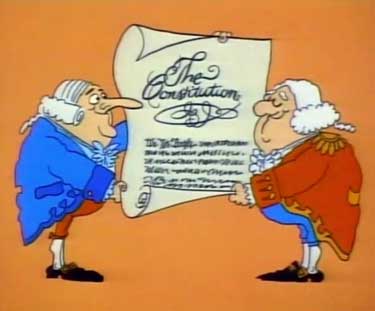
I am of the generation that got to experience the greatness of Schoolhouse Rock in its original run. They were short (three- or four-minute-long) cartoons that aired during the Saturday morning cartoon block, I think on CBS, but I might be misremembering the network. The Schoolhouse Rock shorts were exceptionally effective educational tools, priming American kids from coast to coast on basic math principles, the weirdness of the English language, and, most importantly, civics.
I'm reminded of those now because I've been reading The US Constitution: A Comprehensive and Annotated Guide for the Modern Reader, newly published. The book, by legal scholar Melissa Murray, might be called Schoolhouse Rock for grown-ups, at least as concerns American civics. Murray breaks down the text of the Constitution and gives each section an easily-digestable summary before providing historical context and analytical commentary on how the section has been applied over time and what ambiguities did at one time or still today exist.
It couldn't be a more timely publication, really. I don't know exactly what is being taught in elementary schools these days re: American civics; I asked a friend who is a Bellevue public school teacher about it a few years ago, and though she herself doesn't teach it she says others do. I can't imagine it's a very robust course, though, given how woefully ignorant most Americans appear to be on the subject. Perhaps her district, being a suburban one with decent resources, relatively speaking, does better. But I'd be curious to know what the typical elementary school—hell, even up to high school—curriculum has in the way of American government/civic education requirements. People seem to know little.
I know, it appears that people are ignoramouses because 77 million of them voted for a fascist con man (again). That skews the perceptions. But an even greater number of eligible Americans don't bother to vote at all, so maybe I'm actually underestimating how many of us are civic dunces. Hard to say.
In any event, Murray's book is highly accessible, which is helpful since the verbiage in the Constitution, having been written in the 1780s, can be both dense and, to modern eyes, oddly formed (the original text is included, complete with spellings of the day and original punctuation that would get you red-penned in English class today).
For me, having learned from "I'm Just a Bill," "The Preamble," "No More Kings," and "Shot Heard Around the World" as well as, you know, civics and history courses and just being an attentive citizen, the value of the book isn't so much in the explanations of what is in the Constitution so much as the material describing the debates of the day that led to its particular language; how it had to differ from the earlier Articles of Confederation and why, the disputes among the 13 states of the day that gave us compromises that we still live with the failings of, the oversights that required remedy shortly after ratification. Also what areas have been relevant for the Supreme Court over the decades; how clarifications have been made and, in infamous historical cases as well as under the Roberts Court of today, how the Court has sometimes twisted Constitutional language (that's my interpretation, Murray doesn't ever use language like "twisting the words of the Constitution" here) and ruled in ways contradictory to precedents they claim to respect (as with the Roberts Court's 2020 ruling that language included by Congress stipulating that the head of the Consumer Financial Protection Bureau can only be fired by the president for cause was not permissible even though in 1935 the Court upheld the law requiring the president to show cause—that is, “inefficiency, neglect of duty, or malfeasance in office”—in order to remove a member of the Federal Trade Commission, a body established by Congress in similar fashion).
To say I highly recommend this is underselling it. Anyone interested in American ideals of democracy and government; the principles behind the concept of checks and balances; why we have two houses of Congress instead of just one; the historical reasons we have, for example, an Electoral College; how and why states are engaging in redistricting mania now and how come the Supreme Court allows it; how we are still today saddled with legal flaws in our system that are rooted in slavery; really, anyone curious about how the government works in any way would find this book useful. (If nothing else, reading the details of Constitutional principles and requirements should help you understand how so very many of Felon47’s actions as president have been unconstitutional violations of the separation of powers.)
Check it out. The eBook version is only $15.
Tagged
Politics,
Civics,
Schoolhouse Rock,
Posted on May 11, 2026 at 1:16AM | Permalink | |