

Tag: Schoolhouse Rock
Civics class
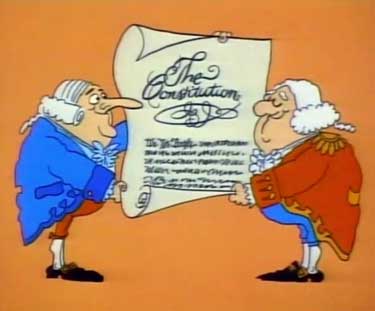
I am of the generation that got to experience the greatness of Schoolhouse Rock in its original run. They were short (three- or four-minute-long) cartoons that aired during the Saturday morning cartoon block, I think on CBS, but I might be misremembering the network. The Schoolhouse Rock shorts were exceptionally effective educational tools, priming American kids from coast to coast on basic math principles, the weirdness of the English language, and, most importantly, civics.
I'm reminded of those now because I've been reading The US Constitution: A Comprehensive and Annotated Guide for the Modern Reader, newly published. The book, by legal scholar Melissa Murray, might be called Schoolhouse Rock for grown-ups, at least as concerns American civics. Murray breaks down the text of the Constitution and gives each section an easily-digestable summary before providing historical context and analytical commentary on how the section has been applied over time and what ambiguities did at one time or still today exist.
It couldn't be a more timely publication, really. I don't know exactly what is being taught in elementary schools these days re: American civics; I asked a friend who is a Bellevue public school teacher about it a few years ago, and though she herself doesn't teach it she says others do. I can't imagine it's a very robust course, though, given how woefully ignorant most Americans appear to be on the subject. Perhaps her district, being a suburban one with decent resources, relatively speaking, does better. But I'd be curious to know what the typical elementary school—hell, even up to high school—curriculum has in the way of American government/civic education requirements. People seem to know little.
I know, it appears that people are ignoramouses because 77 million of them voted for a fascist con man (again). That skews the perceptions. But an even greater number of eligible Americans don't bother to vote at all, so maybe I'm actually underestimating how many of us are civic dunces. Hard to say.
In any event, Murray's book is highly accessible, which is helpful since the verbiage in the Constitution, having been written in the 1780s, can be both dense and, to modern eyes, oddly formed (the original text is included, complete with spellings of the day and original punctuation that would get you red-penned in English class today).
For me, having learned from "I'm Just a Bill," "The Preamble," "No More Kings," and "Shot Heard Around the World" as well as, you know, civics and history courses and just being an attentive citizen, the value of the book isn't so much in the explanations of what is in the Constitution so much as the material describing the debates of the day that led to its particular language; how it had to differ from the earlier Articles of Confederation and why, the disputes among the 13 states of the day that gave us compromises that we still live with the failings of, the oversights that required remedy shortly after ratification. Also what areas have been relevant for the Supreme Court over the decades; how clarifications have been made and, in infamous historical cases as well as under the Roberts Court of today, how the Court has sometimes twisted Constitutional language (that's my interpretation, Murray doesn't ever use language like "twisting the words of the Constitution" here) and ruled in ways contradictory to precedents they claim to respect (as with the Roberts Court's 2020 ruling that language included by Congress stipulating that the head of the Consumer Financial Protection Bureau can only be fired by the president for cause was not permissible even though in 1935 the Court upheld the law requiring the president to show cause—that is, “inefficiency, neglect of duty, or malfeasance in office”—in order to remove a member of the Federal Trade Commission, a body established by Congress in similar fashion).
To say I highly recommend this is underselling it. Anyone interested in American ideals of democracy and government; the principles behind the concept of checks and balances; why we have two houses of Congress instead of just one; the historical reasons we have, for example, an Electoral College; how and why states are engaging in redistricting mania now and how come the Supreme Court allows it; how we are still today saddled with legal flaws in our system that are rooted in slavery; really, anyone curious about how the government works in any way would find this book useful. (If nothing else, reading the details of Constitutional principles and requirements should help you understand how so very many of Felon47’s actions as president have been unconstitutional violations of the separation of powers.)
Check it out. The eBook version is only $15.
Tagged
Politics,
Civics,
Schoolhouse Rock,
Posted on May 11, 2026 at 1:16AM | Permalink |  |
| 