



SNW 408: Orders of Magnitude
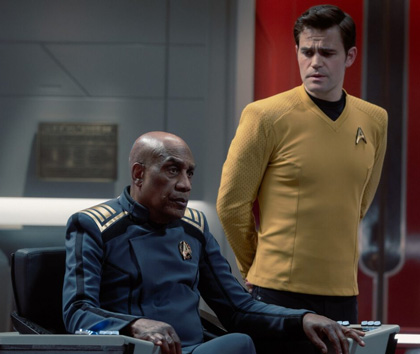 Don't get too comfortable in that chair, Admiral, it'll be mine in a couple years
The latest episode of Strange New Worlds is a departure from the rest of the season. Which is to say, it's not a departure from the basic Star Trek concept. There's no blatant gimmick being built on for the first time since the season premiere (which had its own subtler gimmick, if you can call dinosaurs subtle).
It is, however, derivative as hell in drawing heavily on Crimson Tide and other films, not to mention the trope refined in The Next Generation of the Bad Admiral (or "badmiral"), in attempting to tell a story about people in a chain of command resisting illegal orders and the suspect motivations of military leaders.
There's plenty of potential here, to be sure, but like many entries of seasons three and four of SNW, this episode went to production with a script that needed heavy rewrites but the writers' room and showrunners didn't recognize that they had an unfinished product. I continue to be profoundly disappointed that the people currently in charge of my beloved Star Trek do not understand why it has the fanbase it does and do not know how to write well. To be fair, they do write character reasonably well; the failings tend to be in the areas of story structure, plot details, building up to a climax and satisfactorily resolving the action. All of that is on display in this one.
Episode 408: “Orders of Magnitude” | Written by Alan B. McElroy | Directed by Sharon Lewis
★★★
Co-showrunner Henry Alonso Myers was interviewed over at TrekMovie and called this week's episode "as high level a version of a classic Star Trek episode as we have." Well, that is true, but it isn't the accolade he thinks it is; it's more a comment on what's lacking in the rest of the season than it is praise for "Orders of Magnitude."
We have a classic "badmiral" situation brewing when, while Captain Pike and Number One are off the ship and incommunicado (pursuing a B-story we'll cut back to now and then), hero of the Klingon war Admiral Simon Reeger—played by the great Joe Morton, the Brother From Another Planet himself, given a raw deal here—arrives and commandeers the Enterprise to pursue a mysterious cloaked ship alleged to have been the culprit in a recent attack on a Federation colony world. Also on board is Lt. Commander James T. Kirk, ostensibly because he wanted a checkup by Dr. M'Benga, but as even M'Benga points out, that's a flimsy excuse. He's there for no reason except he needs to be so he can be the hero of this story, so best to just accept the stupid in why he's there and move on.
Anyway, Reeger decides the pursuit of the mystery invisible craft supersedes all, and in the absence of Pike and Una appoints the highest-ranking officer aboard—Kirk—to be his exec for the duration (Pelia is the same rank as Kirk, but she's not in the line of succession, as it were) and they warp out of orbit, leaving Pike and his party without so much as a phone call. (They do leave a voicemail, though, in the form of a "message buoy.") Spock points out that it would be more logical for an actual Enterprise officer to serve as acting exec, but Kirk quips that, not to worry, Spock will someday be able to aim his logical brain at some other captain as first officer. Because these guys never miss a chance to foreshadow anything.
Initially, we don't see Reeger as a bad guy. In fact, he's revered by a few Enterprise crewmembers who are fellow veterans of the Klingon war—notably Ortegas and La'an—and Reeger makes attempts to flatter and ingratiate himself to the crew at large. He nevertheless comes off as overly intense, and from the get-go he's doing things that strike the viewer as extreme, starting with leaving Pike without warning. Before long he chastises Kirk for doing the job of XO and providing (quite sensible) suggestions and options he doesn't like, as well as rather obviously attempts to manipulate Kirk by comparing him to his father, George Kirk, who was Captain Reeger's XO on the USS Constitution during the war. So by the first act, we the audience can tell that Reeger has an agenda that isn't above board and suspect he chose Kirk as XO because he felt he lucked into a situation where he could manipulate a key subordinate that has little to no established relationship with the crew. Kirk is also getting suspicious, but mostly because Reeger got into his head about his dad, not because of what Reeger's doing on the Enterprise.
Soon after checking in on the B story with Pike, Una, Uhura, and Cadet A'Sha on the landing party (more on that later), the Enterprise has caught up to the mystery ship in the Argus system and Reeger goes silent-running in order to sneak up on and, hopefully, destroy it. However, a freighter enters the system and, because of the sensor tech, as soon as it gets in range it will effectively "ping" the Enterprise and thus reveal the starship's presence to anyone in the vicinity. Reeger can't have that, and he won't wait out the freighter lest he lose his attack window. He implies he wants to destroy the freighter to keep them from detecting the Enterprise by ordering a torpedo readied. but Ortegas and Kirk point out there are other ways to avoid detection (they do not point out that a sudden destruction of the freighter would probably also alert the mystery ship to their presence, but OK). Reeger modifies his order to fire a "zero-thrust" torpedo (an obvious misnomer, something that makes no sense yet somehow made it all the way to the shooting script; it should have been "zero-yield" torpedo, or "unarmed" torpedo) at the freighter. With no explosive, the torpedo would be a simple projectile that takes out the freighter's engines and communications. Sure. Not believable, but OK. Still, the move is risky—if the torpedo doesn't hit its precise target, the freighter is apparently so fragile that it could still blow up. Odds of destruction are over 40% according to Spock, but Reeger manipulates the crew into quasi-supporting his order by putting the onus on doubting La'an's abilities as a markswoman. The gambit proceeds and is successful, but Kirk and the audience are further pushed into believing that Reeger is unhinged to some degree, having wanted to fire on another ship unprovoked.
This is reinforced to what should be the last straw when Reeger, angry that the delay debating what to do about the freighter gave the mystery ship time to land on Argus II, decides that preventing the mystery ship from leaving Argus II is so important that the only solution is to implement General Order 24 and obliterate the surface of the planet. (Aside: the first mention of General Order 24 was in "A Taste of Armageddon" when Kirk invokes it in a bluff gambit on Eminiar VII. One of the great headcanon puzzles for decades is why in the universe Starfleet had a general order that wipes out a planet surface. Though not explicitly stated, here we can infer the order originated as part of the Klingon war as a last-ditch solution to some scenario. It's as good an answer as any to the puzzle.) After all, the mystery ship landed "with no resistance," so Reeger concludes the people there are in cahoots with it. Never mind that it could have landed anywhere and the populace is relatively concentrated; it may well have hidden far away from the people for all they know. In fact, they know next to nothing about the planet.
Kirk objects, as (a) though Reeger assumes Argus II must be the mystery ship's home base, they have no evidence of that; (b) the small planetary population would be collateral damage; (c) even if the population was supporting the mystery ship, they might be doing so unwillingly; (c) there is no state of war declared against the mystery ship as they don't know who controls it; and (d) it simply goes against basic Starfleet ethics. It would probably also be classified a war crime if the Federation has such classifications when not at war. I'd have added (e) the mystery ship may have landed because, despite Reeger's "silent running," they'd noticed they were being followed and were hiding behind human (alien) shields on the surface to wait until their pursuers left.
All of which should be plenty—PLENTY—to convince the entire bridge crew that Reeger should not be in command and they should not obey his orders. But somehow it isn't. Aside from Kirk, no officer speaks up against GO 24 even though it's clear they don't like it. Reeger dismisses Kirk from the bridge and targeting begins; we see a half-hour countdown to readiness to obliterate on a console.
Kirk, who has spoken with his brother Sam and learned that Dr. M'Benga also served on Constitution under Reeger during the war—what a fortunate coincidence! What a small fleet this is!—tries to get more info about Reeger from the good doctor, but is stymied by good ol' medical confidentiality. But, Kirk has also—by lazy writing happenstance—read on a conveniently placed PADD that drew his attention by conveniently beeping that Reeger's family was among those killed in the colony attack thought to have been perpetrated by the mystery ship. Thus, Kirk has concluded Reeger's motivation is revenge, not justifiable Federation security.
Somehow, all of this is still insufficient for M'Benga to relieve Reeger on medical/psychological grounds because it doesn't "make him unable to perform the duties of command." Even factoring in M'Benga's own recollection that after the war Starfleet promoted Reeger in part to "move him off the bridge of a ship" doesn't budge him.
OK, here I have to digress to say, just who the hell do the writers want Joseph M'Benga to be? Every time we learn about his history something unsavory is revealed, and here he's just allowing minor genocide despite ample reason to intervene. Just how much war-related PTSD does this guy have? Maybe someone should look into his fitness to be CMO.
Back on the bridge, Reeger orders a phaser upgrade using "a trick [he] learned in the war" and Kirk volunteers to oversee the work. Arriving in engineering, Kirk gets info from Scotty about where one might, hypothetically speaking, screw up the phasers. Just curious. After a check-in on the B story, Kirk has returned to the bridge and tries to clandestinely message Starfleet Command to ask them to relieve Reeger since M'Benga won't do it, but he's caught in the act. Reeger relieves Kirk of duty and orders La'an to put Kirk in the brig.
In one of the more believable sequences in this script, Kirk distracts La'an enough to swipe her hand phaser and escape custody. He then recruits Sam Kirk to help him sabotage the ship's phasers; Sam, by the way, has dug up some old correspondence from George Kirk and found something interesting that doesn't jibe with the official record. So, Kirk naturally hacks into M'Benga's confidential records from the Constitution—what's a little invasion of privacy and probably felonious breach of cybersecurity among friendly acquaintances?—and finds out that the war heroics Reeger has been taking credit for and built his reputation on could not have been his because he was injured and sedated at the time and the acting captain of Constitution then was... George Kirk.
Sam acts as a decoy to buy Jim Kirk time to go to the dangerous phaser junction Scotty told him about. La'an shortly locates him and has Scott beam him out of the junction room; he's been injured and is suffering from radiation exposure, but instead of taking him to sickbay, La'an marches him up to the bridge so Reeger can yell at him and have him on hand to witness "what has to be done." (She does ask Scott to page M'Benga to meet them there to treat Kirk, though.)
As Reeger orders the phaser barrage, Kirk countermands, telling all that he has rigged the phasers to misfire—implementing the firing solution will actually destroy the Enterprise rather than the planet surface unless he enters some abort codes. Reeger becomes incensed, screams that the people on the mystery ship must be made to bleed, threatens Kirk (and Sam Kirk) with court-martial, asks Spock to get the abort codes form Kirk via mind-meld ("I respectfully refuse" is the reply to that), then physically assaults Kirk and puts a phaser to his head. Kirk taunts him about his war record and his stolen honor from claiming the actions of George Kirk as his own, further enraging Reeger into ranting until we get the scream analogous to "YES, I ORDERED THE CODE RED" and then, then M'Benga has enough to relieve him of duty. But Reeger isn't having it and tries to hit the firing controls himself before getting phaser-stunned.
All GO 24 prep is aborted, Kirk admits he was bluffing about the phasers, and the Enterprise returns to the moon they left Pike and company on. The landing party has survived their B-story, so Pike is back aboard for the resolution scene wherein Reeger protests his innocence and claims that he must have been drugged to exhibit that manic, violent behavior. He blames Kirk for drugging him, but M'Benga speaks up and says, no, "it wasn't Kirk, it was me. I drugged you in order to declare you unfit." (Except, as we learn later, Reeger was right and Kirk did drug him, having spiked his coffee with cordrazine. M'Benga is just taking the fall to protect Kirk's career.) Reeger demands punitive action be taken, but Pike realizes he doesn't have all the facts and will let Starfleet Command sort out the details, he just wants Reeger off the ship.
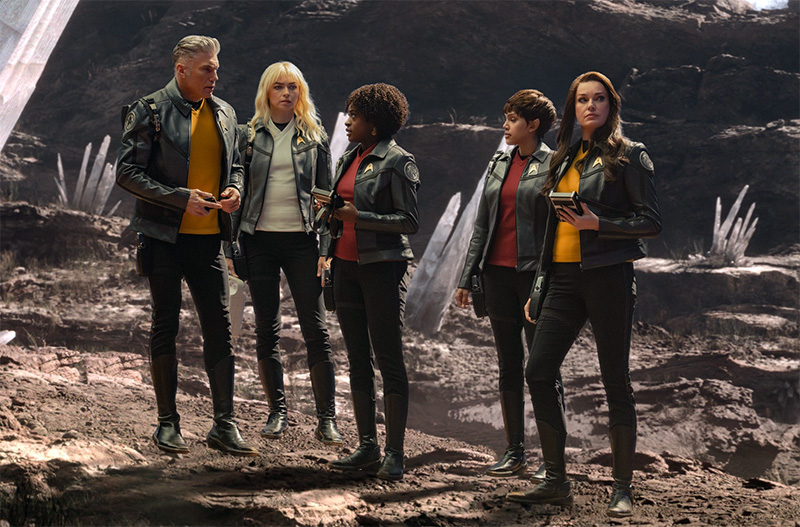
You guys are in this one, but your main function is to be off the ship. Here's $20, maybe take in a movie or get trapped by some smugglers for a while.
Our other resolution scenes are about the B plot, so to sum that up: Pike and the landing party were responding to an SOS, only to discover it was a trap laid by some Andorian smugglers. The smugglers lured a Starfleet ship in order to possibly hijack it but to definitely get someone to alter their equipment to better detect and fool Starfleet ships. To leverage their demands, they critically injure Cadet A'Sha; eventually Uhura agrees to help them in order to save the cadet. Except, not really, as what Uhura actually does is rig the Andorians' gear to emit a sustained high-frequency tone that screws with their sensory antennae, causing enough chaos for her to then singlehandedly take down all of the smugglers and free the rest of the landing party.
So wrapping that up on the ship we see A'Sha recovering in sickbay and declaring to Uhura that she is leaving Starfleet, which should surprise no one since she's stated from the beginning that she didn't want to be there, yet Uhura takes it personally. Reporting to Pike and Una, she apologizes for her failure but Pike isn't hearing it, instead praising her for heroic actions on the moon and awarding her a battlefield promotion to Lieutenant junior grade.
It's a bit of a mess, but at least there's a Star Trek story here; we have something to think about afterward. But it's overly bloated, in dire need of streamlining and focus. The B-plot is fine, kind of by-the-numbers, but coherent and well-paced. The A-story, however, needed to be focused entirely on a fundamental difference of opinion between two officers and how that difference is dealt with. We didn't get Crimson Tide or A Few Good Men here, we got an obviously obsessive admiral going to extreme lengths for a military mission during peacetime, perhaps seeking nothing but vengeance, and one guy saying hey, this is batshit, let's not do this while the rest of the crew just follow the nutjob. Instead of making Reeger the villain—or even a sympathetic villain, which I think was the intent—what we really see is a bridge crew (and CMO) of lemmings that wouldn't support the ethical position of their acting first officer.
We needed a slower burn, for Reeger's attitude to feel acceptable before gradually approaching frenzy, but he was abandoning the captain and committing the ship to wartime actions in peacetime within minutes of coming aboard. We needed Kirk to be proactively seeking out info on Reeger rather than just stumbling across it. We needed less in the way of flailing and more coherence.
Think Richard Daystrom from "The Ultimate Computer," or Admiral Satie from "The Drumhead," or Admiral Leyton from "Homefront." They all go off the rails, but when they do it's at least somewhat surprising; they build up to it. And they didn't need to be drugged to do so.
That may be the biggest flaw in this script—having Reeger's climactic tantrum be cordrazine-induced muddies the waters, it detracts from the whole point of the episode and makes Kirk less heroic. I'm thinking they want to use this to further the M'Benga throughline of the past few episodes that seems to indicate he'll leave the fleet. But it's lazy. If you need that for the future, then make M'Benga actually be the one to drug Reeger and have him do it because of what he knows from past history. (This would also let the staff do a M'Benga's past plotline that paints him positively instead of as just a possibly sociopathic violent special ops killer.) Have Reeger's more slow-burn actions be enough to clue M'Benga in to the fact that Reeger's just out for revenge, have M'Benga collude with Kirk to foil the plans, have them know with certainty that Reeger will eventually create a crisis point while the rest of the crew can justifiably note that he's not really done anything to justify a mutiny yet. You can even keep the climactic scene as is, just build up to it much differently. If you need more time in the episode to do that well, trim the B-plot, it's very formula as is. And you aren't under network rules, you can go a few minutes longer with no issues.
I can think of these things with just a few hours reflection on it, so why does the SNW writer's room not see these problems?
Alas.
Stray particles:
- Kirk will return to the Argus system when he goes slightly Reegerish himself in the original series episode "Obsession."
- There's a lot of telegraphing in this one, both in dialog and visually: Cordrazine is introduced in the teaser, Reeger's coffee habit is dwelt on a bit too much, La'an's hero-worship of Reeger is over the top at first. Even Pike and company going incommunicado is a flashing signal to us that they need to be out of the way.
- Ortegas is given the Chekov job of narrating the obvious to the audience, but worse; she's given the lines that talk down to us, like comparing the method of tracking the mystery ship to the allies tracking U-boats in World War II. In case we didn't get the gist by the already-too-detailed explanations.
- I enjoyed the several James Horner-esque music cues while the Enterprise pursued the mystery ship. Just a little evocation of Wrath of Khan without rubbing our faces in it.
- The dynamic between the Kirk brothers is excellent, their interplay in this episode almost justifies the odd choice to put Sam Kirk on Pike's crew in the first place.
- La'an tracks Kirk on a tricorder by isolating "his biosignature." Sounds good and all, but that doesn't track with established Treknology and took me out of the flow for a bit.
- Uhura's one-woman takedown of the smugglers in the B plot was well-executed and gives the character some deserved badassery to perform, plus the gambit of pretending to do the smugglers' bidding foreshadows a similar gambit she'll do in "I, Mudd" (TOS).
- Early on, Reeger criticizes George Kirk as part of his manipulation efforts with the line, "there's no hiding who you are once you sit in that chair." You knew then and there that the line would be thrown back at him before the end, but when it does happen it's quite satisfying, so I'll allow it. :)
- Paul Wesley in this episode joins Babs Olusanmokun in the tiny club of post-TOS actors who correctly pronounce "Klingon." Always makes my smile to hear it right.
- M'Benga's reasoning, as explained to Kirk, for taking the heat on Kirk's spiking of Reeger's coffee is that he's basically paying forward George Kirk's actions from the Constitution, when the senior Kirk opted not to scandalize Reeger for the good of the fleet. It's a little dubious and doesn't make a great deal of sense, but if it does turn out that his motives are actually in service of another plotline it'll work better.
- Speaking of Kirk spiking Reeger's coffee, when could that possibly have happened?! The only opportunity for Kirk to do it was rather early in the story. And how did he get the cordrazine? I suppose a little drug theft makes for a nice companion task to hacking confidential medical records, but when did he have time to get to the coffee pot? It would have to have been before he tried contacting Starfleet, meaning he was waiting half the episode for Reeger to pour himself a cup.
- At one point Reeger chastises Kirk for being away from the bridge during a red alert, but he doesn't actually order the red alert until well after Kirk has returned. Asshole.
- This is the first time that Paul Wesley's Kirk is believable as the same character we know from the original. He's finally given proper Kirk material and he plays it very well—complete with a Kirk bluff gamble and knowing better than his superior officers and earning loyalty from his subordinates (even if they don't really recognize it).
- Cordrazine, of course, is the stimulant drug that McCoy accidentally overdoses on in "City on the Edge of Forever," so as soon as it was mentioned in the teaser we knew it would come into play, but the writers thought we needed more expository description so M'Benga has to tell Kirk (the audience, really) that in larger doses it causes paranoia. Everything must be telegraphed.
- It's explicitly stated that Reeger ran interference every time George Kirk wanted to take leave as part of his quest to punish the elder Kirk, and implied that this is why the Kirk brothers saw so little of their dad while growing up. But the timing doesn't work for that; Reeger's beef with George Kirk began during the Klingon war, which was only six or so years prior to this episode. I'm not sure who the older brother is, Sam or Jim, but Sam's been away from home long enough to have a wife and three kids and Jim would be approximately 29 in this episode. For Reeger to have had impact on George Kirk's family time when Jim and Sam were kids, their conflict would have to have preceded the Klingon war by about a decade.
I really want next week to be good without so many caveats. Somehow I doubt it will be as I'm pretty sure it's another gimmick episode given the title, "Once La'an a Time."
Tagged
Star Trek,
TV,
Posted on September 15, 2026 at 7:36PM | Permalink |  |
| 
Comments
Posted by Karen on September 15, 2026 (28 days ago)
Well this one I got! Though I didn’t get much of what you wrote because I am not watching. Cool Uhura stuff though!
No one has commented on this page yet.
Post your comment
RSS feed for comments on this page | RSS feed for all comments