


SNW 409: Once La'an a Time
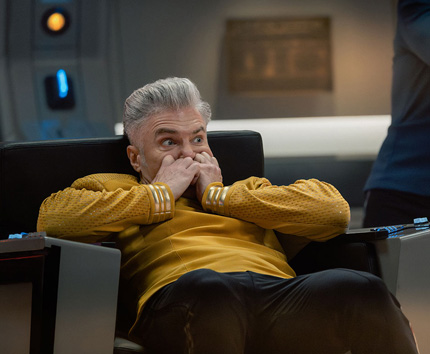 Is this Anson Mount playing Sir Rauth or is this Anson Mount imagining the audience reaction to yet another gimmick episode?
At this point I have to ask if anyone on the writing staff of Strange New Worlds has now or ever had any interest in writing for Star Trek. Because they have done their damnedest to avoid it all season. They've apparently preferred to write anything, anything other than a thought-provoking science-fiction story about Captain Pike and the crew of the USS Enterprise.
The latest installment of this failed season is a swords-and-sorcery type fantasy lark that is ostensibly about paying off a season-long character arc but is actually just an excuse for the cast to act goofy and out of character. Again.
Why? Why are they wasting their time on this stuff? Season three was chock full of lazy writing and bad execution from start to finish, but at least most of the episodes had something resembling a point, however hidden behind lousy structure it was. Here we get another one that pursues very little substance in the name of a gimmick that is thought to be stronger than it could ever be.
Episode 409: “Once La'an a Time” | Written by Onitra Johnson | Directed by Sydney Freeland
★½
I actually didn't hate it. There's enough here that is genuinely amusing to keep me from rating it as low as last season's terrible finale episode, and if you go into it with a certain mindset it could be pretty enjoyable. But it nonetheless fails on so many levels as an episode of Star Trek.
"Once La'an a Time" is a sequel to season one's "The Elysian Kingdom," wherein an alien intelligence likened to a "Boltzmann brain"—yet another instance of the SNW writers grabbing something from cosmology that sounds on the surface like a suitable explanation for what they want to do but in actuality is nothing of the sort, ala "blackbody radiation"—somehow read the mind of Dr. M'Benga's terminally ill young daughter and turned the Enterprise and its crew into a fantasy environment based on her favorite book. That episode sought to resolve a season-long character arc for Dr. M'Benga, this one similarly tries to pay off one for La'an. Whether satisfactory or not, "The Elysian Kingdom" did resolve it for the good doctor; "Once La'an a Time" did not for the troubled security chief, though the writers seem to think it did.
We open with a log entry voiceover from La'an that right off the bat telegraphs the plot by essentially referring to herself, confusingly and inaccurately, as a split personality. She and Captain Pike, along with lieutenants Spock and Ortegas, are beaming back aboard after acting as Federation/Starfleet representatives at the wedding of an important Benzite dignitary. She's not happy. The rest of the team knows she's not happy, Ortegas voices concern for her well-being while Spock continues with the telegraphing by stating that La'an is struggling with "two sides of herself." Through exposition we learn that La'an exposed an Orion espionage operation at the wedding, an important achievement and overall success, but in doing so ended up bashing the groom's face into the wedding cake and setting the bride's gown on fire. And she's generally full of pent-up aggression she needs an outlet for. (I don't know about you, but to me, that story sounds like a worthy episode, much better than the farce we see over the following 45 minutes.) Pike has La'an visit sickbay for a once-over, M'Benga pronounces her fit for duty, and we go directly to a mission brief.
The ship—which, remember, was orbiting Benzar but somehow between the beam-up and sickbay has been at warp long enough to find itself in interstellar space—has encountered what Spock describes as a planet that should not exist. It is labeled on the monitor graphics as "unknown flat planet" and it is a big chunk of conical dirt and rock beneath a relatively flat surface full of vegetation and atmosphere and inexplicable gravity that moves under its own power. Seems to me that Spock is not describing a planet that can't exist so much as a bizarre spacecraft, but sure. It's weird and intriguing, so naturally they decide to beam down and check it out.
Pike, Spock, Pelia, and La'an materialize in a grassy spot in a forest, where they spot someone that appears to be Dr. M'Benga, but isn't. Not-M'Benga recognizes La'an as "the princess" and moves to protect her from the others despite La'an's insistence that she is not, never has been, and never will be a princess; the party contacts M'Benga on the Enterprise (on a PADD rather than a communicator, something they didn't beam down with; I will headcanon that they called up, started asking M'Benga if he knew what this lookalike might be, and he sent down the PADD so they could have a video chat in which he could use visual aids) and he tells them what happened in that season one episode. (Only M'Benga remembers it because everyone else had been coopted to play roles from the fantasy book.)
M'Benga explains that each of the crew from back then should have a dopplegänger on the planet, the character they were coopted to play before—Pike's is Sir Rauth the Cowardly, Spock's the evil wizard Pollux, Uhura's the evil queen of the realm, and so on. Further, M'Benga says, the Boltzmann Brain entity back then had manifested aboard ship in response to his emotional issues surrounding his daughter; therefore, this same intelligence must be honing in on La'an's inner turmoil and formed a scenario for her. This, of course, is a gigantic leap of logic that no one questions and the entirety of the explanation we get for what the hell is going on. When magic is invoked and La'an incredulously asks if they're seriously treating "magic" as a real thing, Spock merely quotes Arthur C. Clarke that any sufficiently advanced technology is indistinguishable from magic and Pelia cracks wise about having given Clarke and Kubrick "notes" on 2001: A Space Odyssey. Nothing about the fantasy trappings is questioned again. Along with a copy of the book the environment is based on, appropriate costumes are beamed down for our characters to blend in and now everyone can play dress-up, though La'an refuses.
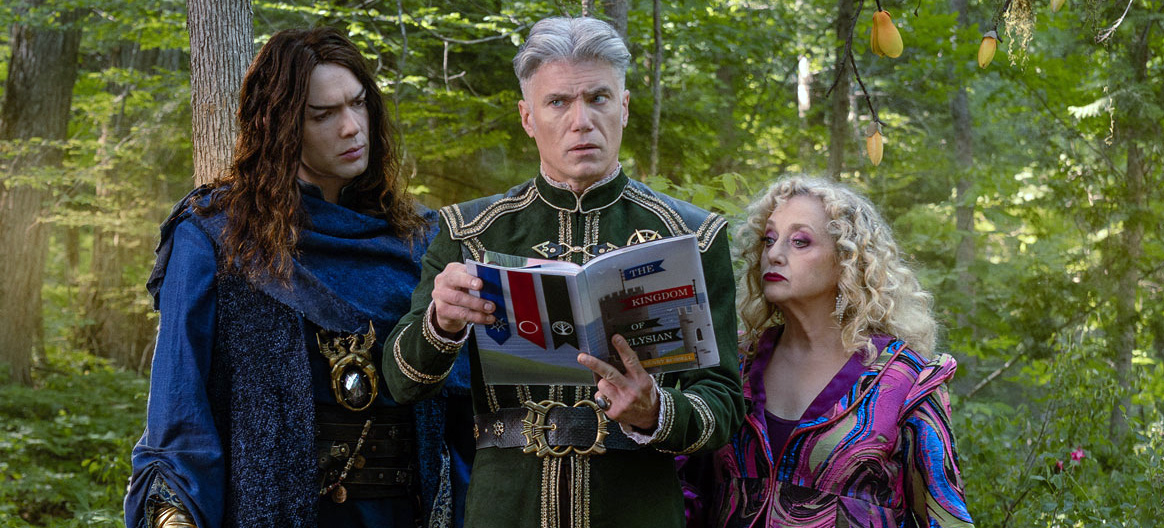
Spock, I'm confused, isn't this supposed to be Star Trek?
The group is soon set upon by soldiers in service of the queen, who capture Pike, Spock, and Pelia; La'an is accosted by another soldier, who is felled by Prince Dashing, a doppelgänger for James T. Kirk (who was not in "The Elysian Kingdom," but never mind that) who also mistakes her for "Princess Thalia." Unable to convince him she isn't Thalia, she plays along with the idea that her memory was stolen and she must get back to the castle, not to free Pike and Spock (who he thinks are Rauth and Pollux) but to recover the necklace the queen has placed her memory in. Works for the simpleton prince. They soon encounter Ortegas' doppelgänger, Sir Adya, who takes them to Una's doppelgänger, who provides the key to the castle. Dashing, we realize around this part, is also a werewolf, which he hides from all. Because sure, why not, let's add some more dual identity stuff.
Meantime, Sir Rauth and Pollux are looking for clues regarding the "iron dragon," and come across Pike and Spock's discarded uniforms and communicator (just one; hopefully Spock still has his, right?) which Pollux calls strange garb and a folded clam. Rauth opens the "folded clam" and is surprised when the voice of Ensign Salazar comes out of it asking if they want to come back to the ship. They decide that, yes, that sounds good, and they're beamed aboard. Uh-oh. Once there, via magic spells cast on Salazar in the transporter room, they learn who they are supposed to be in this place, deduce that they are aboard the "iron dragon," and outfit themselves in proper uniforms (magically).
The real Pike, Spock, and Pelia are brought first to a dungeon, where they meet the actual Princess Thalia and her dog, then to the queen, who has confiscated the book they brought and deduced that they are not who they appear to be and are in fact from the iron dragon. Because sure. Pike introduces himself and Spock, but since Pelia has no counterpart there, he introduces her as the author of the book. The queen's not interested in what Pike or Spock have to say, though, so she magically traps them in paintings while Pelia is told to write a further chapter in which the queen captures the iron dragon. She can't figure it out herself, but I guess if it's in the story, the queen can follow directions. Pelia makes a show of working on it, but is really just enjoying all the wonderful snack foods present and calls the chef, Max, a "miracle worker" in one of several direct references to The Princess Bride in general and Carol Kane's role in it specifically.
La'an and Dashing reach the castle and come upon the queen, who along with her witch assistant (Chapel's doppelgänger) schemes to bind the princess and La'an as "shadow selves" and thus become a dragon herself that can challenge the iron dragon in battle. That happens (after Dashing is transformed into his were-self and banished into a painting), the queen as dragon ascends into orbit to attack the ship, and La'an and Thalia are unconscious for a while until they awake and find themselves each experiencing the emotional demeanor of the other. They begin to sword-fight, because that's obviously necessary, but ultimately decide to try and join forces utilizing the potion the queen used to do whatever she did to suck their "shadowself" energy from them and get dragonified.
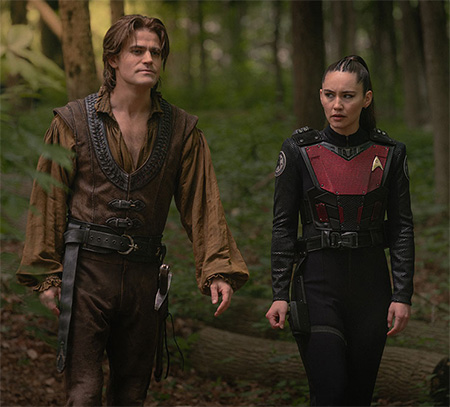
The Dread Pirate Rob— er, Prince Dashing and La'an
Aboard ship, Rauth and Pollux try and fail to play the roles of Pike and Spock, but despite encountering several crewmembers and chugging beers in the galley, no one clocks that their behavior is concerning. When they arrive at the bridge, it's in time to see the dragon begin its attack and they try fighting back; it's not working, though, so Rauth convinces Pollux to drain his reserves and attack the dragon magically, which, along with energy rising from the planet from La'an and Thalia's potion tinkering, reverts the dragon back into the queen and saps her of power. The people imprisoned in paintings are back to being people, and Number One confronts Rauth, having belatedly realized he and Pollux are fantasy characters and not the captain and science officer.
La'an and Thalia now have the best traits of each other and La'an feels complete in a new way. All except Pelia are returned to their proper places—Pelia, we're told, has hooked up with Max the chef and decided to stay behind to study the engine of the planet-which-isn't-a-planet-it's-a-ship-just-like-we-thought-when-Spock-first-described-it and pilot it "home," wherever that might be. Back aboard ship, La'an discovers that Thalia has gifted the dog, Runa, to La'an since Prince Dashing is allergic. So Runa now lives with La'an, who is content enough to literally let her hair down and go meet Lt. Cdr. Kirk for a date in the galley/rec room.
Hang on, Kirk is on the ship AGAIN? Did he just stay there after the last episode even though there was that whole Benzite mission and who knows what else in between? How has he not been busted down to steward for being the fleet's worst First Officer, never aboard his own ship? Farragut's captain is OK with all this? How? Why?
As this episode ends, I think we're supposed to think that all the stuff throughout the season with La'an worrying about her recessive augment genes and if she's destined to be a violent megalomaniac is now resolved and she can now feel good about herself and be a properly balanced and healthy woman who may or may not have special enhancements. I call bullshit on that. Nothing in this story, nothing, addressed her real issues. It merely dealt with her anger and inner tumult, not once even tangentially recognizing the cause of that anger and tumult. The experience cured her of a stretch of bad mood and she learned to love a dog. That's all well and good, I'm glad for her, but it's a band-aid at best. Or would be under better writers. This bunch appear to think simplified answers and non-answers are fine solves for big questions, just as they think spouting some simple-minded nonsensical fake science is enough to allow them to have complicated or even impossible plot elements. It's a deeply unsatisfying payoff to La'an's throughline.
That's bad enough, but it fails as a Star Trek episode because it's a wholly implausible plot that asks us to accept that a spontaneously-formed alien consciousness somehow read a character's mind and invented out of nothing a fairytale fantasyland spaceship as a therapy device. It further asks us to accept that said device includes living, breathing, people that exist and can exist anywhere other people can exist and continue to exist out in the galaxy somewhere (with Pelia) despite being created as avatars out of a children's book AND who can defy physics and reality by wielding magical powers. And not a Q in sight.
What redeems this a little bit, and what makes it a fun watch so long as you don't think of it as Star Trek, are the performances. Anson Mount in particular has brilliant comic chops and is a delight as Sir Rauth. Ethan Peck isn't on the same comic level, but he clearly had fun with Pollux. Christina Chong showed her range in both of her characters. There are some real laughs to be found. It's just not Star Trek. At all.
Bits:
- I adore The Princess Bride. Brilliant film. Hail Rob Reiner. But all the references to it got a little tiring after the third or fourth one.
- There's a scene near then end with La'an getting used to having Runa as a pet: she goes to the transporter with Runa following, tells Runa to wait there, and beams away. To where? Who knows. An indeterminate time later, she beams back and Runa is still waiting for her. Good dog. Um...where did she go? Why? Was this just a dog-training exercise? Did she just go into the buffer for a couple minutes and come out again? What? That would be insane.
- When the Enterprise is fighting the dragon-queen, it fires pulses of something from somewhere on the ship that does not correspond to phaser banks or torpedo tubes. What? Also, dragon fire breath (which somehow exists in vacuum) overpowers starship shielding. Magic, I suppose, because that's apparently real now. Because we've totally abandoned science-fiction and are now doing a space-fantasy show.
- The author of the children's book the Elysian Kingdom world is based on is cited as being Benny Russell (both here and in the first-season episode). This is yet another reference to the Star Trek canon for no reason other than being a reference. It serves no purpose. Beyond that, unlike the other nonsensical references to, say, the borgia plant or Kor or gratuitous tribbles, using the name Benny Russell is demeaning to the source material. We weren't meant to know if Benny Russell was or wasn't a real person. Having him declared real harms his story. And if we do accept him as a real person, having him be the author of a children's fantasy book rings false. I mean, one could headcanon a rationale for him to have written it, but why? Why damage that wonderful episode of Deep Space Nine and its followup use of Benny Russell by using his name here? Because these writers don't understand what they did. Because they just think of it as an "easter egg" for us nerds, dropping a name to show us, see, we're fans too, except in this case in particular it shows that even if they're "fans," they're not grasping the meaning and/or don't respect the substance of what came before. This reference is not only pointless, it's offensive.
- On two occasions, this script misuses the phrase "begs the question." First M'Benga says it, then Pike. Both improperly. The phrase has been colloquially misused in general society for some time now, but you'd think professional writers would know it properly. It does not mean "prompts another question"; its use is for noting a given premise is unsupported or incomplete. "Starfleet officers wear their rank on their sleeves, therefore you can tell who outranks whom just by looking." This begs the question, by what sleeve pattern can you discern a rank? "Captain Jones has commanded eight ships." That might prompt, but does not beg, the question, "what ships were they?" because there is nothing in the statement of serving on eight ships that presupposes other knowledge. Spock: "It appears our doppelgängers are quite reviled." Pike: "Which begs the question, where are they?" No. It does not. It prompts that question from Pike, but Spock's statement requires no clarification of contextual knowledge and has no relation to anyone's location.
- Since the fantasy planetship is mobile (and now piloted by Pelia), should we infer that if and when it comes near another person with emotional distress it will reconfigure itself to be a therapy session for that person? If so, will the people and environment remain based on the Elysian Kingdom children's book? Will it manifest new people out of nothing as it did Prince Dashing? Will anyone ever examine one of these created out of nothing people to try and find out how they exist? Of course not, there I go trying to make this science-fiction again. I might as well try and get Sam Kirk to admit that ley lines are bullshit.
- It seems Carol Kane (and thus Commander Pelia) has been written out for season five. Makes sense, but kind of a lame way for her to leave the show/ship/fleet.
Next week is the season finale. Usually, this would be a disappointment, as it means no more new episodes for almost a year. But after this truly annoying batch of episodes, I'm almost relieved. We need new people in charge of Star Trek. If only something else was on the horizon.
Tagged
Star Trek,
TV,
Posted on September 20, 2026 at 12:55AM | Permalink |  |
| 
Comments
No one has commented on this page yet.
Post your comment
RSS feed for comments on this page | RSS feed for all comments