



The facts do not matter
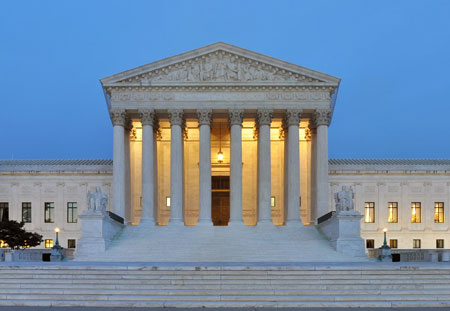
It's been a dark several days for American jurisprudence. The Supreme Court of the United States handed down a number of rulings as the close out their session, and even the rulings that aren't outrageous or corrupt or just plain anti-Constitutional are causes for alarm and spotlight the dire need for reforms of some kind for SCOTUS.
What kind of reform I'm not sure about. I tried my hand at it with my proposal for new Constitutional amendments, but it's a tough nut to crack. At minimum the Court needs ethical standards that are enforceable by an entity outside of the Supreme Court, but how we get there is murky.
We can't really celebrate the "good" decisions, the ones that are in favor of upholding law and the Constitution and the forces of good, because the votes have been astonishingly close, with several justices making no bones about their allegiance to the Dark Side of the Force.
The Court has, just this week, ruled the following:
-
That states can legally discriminate against trans women in public schools and universities. The cases involved lawsuits in West Virginia and Idaho challenging those states' bans on trans women participating in women's sports; in both instances lower courts found the bans to be illegal. SCOTUS said the lower courts were wrong. "The Constitution and Title IX do not require an overhaul of women’s and girls’ sports throughout America," wrote Justice Brett Kavanaugh in a ridiculous overstating of the nature of the case.
The state laws clearly violate the equal protection clause of the Fourteenth Amendment, but the majority on the Court bent over backwards to justify their bigoted ruling. After going on at length about biological differences between men and women and the purposes of having distinct men's and women's sports in the first place, Kavanaugh dismissed the very idea of the lawsuits, claiming that "the legislatures and the schools are better equipped—and under the Constitution, are the more appropriate entities—to assess the competing medical and scientific considerations and draw appropriate lines."
There's Brett Kavanaugh awarding fake MDs to state legislators and public school officials, assigning them expertise that the vast majority of them simply do not have. Kavanaugh summed up his opinion with, "Whether biological males may participate on women’s and girls’ sports teams may be a debated policy question. But the legal question for Title IX purposes is whether West Virginia may limit women’s and girls’ sports teams to biological females. As a matter of text and history, West Virginia may do so."
I'll give Clarence Thomas some credit for honesty, though. In his concurrence, Thomas just waved his bigot flag proudly: “Men and boys with gender dysphoria are not women or girls, even if they believe that they are. Sex is an immutable, ‘biological’ characteristic; it is binary; and ‘man’ and ‘woman,’ ‘boy’ and ‘girl,’ are the terms that correspond to adults and children of each sex. To use language to obscure reality—to show ‘indifference regarding the truth’—is to lie to the public and cease to treat our fellow citizens ‘as equal[s].’” Clarence has no sense of irony, it seems, finding no fault with ruling in favor of discrimination and a disallowing of equal protections with a claim that it's in the service of equality. (Clarence also has no idea that, medically speaking, gender has been found to be linked more to brain patterns and neuron activity than genitalia.)
In dissent, Justice Sonia Sotomayor noted that the ruling ignored any medical or scientific or any other investigative study on the matter of trans women undergoing hormone therapies and puberty blockers. “Because of the Court’s decision today,” Sotomayor concluded, “West Virginia, and any other state actor, can deny [the plaintiffs and others like them] simply because it thinks they have an inherent athletic advantage, even if the facts show that they do not.” Sotomayor was joined in the dissent by Justices Ketanji Brown Jackson and Elena Kagan, with the rest supporting the Kavanaugh/Thomas view.
Interestingly, the case does not once mention trans men, implying that if they want to play on men's school sports teams that's fine; I await the day that a trans man beats out cis dudes for a championship in something and the Republicans start losing their shit about that.
-
That states are the only jurisdiction that may set rules regarding when ballots may be counted in elections. This is a positive ruling and a great relief, as the reason this case was brought at all was to suppress the vote in, in this case, Mississippi. Specific to this case was the idea that ballots arriving at the board of elections after election day, but postmarked on or before it, should be thrown out; Mississippi's law, and by extension any other state's laws on what ballots are allowed, will stand because a Federal law on the subject makes no reference to when ballots are counted, merely that votes in a general election must be cast by the first Tuesday following the first Monday of November.
The reason this ruling is concerning is that the decision was on a 5-4 vote and not 9-0. The Constitution isn't ambiguous about this, states handle elections. Period. Federal influence has no bearing on the methods of administration a state chooses. Justice Samuel Alito, in dissent, claimed that "from this Nation’s founding until the last few decades of the 20th century—a period that spans the enactment of all three election-day statutes—having an ‘election’ on a particular day meant completing ballot collection on that day." This is factually untrue, of course, as absentee balloting by military personnel stationed overseas or citizens living abroad has been going on for much longer and often those ballots have arrived after election day yet were still counted so long as they were sent on or before. Not that Alito cares about what's true or untrue.
Alito was joined by Kavanaugh, Thomas, and Neil Gorsuch in attempting to twist the plain language of law to suit their own ideological agenda.
- That Felon47’s attempt to fire Lisa Cook from the Federal Reserve Board must be stayed pending Cook's litigation over the legality of her firing "for cause," which in this case was an alleged (and highly likely untrue) commission of mortgage fraud before she served on the Fed board. Noting that the president being able to fire a member of the Fed Board of Governors at will necessarily would influence how that member voted, Chief Justice John Roberts wrote, "Nothing could be more corrosive of the independence that Congress sought to preserve." Let's put a pin in that sentence, we'll come back to it later. This was a 5-4 decision, with Alito, Thomas, Gorsuch, and Amy Coney Barrett on the side of authoritarianism and no independence for the Fed.
-
That unlike the Federal Reserve Board, every other previously independent agency of the government is now subject to presidential whims. In a case centered on the Federal Trade Commission, the Court ruled that members of the FTC can be fired for any or no reason at any time by the President despite the clear language of the law that created the FTC, which unequivocally states that any firing must be due to "inefficiency, neglect of duty, or malfeasance in office." The majority concluded that the statute violates the separation of powers, that the FTC is part of the executive branch and thus cannot be restricted by the legislative, even in the law that created it.
This directly overturns SCOTUS precedent from a similar case in 1934, when Justice George Sutherland, in writing for the majority, stated that the FTC "cannot in any proper sense be characterized as an arm or an eye of the executive. Its duties are performed without executive leave and, in the contemplation of the statute, must be free from executive control." To which six SCOTUS justices in 2026 said, "yeah, fuck that."
Roberts, Alito, Gorsuch, Thomas, Kavanahugh, and Barrett all agreed that law needn't be respected, that they can twist the concept of separation of powers into a pretzel in order to give the president greater powers than ever before to dominate the Federal government. In the majority's opinion, Roberts wrote that "Subordinates who exercise the President’s power are subject to removal by him. Then, and only then, can they remain accountable to the President, and the President to the people." This is based on a falsehood: FTC governors are not subordinates of the president and do not exercise the president's power. The FTC was created as an independent agency.
Remember Roberts' line in the Lisa Cook/Federal Reserve ruling: "Nothing could be more corrosive of the independence that Congress sought to preserve." That same sentence applies here, it is essentially an identical situation, so the two rulings appear on their faces to be contradictory. Roberts made up some stuff to justify a difference, citing "central banking" in addition to the intent of Congress as his rationale in the Cook case, writing that "political manipulation of monetary policy" was unacceptable. Thing is, though, the idea that monetary policy is special compared to other policies in this regard (or what even constitutes monetary policy; this is about a trade commission, after all) is just his political opinion, not something based in law or the Constitution, and his personal political opinion can't be a factor in the merits of a case. Thus he cites "the independence that Congress sought" to support that ruling. Here, though, that same independence sought by Congress he considers to be worthless.
Sutherland understood the stakes in 1934. He spelled it out for just this sort of eventuality: "If Congress is without authority to prescribe causes for removal of members of the trade commission and limit executive power of removal accordingly, that power at once becomes practically all-inclusive in respect of civil officers with the exception of the judiciary provided for by the Constitution." Which is precisely what Roberts and company want—to relegate Congress to an advisory board with no real power. Roberts was dismissive, even contemptuous, of Sutherland's ruling, calling Sutherland's view "an almost fictional" assessment of the FTC and consigned the detailed and highly considered Sutherland opinion to the garbage heap even though he used the same sort of arguments himself in the Cook/Federal Reserve case.
Sotomayor, in dissent, wrote that the ruling "gives the President a power unknown even to the English Crown against which the Founders revolted, elevating him above his once-coequal branches by transforming a duty to take care that the laws be faithfully executed into a license to act in defiance of those very laws."
In truth, the Roberts Court is the one violating separation of powers. Again from Sutherland: "The fundamental necessity of maintaining each of the three general departments of government entirely free from the control or coercive influence, direct or indirect, of either of the others, has often been stressed and is hardly open to serious question. So much is implied in the very fact of the separation of the powers of these departments by the Constitution; and in the rule which recognizes their essential co-equality." By lumping the FTC, and by extension every other independent agency established by Congress, into the executive branch as subordinates to the president, Roberts and company have given control and coercive influence power to the executive, power that did not exist before this ruling, and diminishes the Congress by declaring that its duly passed and enacted statutes may be ignored, at least sometimes, if the president feels like it. Or, as Sotomayor put it, "Dozens of independent commissions are now likely to become purely executive agencies, shifting tremendous power over broad swaths of American life into the President’s hands."
-
That the Fourteenth Amendment of the Constitution is a concrete legal reality and not a malleable glob of Silly-Putty. By ruling that Felon47’s executive order ending citizenship-by-birth is unconstitutional, five and only five SCOTUS justices demonstrated that they were able to read and comprehend the English language. The other four—Alito, Kavanaugh, Thomas, and Gorsuch—maintained that just because something is written in the Constitution that they swore to uphold doesn't mean you have to take it seriously.
Alito, in dissent, called the decision to respect the 14th Amendment as written to be "a serious mistake." Instead, Alito chooses to believe that the Amendment has different wording, claiming that it "confers citizenship on only those children who, at birth, owe allegiance solely to this country." Alito does not seem to understand that newborns have no concept of national allegiance or geopolitics, and thus no infant ever in the history of the world is born with allegiance solely to the United States. Thomas, also dissenting, chose to believe the amendment has yet different wording that restricts citizenship at birth "for the freed blacks" and no one else; this ignores not only the plain language of 14A, but SCOTUS precedent from 1898, which affirmed that a child born in San Francisco to Chinese visitors was, in fact, a U.S. citizen. Gorsuch dissented with a word salad about "domiciles," claiming that citizenship is dependent on the parent's being domiciled in the United States despite, again, the fact of the 14th Amendment. Kavanaugh, on the other hand, did vote with the majority but on a technicality—he said the executive order should be struck down, but not because it's unconstitutional; he didn't care about the 14th Amendment, that could be ignored, but a Federal law that basically parrots 14A’s language invalidated the order and thus birthright citizenship could be overturned merely by an Act of Congress.
This is a case that the Supreme Court should never have agreed to hear, let alone one that wasn't unanimous. The fact that four justices, bold as you please, declared that respecting Constitutional language was optional, that the Court could just add imaginary words to it by fiat, is outrageous. If we had a functioning Congress, all four of them would be impeached just for this.
-
That there can be no restrictions at all on how much money parties may spend in coordination with candidates for election on campaigns. This decision overturns SCOTUS precedent of just 25 years ago, when the Court ruled the restrictions in question in this case to be legal.
In simpler terms, this case is about Political Action Committees, PACs and SuperPACs—which are already exempt from the sort of contribution limits that exist for individual candidates—being able to function as an arm of a candidate's campaign for office rather than (or in addition to) as an advocate for specific issues generally. This ruling, as explained in Kavanaugh's majority opinion, enables PACs "to participate more freely and compete more fully in the political process, and to coordinate more closely with their candidates," precisely what they for good reason have been prohibited from doing. Contribution limits to political candidates exist to reduce opportunities for corruption and bribery, as well as encourage an equity of scale in competing campaigns. Allowing PACs to finance campaigns without restriction anonymizes individual contributors and provides an easy way to circumvent such limits, but Kavanaugh doesn't see that as a problem because the ruling "treats all political parties equally." So if a Republican-aligned SuperPAC engages in quid-pro-quo financing and bribes, that's OK because Democratic-aligned SuperPACs can be just as corrupt to balance it out.
It's the Supreme Court putting their stamp of approval on the sort of "both sides" propaganda that the Republican party has relied on to convince the public that they shouldn't care about Republican criminality because "both sides" engage in corruption. It's a claim that is now and always has been disingenuous at best, complete bullshit at worst—yes, individuals from both parties have been corrupt, but the scales do not balance. There is far more malfeasance and corruption in Republican politics than Democratic, the basic values of the parties assure this.
That shouldn't matter for this ruling, though, this ruling is wrong not because it assumes an equal tendency toward corruption but because it in and of itself supports corruption. Kavanaugh justifies the decision by citing the First Amendment's free speech clause, building on the abuses unleashed in the Citizens United case that declared corporations to be people and money to be speech when it comes to campaign finance law.
Sotomayor, Kagan, and Jackson dissented on this one, with Kagan's dissent noting that the decision "jettisons a rule needed to protect our democracy’s integrity."
The Roberts Court has already, well before these recent rulings, established itself as anti-American and authoritarian, what with its penchant for racism, misogyny, greed, and immunity for presidents who commit crimes. But this batch of rulings serves to illustrate the depths to which SCOTUS has sunk, how rank the stink is. When it comes to cases before the Roberts Court, as Justice Sotomayor wrote in one scathing dissent, "the facts do not matter, even though the consequences are serious."
Something needs to be done.
I just wish I knew what.
Tagged
SCOTUS,
Republicans,
Politics,
Society,
Posted on July 3, 2026 at 10:12PM | Permalink |  |
| 
Comments
No one has commented on this page yet.
Post your comment
RSS feed for comments on this page | RSS feed for all comments