


Tag: Baseball
A WBC game for the books
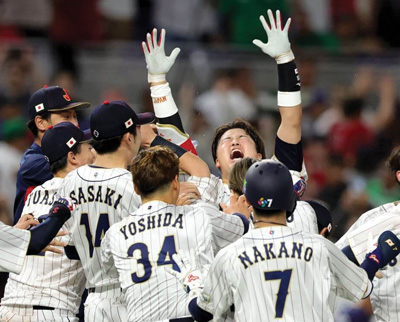 Munetaka Murakami is mobbed by teammates after delivering the winning hit
Holy moly but that was a thrilling end to the WBC semifinal game between Mexico and Japan this evening, 180 degrees from the other semifinal (wherein the US trounced Cuba by 12 runs in a dull dramaless pounding). I know most of y'all don't care about such things and fewer still watched along with me, but I was into it and this is my blog, so I'm gonna tell you about it anyway.
Boosting Japan all the way, I was, naturally, feeling a bit frustrated at how things were going. Starting pitcher Rōki Sasaki, he of the 102mph fastball, devastating forkball, 2022 perfect game, and heartbreaking personal story—he's from the Tohoku region near Fukushima and lost everything including his father and grandparents in the 2011 tsunami—had been burned by a successful two-out hit against an infield shift that should not have been employed (I know Team Japan's manager, Hideki Kuriyama of the Hokkaido Fighters, is one of those sabermetric types, but when your pitcher is throwing 100+, do you really think batters are going to pull every batted ball?) and a popup that fell in behind the third baseman before his one hiccup of the game—a hanging forkball that got crushed for a homer. 3-0 Mexico. Meanwhile, Mexico's pitching was unexpectedly sharp when it needed to be and Japan's star third baseman, triple-crown winner Munetaka Murakami, continued his tournament-long slump by failing to cash in with runners aboard (three more Ks with runners on tonight).
By the 7th inning it was looking pretty bleak and I was resigning myself to the idea that at least I wouldn't have to worry about the championship game tomorrow being spoiled for me (I will be umpiring while it's being played and planned on watching it after the fact, and softball players have a tendency to look at their phones in the dugout and gab about scores they look up, heedless of my DVR no-spoiler lockdown).
But then came the bottom of the 7th. After a frustrating strikeout by catcher Takuya Kai and a lineout by Lars Nootbaar (yes, he's on Team Japan with that name, his mom's Japanese and his dad's Dutch-American), Kensuke Kondoh delivered a base hit to generate a little hope. Mexico went to the bullpen for a lefty to face Shohei Ohtani, but Ohtani took five pitches and walked. That brought up former Osaka Buffallo and new Boston Red Sox OF Masataka Yoshida, who leads the entire tournament in RBI. Hope welled some more. Yoshida ran the count to 1-2, but I'd seen enough of his at-bats by now to know he's a bit like Edgar Martínez in that two strikes doesn't faze him. He got a changeup falling into the lefty low-inside happy zone and golfed it over the wall a couple of feet inside the foul pole to tie the game. SUGOI!!
But then Mexico retook the lead immediately in the 8th as Japan's pitcher, Yoshinobu Yamamoto, was missing with everything. Yamamoto had been brilliant in his start against Australia and for two innings tonight, but here in the 8th he couldn't seem to locate any pitch. He got Austin Barnes to strikeout on fastballs out of the zone, but Randy Arozarena creamed a hanging forkball for a double and on the next pitch Alex Verdugo bashed a fastball down the pike for another double. It was time to pull Yamamoto, but no relief was ready yet, so Joey Meneses got to whack another hanger and now runners were on the corners. Too late, Yamamoto is relieved by the young setup man for the Hanshin Tigers, Atsuki Yuasa, and order seems restored when Rowdy Tellez strikes out; but Isaac Paredes still has something to say about it and grounds one through the hole into left field. That plated one run, but Japan escaped further damage when Yoshida threw a missile in from LF to cut down Meneses on a play at the plate and end the inning. Whew, and yikes.
Down two runs, Japan puts their first two batters on in the bottom of the 8th via a hit batter and base hit. Unfortunately, the bottom of the order is now up, but in true NPB fashion, shortstop Sosuke Genda, broken finger and all, squares to bunt and lays one down to advance the runners to 2nd and 3rd. Hokata Yamakawa is summoned from the bench to bat for Kai and hits one hard to left, but it's caught by Arozarena so all Japan gets out of it is one run on the sacrifice fly. Nootbaar follows with a walk, but reliever Gerardo Reyes gets Kondoh on strikes and things go to the 9th with Mexico still ahead.
In the top half, new pitcher Taisei Ota makes short work of Mexico so when Japan comes up in the last of the 9th it's still a one-run deficit. Mexico goes to its closer, Giovanny Gallegos, a solid Major Leaguer with St. Louis during the regular year. Ohtani leads off and doubles on Gallegos' first pitch to get the crowd and his dugout (and me on my couch) excited. Yoshida gets nothing good to hit and walks, which may have been a pitch-around situation—Yoshida has been Mr. Clutch all tournament and the next guy is Murakami, mired in a slump. So now 1st and 2nd, nobody out. Yoshida's no slowpoke, but still Japan goes to the bench for a pinch-runner, the very fleet-of-foot Ukyo Shuto, in case there's a need for speed. Nevertheless, this is a good double-play opportunity for Mexico and Murakami's slump might be exploited here. And he does foul off a pretty juicy fastball to go 0-1, then lays off a breaking pitch that gets buried at the plate. But this is still the guy who just won back-to-back Central League MVP awards, slump or no slump, and the next delivery is a fastball much like the first one and this time Murakami doesn't miss: he squares it up and drives it all the way to the center field wall, scoring Ohtani easily while Shuto kicks it into warp drive and slides home well ahead of the throw in from center. Game over. Japan wins. Much jumping around and screaming. The players seemed jazzed by it, too.
Really, one of the best finishes to a game I've ever seen; it sparked memories of the 1995 ALDS, even though the stakes in a short tournament aren't nearly the same. Mexico manager Benji Gil may have the quote of the night, summing things up thusly: "Japan moves on, but the world of baseball won today."
So, tomorrow we get the WBC finale we deserve, the two most established and historic baseball nations going at it, USA vs. Japan. Should be fun.
Now, if only I can get the softball players to keep their yaps shut so I can watch late tomorrow night unspoiled by "future" knowledge.
Tagged
Baseball,
WBC,
Posted on March 21, 2023 at 2:46AM | Permalink |  |
| 
WBC fun
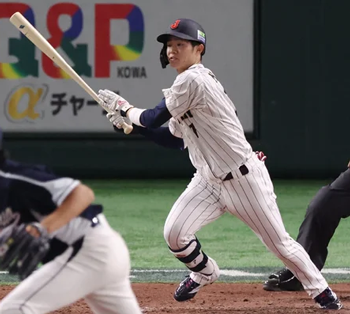 Takumu Nakano laces a triple against Korea in the WBC last Thursday
I've been enjoying the 2023 World Baseball Classic this past week. Because of the pandemic, this is the first edition of the WBC in six years. (Usually it's played every three years except when it coincides with a Summer Olympics year, when it gets bumped ahead one year...which, as I think about it, really means it'll go to every four years because it'll get stuck always hitting an Olympic year. Hm. Methinks an adjustment is needed.) The tournament came into existence in 2006 as a way to grow the game in countries around the world that haven't traditionally been hotbeds of baseball and I've always found it to be great fun. This year the Asian opening bracket kicked off last week and the Western one started yesterday. (The difference to allow qualifiers from the Asian rounds a few days to acclimate to the severe time zone change when the advancing teams move on to the semis and the finals in Miami.)
My primary WBC enjoyment comes from getting to see the Japanese National team play. Made up of stars from Nippon Professional Baseball, aka the Japanese Major Leagues (plus a few Japanese players that make their living on this side of the Pacific), Team Japan is an international powerhouse that plays my brand of baseball. Heavy on the fundamentals, prioritize speed and defense, a real all-for-one-and-one-for-all mentality over the swing-for-the-longball-at-all-times approach that has become pervasive in the Majors over the last 10-20 years.
In prior WBCs there were particular NPB players I wanted to see play. I paid more attention to the ongoing seasons in NPB back then and knew of the star players then playing—your Ryosuke Kikuchis, your Kenta Maedas, your Shunsuke Watanabes, your Seiichi Uchikawas. This year there is only one NPB player on the roster that I was familiar with, infielder Tetsuto Yamada of the Tokyo Swallows. All the other guys I looked forward to seeing are now retired, playing over here now, or have aged out of star status and hanging on with lesser performances for their teams.
That's OK, though, now I have new NPB guys to pay attention to. I missed the first game of the tournament because of a TV rights situation I hadn't been paying attention to—Fox Sports got themselves exclusive TV rights to the tournament and thus I couldn't watch on MLB.TV—but once the situation was sussed out I ponied up for a month's worth of the Sling Blue streaming service, which carries two of the three Fox sports channels. (The third one carried some of the games being played in Taiwan, so I didn't see any of those.) So I DVR'd the 3:00a.m. games from the Tokyo Dome and got to see three games won by the Japanese.
No one caught my fancy as much as Ryosuke Kikuchi and Norichika Aoki and Michihiro Ogasawara had in prior WBCs, but there are some impressive participants. Tokyo Swallows third baseman Munetaka Murakami won the triple crown in the NPB Central League last year, which I had been unaware of. He seems to be slumping in the tournament, but he's got plenty of help. Left fielder Masataka Yoshida will be playing for Boston this upcoming season, but had been a monster hitter for the Osaka Buffaloes through last year and looked really damn good. Over seven years the guy has a career on-base mark of .419 and all he did was drive in eight in the first two games I saw. Shortstop Takumu Nakano looks a little raw—he's only been in NPB for two years—but I love his approach, with slap hits and blazing speed. For the first time, one of Team Japan's big contributors is an American—St. Louis Cardinals outfielder Lars Nootbaar qualified to play for Japan because his mother was born there, which makes for a strange juxtaposition of an Asian face with a Nordic name (strange for that culture, anyway). I think he's only playing because Seiya Suzuki of the Chicago Cubs bowed out due to injury, but he's won over the Tokyo Dome faithful.
Japan unsurprisingly ran the table in the first round of the tourney, beating Australia today to advance to the quarterfinals. They'll play Italy on the 16th for the honor of advancing to the next round in Miami. Italy is a surprise entry for the quarterfinals, advancing out of the Taipei group along with Cuba, which is far less surprising. The Taiwanese and the Dutch were favored over Italy there; the Italian baseball program is comparatively minuscule, but they pulled it off.
Of course, the roster rules are pretty lenient. In order to get the WBC off the ground and fill teams with decent players, someone was qualified to play for a country's team if he was a) a citizen of the country, b) eligible to be a citizen of the country, c) had at least one parent from the country, or d) maintained a permanent residence in the country. Which means if you're Jewish you can play for Israel no matter where you're from, so their team is actually not bad, and Italy's team is therefore almost entirely Americans with an Italian parent. I think the idea is that as national programs grow and evolve these allowances will tighten up, but for now the alleged European teams are kind of silly.
Except the Czechs—there's one former big-leaguer on the Czech team (Eric Sogard), the rest are amateur or semi-pro players that have regular jobs in Prague or wherever. One teaches high school, there's a fireman or two, one is even a neurosurgeon. They're not good compared to the pros, but they are having a blast and they actually won a game, beating the lowly Chinese to earn a bye into the ’26 WBC.
The Japanese, Koreans, Taiwanese, Latin Americans, and to a lesser extent the Australians don't have a problem filling a legit roster—there's stiff competition for those squads from actual nationals that play in actual competitive professional leagues in those places as well as in MLB. (In fact, there are so many Puerto Rican players that they get their own team even though PR is part of the United States.) And the Chinese don't have a lot of non-citizen options to pull from, so they're always pretty lousy. In five iterations of the WBC, Italy is the first European team to advance past round one (I'm not counting the Netherlands as they have a lot of players from Aruba), so it hasn't been an issue yet, but I can't imagine it feeling "right" if a team full of Americans win a title representing, say, Italy or Germany.
Another interesting thing this year is that the WBC isn't using Commissioner Manfred's new Major League rules, so there's no distracting pitch clock, the bases are standard, and defenses can still play wherever they like. Just out of curiosity I timed the pitches during an inning of the Japan/Czech Republic game and not once did anyone exceed the new pitch clock limitations, which reinforced my existing bias that the whole thing is just more Manfred nonsense. But then I watched Venezuela and the Dominican Republic, and that game would have had a few violations. I still think it's mostly nonsense, but I think more than anything it shows that the Asian leagues play in cultures that are a lot more disciplined and largely less homer-happy and, for me anyway, that makes for way more interesting baseball. Only one time was there an infield shift used in the three Japan games, implemented by the Australian team, whereas I'm seeing them more frequently among the Latino teams (Venezuela got burned using it just now as I type this) for the same reason: In NPB and KBO (the Korean Baseball Organization) every player is expected to know how to bunt and play a contact-hitting style even if his strength is hitting for power and they will try to beat the shift with a slap hit. Latin America and the US not so much.
Italy wasn't the only upset this year thus far. Australia also advanced to the quarterfinals for the first time, beating a frankly far better Korean team. Seeing them get creamed by Japan, I'm not sure how the Aussies managed it, but if they want to go to Miami they'll have to get past the Cubans on Wednesday.
All this makes me wish once again that there was a reliable way to watch regular season NPB games from this side of the Pacific. Hokkaido has some great looking players, the Swallows are really good, and—for now, anyway—the NPB Central league still plays real baseball with no DH, the way God intended. Also, I'd like to get a better look at a couple of the ballparks. Hiroshima has a newer modern facility that replaced the old dilapidated one they were using when I was there, and the Hokkaido Fighters open a new snazzy one just outside Sopporo this season.
For now I'll enjoy Team Japan in the WBC. Beat "Italy" and proceed to Miami! Ikimashōō!
Tagged
Baseball,
WBC,
Posted on March 13, 2023 at 1:57AM | Permalink | |
Get off my lawn, pitch clock
As I have previously mentioned, I am, shall we say, not a fan of baseball commissioner Rob Manfred. He's terrible. And his new rules imposed on the game, both prior to this year and the new batch in 2023, rankle me. Well, OK, the three-batter minimum for pitchers is fine. But about most of the rest, I am rankled.
Still, this year's batch of changes—the pitch clock, the shift ban, the pickoff limitations—are being met with overwhelmingly positive reaction from people who choose to opine on such things. This also rankles me, but the reasons are more amorphous and vague.
Take Pos and Schur's effusive praise of the new normal. Joe Posnanski and Michael Schur have a podcast ("The Poscast") I find very entertaining (except when they go too long on about non-baseball sports). This week's Poscast was mostly about the new rules and, as Schur put it, he finds them "an unmitigated success." Pos calls the new setup "so awesome" and thinks criticism of it is "insanity." I generally love these guys, but this is…excessive.
They illustrate their position by comparing the pitch-clock setup to the extreme of the previous norm, referring to a side-by-side video someone posted of an entire half-inning of a spring training game from this year alongside a clip of Pedro Baez facing the Cubs in the postseason a few years ago that encompassed a single pitch over the same span of time. Yes, that Pedro Baez example is excessive. That wasn't good and making such an extreme sequence impossible isn't bad in and of itself. But it wasn't a representative AB, it was very much an outlier.
They further cite comparisons to other sports to justify the pitch clock. "Imagine basketball without a shot clock," Schur says. Well, Michael, I don't know or give a damn about basketball. Or football or hockey or any of the other examples he cites. A more frenetic pace might well be appropriate for those games, I don't know. Those sports are not baseball. Baseball is unique. Those arguments mean nothing to me. Eventually he gets back to baseball and makes arguments that mean something, and I respect those, though I disagree with the idea that eliminating the ability of the pitcher to effectively hold a runner is a net good.
Posnanski reminds us that these new rules are a correction, the idea is to return the game to what it was 35, 40, 50 years ago when batters did not step out of the batters' box all the time and pitchers didn't consider his next delivery for a minute before getting into the stretch. And defenses didn't move around the field because of a batter's spray chart that says he never hits to the opposite field. And that, he says, is what we want.
That point I agree with. I do want the game to be played more like it was in the ’80s and ’90s. I just don't like this methodology.
Maybe I'm just a grumpy old man and once I give this a chance I'll be fine with it. Entirely possible. I freely admit that my resistance to accepting the pitch clock and shift ban is tied inextricably to everything else Rob Manfred has done since he took over as commissioner—ads on the field; ads on the uniforms; proscribing who can pitch and who can't; devaluing the season with extra Wild Card playoff slots that are just as good as winning a division; the fucking "zombie runner" in extra innings; and the worst of the worst, the "universal DH"—and giving him even indirect credit for anything feels like having to eat a bowl of moldy nutraloaf. Had Manfred not screwed around so much with these awful things already, I'd likely be closer to Pos and Schur's position.
Yet, having watched some spring training action this year, it does feel rushed. Not frenetic, necessarily, but maybe a little too fast. There is value in having a moment to ponder the next pitch selection for those of us who, you know, pay attention. 15 seconds might be too short a span. When a runner is aboard and the clock extends to 20 seconds it's not bad, that feels proper. It's early days, of course, and it's spring training, but part of the goal for these changes is to create more offense and what I'm seeing is actually more striking out. Batters aren't ready when they swing. That'll change as we move forward, the adjustment period is going to be at least a few weeks of in-game at-bats, but I think 15 might need to be, say, 18 or 20.
Practically speaking, I will not miss the infield shift. I do not like banning it, but batters have unequivocally refused to combat it. In the early days of infield shifts being common, Ken Griffey Jr. would take advantage of it once in a while and bunt to the empty side of the field for an easy hit. Skilled contact hitters could beat it. But that went away, analytics decreed that batters should just keep on trying to pull the ball and hit for power, so defenses started shifting on nearly everybody.
Schur describes the shifting-for-everybody as an "overcorrection" to the steroid era. I see what he means, but I don't like that description at all, because the underlying problem is so many more batters swinging for homers and that hasn't been corrected for at all. Emphasis on power hitting is the underlying problem as regards the infield shift. That plus emphasis on power pitching is the underlying problem behind excessive strikeouts.
Move fences back. Make homers harder to hit and make the outfielders cover more ground—which is also more like things were in the ’80s—and you'll see fewer homers but more singles, doubles, and triples. And when batters (one would hope) stop swinging for the fences all the time, fewer Ks. And less incentive for infield shifts.
The shift ban makes that last bit moot, there's no way that rule is ever going away now that it's in place. We're likely stuck with the pitch clock forever too, and with luck over time it'll fade into the background and not be such a distraction.
But I will campaign until the end of time to do away with the Manfred Man zombie runner and the worst rule of all, the designated hitter.
Tagged
Baseball,
Rob Manfred,
Poscast,
Posted on March 5, 2023 at 11:27PM | Permalink | |
Another rant about Rob Manfred
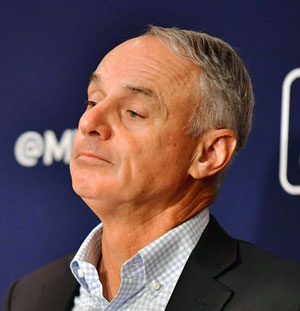 Hey Rob, you're bad at your job and nobody likes you.
We're getting close to baseball season 2023. Which is, for some of us, all kinds of fun and cool. However, because we live in the Rob Manfred Era of Major League Baseball, it also means we need to prepare for what is now an annual period of adjustment to the new ways Commissioner Manfred has decided to screw with the game and piss us all off.
I've written plenty about Rob Manfred's penchant for damaging the game of baseball over at that-other-site-I-used-to-run-that-is-now-defunct-and-one-day-I-will-put-selected-posts-up-here-as-a-form-of-archiving. He is without a doubt the worst person to ever occupy the office of Commissioner of Baseball. He doesn't appear to even like baseball. He's all about incessantly tweaking anything he can think of if there's the slightest possibility it might mean more money for team owners in the short term. (Fuck the long term. Compared to Manfred, even Mr. Magoo has telescopic HD x-ray vision.)
Ever since Manfred took over the job, he's been altering the game in both large and small ways. To date it hasn't gone so far as to make the game unrecognizable, but give the guy a few more years and we'll be watching blernsball or Calvinball.
A lot of the alterations are "behind the scenes," dealing with money stuff and organizational rules about how long a stint on the injured list is, how the amateur draft is conducted, how many times a player can be shuttled back and forth to the minor leagues, that sort of thing, and those might be good or bad but they don't actually affect the game as it's played on the field from first pitch to last out. It's the on-field stuff that grates my cheese the most.
2023's new rules include:
- A pitch clock
- Bigger bases (18" square rather than the traditional 15")
- Restrictions on where defenders may position themselves
- Severely limiting what a pitcher may do to hold a runner close to a base
This, of course, is on top of other rules that were implemented since 2019, which include:
- The automatic intentional walk
- Three-batter minimum for pitchers
- A limit on how often catchers can go to the pitcher's mound
- Proscriptions on what players may and may not pitch and when
- The "zombie runner" in extra innings, which was supposed to be a temporary COVID-era measure that has, as of last Monday, been made "permanent."
- The metastasization of the cancer known as the designated hitter rule
- Diluting the season with added Wild Card teams in the playoffs
The only new rules I don't detest are the mound-visit limit and the three-batter minimum. Those actually add an element of strategy while addressing Manfred's complaint, which was so-called "dead time" while pitcher and catcher discussed tactics and too many pitching changes. Otherwise, these changes all completely suck. I could go into why for each of them, but I'll spare you that for now.
Manfred's stated goal with all these tweaks and changes is to "increase the pace of play," by which I think he really means "make the game more accessible for those with attention-deficit disorder." (Come to think of it, Manfred himself may well have ADHD, which would explain some of this nuttery.) His actual goals are open to speculation, but you would not be out of line to think dumbing things down is high on the list.
Unquestionably the experience of the game has slowed, for lack of a more accurate shorthand, over the past couple of decades. Relief pitching has become far, far more prevalent and that brought along the "dead time" of more pitching changes during games; existing rules regulating batters stepping out of the batter's box were not enforced and more and more players developed Nomar Garciaparra-like habits; the steroid-era created so much more emphasis on home-run power that more and more and more players adopted approaches to hitting that made "This misnomer of a phrase refers to a plate appearance resulting in a strikeout, a walk, or a home run. A “three-true-outcome hitter” is statistically unlikely to do anything else in any given time at bat.three-true-outcome" players common rather than rare; certain matchups like Yankees-Red Sox came to have so many mound meetings that if you worked it right you could time a trip to the concession stand during one and not miss a pitch. And, of course, TV demanded more commercial time, about which there's only so much anyone would be willing to change.
Imposing some sort of "correction" on the game to address this slowing isn't in and of itself something I would oppose categorically. On the contrary, I would very much like to see the obsession with home runs fade away and contact-hitting return to favor. That would reduce the number of pitches per at-bat, reduce the incentive for defenses to employ position shifts, even cut down on relief usage by allowing starting pitchers to go deeper into games before tiring. But you don't accomplish that by imposing a pitch clock; or, if you do, it's a side effect rather than the plan.
The pitch clock might work out OK in the end, but it sure seems problematic. It's pretty brief—not so much for the pitcher as for the batter; pitchers will have 15 seconds to start their throwing motion (20 if there are runners aboard), batters must be in their stance and “alert to the pitcher” within eight seconds. The problems come in when the time is exceeded and a ball or strike is added to the count to penalize whichever player wasn't ready in time. Imagine that happening during a tense moment in the late innings of a tight game. One effect might be that pitchers don't throw as hard, which would be welcome. Another might be that pitchers get hurt more often, which would not.
Larger bases...eh, they look weird, but this will quickly become "normal" and not be much of a thing. It's just a way to increase offense, get more safe calls, but it might make for fewer collisions and injuries to first basemen. I can live with it.
The restriction on pick-off attempts is the worst of these new changes, it's a naked tipping of the scale away from the defense in favor of baserunners. It'll turn every pitcher into Jon Lester, except he won't even be able to step off the pitching rubber or hold before the pitch to keep a runner close to the base. It's a much more significant change to the game than I think anyone realizes at this point. Don't get me wrong, I love stolen bases—my favorite team of all time is the 1985 Cardinals, after all—but don't cheapen them. Cat-and-mouse between a pitcher and a Lou Brock or a Vince Coleman on first was part of the tension, part of the thrill of getting a steal. Now it's gone.
Manfred has done away with the pitcher-runner tension, eliminated all strategy related to pitchers batting and worsened the existing DH rule to favor Shohei Ohtani alone while enacting rules that make future Ohtani-like "two-way" players nearly impossible, imposed radical restrictions on who can play where and in what circumstance, destroyed the potential for epic extra-inning games, cheapened the meaning of the long season schedule with almost participation-trophy tiers of playoffs, and that doesn't even get into his penchant for negotiating in bad faith, his pathetic response to cheating teams, his dishonest remarks to the press, basic stupidity about the game, and utter disregard for fans and consumers of the sport—his ostensible constituency as commissioner of baseball.
Or is it even ostensible? The fact of the matter is that ever since Bud Selig, then the owner of the Milwaukee Brewers (and thief of the Seattle Pilots), succeeded in his coup d'etat to overthrow Commissioner Fay Vincent to install himself in the position in 1992, there has been no figure in the MLB hierarchy that represents the baseball consumer. Selig made the job into a mouthpiece for ownership, an autocratic office firmly entrenched with championing the interests of club owners and club owners only. Calling the position "Commissioner of Baseball" is improper. Needs a new title, like "Agent of Greedy Asshats." I mean, there isn't a "commission" anymore. There aren't even league presidents to mediate.
The Commissioner position was created (well, technically reformed, but for all practical purposes created) in the wake of the Black Sox scandal and ensuing threats by National League officials to effectively destroy the American League by absorbing big-city AL teams into its own circuit. To contend with the public relations nightmare, an outsider was brought in to safeguard the national pastime as chair of the reimagined National Baseball Commission, which was to be made up of, by design and specific intent, people not otherwise affiliated with the business of professional baseball. That chairperson was Kennesaw Mountain Landis, who insisted on being a commission of one and, as he knew the lords of the Majors needed him more than the other way around, negotiated himself ultimate authority as the commissioner to act "in the best interests of baseball" as a whole, not of club owners or ballplayers or media figures or any other isolated group. Essentially, to represent the consumers, the public, as well as mediate disputes, regulate conflict, and be a check on ownership (players of the time didn't have any power to check). Subsequent commissioners had the same authority, purview, and requirement to be otherwise unaffiliated with the business of the leagues. Until Bud Selig's coup, which almost immediately begat the 1994-95 strike. (The revisionist history of Selig's reign reminds me a lot of how people talk about George W. Bush—"he kept us safe." You know, except for that one time. "Selig presided over great growth of the game," you know, except for that one time.)
Manfred claims to have the fans' interests at heart. “I think that the concern about our fans is at the very top of our consideration list,” he actually said with a straight face during the last collective bargaining sessions with the players' union, after which he imposed a lockout and canceled the beginning of the 2022 season.
Baseball doesn't have a commissioner, it has an agent of greed, and in this case one that doesn't like the sport and wants to make it something else.
Alas.
I'm trying to keep an open mind on the pitch clock. But I suspect the law of unintended consequences will rear its ugly head and it'll be bad.
Tagged
Baseball,
Rob Manfred,
Posted on February 16, 2023 at 1:23AM | Permalink | |
Playoff highs and lows

Having quit maintaining that other website that was all about baseball and the Seattle Mariners, one might think I'm not interested in writing more about them. But even though that endeavor was ultimately a bust, I am still a fan and it is October, when the MLB postseason rules the mind.
And the surprising Mariners continued to surprise. I had every expectation that the M's would not survive the new Wild Card round, a more difficult hill to climb than the prior system which would have required them to win one game to play-in to the American League Division Series. But they did survive it, and did so in dramatic, historic fashion, coming back from seven runs down to beat the offensively-superior Toronto Blue Jays 10-9 in the second game of the best-of-three series and thus advancing.
It changed my attitude. My borne-of-two-decades-of-futility jaded pessimism, reinforced by the team's performance in the last couple of weeks of the regular season, had given way to the thrill of unlikely victory and, in true Ted Lasso fashion, belief. These guys could really do it.
Then came yesterday.
In the opening game of the best-of-five series, matched up against their principal nemeses from Houston, the Mariners faced the great and historically dominant Justin Verlander, the Houston ace pitcher that had eaten the M's for lunch all season long. They didn't flinch and hit Verlander hard and bounced him out of the game early, scoring six runs off of him. They took a 7-3 lead into the eighth inning. Even when reliever Andres Muñoz faltered and gave up a two-run homer to Alex Bregman, they were still in good shape, heading into the bottom of the ninth up by two. "Believe" seemed to be holding strong.
But you can never completely believe with this team, because the Mariners are managed by a guy named Scott Servais. As I've repeatedly said, Servais has got to be absolutely brilliant at the off-the-field aspects of his job. Handling the egos of 26 young men with varying degrees of maturity and more money than they know what to do with, keeping that group in a good frame of mind, all that stuff. But during the actual game, when his job requires executing baseball strategy, he is, well, not brilliant. Dim, you might say. Often the players are good enough to overcome this deficiency, which is why the team won 90 games and got into the postseason in the first place. But it's not always possible.
I was watching yesterday's game with my friend Bill, and we were naturally enjoying how things were unfolding. But in the ninth inning the TV cameras cut to the Seattle bullpen, where a left-hander was warming up, presumably readying himself to pitch in the bottom of the ninth. That left-hander was number 38, the high-priced free-agent starting pitcher that won the Cy Young Award last year but this year has been all kinds of mediocre, and over the last few weeks has been eminently hittable and homer-prone.
"Uh-oh," Bill said.
"What the fuck?" I said.
Bill's concern was more general—he feels, and with good reason, that when managers in the postseason use pitchers who had been starters their whole career in relief it usually blows up in their faces. Not always—see Johnson, Randall J., 2001—but when it succeeds there's often (though not always) some extenuating circumstance, like you've burned all your regular relievers already, or the pitcher's specific attributes are especially suited to the situation at hand. You can find numbers to back up either side of the argument, but Bill was adamant. He didn't want to see a starter, any starter, go into the game in relief. Sometimes even when it seems to work it doesn't; see last year's National League Division Series, when Dodger manager Dave Roberts brought starting pitcher Max Scherzer in to close out a win in Game 5—the Dodgers won and advanced, but Scherzer tried to make his next start and had nothing, then couldn't pitch at all for the remainder of the postseason (Scherzer had been called upon in this way before, in Game 5 of the NLDS in 2017, and was terrible and lost the series).
| G | IP/G | BA | HR/IP | ERA | WHIP | |
| vs. Astros | 3 | 31⁄3 | .442 | 0.6 | 10.97 | 2.813 |
| vs. rest of AL | 24 | 61⁄3 | .217 | 0.1 | 3.60 | 1.094 |
| First 27 gms | 27 | 6 | .220 | 0.15 | 3.45 | 1.132 |
| Last 6 gms | 6 | 5 | .307 | 0.33 | 5.93 | 1.58 |
My concern was more specific. Robbie Ray was bad the last three times he started a game. Five of the last six, actually, a stretch in which he racked up an ERA just shy of 6.00 and surrendered ten home runs. It was my judgment that he was only on the playoff roster because he was a very pricey free-agent acquisition prior to the season and the team would have been better off with Marco Gonzales on the active roster and Ray off of it (Marco had one poor start vs. Houston this year and two excellent ones).
So, the ninth begins and the pitcher on the mound to begin things is Paul Sewald, who rather inexplicably has excellent numbers on the season. He always struck me as punching above his weight, but OK, sure, Sewald. I'd have Erik Swanson ready to go to back him up, though, just in case. Anyway, Sewald gets a couple of outs, but also gives up a hit and puts a runner on with a hit-by-pitch, bringing up Yordan Alvarez, a left-hand batter and the Astros' best hitter.
Servais has a few options here. 1) Do nothing, let Sewald try and get Alvarez out (Alvarez is 1-for-7 career vs. Sewald). 2) Walk Alvarez. This would be risky, loading the bases and moving the tying run to scoring position, but would let Sewald or another reliever face a right-hander. 3) Go to the bullpen for Erik Swanson, a proven quantity in late-inning relief who had surrendered all of one home run to lefties this year (though with no real history vs. Houston). 4) Go to the ’pen for left-hander Matt Boyd. 5) Go to the ’pen for Robbie Ray.
He went with (5), which was the obviously worst option (though (4) was not much better). Alvarez actually hits left-handers better than righties, Ray was abysmal vs. the Astros all season (as a team, Houston hit .442/.509/.865 off of Ray in three games for a nearly-11.00 ERA and a WHIP of almost 3.000), and as noted before Ray had been homer-prone when a home run would lose the game. It was a decision with no merit to it at all. Calling it stupid is too kind. And it wasn't all that surprising, ’cause Servais has always been a dunce at strategy.
Sadly, Ray only threw two pitches in the game, with the second one sailing over the fence for a walk-off Astro victory, so he didn't pitch enough to prevent him from perhaps starting in Game three or, if it gets that far, four. He shouldn't anyway, but, you know, Servais.
So, the M's are in a hole now, down one game to none in a best-of-five to the arch-enemy rival, and it's their manager's fault. I feel OK about tomorrow's Game Two, with Luis Castillo starting for Seattle against another Houston All-Star in Framber Valdez; Castillo is who you want out there in a do-or-die game. (And while not an elimination game, it does feel like it's do-or-die.) But Castillo can pitch the game of his life, and if it remains close by the late innings one will have to wonder: What nonsense will occur to Scott Servais to do with the game on the line? And will he turn to Ray for the next game?
"Believe" was short-lived. Sorry, Ted Lasso.
Tagged
Baseball,
Seattle Mariners,
Posted on October 12, 2022 at 9:57PM | Permalink | |
Ex-M's in the playoffs
By special request, a post that I would have done over at GrandSalami.net had I not given up on that site as too much work for too little reward. The topic of which is: After the Mariners are eliminated from the postseason (not saying it's going to happen for sure, but…it's gonna happen, for almost sure), which playoff team should a Mariner fan root for if said fan has no preexisting rooting interest in any of these teams?
One metric is, which team has the most former Mariners on it? Guys you remember from before, whom you might have seen in person, who you fondly recall rooting for in the navy and teal of the Northwest. Another might be, who are the most interesting players still in the mix that you don't know yet but would enjoy? I'm sure there are other metrics, but those are the ones for this post.
So, who's playing for whom now? Let's go down the list of 12 (ugh, twelve? Really, Manfred? OK, fine) playoff teams and find the former M's:
- Well, the Mariners themselves are one of the dozen clubs, so we'll just assume they're your first choice. Next!
- Tampa Bay Rays (2 ex-M's likely on the playoff roster): The "extra" team this year filling out the new cash-grab Wild Card round, the Rays still have Mike Zunino, but he's injured. They also have former Seattle reliever J.T. Chargois, who had a really nice season in west Florida (2-0, 2.42 ERA, 0.940 WHIP in 21 games), and fellow relievers Shawn Armstrong and Jimmy Yacabonis (who probably isn't going to be on the roster), both of whom were technically Mariners once. Non-former-Mariner players worth watching are likely Cy Young Award winner Shane McClanahan, the lefty ace of the Rays' staff, and first baseman Ji-man Choi, who defies his physique with athletic plays on the infield.
- Cleveland Guardians (0): The only former M the Guardians featured this year was relief pitcher Bryan Shaw, who was gawd-awful for Seattle in the mini-season of 2020. He was outrighted to the minors at the end of the season, though. But, Cleveland does have rookie outfielder Steve Kwan, who is worthy of attention, as is second baseman Andres Gimenez.
- Toronto Blue Jays (3): Toronto is Seattle's opponent this weekend, but should they beat the M's and advance, the Jays might be a team to pull for the rest of the way. Not for any ex-Mariner reasons, though. Toronto has former M's Yusei Kikuchi, who lost his starting job for a bit and had a pretty lousy campaign, and reliever Anthony Bass, who had a pretty good year. Also, David Phelps and fellow reliever Casey Lawrence, but the latter doesn't figure to be active in the postseason. No, the really interesting guys are the second-generation big-leaguers, shortstop Bo Bichette and first baseman Vladimir Guerrero Jr.
- New York Yankees (2): You'd hardly believe it's the same guy, but the Yankees' best pitcher is Nestor Cortes, who stunk up the joint for Seattle in 2020. They also have reliever Lucas Luetge, who was in the Seattle ’pen in 2012 and 2013 (plus cups of coffee in ’14 and ’15). They've also got outfielder Aaron Judge, who hits a lot of homers, and third baseman Josh Donaldson, who is a jerk and nobody likes him.
- Houston Astros (1): Now, there's no reason whatever to root for the Astros—maybe unless they're up against the Yankees, but even then it's dubious—but they do have a former Mariner. But that former Mariner is reliever Rafael Montero, who was so bad with Seattle it'll be easy to root against him even though he's been really good for Houston. Or maybe because he's been really good for Houston. Either way.
- Philadelphia Phillies (1): I don't know how the Phillies managed to get this far, but they did, somehow winning 87 games. Their ex-Mariner is infielder Jean Segura, an All-Star for Seattle in 2018 who's been steadily solid for the Phils since being traded for J.P. Crawford. They also have Bryce Harper, who's really good, and Kyle Schwarber, who is not but can hit a ball a very, very long way if he makes contact.
- San Diego Padres (1): With all the dealing back and forth between the Mariners and Padres over the last couple of years you'd think there would be a lot of ex-M's there, but no. Just catcher Austin Nola, who was key to the trade that got Seattle Ty France, Andres Muñoz, Luis Torrens, and Taylor Trammell. There're a few other guys worth your notice, though—superstar Juan Soto hasn't hit well for San Diego since being traded there, but he's still Juan Soto; veteran third baseman Manny Machado had an outstanding season carrying the Friars' offense; and pitcher Yu Darvish is always interesting to watch. Oh, lest I forget their manager—Padre skipper Bob Melvin also helmed the Mariners in 2003 and 2004.
- St. Louis Cardinals (0): No former Mariners grace the Cardinals' clubhouse, but a former Mariner farmhand does. Outfielder Tyler O'Neill was a highly regarded Seattle prospect when the M's traded him for pitcher Marco Gonzales. O'Neill is injured now and had a rather poor season, so you won't see him anyway. But, the Cards have the legendary Albert Pujols, ending his career back where it started, and MVP candidates Paul Goldschmidt and Nolan Arenado.
- New York Mets (3): No, they don't still have Robinson Canó, they're just still paying him. But they do have some big names you'll remember: DH Daniel Vogelbach, starting pitcher Taijuan Walker, and relief ace Edwin Díaz. Vogey joined the Mets midseason after starting ’22 in Pittsburgh, and he's done pretty well—.393 OBP and six homers as a Met. Walker's been a solid back-end starter and Díaz has been lights-out with a career year. Oh, the Mets also have Max Scherzer and Jacob deGrom, two of the best pitchers to ever play in the Big Apple, as well as NL batting champ Jeff McNeil and NL RBI leader Pete Alonso.
- Atlanta Braves (1): The lone ex-Mariner on the defending World Champions is outfielder Guillermo Heredia, who had a terrible year but still gives Atlanta some value as a pinch-runner and defensive replacement off the bench. Their big star is Ronald Acuña Jr., but to me the guy to watch is rookie outfielder Michael Harris, who was one homer short of a 20/20 season (20 home runs and 20 stolen bases).
- Los Angeles Dodgers (2): Utilityman Chris Taylor has been with LA a while now, so it's not likely news that he's in the mix, but how about starting pitcher Tyler Anderson? After the M's passed on bringing him back to Seattle this year he hooked up with the Dodgers and had an All-Star year, going 15-5 with a 2.57 ERA. Would the Dodgers be where they are without him? Well, yeah, probably, because they're the Dodgers and have the deepest roster in the known universe, including shortstop Trea Turner and outfielder Mookie Betts, not to mention MVP candidate Freddie Freeman. These guys are loaded.
Who do you like? Mets? Blue Jays? Cleveland? Bo-Mel's underachieving San Diegans? The best teams here are the Dodgers and Astros. Please let that not be the World Series matchup again. Bleh.
Tagged
Baseball,
Seattle Mariners,
Posted on October 7, 2022 at 6:00AM | Permalink | |
Season finale

The baseball season is over. You can put 2022 in the books for MLB, and it was a good one. Well, it had its moments. It was fun despite some issues. I mean, the DH thing is a horror show and Commissioner Manfred keeps dicking around with things he should leave alone, and there was that whole lockout thing, and hoo-boy were there a lot of strikeouts, but yeah. Good time.
For one thing, Your Seattle Mariners are still playing. Game 162 has come and gone—a dramatic one, at that, so far as a game with no bearing on the standings can be dramatic—and the M's are still in the mix for a title. As fellow baseball aficionado Craig Calcaterra put it, "For the first time in forever the Mariners' season is not ending on the final day of the regular season. Crazy." They'll play at least two more games, in Toronto against the Blue Jays this weekend, and maybe even more than that. Boggles the mind.
Other notables from 2022:
 The Los Angeles Dodgers won more games than any other National League team save the 1908 Chicago Cubs, who share the record of 116 with the American League record-holder, the 2001 Seattle Mariners. LA's 111 victories were fairly evenly split across home and road games, night and day games, first and second halves, in-division and not. The only category they didn't stand out in is tight games: the Dodgers were 16-15 in one-run decisions and 6-9 in extra innings. Which really just means that they were so good they had breathing room for more wins than 25 other teams had in total. They'll open the National League Division Series at Dodger Stadium on Tuesday evening against either the Mets or the Padres.
 Aaron Judge of the New York Yankees hit 62 home runs, besting the previous American League record of 61 held by Roger Maris of the New York Yankees (set in 1961), which bested the prior record of 60 held by Babe Ruth of the New York Yankees (1927). Record hogs. Roger Maris Junior has opined that Judge's new record of 62 should be the official Major League record and the National League feats of 73 (Barry Bonds, 2001), 70 (Mark McGwire, 1998), 66 (Sammy Sosa, 1998), 65 (McGwire, 1999), 64 (Sosa, 2001), and 63 (Sosa again, 1999) homers should be dismissed as unofficial because Bonds, McGwire, and Sosa all cheated with performance-enhancing drugs. OK, I see his point, but I have to point out that tons of people back in 1961 said Maris Senior's record shouldn't count because the season schedule had the modern standard 162 games in it whereas Ruth played in 154-game seasons. So, not the same issue but still...irony.
- The Atlanta Braves and the New York Mets finished the year tied for first place in the National League East, and while in years past that would mean an exciting Game 163 tiebreaker would be played for the division crown, we now have Commissioner Manfred's lame Wild Card playoff round that simply declares Atlanta the division champ based on the fact that they beat
 the Mets ten times, while the Mets beat them only nine times. Now, the Mets won 50 games overall against the NL East while Atlanta only won 48 intradivision contests, which seems to me like a better way to break a tie for first place in the division, but then I am not commissioner of baseball. (If I were, there would be no "Wild Card round" of playoffs in the first place and there would be Game 163, but as we say on Earth, c'est la vie.) The Metropolitans will thus have to play the Wild Card round against the San Diego Padres while Atlanta can sit back and cool their heels until the NLDS starts.
 - Minnesota Twins infielder Luis Arraez won the American League batting title with a paltry .316 batting average, lowest top figure since Carl Yastrzemski's .301 in "the year of the pitcher," 1968. Perhaps most impressively, Arraez did it while striking out only 43 times, which is nigh-unheard of in today's Major Leagues. The only other guy with at least 600 plate appearances and fewer than 70 Ks was Cleveland rookie Steve Kwan (who is a really fun player to watch and perhaps the only reason I'll watch the Cleveland/Tampa Bay WC series), who had 60. Also, Arraez's .316 prevented Aaron Judge's .311 from being the top spot which would have given Judge a Triple Crown. So I'm now a Luis Arraez fan.

Good seats still available! Until 2027, after which the Rays are out of here.
- The Oakland A's, who play in one of the worst facilities in the game, and the Miami Marlins, who play in a modern retractable-roof park with all the amenities, both had season attendance totals under a million. They're both terrible teams this year, so OK, I guess. The Tampa Bay Rays, who made the postseason thanks to the new participation-trophy Wild Card setup and who have been good for years now, barely topped 1,000,000. If not for Miami's relatively new and expensive stadium, all three would be looking for new hometowns as soon as possible; as it is, the A's and Rays will surely skip out as soon as their respective leases allow. (Weirdly, the Cleveland Guardians also had lousy attendance this year, shy of 1.3M, despite winning their division and having a splendid ballpark. The downstate Reds outdrew them, and the Reds are bad.)
- Lowest-payroll playoff team? The Guardians, roughly $66M (the Mariners are next at $78M, then the Rays at $86M). Highest-payroll playoff team? The Dodgers at $289.3M. (Yankees, Mets, and Phillies follow close behind at $239M, $237.5M, and 209.5M, respectively.) Bit of a spread.
- The average Major League batter (using a benchmark of 600 PAs) struck out 136 times in 2022. In 2001, the last time Seattle made a postseason, the average figure was 105. Two decades before that, it was 79. Not a good trend.
Personally, I saw just 16 games in person this year, all here in Seattle. The Mariners won 11 of them. I saw six Marco Gonzales-started games (1-4, 2.35 ERA when I went; the guy just couldn't catch a break this season), four Robbie Ray starts (1-2, 3.70), two Logan Gilbert starts (2-0, 0.00), two Chris Flexen starts (1-0, 3.27), a George Kirby (0-0, 4.15), and a Justus Sheffield (1-0, 9.00). Mitch Haniger was the best Seattle hitter when I attended (.469), Julio Rodríguez hit .311. Worst with me in the seats, Jarred Kelenic (.150) and, weirdly, Ty France (.161). Best game might have been the home opener, when Marco beat the hated Astros 11-0, though Logan Gilbert's seven shutout frames in a 6-0 win on May 28, also against Houston, is up there. Worst was definitely September 27th, Seattle lost 5-0 to nobody pitchers for Texas in a snoozer (had great seats for it, though).
Of course, it ain't over yet, there's still a remote possibility I could add one more in-person game for ’22. Fingers crossed. We'll see.
Playoffs start in about 12 hours.
Tagged
Baseball,
Seattle Mariners,
Posted on October 6, 2022 at 9:37PM | Permalink | |
Good company, bad baseball
We are nearing the close of the 2022 baseball season, and as the weather has been unseasonably warm—climate change is catastrophic, but for the here and now it does give us warm sunny October afternoons when by all rights it should be damp and cool enough to be uncomfortable—I've stocked up on games for the last few days of the campaign. Today I went with a number of my softball teammates from the Smiling Potatoes of Death, sitting out in the left field bleachers to witness what was, for most of the game, a contender for Worst Mariner Game Attended This Year.
I can't quite believe this is a playoff team. And yet, Your Seattle Mariners are officially in the postseason, having clinched no worse a finish than the final Wild Card berth in the standings on Friday night in dramatic fashion. Erik can tell you about it.
Of course, it remains to be seen if the M's would have made the playoffs under the system that existed through last year. Or the system that existed from 1994-2012. We can be reasonably sure they would not have qualified under the pre-1994 system, though it's possible; they do have a better 2022 record than any of the other teams that were in their division pre-1994, but the scheduling was a lot different then, it figures things would have played out differently (on the other hand, the Twins won the World Series in 1987 after topping the American League West with just 85 wins, sometimes weird things happen). No, all the Mariners of ’22 have done so far is qualify for what would properly be called the Commissioner Rob Manfred Cash Grab Wild Card Playoff Round That Cheapens the Regular Season and Unfairly Screws a Division Champion.
While it's still technically possible for the M's to play the CRMCGWCPRTCRSUSDC games at home, that scenario will likely vanish tomorrow, and since I have… well, not zero hope, but let's call them realistic/jaded expectations that whomever the M's play in the CRMCGWCPRTCRSUSDC (either Cleveland or Toronto) will beat them relatively easily. Meaning the next three days will be the last games played in Seattle this year. So I went today. I'm going Wednesday for the last game of the season as well. Thought about going tomorrow, but this afternoon's lameness put me off the idea.

J.P. Crawford
Ty France
Abraham Toro
The Mariners were hosting the Oakland A's, otherwise known as The Worst Team in the American League. A playoff club versus a team that lost over 100 games. Much like last Tuesday's experience vs. the not-quite-as-bad-but-still-bad Texas Rangers, the Mariners stunk up the joint, not even getting a hit until there were two out in the 6th. They finally made some noise in the 9th, but by then they were down 10-0 and it hardly mattered. Yep, 10-0. To the A's. And Tony Kemp wasn't even in the lineup.
This, along with last Tuesday and even Friday night's clinching game, illustrated in bold strokes why I don't see the M's surviving the CRMCGWCPRTCRSUSDC. They just don't have the depth. Someone gets hurt, someone makes a costly error, one bad pitch is grooved to the wrong batter, and that's it, the M's have no margin for error. Everything has to go right. Twice. The bench stinks except for Haggerty (who probably should start), the starting lineup has too many all-or-nothing hitters, and the manager is strategically-challenged.
Anyway, so this is likely last chance for in-person baseball before the long winter. The M's reeked of ineptitude this afternoon, but my friends and I still enjoyed the day. I don't see my "Spuddie" teammates much outside of the early-summer softball season, so it's good to have an excuse to hang out and catch up. So I got to hear about D¹ & P's trip to Ireland, discussed the nuance of regional UK accents with C, co-heckled with M, covered a little baseball history with D², and, of course, debated with J and several others who the best-looking Mariners are.
There was no consensus on the latter point, largely because J has an aversion to facial hair. Just not her jam. She went with Adam Frazier and Ty France, who strike me as unremarkable-looking bland generic dudes. (I mean, as pro athletes go.) Aside from J, though, both male and female debaters named J.P. Crawford as a hot number. B chose Abraham Toro, and, sure, he's good-looking guy (and speaks three languages); he's just a crap Major League hitter. But that wasn't the metric of the moment.
Such was the focus of several innings since the M's were doing jack squat on the field, but it was still a good time.
Even though some of my favorite Spuddies did not attend. Where were my gay gals at? S & A¹? L & A²? We missed you. Well, I did, anyway. Next time.

Tagged
Baseball,
Seattle Mariners,
Smiling Potatoes of Death,
Posted on October 2, 2022 at 11:59PM | Permalink | |
How deep is your fandom
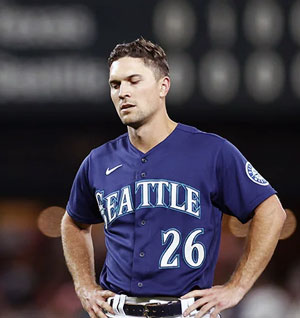 Mariner infielder Adam Frazier exuding the team's current level of energy and enthusiasm for life
I went to the ballgame tonight with my friends K & E, who are relatively new converts to the roller coaster ride that is the Seattle Mariners. Well, K is, anyway, E was half in the bag beforehand. But they're into it, and this year has been especially fun for them as well as lots of other longer-suffering fans as the team has been contending for the playoffs for most of the season. If the season ended today, they'd be in. (Sure, only because of Rob Manfred's BS expansion of the playoffs, but still, they'd be in.)
But as I've said a few times to various people over the past few weeks, there's still time for them to screw it up. The Mariners have psyched us out before, so it's easy to be jaded. And in the last two weeks, they've reminded us of why jaded is the default emotion for Seattle baseball fans.
From September 15th onward, the Mariners' schedule featured 20 more games, none against even remotely intimidating opponents, and on paper it looked like an easy cruise to a Wild Card berth—the top of those three positions, even. But what did they do? First the went to Anaheim to play the pathetic, perpetually snakebit and geographically confused Los Angeles Angels for four games. The M's lost three of them. Then they hopped up the coast to the East Bay and played the last-place Oakland Athletics. The M's lost two of three. Then a jaunt to Kansas City to play the 28-games-under-.500 Royals. The M's not only dropped two of three to KC, in the finale they blew a nine-run lead, allowing the Royals—who had topped ten runs in a game only five times all year—to score eleven runs in a single inning on the way to beating them 13-12.
Which brings us to tonight. I had by flukey happenstance gotten my pals and myself outstanding seats for tonight's game, right below the pressbox on the club level. The teams that the M's are competing with for playoff spots had already lost or were losing (though Tampa Bay came back and won in extras). The Mariners' big offseason free-agent star, defending Cy young winner Robbie Ray, was pitching against the visiting Texas Rangers, who were 22 games under break-even and ranked near the bottom of the  league in most pitching categories. Time to right the ship and stake a claim to that postseason berth.
Naturally, they got shut out.
It would be one thing if the Mariners lost 5-0 to a pitcher having a brilliant game, or a team that made astounding defensive plays to keep them off the scoreboard. But no. This was still the Texas Rangers. And to rub salt in the wound, they even used the stupid "opener" strategy of starting a relief pitcher for the first inning or two before going to the guy that they expect to pitch the bulk of the game, a tactic that has so much going against it that it tends to backfire spectacularly. Nothing-special Triple-A callups pitched the first 52⁄3 innings and nothing-special veteran relievers pitched the rest, a total of six guys, all of whom looked rather "meh" on the mound. This is the crack staff that held the ostensibly playoff-bound Mariners to just two hits over the first six innings.
The M's would get three more hits before it was done, but one was immediately erased on a double-play and the others came with two outs (in the 7th and 9th) down 5-0 and were inconsequential nuisances akin to a single gnat buzzing one's hairline as far as the Rangers were concerned.
I get it, it's a long season. The guys have been playing hard for six months and they're tired. They're a little banged up (Eugenio Suárez was even batting with a broken finger). But tonight it looked like they weren't even trying. Like they didn't care anymore. And that includes their manager.
Sure, Scott Servais often appears not to care about his team winning games when he "strategizes," so that's not new. But here's what he did today. First, he made out a lineup card featuring a middle three that are all all-or-nothing guys: .200 hitters, more or less, that will bop a home run if they make good contact but strike out a lot more. (You could add a fourth consecutive guy if you count No. 7-batting Jarred Kelenic as all-or-nothing, but really he's still just an underachieving mystery surprise.) This is in keeping with the Servais (and Mariners in general) history of living and dying by the home run while giving no more than lip service to other methods of baseball offense and it annoys me. I'm not saying you don't use those guys in your order, I'm just saying don't bunch them all up together. So, of course, the first time the M's had an offensive threat it fizzled—Ty France and Mitch Haniger led off the home 4th with hits, the first of Seattle's night. Two on, none out, middle of the order due up. Home-run threats all, but incapable of much else. Predictable result: strikeout, fly ball, strikeout.

It's a crap photo, but the dude can play the sax.
At that point it's still just 1-0, not that bad. We get to the 8th at just 2-0 and Servais goes to the bullpen for his only lefty reliever, Matt Boyd—who strangely got the sirens and the light-show "Los Bamberos" introduction despite not being (a) a particularly hard thrower or (b) in to put out a fire of some kind or (c) in a position to hold a lead or even a tie—to face the left-handed-batting Corey Seager and Nathaniel Lowe. Not the worst move, but still a bit of a head-scratcher given the circumstance. Boyd promptly hits Seager on the wrist and gets Lowe on a foul out. Then the inexplicable: Servais has Boyd intentionally walk Adolis García to get rookie Josh Jung to the plate with two aboard, but not trusting Boyd to continue he goes to the ’pen again for Diego Castillo. Jung had already homered in the game and driven in the second Texas run with a hard single, but that's the guy Servais wanted to face and what do you know, Jung crushed another one deep into the night for a three-run bomb. Jung had all five RBI for his team.
Not done yet, Servais also made us channel Professor Farnsworth in the 9th, when the M's were trying to keep hope alive with two runners aboard and one out he went to his bench to send up pinch-hitter…Abraham Toro. Eh, whaa? Toro popped up, which was surprising in that he managed to actually make contact with a pitch. Last man up Adam Frazier tried to make it mildly interesting with a deep liner, but it was caught on the warning track to end things with a whimper.
But really, no matter what the manager chose to do or not do wasn't going to matter tonight. These guys didn't have it in them. They're dragging. Listless. Playing as if they are all feeling as I do in the midst of a black-hole episode that has all my senses seemingly encased in a thick layer of gauze.
As we were making our way out of the stadium, we went by a guy playing the saxophone near the parking garage. He was belting out a pretty fine rendition of "How Deep is Your Love" by the Bee Gees and I wondered if he was making a comment on the Mariners and their late-season crash-and-maybe-burn. As in, hey, what a crap couple of weeks for these guys! They look like toast! But we'll love them no matter what. I think. Wait, will we? 'Cause we're living in a world of fools, breaking us down...
My friends and I still had a nice evening. It was a warm night out at the ballyard in good company with a terrific view from seats that are generally well beyond my price range, and I feel like I need to get at least one game per season in with these particular pals or things just go off-kilter, so totally worth it.
I just wish the team we came to see play had been up to the task.

Tagged
Baseball,
Seattle Mariners,
Posted on September 28, 2022 at 1:38AM | Permalink | |
New Rules
 Commissioner of Baseball Rob Manfred, laughing maniacally as he continues to mold the game of baseball like a toddler pounding a lump of play-doh into an unrecognizable blob
He's at it again.
The Commissioner of Baseball, one Robert D. Manfred, has made it his mission to turn the game he is the current custodian of into something all of its previous custodians would not recognize. So far, he has instituted a swarm of smallish rule changes as well as a few huge ones to Major League Baseball and he's got more coming next year.
If I may paraphrase J. Jonah Jameson, the man is a menace.
Manfred simply does not like baseball, at least not in the sense of the game as a whole, balanced concept that requires strategic thinking and intellectual trade-offs to navigating the game. Nor does he value competitive integrity or the richness of detail. He likes simple. He likes not to have to think. He likes short attention spans.
Thus far, the Manfred regime has given us:
- The no-pitch intentional walk
- The "universal" designated hitter (ugh)
- Requiring teams to declare in advance who is a pitcher and who is not and imposing a limit on how many pitchers a team can carry
- The "zombie runner" in extra innings (which some of a certain age have humorously taken to calling the "Manfred Man")
- An entirely avoidable and self-inflicted labor stoppage that delayed the opening of this season
- Expanded playoffs, the first taste of which we'll get next month, which now allows nearly half the teams in the Majors into the postseason and devalues both the season as a whole and the winning of a division title
- Advertising on the fields, not just on stadium walls and scoreboard signage, but on the fields themselves (in foul territory and on the pitcher's mound)
- Advertising on uniforms, which we'll start to see in this year's playoffs and will be an everyday thing starting next year
- The three-batter minimum for pitchers (this one I actually don't have a problem with, though the reason it came into being is no better than the rest of this)
- Ugly unis for the All-Star Games
- Effective acceptance of the Houston Astros' cheating scandal with virtually no repercussions for the perpetrators
Starting in 2023 we will also now have:
- A pitch clock. No longer will baseball be the game with no clock, there will be one to mandate that pitchers and batters move things along regardless of circumstance. Well, not quite regardless—the clock will have 15 seconds on it when the bases are empty, 20 when a runner is on base. If a pitcher takes too long before delivering a pitch, a ball will be added to the count; likewise, if a batter steps out or isn't ready to go within eight seconds (he will be permitted to request a time out once per plate appearance) a strike will be added. Further, only 30 seconds will be permitted between batters; if the next batter in the lineup isn't ready to go 30 seconds after the previous play, he starts with a count of strike one. Despite this having been experimented with in the minor leagues in recent seasons, it remains to be seen how this will play out; it might be OK. Used to be that the players that were slower to deliver a pitch or who took "excessive" time at the batter's box between pitches were relatively rare, but today they're more commonplace and it will at least be interesting to see if this cuts down on so-called dead time without disrupting anything else. But the law of unintended consequences pretty much guarantees there will be issues.
- A limit on how often a pitcher can try to pick off a baserunner. This is a clear and blatant declaration that pitchers should not care about runners; Manfred has openly said he wants to "create more action," which apparently means preventing a defense from trying to get runners out. I love the stolen base, it's one of my favorite plays, but all this does is cheapen it.
- A restriction on where defenders can play. For the history of the game, only the pitcher and catcher were required to be at any specific point on the field. No longer. Two infielders must begin each play on either side of second base and forward of the outfield grass. No more shifting three infielders to one side, no more moving your second baseman into the outfield, no more four-outfielder defenses. This also is based on Manfred's desire for "more action," and because batters as a whole have chosen not to combat defensive shifts over the years, it probably will result in more base hits as fielders will be prevented form playing where they should be allowed to play. The language of the rule is vague enough that someone will at some point cause it to be clarified; it's intention is to maintain the restriction until "the pitcher releases the ball," but it also says the infielders "may not switch sides during the game." So when J.P. Crawford makes a great play running from his shortstop position to flag down a hard grounder on the outfield grass at the right side of second base, is he in violation of the rule? I think not, but someone will exploit the language to challenge such a play.
- Larger bases. The bases on the field will grow from 12" square to 15" square. This will be odd at first but quickly folded into expected norm, I think. Again, this is to give offenses a boost by making it that much harder to get baserunners out. The one positive to this is the extra area will give first basemen a little more of a safety margin on potential collisions on close plays at first, but this could have been accomplished simply by extending the base an inch or two into foul territory instead.
- The completion of the destruction of the American and National Leagues as anything more than labels. Manfred's predecessor started this process in the ’90s, but with this year's adoption of the designated hitter rule (pause for dry heaves) by the National League and next year's change in the schedule that has every team play every other team in both leagues during the regular season, the merger from two distinct entities into one is concluded.
Not one of these changes was made with the good of the game in mind. Every one has been with an eye toward getting bigger short-term profits for a business that already rakes in $10 billion in annual revenue.
Manfred believes that the game needs to be dumbed down and sped up in order to attract younger viewers with short attention spans. He thinks that making the game into something else will get him bigger television ratings. He things more playoff games will mean more TV money overall. He thinks that the baseball audience likes hitting and doesn't care about fielding and by making these changes to unbalance things a bit that people who do not watch baseball will decide they now will watch baseball.
Which is just dumb.
You don't say, "hey, non-fans, I know my game is slow and boring because it requires thinking and thus doesn't appeal to you, so I've dumbed it down closer to your level and made it a little bit more frenetic! You like that, right?" and expect to convert everyone. People who come to baseball come to it because it's different. Because if you know what's going on, that so-called dead time isn't usually so, there's actually tension and stuff going on strategically.
A pitcher worried about a stolen base threat on first was actually valuable to both sides if you understood the situation. Having the pitcher in the lineup made for decisions during the game and a thought process about building your team and planning a game that are just wiped out now. Having the option to dare a batter to hit the other way by leaving a whole third of the field undefended was an opportunity for both teams to exploit. Gone. Sure, few if any people will miss the Nomar Garciaparra-like ritual of stepping out of the box, re-fastening the batting gloves, and taking three practice swings like a mini-hokey-pokey before every pitch, but not many guys did that.
Frankly, the 2023 changes aren't going to be as big a deal as the ones we're already seeing now (or have known are coming, like the jersey ads), which are far more damaging. The pitch clock, the shift ban, sure, I object to them on principle, but in the old days shifts were rare and few players took a lot of time between pitches anyway, so it won't seem too bad. The step-off rule, that I hate and can't figure why any pitcher would approve of it.
Still, I'd accept it all gladly if Manfred would use his new, negotiated ultimate power to impose changes without union approval to abolish the DH and consign it to a fiery death.
Tagged
Baseball,
Rob Manfred,
Posted on September 13, 2022 at 6:30PM | Permalink | |
Frequent flier miles
As part of the collective bargaining agreement adopted by Major League Baseball and its players' union earlier this year, a number of changes (mostly unwelcome) have come to the game this season and more are coming next year. The most egregious of these, of course, is the "universal designated hitter" rule that began this season, which is a crime against the sport. Other heinous changes include advertising on uniforms, which will either begin this postseason or next season; expanded playoffs, which we will see in a little over a month; and a tripling of the number of games devoted to Interleague-play, starting next year.
That last point became less abstract today when MLB released its tentative schedules for 2023. The new formula has teams playing clubs in their own division 13 times each (down from 19) and clubs from the other two same-league divisions six or seven times each (roughly the same as now), with the remainder of the schedule devoted to Interleague—teams will play every team in the other league three times, four in the case of its so-called "rival team." (One issue I can't figure—why 13 per intradivision team? Make it 14, take the those four games out of the same-league interdivision mix, which has seven games against four teams and six against the other six; make it equitable all around. That wrinkle is just dumb.)
As a concept, I don't object to this, at least not any more than I object to Interleague play generally; I preferred it when the leagues were contained unto themselves and only met at the All-Star Game and the World Series. Since it came into existence in 1997—as a gimmick to sell more tickets in the wake of the disastrous work stoppage of 1994, which itself was supposed to be the first year of expanded playoffs that were designed to be a gimmick to sell more tickets—it had been limited to 15-20 games ostensibly limited to a single division; greed got in the way of fairness, of course, and over the years it was tweaked to give extra games against opposite-league teams that sold more tickets in the major markets. The new norm of 46 Interleague games is much more suitably apportioned, with only one Interleague game differing from team to team; the current setup has been absurd when looked at in terms of competitive fairness for winning a title, so in a lot of ways the new system will be better.
Still rankles me a little, though.
Being a more-or-less traditionalist when it comes to baseball, I am sad to see the death of the two separate and distinct major leagues. Really, that kicked in this year with the metastisization of the DH cancer to the National League, but the new schedule just underlines the point. The American and National Leagues are mere labels now, the slow merger into one entity (which began in the '90s) is complete. So that's one thing.
The other issue I have is how it affects my hometown Seattle Mariners.
Just by nature of geography, the Mariners already travel a lot more than most teams do. Occasionally a schedule will have the Oakland A's or the Not-Really-Los-Angeles-You-Don't-Fool-Me-I-Know-You-Play-in-Orange-County Angels traveling more miles over the course of the year, but usually it's the M's. Seattle is an isolated outpost far from every other team's home, it figures they'd have the biggest travel burden. So I was concerned that the new normal would eliminate road trips to California and Texas in favor of more east-coast trips, and adding even more travel to the already well-traveled Mariners could be detrimental. But that's not going to be the case.
Looking at the ’23 draft schedule I see the number of road trips remains the same at 11. The M's make five trips to the Eastern time zone (one of which is Cleveland after Chicago then home, not bad; another ends with a stopover in Oakland on the way home, which isn't great but is probably better than shoehorning that Oakland stop in elsewhere) and six to the Central, most of which are paired with Pacific Time stops on one end or the other. And there are no instances of backtracking weirdness like they had in 2019, when they had trips that went Seattle-Anaheim-Minneapolis-Oakland-Seattle and Seattle-Dallas/Ft. Worth-Chicago-Houston-Seattle. The closest one to something like that in the ’23 grid is Seattle-Kansas City-Houston-Chicago-Seattle, which seems not as dumb/wasteful. Otherwise, all of the trips make geographic sense; ideally, of course, you would pair the visit to Phoenix with a stop in San Diego or Anaheim instead of Minneapolis (July 24-30), play in San Francisco back-to-back with a stop in Oakland, and get the Rangers and Astros on one jaunt. But it's a mess getting every date to fall into place with 30 teams, so I guess this is OK.

All told, we get a season sum of 49,007 miles flown. More than this year's just-over 47,000 and last year's 48,400, but not as bad as I thought it'd be. In 2014, the Mariners' schedule had them flying 51,500 miles; I figured it would be that every year now. Glad to be wrong.
One other good thing: despite the news media calling it a "balanced schedule," it remains division-weighted, which I consider a necessity. For a while there, MLB used an actual balanced schedule (mostly) which made standings in a division artificial. At least this plan continues to make it meaningful to be a division champ. Now, if we could just get Commissioner Manfred and company to change the stupid new playoff format that lumps a division winner in with Wild Card teams to one that respects the division flag...
Tagged
Baseball,
Seattle Mariners,
MLB,
Posted on August 25, 2022 at 1:38AM | Permalink | |
My Favorite Marti—er, Mariner
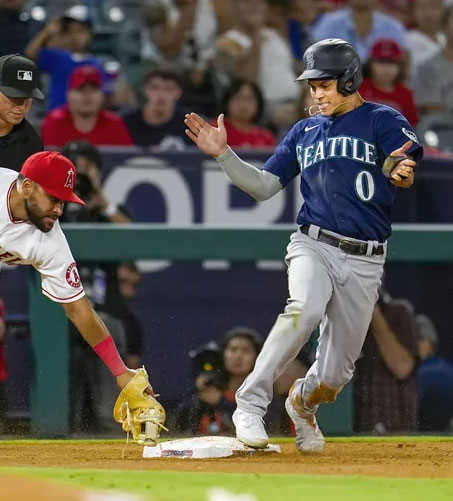 Sam Haggerty steals a base against the Angels
Not long ago, on a day like this I would be spending a couple of hours writing an opposition primer for the series the Seattle Mariners are about to embark on for grandsalami.net. And then three or four people might read part of it. Wasn't a good ROI, if you will, which is why I'm not doing that today in advance of the Mariners' three-game set in Oakland vs. the Athletics.
But this is a landmark year for the M's and I'm following closely even if I'm not keeping up that site. Currently in position to make the postseason for the first time in more than 20 years, the Mariners have been fun to watch. Also frustrating to watch. Because they are still the Mariners, managed by a guy (Scott Servais) that by all accounts is outstanding when it comes to keeping up morale and handling all the egos but by all observable evidence is, shall we say, intellectually challenged when it comes to actual baseball strategy. But thanks in large part to personnel moves made by Servais' boss, Jerry Dipoto—and by a new rule in Major League Baseball that I do not like but works to advantage here, a limit on the number of pitchers a team can carry—Servias' strategic deficiencies have been minimized and the team is flourishing. (Relatively speaking.)
Having just swept the hapless Los Angeles Angels of Orange County Not Really Los Angeles at All, the Mariners play their next five games against teams at the bottom of the standings, Oakland (43-76) and Washington (40-80). Those two are in a race to see which will be the first of the 30 MLB clubs to be eliminated from playoff contention, so it looks like a good next few days.
Especially since there was a personnel move I expected to be made that wasn't.
The M's had been enduring a number of injuries and absences for much of the year and now everyone (mostly) is healthy again, which created a roster crunch. Some guys were going to have to be sent down or let go, and based on Servais' history with various players I thought that infielder Abraham "Fatty Tuna" Toro would remain with the team despite his near-uselessness this season, while utilityman Sam Haggerty, who had already been relegated to the minor leagues twice this year, would again be demoted. Because history.
Instead, Fatty Tuna got optioned out. I mean, that should have happened months ago, but instead Servais kept putting him in the starting lineup to provide a black hole in the order (.180/.239/.322 batting line in 84 games) while Sammy and his .369 on-base percentage stayed at Triple-A until the end of June.
I'd been a Sam Haggerty booster since the M's acquired him after the 2019 campaign. In five minor-league seasons he'd put up great on-base numbers and stolen lots of bags while playing solid defense at six different positions. He looked like a speedier version of José Oquendo. Here's what I wrote in his player profile over at gs.net when he was first called up to the Major League club in August of 2020:
No one paid much attention to the line on the transactions page when this switch-hitting infielder was claimed off the waiver wire last winter, but you might want to sit up and take notice now. Haggerty started his pro career in Cleveland's organization, but despite exceptional on-base numbers and stellar baserunning, he didn't hit much so the Indians deemed him expendable and traded him to the Mets for next-to-nothing. The Mets didn't respect his abilities that much either, despite a nice performance at three of their minor-league levels last year, and put him on release waivers. Thankfully, Seattle GM Jerry Dipoto thought he was worth a look and snagged Haggerty for the M's.
He was having a nice spring training before the pandemic shut everything down, but with manager Scott Servais' penchant for overstuffing his bullpen, there was no room for Haggerty when the truncated season finally got going. The M's finally promoted him from the satellite training facility in Tacoma in mid-August, though, and all he's done since then is hit, drive in runs, and steal bases. With Shed Long struggling to perform as an everyday player, Servais and the M's might be wise to give Haggerty a shot at that everyday second-base job.
Meanwhile, we'll keep enjoying seeing Sam get aboard and run the basepaths. One other observation: Haggerty has one of the best slide techniques of anyone playing now. Check it out next time he steals a bag—it's short, quick, and gets him back to a standing position right away in case of errant throws. It's a small thing, but with so many players sloppily diving headlong from eight feet away and struggling to either stay on the base after they get there or keep from hurting themselves and getting spiked, it's refreshing to see someone slide with such fundamental elegance.

Sam finished 2020 batting only .260, but it was a tiny sample size (13 games). He started the next year with the M's but did poorly (.186) and hurt his shoulder (or, maybe, did poorly because his shoulder was hurt), causing him to miss most of the season. This year he wasn't even given a chance to make the team out of spring camp over the likes of Toro and Dylan Moore (.202 career BA). So you can understand why I figured he'd get the short end of it again despite the fact that he's been the Mariners' best hitter since he was called up on June 29th (.330/.371/.536).
Also, I've been negatively prejudiced by the Mariners' historical tendencies (in the Servais era as well as before) to live and die by the home run, and Sammy is most definitely not that kind of ballplayer. Sam is a throwback to the style of baseball played by the favored teams of my youth: a switch-hitter that relies on swiftness, putting the ball in play, smart baserunning, and exceptional defense. He might occasionally crank a homer, but it's never the plan. It's decidedly more fun than swinging for the fences all the time, and I'm surprised the Mariner brass even noticed.
But they did. At least, Dipoto did. “It may be the most fun that we have every day is smiling every time Sam does something else that’s just awesome in a game,” the Seattle GM said to a radio show earlier this month. Servais is still batting Sam at the bottom of the order for some reason (I'd bat him second), but hey, I'm glad he's starting at all. I'm glad he's on the team at all.
Sure, Seattle has bigger names—your Julio Rodríguezes, your Mitch Hanigers, your Ty Frances—and those guys are great. Love ’em. But me, I want more Sam Haggerty.
Tagged
Baseball,
Seattle Mariners,
Sam Haggerty,
Posted on August 19, 2022 at 6:15PM | Permalink | |