



Tag: Society
The facts do not matter
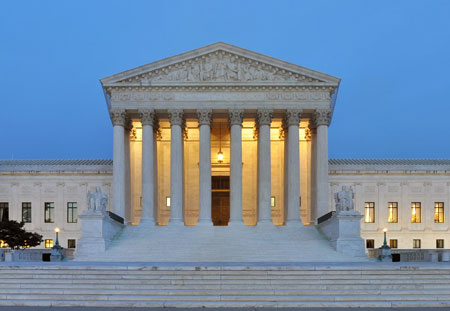
It's been a dark several days for American jurisprudence. The Supreme Court of the United States handed down a number of rulings as the close out their session, and even the rulings that aren't outrageous or corrupt or just plain anti-Constitutional are causes for alarm and spotlight the dire need for reforms of some kind for SCOTUS.
What kind of reform I'm not sure about. I tried my hand at it with my proposal for new Constitutional amendments, but it's a tough nut to crack. At minimum the Court needs ethical standards that are enforceable by an entity outside of the Supreme Court, but how we get there is murky.
We can't really celebrate the "good" decisions, the ones that are in favor of upholding law and the Constitution and the forces of good, because the votes have been astonishingly close, with several justices making no bones about their allegiance to the Dark Side of the Force.
The Court has, just this week, ruled the following:
See full post: "The facts do not matter"...
Tagged
SCOTUS,
Republicans,
Politics,
Society,
Posted on July 3, 2026 at 10:12PM | Permalink |  |
| 
Pride and prejudice
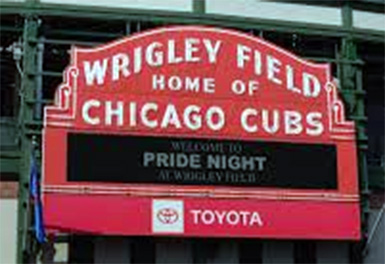
June is, of course, Pride Month, when our LGBTQ compatriots celebrate being here and being queer, and Major League Baseball teams all have Pride Night on their June promotional calendars. Well, most do. For some reason, the San Diego Padres held theirs in May. And for a quite different reason, the Texas Rangers don't have one at all. (The Rangers also have a commemorative statue of a pro-lynching segregationist at their ballpark, so they've got a particular vibe to them.)
As I understand it, the whole concept of Pride Month and, by extension, Pride Night—aside from the usual crass commercial reason of selling tickets—is a form of celebratory protest. The gay community has been historically marginalized, to put it mildly, and pride parades and the like have been a way to both enjoy a party amongst themselves and to prominently remind the rest of us that they exist, they're not going away, there are a lot of them, and they're really not so scary so why all the fuss? As time has gone on and social acceptance improved, the emphasis has shifted toward the celebration side of things and been less focused on the protest angle, but here in the first third of 21st Century there's sadly still a need for both.
Anyway, the point is that while most(?) of us enjoy things like Pride Nights for what they're intended to be, celebratory events akin to similar promotions like Native American Heritage Night or Gonzaga University Alumni Night or even Little League Day, where a subset of the crowd is recognized for their community within the greater community, some don't.
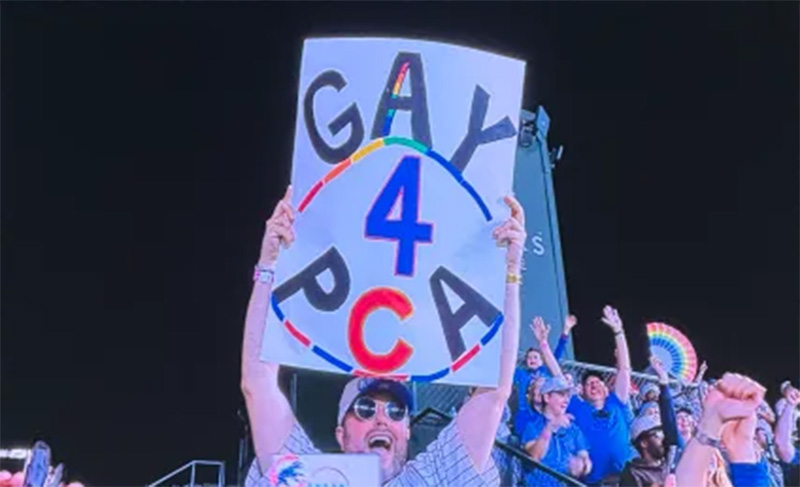
Two recent Pride Nights highlight the disparity: June 15 in Chicago and June 12 in San Francisco. The crowd at Wrigley Field was into it, as evidenced by this presumably straight guy enjoying a truly great night from center fielder Pete Crow-Armstrong, #4, who hit for the cycle (in reverse order, no less—homer-triple-double-single) in the Cubs' win:
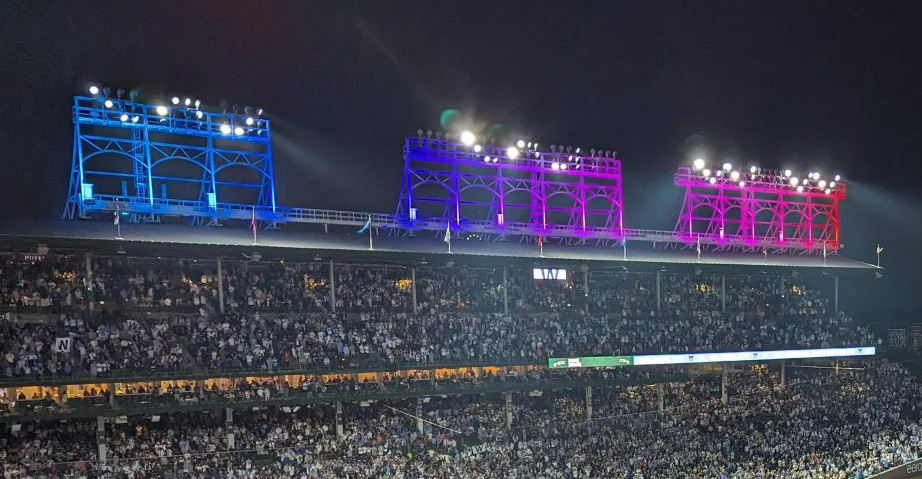
The Cubs also rainbowified their light structures, had the Rainbow Dads family throw out the ceremonial first pitch, had the Chicago Gay Men's Chorus on field for a number, and promoted local LGBT-owned businesses. Near as I can tell, the players were enjoying or at the very least not bothered by the whole deal.
On the other hand, the San Francisco Giants' Pride Night was marred by a number of Giants players protesting against it. And by extension—no, check that, not by extension, directly—protesting against the people in the stands, in the city, watching on television, anywhere on Earth, basically, who didn't share their homophobic bigotry.
Pitchers Landen Roupp, JT Brubaker, Sam Henges, and Ryan Walker, each of whom appeared in the game, either eschewed wearing the team's rainbow-logo Pride caps or defaced them with a bible verse (Genesis 9:12-16) they see as "reclaiming" the symbol of the rainbow from the gay community and for Christianity. "The verse says the rainbow is a symbol of God's covenant to us and us as believers stand firm in that,” Roupp said, not knowing his grammar was as flawed as his selective reading of the verse in question. Henges was more straightforward, if you'll pardon the unfortunate pun. "I don't morally support it," he said.
Manager Tony Vitello said nothing, allowed the pitchers to express their contempt for their fellow human beings with no consequence, but the Commissioner's Office—under pressure from media backlash, not out of any sense of justice—issued a warning to those players in a weak attempt to stop future offenses. I say it was only under pressure from bad PR because this exact thing has happened before and they did nothing. Last year it was Dodger pitcher and future Hall of Famer Clayton Kershaw protesting with the same bible verse. Fellow Dodgers Blake Treinen and Alex Call refused to wear the rainbow caps, no consequence. A few years back, several Tampa Bay Rays tore the rainbow patch the team wore on their Pride Night off their uniforms and all Rays manager Kevin Cash had to say was "we want to support our players that choose to wear [the patch] or choose not to wear [it]."
Aside from Henges, who seems quite willing to be upfront about his bigotry, all of the players involved in these protestations offered up nice-sounding verbiage to excuse their behavior as being about love and faith and Jesus, either obtuse to the fact that they were full of shit or knowing it full well.
The Genesis verse these people cite concludes with this, as the Word of God: "I have set my rainbow in the clouds, and it will be the sign of the covenant between me and the earth. Whenever I bring clouds over the earth and the rainbow appears in the clouds, I will remember my covenant between me and you and all living creatures of every kind." They seem to be conflating that "covenant" with a hateful behavior never evidenced or referred to by this Jesus fellow they claim to revere and giving no thought to the "all living creatures" aspect of it.
As for the Giants, the team issued a statement that fell flat. "We understand the choice by individual players has caused pain and anger to many in the LGBTQ+ community and we are sorry for that." OK. What are you going to do about that? Anything other than this non-apology apology?
Measures of inclusion like Pride Nights, symbols of progress and recognition of wrongs done in the past, these sorts of small things aid in making our society more enlightened, more civil, and bring us closer to that "more perfect union" we like to tout every July 4th. They hurt no one, they damage nothing. Roupp, Henges, and company, by making a stink about it, hurt their fanbase and their team's reputation, alienate people they work with, and gin up hatred among others to perpetuate the problem. Giants broadcaster (and former pitcher) Mike Krukow summed it up thusly: "What makes San Francisco so great is the acceptance of others—ethnicities, opinions, cultures—and that extends to the gay community. I would just hope [the players] would understand the demographic of San Francisco and respect people for who they are. What you do to your uniform, that has weight to it. You can offend people. And why would you do that?"
So, what do you say, America? Let's be more like the Cubs and the Wrigley dude with the sign, and less like the Giants' pitching staff. Can we do that?
Tagged
Baseball,
Society,
Posted on June 17, 2026 at 5:20PM | Permalink | |
Activist Justices
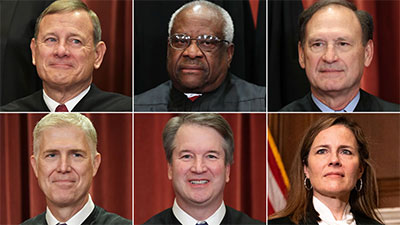 These people are serial abusers of power and must be stopped
For decades, the Republican party has made the case that legal matters were being abused and twisted by what they called "activist judges." That is, judges who would, rather than decide a lawsuit on its legal merits or lack thereof, decide it to favor their own ideological preferences.
That was all bullshit, of course. The "activist judges" line was nothing more than Republican propaganda, a talking point to be interjected whenever possible during the Sunday shows and floor speeches and campaign rallies. It was employed to object to, and stoke public opinion against, judicial rulings that didn't favor the Republican ethos of unregulated greed—whether that be economic greed, sociopolitical greed, or the power-based greed of white supremacists.
Judicial activism as a term isn't new or restricted to use by Republicans, but in its use as a dishonest avenue for grievance it is. Nixon used it to complain that courts were "too lenient" on criminals and by implication that Constitutional and legislative protections didn't apply to all. Reagan one-upped Nixon by claiming that "activist judges" weren't just too lenient on criminals, but that they caused crime: "The rise in crime was not an unavoidable accident; it didn't just happen. It was the result of a liberal social philosophy that endorsed and supported leniency in the courtroom ... the result of judicial activism: judges who thought it was their right to make the law, not just interpret it; judges who fashioned new rules that were a catastrophe for law-abiding citizens, new rules that made it harder to convict even the most hardened and obviously guilty criminals." In their minds, or at least in their words, these paragons of Republican dogma resented that Constitutional and legislative protections weren't ignored in some cases. Now, one can certainly argue about the merits of such protections and whether or not they're a good idea, but they do exist and calling judges and justices that fail to ignore them "activist" is disingenuous at best.
Felon47 has taken it to a new level, of course. He decries anything he doesn't like as "illegal" and has abused the Department of Justice in ways that should be intolerable but somehow have been tolerated. That includes multiple accusations that judges have decided against his preference out of activism, labeling them "Obama judges" or "Biden judges" to imply they decide cases as partisans.
As with many Republican criticisms, however, it's important to remember one of their most favored public relations tactics: Accuse your opponents of your own misdeeds. For as we have seen with Chief Justice John Roberts' Supreme Court, it is the Republican party and their adherents that actually employ judicial activism.
The Roberts Court has been so activist that it has upended many aspects of our society. To date, its decisions have included:
- Support of inequality by ignoring facts in gender-discrimination cases, including one that led to the Lily Ledbetter Fair Pay Act that clarified that SCOTUS' decision in Ledbetter v. Goodyear was a misinterpretation of law;
- Ruling against the First Amendment principle of separation of church and state on numerous occasions, sometimes in direct contradiction to SCOTUS precedent;
- Expanding the definitions of the Second Amendment well beyond its Constitutional language in order to repeatedly strike down gun control laws in non-Federal jurisdictions;
- Curtailing the ability of government agencies to enact environmental regulations because "to impose billions of dollars in economic costs" was too severe a consequence for mitigating the actions of polluters who poison the public and the planet;
- Inconsistent rulings in gerrymandering cases, supporting those favoring Republicans and denying those favoring Democrats;
- Favoring so-called "reverse discrimination" claims by white litigants claiming racial bias against them even when such arguments were obviously suspect;
- Erosion of voting rights whenever an opportunity was presented, often attempting to legitimize unsubstantiated claims of "fraud" brought by Republican officials;
- Overturning Roe v. Wade and allowing the criminalization of abortion;
- The destruction of campaign finance regulation, declaring money to be "speech" and corporations to be "people" in a legal sense, unleashing limitless dark money into elections in Citizens United v. FEC, a ruling that Justice John Paul Stevens in dissent characterized as outright activist as it went beyond the issues of the case, saying the majority "changed the case to give themselves an opportunity to change the law";
- Granting immunity from prosecution to the President of the United States for anything done in "an official capacity";
- Repeated guttings of the Civil Rights Act of 1965 and the Voting Rights Act of 1965, including, but by no means limited to, yesterday's decision in Louisiana v. Calais, which "renders Section 2 [of the Voting Rights Act] all but a dead letter," according to Justice Kagan in dissent.
John Roberts and his fellow conservative Supreme Court Justices have chosen again and again to twist the language of legislation and the Constitution into pretzels in order to advance their ideological agenda—an agenda that is racist, sexist, classist, pseudo-Christian, partisan, business-centric, anti-environment, and with the presidential immunity ruling approaches totalitarian—regardless of the law.
If Congress was a healthy, functioning body, at least four of those Justices, including Roberts, would be impeached and convicted for betraying their duties, corruption, and perjury. Further, in light if the long tenure of abuse by this court, major reform needs to be enacted.
Franklin Roosevelt had issues with the SCOTUS of his time, running into opposition of the New Deal from Justices determined to thwart it. "We have reached the point as a nation," FDR said in 1937, "where we must take action to save the Constitution from the Court and the Court from itself." I'd argue that Roosevelt's comment is more true now than it was then.
But what action should we take? How do we save the Constitution from the Court and the Court from itself? Term limits? Maybe, though I would allow for renominations when terms expire. Constitutional Amendment? Putting aside the difficulty of enacting one, what would it say? "Justices of the Supreme Court must limit themselves to working within the law and not legislate from the bench?" That's weak tea, for sure. Oversight? For sure, though it can't be left to Congress, we see today how feckless that body can be; besides, the Supreme Court is supposed to be, well, supreme. But some sort of enforceable code of conduct, clear penalties for dereliction of duty, clear restrictions on the court's ability to exceed the parameters of a case, this seems necessary... somehow.
Theoretically, this sort of thing is handled in advance by confirmation hearings and remedied by impeachments. That theory has been blown out of the water, though. Doesn't work. Congress is too vulnerable to corruption itself and too feckless to hold Justices accountable. I just don't know what remedy to propose. For the gerrymandering stuff, laws can be passed to outlaw partisan gerrymandering and require independent, non-partisan commissions to map districts. But for the rest...?
Any ideas?
Tagged
Politics,
SCOTUS,
Republicans,
Society,
Posted on April 30, 2026 at 8:18PM | Permalink | |
Umpire diary
I worked a shift at the softball field tonight. Two games, both with teams I really enjoy. It was going really well for about an hour—I was feeling good, energetic, had managed to successfully switch my brain over from news outrage to facilitating a good experience for good folks and having some fun in the process.
Then there was an interruption. After which my focus was disturbed, I made a couple of bad calls, and generally went from having a great shift to one ruled by distraction.
I'm not going to get into the nitty-gritty details of the interruption because the point of writing this now is to process my reaction to what was said more than the actual things said. Suffice to say the interruption was from a league office colleague and it turned from a jovial "hey, [name], nice to see you, what are you doing here?" to me considering quitting this gig in the space of about five minutes.
Most (not all) of those things said were, while not delivered with much respect for me or my fellow umps, reasonable in and of themselves; in fact, in large part the message delivered to me was more of a heads-up than a critical berating, but it reinforced the feeling that the league doesn't value me as it should and that it was treating my colleague the messenger even worse. I was, and remain to some degree, pissed off on his behalf.
I've no idea what prompted this interruption, I just know that they're going to be standard for us umps and refs now, at least for a while. It's been determined that we need to be policed, and I resent it. It may have nothing to do with me personally, which, really, is part of the problem—I dislike management types that take a one-size-fits-all approach to situations where context is everything.
Now, I am fully aware that I am overreacting. That I am taking things personally when I shouldn't. I am also aware that by nature I resist taking orders, I insist on things having justifications that make sense, I have very little patience for clumsily disrespectful behavior. I'm not exactly one to just take a metaphorical slap without just cause nor am I one to accept whatever's told to me without knowing some context.
And I have very little context here. Something happened to instigate my colleague being ordered to do what he was doing, and my impression is that he's not pleased with how it's playing out either. Whatever "it" is.
Anyway, there's nothing to be done about it, I'm going to continue to do what I do as an ump for the league just as I've always done it because I know my job and, not to toot my own horn overly much, I do it better than most if not all of my fellow umps and make it a priority to facilitate the players—the people who pay the fees and who we want to see keep coming back for more—having a good time and don't just go through the motions. If I can make it more fun for them, I figure that's part of my job.
So being given shit for wearing grey pants—which is very umpire-norm, frankly—instead of khakis—which are very much not, and that's a thing? Since when is that a thing?—and getting no acknowledgment that, for example, players know me by name and always like games I ump better than games someone else does is ... irritating. Maybe they'd all keep coming back season after season and paying the fees without my being there (they probably would), but I don't think it's out of bounds for me to say that it's an easier decision for them because I am there (me and maybe one or two other well-liked officials). Too bad the league apparently doesn't give a damn.
On the flip side, nearly everyone else on the field tonight, all the players in both games, quite independently of this other crap, went out of their way to say they were glad to see me and let me know I was at least appreciated by them. Boku no ichiban suki na senshu was there for the first game tonight as well, making me appreciate that sometimes a gig is worth having even if the people that pay you think you're a replaceable cog.
Given a couple of days to process/get over this thing, I'll likely pivot to ignoring it and just move on and it'll be fine. In the grand scheme of things it's pretty trivial, after all. And if not, if it gets worse or escalates to a point that it genuinely offends me, well, I don't need the gig. I could get by without it just fine.
Tagged
Umping,
Society,
Posted on January 26, 2026 at 11:51PM | Permalink | |
Domestic terrorism
 Domestic terrorist
Unsurprisingly, the response of the Felon47 regime—principally the Secretary of Homeland Security and Felon47 himself—to the murder of a young mother, an American citizen, by an ICE agent in Minneapolis has been to lie their asses off and claim the incident was something entirely different than what occurred in reality.
They are attempting to spin the killing as some sort of justified self-defense action, but if you've seen the videos taken by eyewitnesses you can plainly see that such a spin is, to echo the term used by Minneapolis Mayor Jacob Frey, bullshit. Everything in the statements by the DHS secretary and Felon47 is profoundly untrue, though there is a kernel of truth in one of the lies. Secretary Noem said that ICE reacted to a case of domestic terrorism. That is a blatant lie, easily debunked by the video records. But this was a case of domestic terrorism—just not in the way Noem would have us believe. The terrorists were the ICE agents, and the ICE agent that fired his gun repeatedly into the open driver-side window of Renee Good's car at point-blank range committed murder.
ICE has become a terrorist organization. By extension, the Department of Homeland Security has become a terrorist organization. By extension, the executive branch of the United States government has become a terrorist organization.
One of the many, many reforms I think is necessary for our country to recover from this dalliance with fascist thuggery is to undo the biggest mistake of the George W. Bush administration outside of his wars. That administration crafted the new cabinet agency, the Department of Homeland Security, in the wake of 9/11, making it a sprawling cluster of bureaucracies borne of paranoia and with overreaching, careless authorities. It needs to be abolished, its constituent parts returned to their former agencies or erased from existence. ICE in particular needs to be disbanded, with customs and border control and immigration duties reorganized in ways that actually keeps them in their own lanes.
Right now ICE is just the American Gestapo, with DHS functioning as the American Schutzstaffel.
These people have to be stopped. Since the Republican party is corrupt and Republican officials are functioning as accomplices and accessories to countless crimes including murder and outright betrayal of the Constitution, we may well have to suffer for another year before a new Congress can finally take these fuckers down, assuming we can overcome the inevitable Republican attempts to subvert the midterm elections. But that doesn't mean we don't try in the meantime.
Write your Congresspeople. Write your Senators. Call their offices, shout from the rooftops, communicate however you can to those with the power to fix this—and make no mistake, Congress could end this reign of terror today if they chose to—that we are mad as hell and won't take any more.
Impeach. Convict. Remove. Do it now.
Tagged
Politics,
Republicans,
Society,
Congress,
President VonClownstick,
Posted on January 8, 2026 at 12:26AM | Permalink | |
Bot escalation
 Futurama's Robot Mafia
The neverending battle continues.
A couple of months ago or so I had landed on a potential mitigating tactic to use against the onslaught of so-called "AI" bots monopolizing the bandwidth here aboard StarshipTim.com. It worked for a while, but those bastards, just like the Borg, adapted, and now the problem is worse than ever.
I am at my wits' end. These (presumably) scraper bots have managed to circumvent all barriers against them by convincingly camouflaging themselves as human users and rarely/never using the same IP address twice. Blocking them has become impractical without taking drastic measures.
In and of themselves, these bot visits aren't debilitating. They are most likely illegal in the sense that the scrapers scouring the Internet to feed large-language-model algorithms don't give a tinker's damn about copyright law, but in practical terms, what's to be done about that? At some point there may be a class action suit or several to take part in, but proving theft is tricky and the operators of these bots know it. But each visit isn't a drain on resources by itself. Cumulatively, however...
Since the calendar turned to 2026, there have been 203 visits to StarshipTim.com, not counting hits from myself when posting and checking comments. 185 of them are from unwelcome bots. Nearly 2% of the bandwidth this account is allotted for the month has been used already by bots. If that usage rate stays consistent, 12-15% of my bandwidth for the month will have been stolen by bots circumventing the "keep out" signs. This is a rather low-trafficked site, so that won't hurt me here, but really there's no reason to think the bots will keep themselves to this pace.
I host other sites on this server too, and the larger/more-trafficked of those are hit much harder. On one such site just one percent of visits today were (probably) human users, the other 99% were unwanted bots stealing bandwidth (and stealing content for their LLMs). Gigabytes of bandwidth have been used on that account since 12:00:01am January 1st, almost all of it bot traffic. Typically, that site will use about 30GB per month; last month it used 110GB (mostly bots), this month it's already on pace to use about 150GB, far exceeding its allowed usage. I've been borrowing bandwidth from other accounts to cover the excess so that one doesn't go offline for violations. The client isn't at fault. Elon Musk and his ilk with their scraperbots are.
Unsurprisingly, there is an industry starting to sprout around fighting the bots. This abuse of the system has given rise to a profit opportunity for companies that will basically envelope a site into its own bubble and charge thousands of dollars a month to mitigate the bot traffic. Useful, I guess, for giant corporate websites where adding a several-thousand-dollar-per-month expense beats the loss of resource to bots expense. Cloudfare at least offers something more affordable for the little guys, $20 and $200 per month services that attempt to filter bots by routing your visitors through their server security first, then sending those that clear to your own server. I wonder about the false-positive rate with such a thing.
This is maddening because it's a new example of our societal profiteering on bad behavior. Take a walk around the neighborhood, see how many homes have ADT or some other security service's sign in the yard/window/whatever. These people pay every month for protection against bad behavior. Nice home you got there; be a shame of something happened to it. Now imagine that a bunch of Techbros were running a systematic campaign of stealth home invasions that copied and photographed all of your possessions while running up your electricity and water bills, and that these invasions happened every day, usually more than once. Now further imagine that law-enforcement didn't care about these invasions, that lawmakers were browbeaten into thinking that these invasions were somehow permissible because they involved a digital computer program that allows for entry into the home, so technically it isn't breaking-and-entering, and none of your stuff is actually missing when you get home, so is it really theft? With all that going on ADT would be set to make a fortune in new subscribers, right? Symbiosis.
I'm actually experimenting with one of these pay services, the smallest scale option, to see if it makes a lick of difference. If it does, then I can offer it to clients as a mitigator, but I don't like it. It feels like letting the terrorists win.
Tagged
Site issues,
Society,
Posted on January 5, 2026 at 8:07PM | Permalink | |
Strange New Worldview
 Anson Mount as Captain Pike as a Vulcan/Conehead
WARNING: This post delves into extreme geek territory and may ironically support conscious or unconscious biases regarding the intellectual and social priorities of the so-called "Sci-fi or Star Trek Nerd." Proceed at your own risk.
For the most part, I have been pleased and impressed with the efforts by the writers and production staff of Star Trek: Strange New Worlds. The prequel series hasn't been perfect by any stretch, but its first season came pretty close and its second was also solid. The current third season, though, has been ... iffy.
After viewing each of the nine episodes to have dropped thus far in season three, my opinions have all been tinged with at least some level of "there's something here that bothers me." Usually not something I can immediately put my finger on, more of a sense that if I were to really dig in I would find a troubling bit of sloppy writing or hack shortcut or character misrepresentation or canon violation or whatever. It's been disappointing; ever since J.J. Abrams made his two alleged Star Trek films—Star Trek (2009), which was meh, and Star Trek Into Darkness (2013), which was awful, and neither respected the core of the Trek concept—I've been leery of people taking on this franchise that I hold so dear and fucking it up. But by and large the recent streaming series—Discovery, Lower Decks, Picard, and now SNW—have honored their ancestry relatively well (despite some issues with lazy writing in each season of Disco and the first two seasons of Picard).
SNW season three, while not as good as seasons one and two, still hadn't crossed into fuckup territory until last week's episode eight.
On first viewing, 308 struck me like the rest of season three has: Something I can't quite put my finger on bothers me about this. Additionally, there were things I identified immediately that bothered me, but they were to the "get over it, nerd" side of the I-have-issues spectrum—sci-fi plot elements that didn't hold up to in-universe scientific scrutiny. (I mean, fairly major ones, to be sure, but still things that, if you really wanted to make the episode work, you could manage to solve with some more creative thinking.) On subsequent viewing, though, I realized why this one annoyed me so much.
Titled "Four-and-a-Half Vulcans," the episode opens with an intriguing setup: An alien planetary culture has reached out to the Vulcans for help, but as they are still primitive by Federation standards—and have never encountered aliens other than Vulcans, who encountered them many decades before the Federation existed and who gave the society the nuclear infrastructure that is now failing—only Vulcans can help them, otherwise our heroes will run afoul of the Prime Directive of noninterference by revealing themselves to a pre-warp society. No Vulcan-only ship is able to render assistance in time to avert disaster, to it's up to the Enterprise crew to find a solution. The solution is to (somehow) transform a few of the crew into Vulcans—merely disguising them on a surface level would not fool the native technology—to aid the natives and keep their equipment from melting down while still upholding the Prime Directive. As Chief Engineer Pelia (Carol Kane) put it, "a prime loophole!"
Then we arrive at the first of the "get over it, nerd" problems: Deriving a serum from an elaborate solution to a prior episode's plot—wherein an injectable was concocted by exotic aliens and that far exceeded known Federation science to remedy their own mistake that stripped Spock of his Vulcan DNA—Nurse Chapel doses five of the crew with it and within seconds four of them—it has no effect on Pelia, who is not human—are physiologically transformed into Vulcans. This happens quickly and, aside from some sort-of convulsions and evident momentary pain, easily; we soon see the surface-level change to their ears, eyebrows, and, for some reason, hairstyles. What we don't see, and what is the plot's entire reason for doing this, is the massive internal restructuring that raises the suspension-of-disbelief level unattainably high. But OK, the story needs to move along, so get over it, nerd.
Almost immediately, though, we get the second of the "get over it, nerd" problems: In addition to their physiology, their attitudes and behavior also shift into what appears to be the current cultural and philosophical norm for Vulcans. That is, they somehow adopt learned behaviors that they have no experience learning. There is a voiceover log entry to handwave this problem away, but it's so nonsensical as to be worthless (and I am fairly convinced that it was added after-the-fact when, too late, someone brought up this problem and demanded something fix it).
But that's what's needed for the story—the whole point is for us to see Captain Pike, La'an, Chapel, and Uhura go against character and behave as Vulcans in order for silliness and comic mayhem to commence.
So for the rest of the episode we get silly confrontational behavior from our transformed characters, all played for laughs. One of the principal elements of the "humor" (reflected in the title) is that the transformed Captain Pike continually references the fact that Spock is only half-Vulcan and thus, by implication, inferior. The dilemma with the aliens in need of help is resolved almost immediately, mere minutes after the party beams down to the surface at Pike's order to transport "four and a half Vulcans," the implication being that as Vulcans they were smart enough and efficient enough to conduct a repair thought to take many hours in a small fraction of the time. Upon return, the "un-Vulcanizing" version of the serum fails. With the excuse to get to the point of things disposed of—and perhaps wasted, it had potential to be interesting—let more hilarity ensue.
Here's the real problem: the behavior of our transformed characters is offensive by design, that's the reason we get the allegedly comic scenes. (To be fair, in isolation some of them are funny.) But it's just accepted that they were just being Vulcan. Vulcan does as Vulcan is, or something. Which is more than simply offensive to a character in a scene played for laughs, it's offensive to the audience, it's offensive to the in-universe culture, it's offensive to the core of what makes Trek Trek. When watching this one again it occurred to me exactly why I was having trouble beyond the pseudo-science—this episode is essentially a minstrel show.
What really, truly bugs me about this episode is that (apparently) at no point during preproduction or production itself did anyone say, "whoa, what are we doing here, let's think this through." No one objected to doing this script as is, it occurred to (apparently) nobody in the writers room or on set that they were offending a large chunk of their audience with this episode. Nobody sat back and said, "wait a second, are we basically putting Anson and Christine and Jess and Celia into metaphorical blackface and having them parade around like Jim Crow?" Because that's what they did.
Beyond that, the studio seemed to think so highly of "Four and a Half Vulcans" that when they put together promotional material for the season they led with clips and teases from this installment above all the others. I really think they expected this one to be the fan-favorite of the season. (Also, there were visuals that served no purpose other than for use as promotional images; why the hell would Pike—or anyone—beam down to repair nuclear infrastructure carrying a lirpa? That's only for the photo of Vulcan-Pike carrying the ancient Vulcan weapon, it served no other purpose. They knew before production that this was the one they'd hype up most.)
How did this get made? How obtusely anti-Star Trek can you get in a Star Trek writers' room, J.J. Abrams notwithstanding?
When Discovery was first announced, I noted that one of the top execs in charge was Alex Kurtzman, who was a credited co-writer and highly involved with the making of both Abrams films. That screamed "red alert" to me, those films were so antithetical to what Star Trek really is that I wanted no one from those productions anywhere near any new series. He remains a big cheese in the production of all of the newer series including SNW, but until now the sort of ignorant cluelessness of those films has been minimal at most. Now I'm back to blaming Kurtzman, rightly or wrongly, for bastardizing this thing that has been so much a part of my identity since I was single-digits years old. (More accurately, in this case I blame him for aiding and abetting as the credited writers were Dana Horgan and Henry Alonso Myers, not Kurtzman himself.)
The thing is, this still could have been an exceptionally good episode.
I mean, the serum thing would still be a problem, but with a little more thought and care, we could eliminate the instant-logic problem and we could turn the whole thing into something special.
There is a scene in the middle of the episode wherein Number One, Spock, Dr. M'Benga, Pelia, Batel, and Lt. Ortegas convene and discuss what to do about the Vulcanized officers. The return-to-human serum has been fixed, but the four new Vulcans are refusing to change back. As is, it's not a bad scene, we get some good Spock stuff in particular, but it could have been expanded to include something meatier. It's a streaming show, so if they went over time it's not a problem; length shouldn't matter so much, so we could add something like this:
INT. PELIA'S QUARTERS
UNA, SPOCK, PELIA, M'BENGA, BATEL, AND ORTEGAS SIT AROUND AN ANTIQUE COFFEE TABLE AMONG THE DISORGANIZED CHAOS OF HOARDED OLD-TIMEY ITEMS IN PELIA'S POSSESSION.
UNA: It would help if we knew WHY they were behaving this way. I mean, I've known a fair number of Vulcans in my day, none of them were quite so...
PELIA: Robotic?
BATEL: Insensitive?
ORTEGAS: Mean?
UNA: ... Sure, but also ... Spock, correct me if I'm wrong, but Vulcans don't come out of the womb spouting logic and denying emotions, it's not genetic, right?
SPOCK: Correct. It is most assuredly a learned behavior based on the need to suppress the otherwise overwhelming nature of the Vulcan emotional spectrum. We are trained and educated from a very young age to prioritize our rational faculties.
UNA: So why—?
M'BENGA: Mr. Spock and I have discussed this and we have some thoughts.
SPOCK: Indeed. The closest I have to a working theory is that the captain and the others, having abruptly had that Vulcan emotional spectrum thrust upon them, instinctually adopted what they have perceived in their experience of Vulcan demeanors as a coping mechanism. And while I have been principally focused on the group as a whole, Dr. M'Benga has observed them on a more individual basis.
M'BENGA (THOUGHFULLY): They are not really behaving like Vulcans behave. They're behaving as a sort of caricature of Vulcans, and if you look closely you'll see that they aren't behaving identically—each of them has latched onto their individual preconception of Vulcan behavior.
ORTEGAS: Like La'an's obsession with arming the ship?
M'BENGA: La'an's psyche is rooted in her childhood traumas, losing her family in her capture and escape from the Gorn, so for her, logic would demand defending the ship and eliminating threats; she is motivated by her perception of Vulcans as powerful and strong. Nurse Chapel, meanwhile, has been career-driven with her research and so is using her perception of Vulcans as unfeeling overachievers to focus entirely on multitasking research and experiments to the exclusion of all else.
BATEL: And Chris is, what, just subconsciously the most extreme micro-manager of all time?
M'BENGA: No, I think the captain is more complicated... I think underneath it all he actually thinks poorly of Vulcans.
UNA (SURPRISED): What?
SPOCK (RAISES EYEBROW): That does not appear to be the case given his continual remarks about my merely half-Vulcan biology.
M'BENGA: That's actually the principal reason I think this is true, Mr. Spock. It's clear to me that the captain has adopted arrogance as his Vulcan "north star," if you will. That's his ultimate perception of Vulcan behavior, his sense that they think they're better than everyone else. And, as a Vulcan, such arrogance would extend to you perhaps more than others.
SPOCK (GLANCES AWAY): That would not be a unique behavior among my species.
M'BENGA: Yes, and the captain knows it, but more to the point, it suggests to me that the Captain Pike we know sees you as an exception to his concept of Vulcans. That your human half mitigates the nature he perceives as arrogant and troublesome.
UNA (LOOKING DOWN AT THE TABLE, SLIGHTLY FROWNING): You're one of the "good ones," Spock.
SEVERAL BEATS OF SILENCE AS THE ASSEMBLED GROUP CONSIDERS THIS.
END SCENE.
Now we have changed the tone of the episode away form pure comic farce to thoughtful examination of unconscious and institutional racism.
This also gives more weight to the ultimate solution to the problem. Instead of what we actually get in the episode—a wonderful appearance by Patton Oswalt as the delightful Vulcan katra expert named Doug simply convincing all but La'an to go back to being human, all offscreen and with no explanation, while Spock unconscionably invades La'an's mindspace to bring her back to humanity through their emotional connection (and dance)—we would instead know, whether shown onscreen or not, that Doug's ministrations reveal their behavior to themselves as being distastefully bigoted; there would be a far more believable rationale for the until-then intransigent Vulcanized crew to change their minds and realize that (a) they preferred their old selves, and (b) they were making a mockery of a species they claimed they wished to emulate. The shame would be more than enough to make them demand the re-humaning serum. This, of course, would also demand a different coda scene showing Pike, at least, if not all of them, acknowledging their subconscious prejudicial attitudes. And Spock, along with every biracial member of the audience, deserved an apology.
Oswalt, by the way, is easily a highlight of the season. I loved Doug. I even appreciated the farcical scene with Una and Spock trying to convince Doug that Una was off the market, as it were. I would like to see, if not future appearances from Oswalt/Doug, then future references to him. Perhaps Una receives a message that we hear start to play for her in the background that begins "Heeey, it's Doug," ala Kamala Harris' infamous first voicemail form her husband. I only wish Oswalt appeared in support of a better and less offensive script. Same goes for Anson Mount's brilliant face-acting and comic timing. (My imagined added scene above would also give some credence to Mount's choice to play Vulcan-Pike as a Conehead from Saturday Night Live instead of an actual Vulcan.)
There's been much discussion of this episode elsewhere on the Internet, but I've refrained from looking at most of it and I haven't heard any of the review podcasts about it yet. But I have gleaned that the trans community is particularly upset about it; I can't claim to fully understand that, as I don't see the parallels as being, well, really parallel, but I do get the underlying gist. Frankly, I would expect any minority group to be, if not offended, then disappointed by the obtuseness of the writers and producers in a more visceral way than I'm articulating here.
I can't help but imagine the script as produced being proposed with previous Trek showrunners in place. Neither Gene—Roddenberry or Coon—would permit it, even though Gene Coon would appreciate going for silliness if there was more substance. Ira Steven Behr would have stopped it at an early stage and demanded rewrite after rewrite until it was suitably focused on something about racism. Even the two-headed beast I came to think of as Bermaga—the team of Rick Berman and Brannon Braga that was responsible for the first three years of the series Enterprise and whom I've been highly critical of for juvenile and nonsensical elements in their scripts—might well have recognized this as too flawed to produce.
In the end, this is a similar problem to several scripts in Discovery and Picard—it went into production before it was ready; writing issues were overlooked, unrecognized, or simply ignored. This time, though, the issues were more than just sloppy execution or a dumb lack of coherence with the rest of the story. This time it was really upsetting.
Tagged
Star Trek,
Culture,
Society,
Racism,
Posted on September 5, 2025 at 10:45PM | Permalink | |
Patriot Day: Protests and baseball
 I frequent this place a lot as an umpire. Today the fields were swarmed by protesters, eventually reaching 70,000 strong
A lot happened today. Most of which I didn't actively participate in, but it still deserves some mention here, I think.
I fully intended to attend one of the smaller No Kings protests this afternoon; one took place not far from my home, I was planning to at least go and take photos and add my voice for a little while. I'd intended to, but my nocturnal ways caught up with me and I failed. I was umpiring last night until almost 11:30, got home well after midnight, then watched the full Mariner game from earlier in the evening, then had trouble falling asleep... anyway, when my alarm went off at 10:30am I had only been asleep for maybe three hours. Still, I got up and fed the cats, but then plopped back down to check in with things on my phone and before I knew it I had fallen asleep again. (In a rather awkward position, to, leaving me with a nasty kink in my neck that is still annoying me.) I re-awoke around 2:30. A quick shower and I moseyed out to the protest site, but it had mostly dispersed by then. Alas.
But even without me, Seattle showed up in style, with over 70,000 people congregating at Cal Anderson park (often the site of my umpiring adventures) before marching to Seattle Center. Along with several smaller events around town, the greater metro area represented well in the nationwide protests today and I am most gratified to see the great masses of Americans giving POTUS47 a metaphorical (and occasionally literal) middle-finger salute on his birthday. It's especially gratifying to see the split-screen, as it were, of protest turnout on one side and the "crowd" at Donny's multimillion-dollar ego parade in DC on the other. I hope he's seething about it.
Seems the vast majority of the events were civil and trouble-free, but there were bound to be a few exceptions, like the Virginia MAGAt who drove his SUV into protesters and someone in Salt Lake City shooting a protester. The forces deployed to LA unsurprisingly escalated things there, but not until after the No Kings event had ended; I wasn't there, I have no way to really know if the violence perpetrated by law enforcement/Federal forces was appropriate or not, but my instinct is to believe it was at best an overreaction. I know the elderly veterans being arrested in DC for nothing more than protesting Donny's ego parade will have quite the case when they sue, though.
Anyway, I did not attend but fully support the No Kings events. After my abortive look at the remains of the small suburban one, I came back and fixed a sandwich and started to clean up a bit before heading down to the ballpark. Not knowing what traffic would be like after today's disruptions, I left pretty early but getting downtown turned out to be a breeze and I was over an hour early to the game. Still didn't get a giveaway Steelheads cap, though, that was a small bummer. (I'm over it.)
Turned out to be a fun evening. One of my umpees (hi, Neal) was there and had free seats near him down low, so my Spuds teammate Mona and I ended up taking in the whole game from pretty close in, which was pretty cool. I am still very much used to my perspective from 327, so tracking the ball was a little tough from the more expensive seats. It's a nice change of pace, though, and the opportunity was much appreciated.
It was a great game, too, with the hometown M's staging a 9th-inning comeback to win in walkoff fashion. One dude sitting in the row behind me struck up some conversation here and there during the game, first about my scorekeeping then about ballparks and then about game strategy. Always fun. Nice to talk with Neal a bit off the softball diamond, too, though the PA onslaught at the game makes for a less than stellar discussion venue.
All in all a good Saturday. (Edit: Events in Minnesota notwithstanding—I just read about that a few minutes ago. Jesus.)
Below are a few of my favorite photos/signs from the nationwide protests today. Please to enjoy.
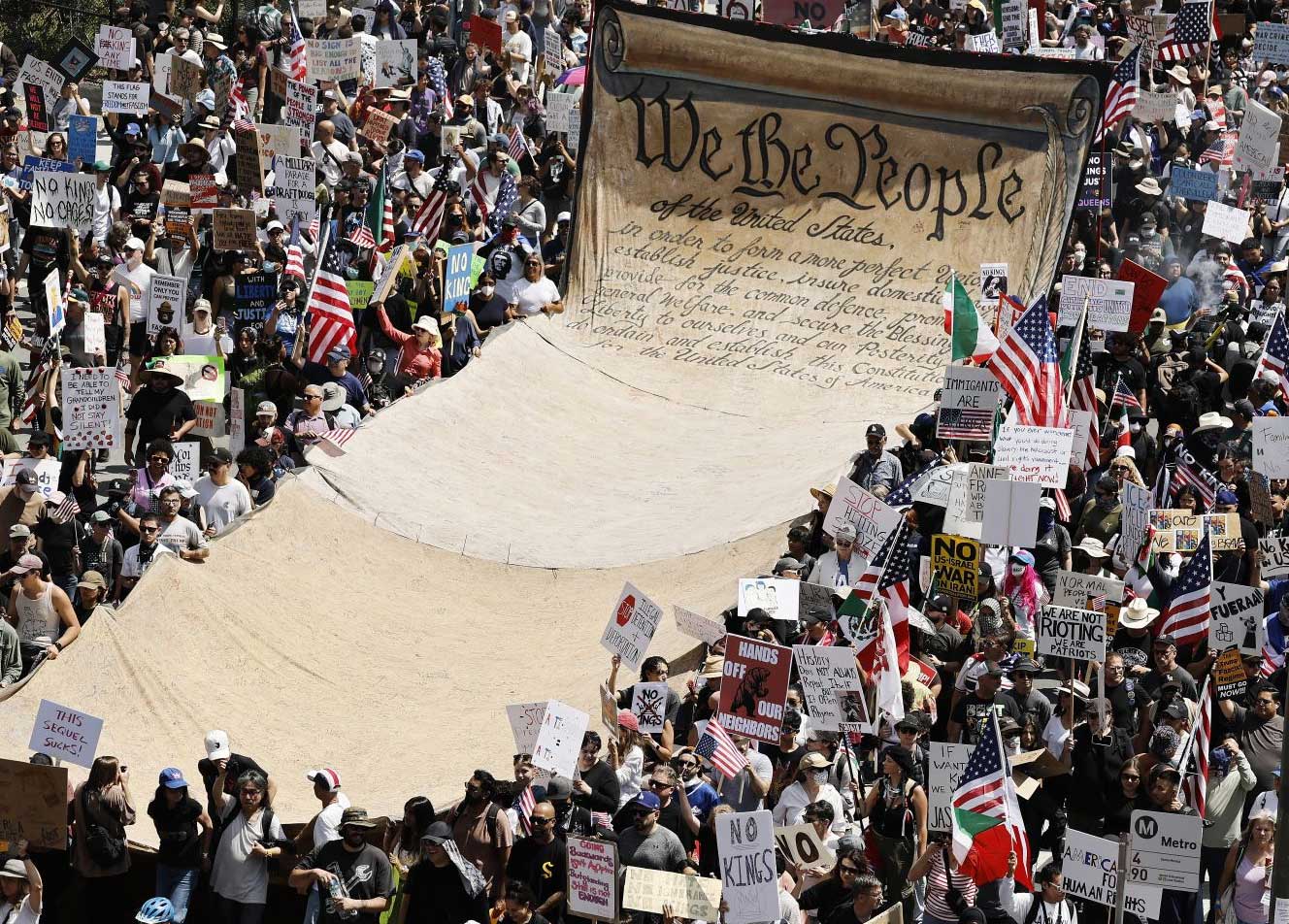
From Los Angeles. The Constitution is a perfect prop for today, but I also really enjoy the sign held up by the guy in the lower left corner.

Handmaid's Tale imagery has been used a lot, but hey, cliches are cliches for a reason. The sign is great, too.
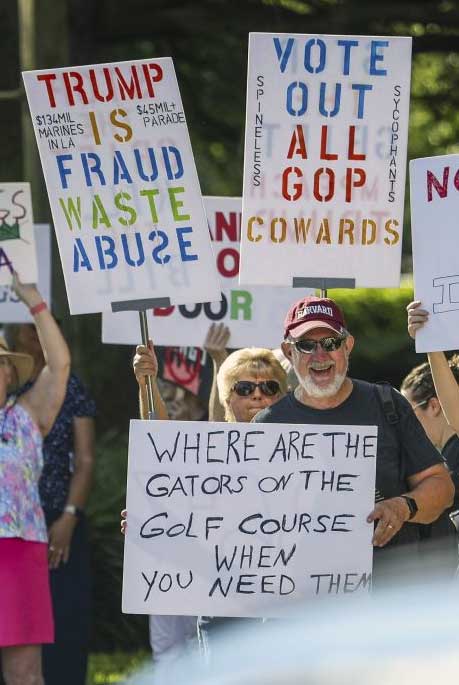
From Florida. Glad to see the rest of the GOP get a mention, but mostly I like rooting for gators here.
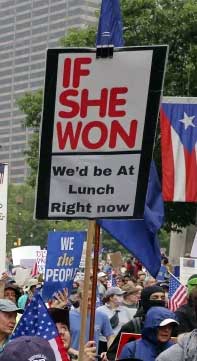
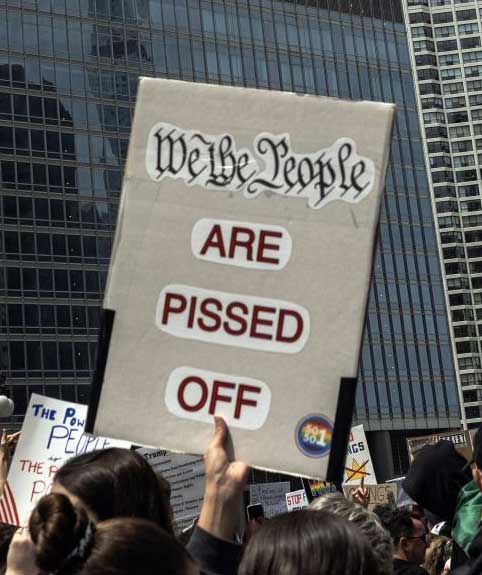
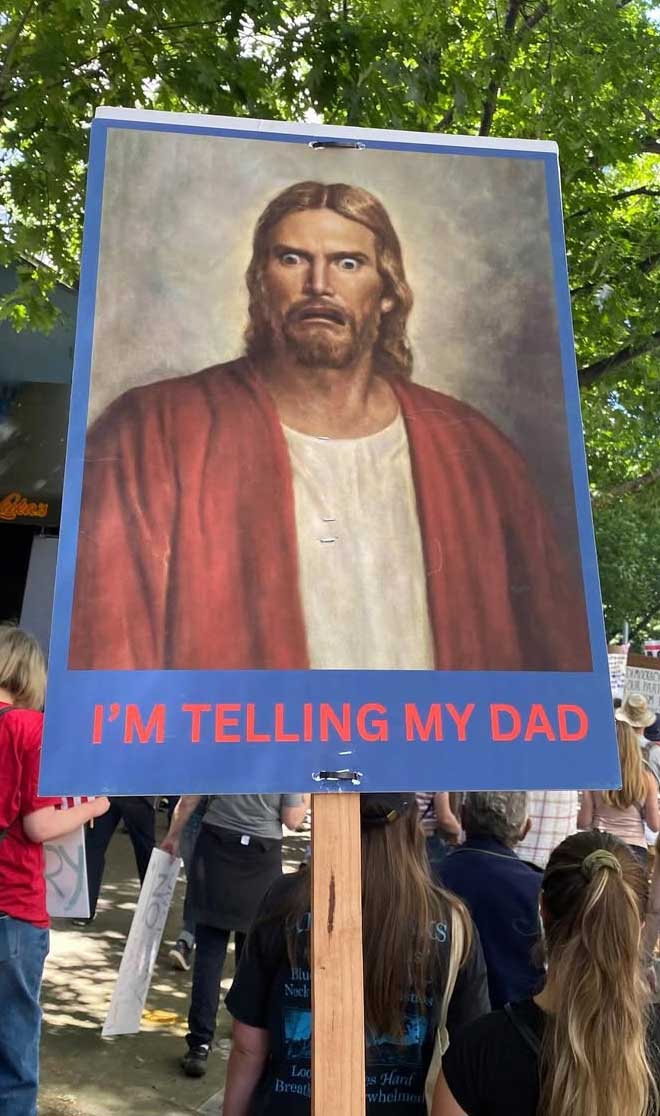
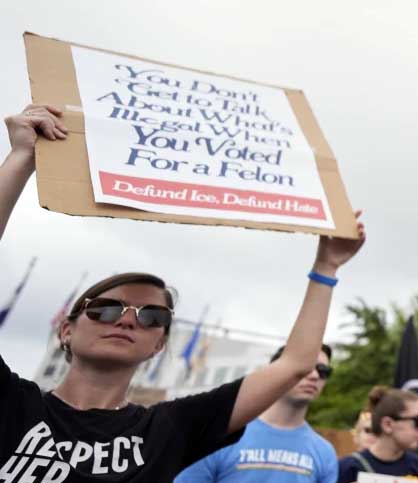
A little hard to read, but it says "You don't get to talk about what's illegal when you voted for a felon."
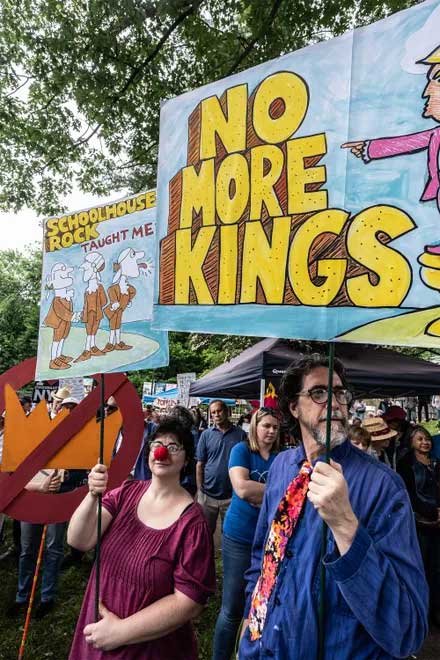
Truly inspired to use "Schoolhouse Rock" here.

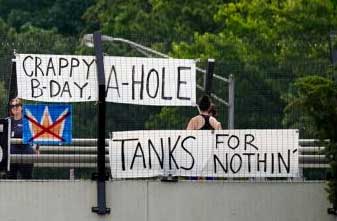
No notes. 100%.
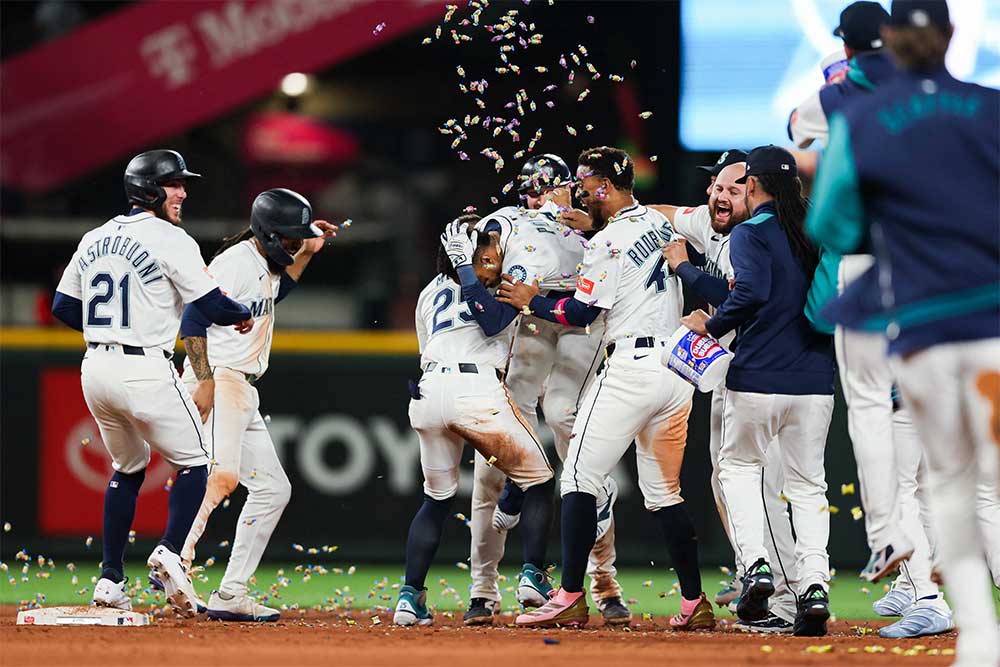
And, just for fun, the celebration after the win at the ballpark. J.P. Crawford (2nd form left) had a perfect night, going 3-for-3 with two walks
(though he did get picked off 2nd base).
Tagged
Politics,
President VonClownstick,
Baseball,
Society,
Posted on June 15, 2025 at 12:49AM | Permalink | |
Signal to noise ratio
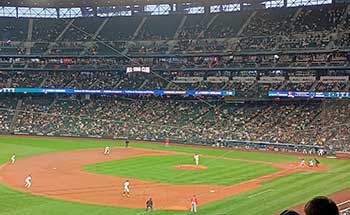
This post's headline could easily apply to other things going on in the world, some of which I've been meaning to write about but haven't yet, but right now I'm just on about a smaller-scale annoyance than the unfolding destruction of the United States.
This is about the slow destruction of our eardrums.
I've been to a couple of Mariner games this past week, and for whatever reason, I was even more irritated by the inexcusably high volume used by the stadium sound system.
I wish this was something unique to the Mariners and the ballpark by Elliott Bay, but it isn't; pretty much any large-scale PA system is like this, and I don't remember it being this way back in the Kingdome days. Maybe I'm wrong and it was just as bad, but I don't think so; almost nothing about the Kingdome was superior to the current facility, but the one thing I can think of was is the ability to hold a conversation with your seatmates. You just can't do it in the current place without shouting unless you're seated in the first few rows near the field. Even out in the bleachers the speakers drown out normal conversation.
Between innings is the natural point in the game to focus on your conversations, but that's also the point when the PA blasts music, goofy scoreboard antics, and so on. Which would be fine—if it was at a volume that didn't feel like an assault. It's so loud that it even drowns out the PA announcer him/herself—without fail, any announcement made at the beginning of a half-inning cannot be understood because it is made while music is still blasting. During the action, there will sometimes be sound effects, implorations from Pavlov's Scoreboard to "get loud," or other gimcrackery that is at the same level of attack that between-inning music is.
Makes me crazy.
It's always been like this for things like rock concerts, at least if we confine "always" to the last four or five decades (no way for me to know about earlier, but I suspect you could go back further), and that may be the reason everything is too fucking loud now.
The generation of kids in the ’70s and ’80s that not only went to lots of concerts and music clubs wherein the standard operating procedure was to deafen the audience, that pioneered headphones and used them to drown out arguments their parents were having or ambient noise on the bus, that made big hits out of album tracks with titles like "Come on Feel the Noize" and "Bring the Noise" and "Rock and Roll Ain't Noise Pollution" that are designed to be overwhelmingly loud are today running the facilities that use these sound systems. And those habits as kids means they have hearing loss as adults.
That's my working theory, anyway, that we have to endure these ridiculously loud sound systems in arenas, stadiums, anywhere really, because they're run by people who don't understand how terrible it is because they themselves have already significantly damaged their hearing. Not being able to converse with the person sitting next to them because the sound system is drowning them out is just life to them.
So now we're all subjected to the assaults, we're all at risk for hearing damage, because of what came before in our society. Which, not for the first time, makes me wonder:
Who originally thought, in their infinite wisdom, that when setting up a venue for an event to be mainly enjoyed as an auditory experience, such as a concert in a club or arena, that best practice would be to make it so loud that the audience would be expected to bring and use earplugs? That's the way it is, and why I have never enjoyed such shows, regardless of the band. My first such concert was the band Yes, at the Tucson Community Center Arena (admittedly not a good accoustical venue), which I came away from absolutely befuddled because the whole setup made it impossible to enjoy the band's performance. I saw the Jayhawks in a club once; couldn't wait to get out of the place. Even when I went to see/hear one of my favorite bands, Fountains of Wayne (RIP Adam Schlessinger), I absolutely hated it, both with and without earplugs, because though the assault might be lessened with the earplugs, so is the ability to discern the music. Makes. Zero. Sense.
I've had tinnitus for as long as I can remember, I don't know if there was some event that caused it or not. But I do know it feels worse when I come out of a baseball game, which is a damn shame because I love going to baseball games. And apparently society is going to continue like this in perpetuity since the half-deaf folks are running the systems which will in turn encourage more people to go half-deaf and so on and so on.
Yay.
Rant over. Go M's.
Tagged
Baseball,
Seattle Mariners,
Society,
Health,
Posted on May 1, 2025 at 8:45PM | Permalink | |
Gun culture

There was a school shooting yesterday. Again. Four dead.
There was a dude firing a gun along Interstate 5 and wounding six people, at least one critically.
Four people were shot dead on a Chicago El train.
Five people were shot at a parade in Brooklyn.
A guy broke into a Birmingham, Alabama, apartment and shot four people playing cards, killing one.
Someone opened fire in a parking lot outside a bar in Nashville and wounded several people.
Two mass shootings in Ohio on the same day, one in Cleveland and one in Dayton.
All this since September first. A span of four days.
And yet nothing will be done about it.
Oh, suspects will be arrested, victims will be treated or eulogized, families will grieve. That stuff will "be done" about it. But nothing will happen to address the causes of this uniquely American problem of gun violence.
I know nothing will be done because nothing has been done. We've been living with this situation for decades—correction, most of us have been living with it, some very much not—and all we get from the people empowered to take action are meaningless "thoughts and prayers" and completely nonsensical, idiotic comments like this one, from Georgia governor Brian Kemp after yesterday's murders: "Today is not the day for politics or policy." Screw you, BK, this is precisely the day for policy. That's, you know, your actual job.
Some people in leadership positions want to do something. Assault weapon bans, stricter background checks, restricting access to firearms in various ways, these have been proposed in legislation but never with any real chance of passage because (a) Republicans, and (b) ingrained gun culture.
We have a real chance at getting something passed in the nearish future if we elect enough Democrats in November and can then bypass (a). So those of us who survive the inevitable shootings to come in the next couple of years or so might see progress. But I'm concerned about (b) being an insurmountable problem, at least for the foreseeable future.
Gun culture is everywhere in this country. It's in our historical touchstones, it's in our entertainment, it's in our language. It's in so many idioms we don't even notice it. We're basically inured to the idea of guns whether we want to be or not.
Just last night, while I was umpiring, I used the phrase "bang-bang play," which is baseball-speak for a super-close safe/out situation or split-second call made by an umpire. I'd never really considered the origins of the phrase until that exchange, which went like this:
Me (umpire): OUT!
Player: I don't know, man, are you sure?
Me: It was bang-bang, they got him.
It was the joining of "got him" with "bang-bang" that clicked it for me, this is a gun metaphor. I know, should have been obvious, but having heard it so many times in the context of a play on the bases it wasn't.
When estimating a timeframe, we say we're "shooting for" a date. We "shoot from the hip" or "shoot our mouths off" or "shoot ourselves in the foot." The passenger seat in a car is for "riding shotgun." We use "bullet points" in memos. If we're confident about the outcome of something, it's a "surefire bet." Someone who's extra gregarious might be called "a real pistol." We implore recipients of bad news, "don't shoot the messenger." If someone is criticized, they've "come under fire." A quickly-fading fad is a "flash in the pan." If we're on a tight deadline we're "under the gun." If you put off a decision or act cautiously in a dilemma, you might be "keeping your powder dry." If you change your expectations or goals you might be "raising/lowering your sights."
And those are just off the top of my head (an idiom which, so far as I know, has no firearm connotations). Even when there are no guns around, there are guns everywhere. I don't know how we get past that.
Of course, making the real guns a whole hell of a lot harder to come by would be a great first step.
Regarding the latest school shooting in Georgia, I leave it to Jeff Tiedrich to lambast the political "leadership" from that state and their useless "thoughts and prayers."
Tagged
Politics,
Society,
Guns,
Posted on September 5, 2024 at 7:27PM | Permalink | |
Sponsored by Acme Anvils
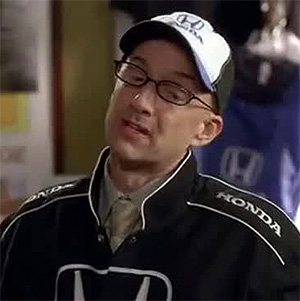 Don't be a level 7 susceptible
The other day I was at the Mariners game with my friend Mack. He and I were discussing the various things, good and (mostly) bad, that have changed in baseball since Rob Manfred took over as Commissioner of Baseball and eventually we got to advertising. The Manfred era has brought more ads to the baseball consumer, including ads on the field of play at some venues (on the back of the pitcher's mound for the TV cameras and on the grass in foul ground along the baselines) and even ads on the players' uniforms.
Thankfully, not even half of the teams have instituted the uniform ads (yet). But there doesn't seem to be enough of an outcry among fans of those teams that have; I suppose our culture has just become so conditioned to accept being inundated with branding and commercialism in every moment of existence that we're kind of numb to it.
Which brings up the meat of my conversation with Mack: What's the point of it all?
Obviously, the point to Manfred and company is revenue; advertisers pay for the opportunity to plaster their logos on spaces that will get exposed to our eyeballs and MLB and the teams rake in some dough. But what's the point to the advertisers? Do they get any benefit out of this, really?
A prominent software company based in the area has an ad on the outfield wall of the ballpark (and on the rotating billboards on the wall behind home plate). Everyone knows what that company is, we see it and register "that's an ad for the software giant we're all familiar with," but does that translate somehow into more money for the company?
Mack listed off all the ads visible from our seats. We know all of the brand names. We may even associate those brands with memorable marketing, e.g. the Bob Uecker ads for a certain beer brand back in the day. We may do business with those companies, we may not. But the fact that they advertise at the ballpark means nothing to us.
If I get on an flight offered by Airline X it's because their schedules and pricing were more advantageous than those of competing airlines, not because they put their logo on the outfield wall or sponsor the Mariners' pregame show on the radio. I suppose if I had never heard of Airline X I might go "hm, they sponsor the Mariners, I will add them to the list of options I look at when booking flights." Maybe. But what percentage of the audience is going to fit into that scenario? Does this bank or that gasoline brand get more business from people that go to baseball games because they put their logos on the stadium wall? Do San Diego Padres fans all now flock to buy the sponsored brand of phones because the Padres wear that company logo on their sleeves? I rather doubt it.
Sometimes marketing has a clear purpose. Like the scenario of never having heard of Airline X, getting the name recognition out there so your company will be thought of and considered, that makes some sense. Big well-known outfits can do well with great commercials; the prominent software company's principal competitor has had some genius ads over the years that have undeniably been very successful. But those tend to be funny commercials or ads that make an impact through the accompanying message, not just a wordmark or a bit of iconography. Don't get me wrong, I love good iconography, and I guess if all else were equal and I was choosing between two brands I may well go with the one with the better design sense. But generally a great logo isn't enough to make me choose Brand X over Brand Y, and the fact that Brand X is in my face every time I watch a ballgame is not necessarily going to help their cause.
I was at another game more recently with another friend, one who still works tangentially in the advertising world, and brought this up. She was of another mind about it altogether, citing various psychological/sociological theories about what are effectively subliminal connections people can make with brands because of the repetition of seeing the names and iconography in circumstances they associate with good times. That sounded a bit too "big brother" to me for comfort, but she's probably right. People are, indeed, sheep in may ways.
I then recalled an episode of the late great sitcom Community, wherein the character of Craig is targeted by a guerrilla marketer because Craig is discovered to be "a level seven susceptible." It's pretty funny as over the course of the half hour we see Craig surrounded by more and more products from the guerrilla marketer's employer corporation. (Also a very creative way to get some product placement bucks while mocking things like product placement. Community was awesome.)
So I guess ballpark ads are like junk mail. There's a relatively tiny rate of return on them, individual consumer-wise, but of those few perhaps enough of them are level seven susceptibles to make it profitable. Kind of like the MAGA problem.
So...humanity is probably screwed.
Tagged
Baseball,
Society,
Posted on April 25, 2023 at 12:29AM | Permalink | |
Social media redux
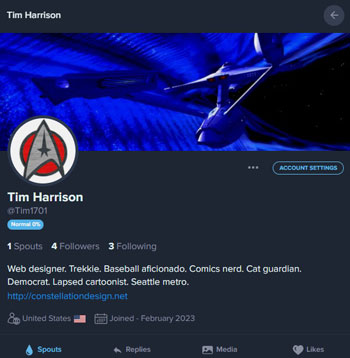
A few months ago I posted about social media and how its landscape is changing in the wake of Elon Musk's Twitter fiasco. I'd signed up at Hive at that point, looking for a Twitter alternative, but I didn't stick with it and, frankly, it has a severe limitation in that it doesn't have a desktop version, it's phones only. It also was going through the expected growing pains of lag time and function misfires and such, and maybe it's better now, I don't know. Because I don't check it.
I don't check my other platforms either, not often. I still waste tons of time looking at my phone, of course, but it's shifted from Twitter and Facebook to SimCity and sudoku.
But now there's Spoutible.
I got interested in this new platform after listening to an interview with its creator, Christopher Bouzy, on Bob Cesca's podcast. I signed up there and have found it to be just as Bob said it was: "Twitter without the fuckery." I'll be checking in there more often, I think. It needs to build its user base, of course. Social media only works when people post things and right now my feed is "spouts" from just a few people. Hopefully by the time baseball season gets here—and that's when I generally use such things more frequently—there will be more folks to interact with.
Anyway, if you like/liked Twitter, check it out. I'd like for it to succeed.
Tagged
Twitter,
Society,
Spoutible,
Posted on February 14, 2023 at 10:42PM | Permalink | |