

Tag: Comics
Art imitating life imitating art
After listening to some recap analysis of Felon47’s pointless address to the nation last night—no, I didn't watch the thing itself, that clearly wasn't going to be useful—I decided to switch gears into some comic-book inspired escapism and watch the latest two episodes of Daredevil: Born Again. But it turned out not to be much in the way of escapism.
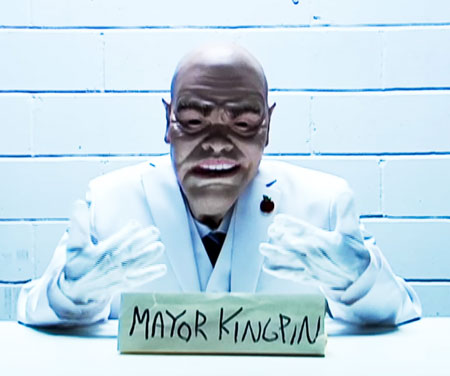
The series reimagines a more-than-a-decade-old Marvel Comics storyline wherein Wilson Fisk, the Kingpin of Crime, becomes mayor of New York City. It's good, well-done in a way that's true to the characters and compelling to watch (though brutally violent in spots), but also depressing because the parallels between Fisk's governance of New York and Felon47’s governance of the United States are a bit too on the nose.
Not intentionally, of course. The source material predates even the administration of Fraudster45, and the scripts for the series were being written before the 2024 election campaign. But how could it not parallel?
The premise of placing a career criminal in a position of massive political power demands plotlines and story tropes that show staggering corruption, manipulation of the press, mob-tactic intimidation, shocking levels of cruelty, even an extra-legal "police force" terrorizing the public. So it's really inevitable that the real-life career criminal given a position of massive political power mirrors the fictional one.
Thankfully, the real-life analog of Wilson Fisk is not nearly as smart. Fisk is a cruel, psychologically broken, utterly corrupt narcissist, but he has intelligence enough to be truly terrifying. Our alleged president is, by contrast, one of the stupidest people on Earth. Which is its own kind of terrifying, to be sure, but does set him apart.
Fisk is opposed by our hero, Matt Murdock aka Daredevil, a lawyer by trade and, despite his tactics of masked vigilantism, believer in the rule of law ultimately taking down Fisk and his corrupt empire. Also on the side of good is internet journalist BB Urich, who by day produces videos that show New Yorkers supporting Fisk's outwardly keeping-us-safe policies while by night making subversive videos that mock Fisk as "Mayor Kingpin," exposing what she can of Fisk's corrupt and violent underbelly. We don't have Daredevil to oppose Felon47, but we do have rule of law, at least for now. We don't have a BB Urich either, and we could use one; but there are journalists outside the mainstream that keep digging for evidence of criminality that might finally take the regime down.
As the series approaches resolution, we know Fisk will be deposed and receive some sort of comeuppance; sadly, we don't have the same surety for his real-life analog. But it does give me a weird sort of hope.
Tagged
Politics,
President VonClownstick,
Daredevil,
TV,
Comics,
Posted on April 2, 2026 at 4:56PM | Permalink |  |
| 
Pop culture and fighting the black hole
My mood since returning from my California travels has been in a state of flux, vacillating between "meh" and "we live in the worst timeline everything is misery." OK, I exaggerate slightly—truly miserable hasn't been part of my black-hole-of-depression episodes since the Zoloft Rx, it's actually more ennui than misery. But you take my point, it's not been peaches and cream. Unless the peaches are moldy and the cream curdled, I guess you could go that route in your metaphors if you like. "Darmok and Jilad at the expired food buffet."
Anyway, I won't go into the state-of-the-world portion of what's depressing in this post. You can look to the news media or your health insurance renewals for those sorts of bummers for now. In fact, for this post I don't think I want to go into any of the stuff that's been bumming me out, the bulk of which is something I don't really have a handle on anyway. Instead, let's discuss some stuff I've actually enjoyed lately.
My consumption of entertainment on the TV machine of late has included a few standouts that I heartily recommend:
-
The Big Thing of the Moment in the streaming world is Plur1bus, on AppleTV+, and it really is as good as its hype. It's high-concept sci-fi, so not for everyone, but the story follows Carol (Rhea Seehorn), a romance novelist with contempt for her readers, who is among a very few people worldwide who have not been afflicted with a mysterious ... something? Ailment? Virus? Extraterrestrial takeover? Freak sunspot storm? ... that has put the vast majority of the global human population into a sort of group mind. There have only been three episodes so far, so the mystery is still quite mysterious, but it's a premise that poses a Big Picture question, if you will, which is: Are people better off content in a happy groupthink mental commune, or as individuals with all of the messy conflicts that are possible between them? Created by Vince Gilligan of X-Files fame, the show's tagline is "The most miserable person on Earth must save the world from happiness." The show works only because Carol is such a well-realized character and Seehorn is so good at embodying her. Without Seehorn in the role I think the show would fail, or at best be something quite different. It's intense, but very well done.
-
Wayward, on Netflix, is a mystery show from creator/star Mae Martin. I liked Martin's prior show Feel Good, so I thought I'd give this one a shot too. It's a whole different kind of thing—Feel Good is a semi-autobiographical slice-of-life comedy/drama, Wayward is about a tiny town in Vermont where there are no children and an academy for teens that "students" run away from as often as possible because horrible things happen there. Based at least in part on the experience of a childhood friend of Martin's who was sent away to a "troubled teen" camp of sorts called CEDU—that friend is a consulting producer of the show—the series follows two parallel tracks: one, a pair of Toronto teenagers who find themselves "enrolled" in the cult-like academy; and two, Martin's character, a cop newly-transplanted to the tiny town who dives into figuring out the mystery of the academy while the entirety of the town tries to prevent anyone exposing its secrets. It's good, but the ending is unsatisfying; it gives two different versions and its unclear which character imagines the false one or if it's supposed to be more of a you-the-audience-can-choose-which-ending-you-like-better kind of thing or what. I liked it overall, though, and it's worth spotlighting the sort of "troubled teen" institutions that still exist and still cause problems in our world of abuses.
-
Then there's The Lazarus Project, a British sci-fi show that follows George, a new recruit to a secret government agency that intervenes to prevent disaster from befalling humanity and uses its most powerful tool to turn the clock back if the worst comes to pass. George notices he's in a time loop, repeating three months of his life, and since people aren't supposed to remember things that happen before a "reset" the agency takes interest and brings him into the fold. When someone has the power to reset the world—always back to the most recent July 1st—there have to be understandings that resets only happen in the most critical circumstances or else there's nothing but chaos. But what if one of the agents feels his/her personal needs outweigh the rules? And what happens if other people discover this whole time-reset thing and try to develop their own method? Or a way to send someone back beyond a reset point? Time-travel stories all tend to have similar elements, but I like the way this one skews them and the way the multiethnic British cast fills out a complex bunch of characters. It's not a show that has any real standout staying power, but its well-produced and well-performed. I enjoyed it.
- A Man on the Inside is a show I watched when it first came out last year, but I rewatched it while visiting Dad & Marty in California a few weeks back. It has a new resonance for me now that my dad is going through some stuff that relates heavily to some elements of the mystery Ted Danson's character of Charles is placed in a retirement home to investigate. Really great stuff, and season two is scheduled to drop this week. Looking forward to it.
Then there's the world of comics. I've been asked a few times, mostly by my friend Nikki, why I, a middle-aged adult man, still spend anywhere from $50-$100 a month on comic books. I don't always have a good answer. Lifelong hobby, appreciation of the art form, investment in the fictional worlds they embody. A lot of them I read and then say, well, that's not memorable or special at all, and think I should reassess my ordering habits. (I'll turn some of them around and sell them on eBay if I don't find any other value in them.) Sometimes I keep getting a particular title for the collector-completeness motive even though there's not much there. Mostly, I simply enjoy them and that's good enough for me. But occasionally something will surprise me, a mainstream superhero comic or a little indy curiosity that reminds me, yeah, that's why I always loved comics.
The most recent of those standouts are Detective Comics #1100 and the 2025 Titans Annual.
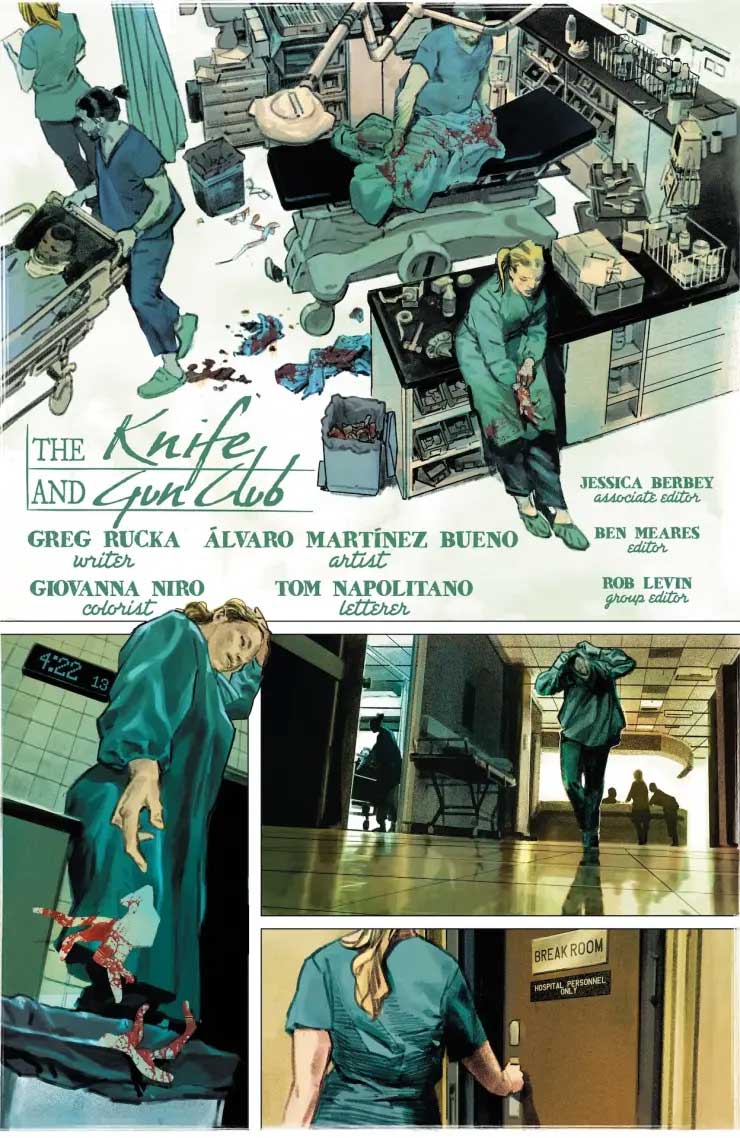
Detective #1100 is an oversized milestone edition with several Batman short stories, all of which are stylishly done and satisfying in their own ways. "Lost and Found" is a silent (i.e. no dialogue, no narrative captions) tale of Batman, aided by Ace the Bat-Hound (a deep cut going back to the goofy Batman comics of the 1950s), helping a deaf child recover his lost dog. It's derivative—Matt Fraction and David Aja did a fantastic issue of Hawkeye several years ago that was from the perspective of Hawkeye's dog Lucky (aka Pizza Dog) that wasn't exactly silent, but the only dialogue rendered in non-gibberish were words Lucky knew—but still fun. "The Knife and Gun Club" barely features Batman at all, it's a peek into the doctors and nurses on staff at the emergency room that treats people involved in a typical night in Gotham City—victims of crime and perpetrators of same that, in one way or another, are sent to the ER by Batman. One doctor is outraged at the number of injured people arriving thanks to the actions of Batman. Another much prefers the injuries they treat now over the fatalities that were the norm pre-Batman. A reveal at the end has Batman himself sneaking in to have a laceration stitched up. "Your Role in the Community" juxtaposes Batman's crime-fighting efforts with the image cultivated by his alter ego Bruce Wayne, who is shown at a fund-raising event in Gotham being browbeaten by a journalist who takes him to task for merely throwing money at society's problems. The last story is "The Fall," which doesn't do anything for me but is illustrated by Bill Sienkiewicz, whose gritty, ink-wash style is always interesting even if not particularly appealing to me.
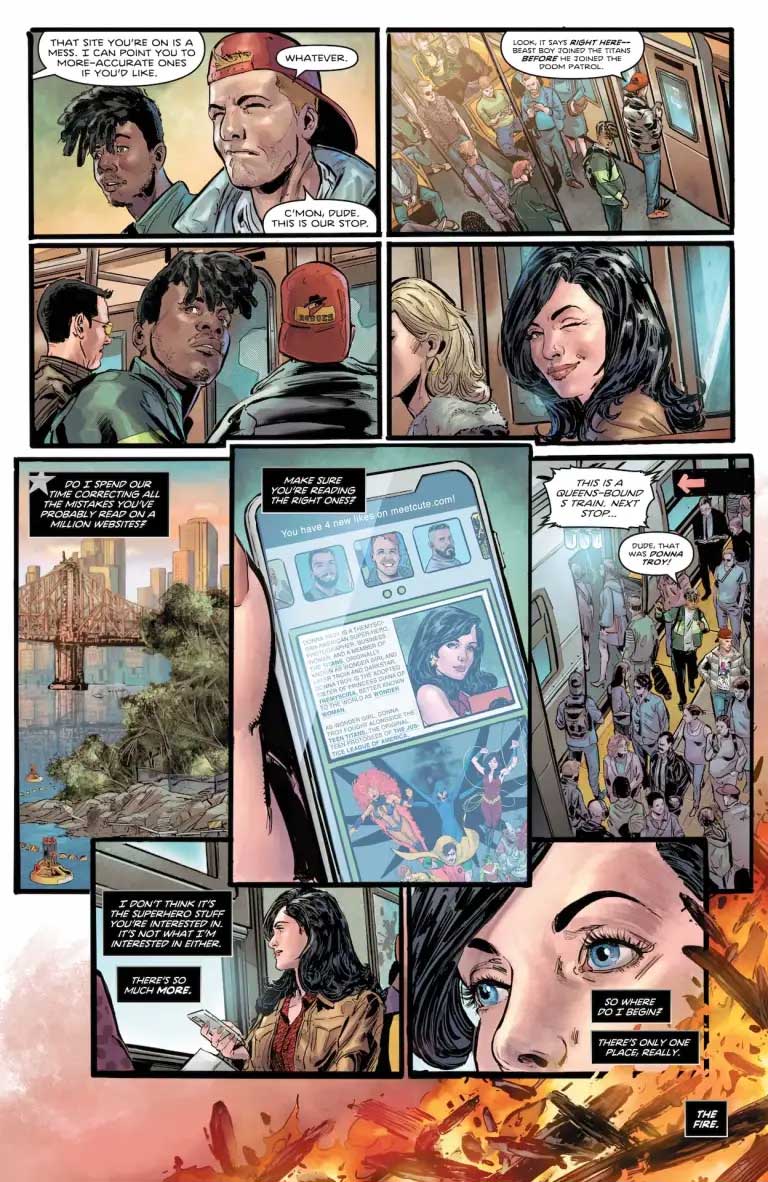
Titans Annual 2025 is a more traditional single-story issue, entirely character-based as Donna Troy recounts her attempt to meet and get to know her birth father. That particular character has had a mysterious background for a long time and there have been a few iterations of "Who is Donna Troy" going back to the ’80s, but this was a welcome addition to the canon, spectacularly written and drawn by Phil Jimenez. The regular Titans title I should probably quit buying, it's one that I simply have a lot of nostalgia for as one of the favorites of my comics-fan heyday even though lately it's been forgettable and ... let's say, unsophisticated. But, had I not been getting it I might have passed on this Annual, and I'm glad to have gotten it.
I've also started the novel Ancillary Justice, by Ann Leckie. It was recommended to me as "in my wheelhouse," but thus far I'm kind of struggling to get into it. Hopefully it'll pick up soon.
So, anything y'all would recommend I add to the entertainment pile?
Tagged
TV,
Comics,
The Black Hole,
Posted on November 19, 2025 at 12:48AM | Permalink | |
Free time
Well, Dad, it took several years, but you were right—there did come a time that I wanted to paint and/or stain these:

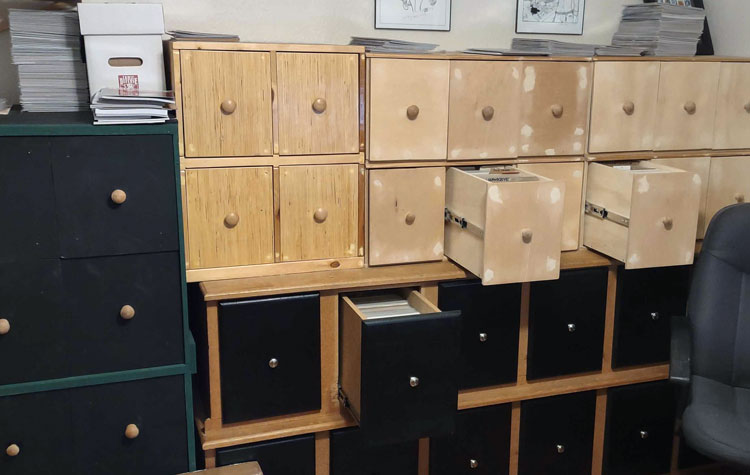
It's the ones on the right and one of the 3-drawer units in the middle that are my original homemade comic-book cabinets, built some time back in my dad's garage. The other center unit is newly built, the one on the left and another 8-drawer unit out of frame were built around the time I moved into my current abode. Out of frame below are ones made when I was a teenager by a contractor that my mom had hired to remodel her kitchen. (Those needed some adjustment; the contractor didn't really know what they were for. Those adjustments were also made in recent years.)
I also replaced, recut, and/or repositioned the 12 front panels on those initial builds, as they were all a little wonky in one way or another, and the 8 fronts in the out-of-frame cabinet that were originally done on the cheap and didn't fit that well.
Even with the new unit, these are all full. But there's no longer any overflow (well, not much) other than the batch previously pulled for eBay sales. There's room for maybe one more unit before drastic measures would have to be taken, so I'd best get really cracking on the eBay selling to slow the growth. This is a collection I've been amassing since I was 10 or 11 years old, some of which I really value having and a lot of which is, frankly, chaff. But collectors of anything will understand—even when trying to pare down and remove some chaff, there's always net growth.
It's been a fun project at any rate, something I had time to do since I don't have a lot of client work at the moment. I'm not minding that, really. Thanks to my mom willing me some resources, I'm not desperate for cash; between the work I do have and my umpiring gig, I'm getting by reasonably comfortably. A little woodworking in the garage has been a nice way to spend part of my summer.

It all looks a lot better now, despite some remaining wonkiness in some of the alignments. I can live with it.
I know, I know: Nerd.
Tagged
Comics,
Projects,
Posted on August 10, 2024 at 12:31AM | Permalink | |
Comics POV
 A superhero and his dog
Every once in a while, someone in the comics world will try something weird, a kind of experiment in format or style. John Byrne did an issue of Fantastic Four that was read sideways. DC had a run of a special Batman title that was in black and white to give it a more noir feel. Marvel had a month wherein their entire line was purely visual, no words.
A few months back—I'm a bit behind, I just read it yesterday—DC published an issue of Nightwing illustrated entirely from the title character's perspective. It took me a couple of pages to understand the gimmick, but once I did I thought it was cool. It was writer Tom Taylor and artist Bruno Redondo's take on the classic M*A*S*H episode "Point of View," which was shot as if through the eyes of a wounded soldier at the 4077th.

The heads-up display is fine, but Nightwing needs to adjust his side mirror, it's not doing him any good.
But more than the M*A*S*H episode, it brought to mind two issues of Hawkeye from about ten years ago. Writer Matt Fraction and artist David Aja delivered a run of that title that is among the best mainstream comics has ever produced, and issue #11 and #19 are standouts because of the perspective the story is told from. It was nice to be reminded of them and I'll have to find some time to dig those issues out and reread them.
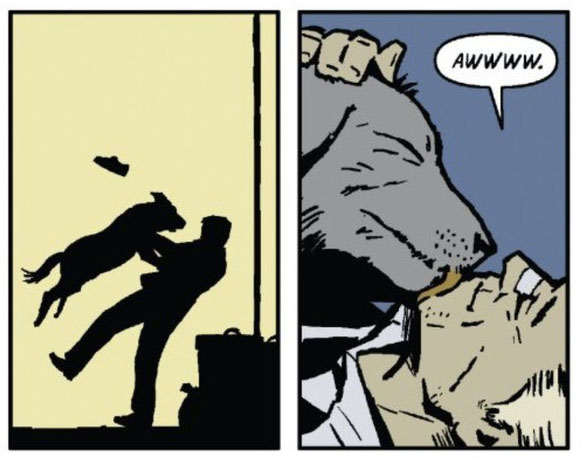
Hawkeye #11 is entirely from the perspective of Hawkeye's dog, Lucky. Dialogue balloons mostly contain chicken-scratch with the occasional word Lucky recognizes—" \\||| \ \\ \|||| || sit \||| -\--||| bad ||\\\//\/\\||| lucky \\\|--///\|| down"—while the reader is shown how Lucky perceives the world through pictograms that translate the smells and sounds he's sensing, as well as how Lucky identifies various people by their associations with odors, events, and objects. The story follows Lucky as he discovers a resident of his building dead on the roof, then finds all the clues needed to find out who killed the guy. It's so, so good.

#19 focuses on the fact that Hawkeye had lost most of his hearing thanks to being caught up in an explosion in a previous issue and is told from his auditory perspective, which is to say, the word balloons are empty and he communicates via untranslated ASL. Just brilliantly done.
The Nightwing issue is a nice little gimmick. I appreciated it. It's well drawn and the story itself is fine, if not particularly memorable in and of itself. But what it really did was make me appreciate Fraction and Aja's Hawkeye all over again.

Tagged
Comics,
Posted on August 28, 2023 at 7:30PM | Permalink | |
Collecting
“Why do you even have these?” a friend of mine asked me.
I was applying some paint to the recently-constructed cabinets I'd made in my garage, cabinets that were custom-designed to hold comic books. I stopped, looked up, and found myself at a loss.
I mean, I had an answer, it was there, but articulating it was proving difficult.
See, I love comics. The medium, the wide variety of cartooning styles found in them, the characters that have permeated our culture, the more obscure works that most people have never heard of. (Well, not all of them, but a lot.) I started reading them longer ago than I can remember and was a fan from a young age of Batman and Captain Marvel (the original '40s one, during his '70s revival) and Spider-Man and the Fantastic Four and other superheroes. I read the occasional Archie comic or Yogi Bear issue too, but mostly I was into the standard DC and Marvel superhero soap operas.
Then, when I was around 11 or 12, I discovered comic-book specialty stores. Back issues. The collector's market.
It was a revelation. At that point I became not merely a fan, but a collector. I learned that the condition of one's comics is vital. That one needed to invest in protective sleeves for them, that storing them lying flat is bad—they don't actually lie flat, you see, the spine side creates a bend in the stack and bent comics are worth less—they should be stored upright. That comics drawn by certain artists are in more demand than those by other artists, that there are "key issues" of long-running titles that command big bucks (or at least "big bucks" by the standards of a 12-year-old in the early 1980s).

Back in the day, my goal was to acquire every issue of Fantastic Four. Never did it, as the first dozen-plus were too pricey for me.
My friend had been holding a copy of Secret Avengers, which was in a small pile of comics destined for the "eBay box," which had by then become a series of boxes. I stalled a little bit in answering her question as I tried to find the right words for my response by going on a tangent. "Well, that pile I'm not keeping," I said. "Those are eventually going on eBay. Even with these new cabinets, I don't have enough room for everything so some stuff will have to go."
But the majority of them, yeah, I was keeping. And I was adding to the mix all the time, spending anywhere from $40 to $100 a month on new comics (which, accounting for both inflation and the changes in the comics biz since then, equates to what about $8-$20 would have bought in 1987, so I feel like I've cut down a lot since my teenage comic-buying heyday). Why do I have them?
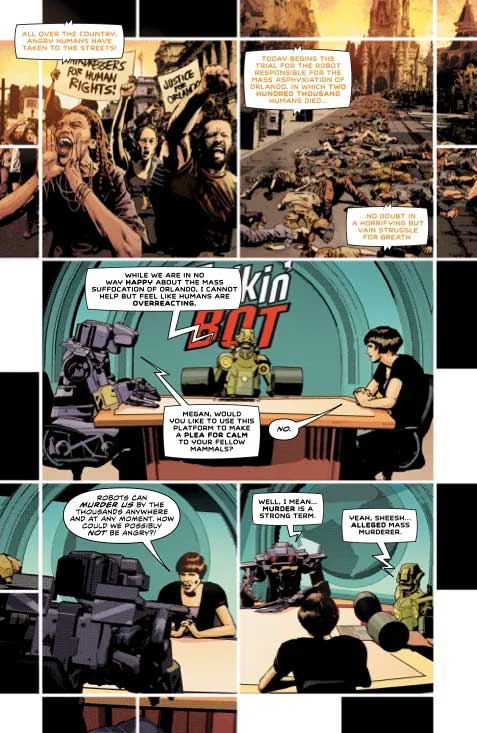
One of the more fun new comics right now is Not All Robots, by Mark Russell and Mike Deodato Jr.
Sure, some of them have decent monetary value well above what I paid for them and keep increasing over time. But most just kind of hold steady or never had much to begin with. If it was about "investing," I'd only have kept about 30% of my collection over the years.
I have them because I like them. Because it's a hobby. Because I am, at my core, a huge nerd. Because my growing-up years were so influenced and tied to the morality plays of Marvel Comics and because I developed a deep appreciation for the talents of people like Marshall Rogers (RIP) and Steve Rude and Neal Adams (RIP) and Mike Deodato Jr. and Terry Moore and Alex Ross and Brian Bolland and Clay Mann and the recently-deceased George Pérez (RIP), among quite a few others.
But that doesn't really get at why I keep them and collect them. I mean, they take up a lot of space. Moving them is a royal pain. Keeping them organized is time-consuming. I've spent a lot of money on their storage (though a lot of that was fun too, building the cabinetry on my own and, on some of them, with my dad). There are reasons not to.
Yet, I do keep them and I do have them. My inventory software (yes, I have inventory software for this) has my current tally at about 8,700 comics, not including some of the 1,000-plus in the eBay boxes. Storage capacity is now once again full up. More keep coming in. Why do I have these?
Because I want to.
Any attempt at articulating the not-rational yet deeply held reasons for it basically comes down to that. I have these because I like them, or in some cases because I did at one time. I keep them because I want to.
As space continues to get tighter more chaff will be moved into the eBay piles, but eventually I will probably make yet another storage unit. It's my own version of the never-ending battle.
Tagged
Comics,
Posted on September 2, 2022 at 3:46AM | Permalink | |
What Dreams are Made Of

It's 4:00am and I can't sleep. Not an altogether unusual occurrence, but not a welcome one either. But not being asleep does mean I'm not enduring another of my subconscious Twilight Zone episode-style dreams.
I've been having a recurring dream of late—well, the actual dream isn't recurring, but the theme and premise is—in which my late mother shows up alive. My science-fiction- and comic-book-reared brain knows that in those genres, death isn't necessarily a permanent state—Spock came back thanks to the regenerative properties of Project Genesis, Buffy was magically brought back by the Scoobies, Captain Jack Harkness dies and comes back all the time. In comicdom, characters are killed off and brought back as marketing ploys with annoying frequency; we used to say there were two kinds of dead comic characters, just-for-now-dead and "Bucky-dead." (We used to say that, because after decades Marvel even resurrected Bucky Barnes as the Winter Soldier, so even Bucky isn't Bucky-dead anymore.) Captain America, the Human Torch, Batman, two different Robins (with a third only thought dead), Doc Ock, and Wolverine are just the most recent characters that come to mind that have come back from the great beyond no worse for wear. Oh, and Phil Coulson. Tahiti is a magical place.
So I guess it's not surprising that my subconscious would generate a scenario like the one I was treated to lat night/this morning, that had both my mom and her husband returning because of some sort of time-dilation mumbo-jumbo during their travels, putting me in the awkward position of having to explain to them that I'd sold their house and depended on some of their money now, oh, and that this was going to seriously fuck up all the struggles I'd been going through with banks and fund managers to get control of their assets. In this dream scenario, I somehow also knew from the get-go that this was a short-term return, that the metaphysics of this mumbo-jumbo just meant I was going to have to go through them dying all over again, and in my mom's case, her finding out that their house was now owned by somebody else just prompted her to drink continually, berate me, and call me unprintable names.
Previous iterations of this dream-theme weren't so wholly unpleasant, in that in them I'm glad to see my mom again and then they veer into unpleasantness when the re-dying happens (it always happens, part of the theme). The details generally fade pretty quickly upon waking up, but the basic outlines remain.
I have, of course, been dealing with a great many entities and institutions since she passed away regarding assets and various executor-like things, most of which eventually got resolved after varying amounts of frustration and outrage. One remains unresolved, and as that item has been occupying a chunk of my waking time in recent weeks (lawyers and judges and probate, oh my) I guess my brain decided to use it as ready-material for REM movies.
Thanks a lot, brain.
Tagged
Mom,
Comics,
dreams,
Posted on July 21, 2017 at 4:59AM | Permalink | |
Right Angles are Our Friends
 Thanks for doing this with me, Dad!
You might recall I posted some months ago about my comic-book collection and its steadily oozing expansion that threatens to consume a whole room in my home. As discussed then, I found some videos on the Interwebs from people that have built themselves some customized storage units and set out on a similar undertaking.
I drew up some "plans," which is a generous term; they were adequate, but not especially organized. I sought out the materials I would need. Then I left it alone for a while while other things came and went.
But last month I drove down to see my dad in Palm Springs, Home Depot gift cards in hand, thinking it would be fun to do this project with him and a good excuse to visit for a couple weeks. Which it was. Dad and I built four cabinets with three drawers each to house roughly 2,500-3,000 comics in total.
It was a learning experience as well as a good time; I've done a fair amount of tinkering and improvising things in my day, but never a start-from-scratch building project like this. We made some mistakes.

The workstation
First off, we bought wood that did not match my plans' specifications — I planned for half-inch thick boards, but I got wood planks that were slightly less than half an inch thick and did not make any corresponding adjustment to my specs. Thus, we made drawers that were ever-so-slightly narrower than spec and drawer housings that were not uniformly wide. So a number of them had to be "MacGyvered" to work properly by shimming the rails with whatever was handy (metal washers, wood scraps, cardboard).

Almost half an inch isn't actually half an inch. Multiplied enough and you need a quarter-inch of shim.
More annoyingly, I didn't think through a proper way to attach the front panels of the drawers. They were intended to overlay and extend beyond the face of the drawers by a half-inch on all sides, but every attempt to attach them was off-center and/or crooked. In order to get them all to fit, we ended up trimming a number of them rather than continue to try over and over to reposition them properly.
Also, though we had a fantastic table saw for the smaller pieces, we didn't have a good way to cut down the larger ones. We improvised something that seemed to work adequately, but then in the process of assembly realized that many of the pieces we cut were not cut straight; the bottom edge would end up being shorter than the top edge, that sort of thing. Not by a lot, and in and of themselves, the pieces worked fine, but in the overall assembly, there were enough weird angles and slight slants to things to cause frustrations and some funky weirdness to the finished product.
In the end, they are completely functional and, I think, more than adequately appealing. But as my dad said while trimming one of the crooked drawer fronts to make it fit alongside the two others in the unit, "at least when anyone looks closely at these they'll know they were home-made."
I'll eventually paint or stain them, but that's something for another day; I don't plan on staying in my current abode all that much longer, so that'll wait until I know what my new place will look like. Plus, I still have a ton of overflow; I'll want to build more of these then, too. With more attention to measurements and right angles.


Of course, now I have an elegant solution for how to position the front panels to attach them properly.
Maybe I'll find it worth the hassle to remove and reattach them later.

The sides of this drawer are cut at a not-quite-right angle, making the front attach with a bit of a warp.

Far, far better than the endless sprawl of cardboard boxes I was previously dealing with, but even when thinned out—the cardboard boxes on top plus a couple out of frame are slated for eBay—I still have 2½ cardboard longboxes and 4 shortboxes (center) full of comics and I can't seem to keep from buying more every month. More building to come!
Tagged
Comics,
Dad,
Projects,
Posted on April 26, 2017 at 10:32PM | Permalink | |
Exceeding Capacity
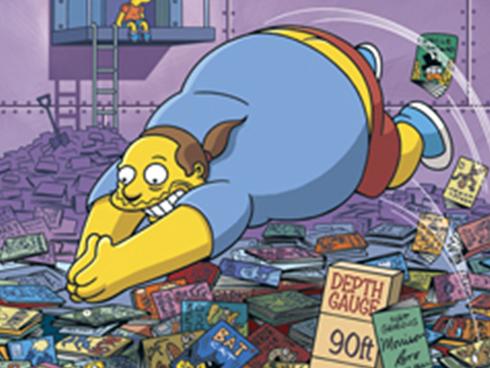
I started collecting comics when I was around ten years old. I organized them, tried to keep them in shape, and struggled to find a way to pile them on shelves that didn't warp them or leave them vulnerable to fading and discoloring or random cat frenzies knocking them over and denting them. Eventually, I learned about the existence of longboxes and bought one, but that soon was outgrown and I improvised other boxes that became ugly and unwieldy.
A couple years later my mom was having our kitchen remodeled, so there were carpenters and other workmen in the house a lot, and one day Mom asked them if they could build some kind of cabinet for my mass of comics. (She did this without any prompting from me, too, which is the sort of thing I try to remember about her rather than the ugly alcoholic stuff that came much later.) So they did, and it was OK, but not really ideal -- just kind of a deep shelf unit turned on its end -- and after a time I maxed it out anyway, so one day Mom again said, "why don't we have them make a better one," and I sketched out what would be better. And by the time we moved into a new house not too long after that, I had a pair of long wooden drawer cabinet things that doubled as furniture and storage.
Those things are great, and I still have them today. They held most of my collection for years, with only a couple of longboxes supplementing, but as needed I would get another box and tuck it away somewhere.


My overflow now exceeds what fits in the cabinets.
Now, though, things are out of control again. I occasionally put some comics on eBay and try to thin the mass some, but the incoming stuff always outnumbers the outflow of eBay dumps (and really, I should just put a lot of the chaff in some bundles and sell it for pennies if I really want to make space), and my library room is in a constant state of disarray. I've cleaned it up some of late and tried to organize, but the conclusion is that, since I can't seem to muster up the will to sell off half my collection, I need more of what my mom suggested for me during her kitchen remodel.
But I'm a grown-ass man now (allegedly; I mean, this is about thousands of comic books) and I don't need to hire contractors to build things, I can do it myself. So I will.
I used The Google and determined that, as expected, my mom was not the only person to conceive of such things and others have built similar units and documented them. One fellow even recorded some of his construction work at the time as well as the finished product. I'm going to come up with something that is a kind of cross between what my mom had made from my teenage sketches and what this "cougarcomics" fellow has done.
I'm putting this up here mostly as a reminder to myself and as a public declaration of intent so I won't blow it off; I don't know when I'll get to it, in some ways I think I should start right away because I have time and I tend to have less work in the winter than the rest of the year. On the other hand, sometime in the next year or so (?) I intend on moving, and do I want to move even more heavy wood furniture than I already have? Maybe better to wait until I'm in a new place. But, who knows, it might take longer to find a place to move to, and in the meantime the problem continues, and when I do move, I'll have a lot of stuff still in these crappy cardboard boxes that could get dropped or dented or whathaveyou. So ... probably ought to do it sooner.
Tagged
Comics,
Projects,
Mom,
Posted on December 4, 2016 at 9:58PM | Permalink | |