

Pop culture and fighting the black hole
My mood since returning from my California travels has been in a state of flux, vacillating between "meh" and "we live in the worst timeline everything is misery." OK, I exaggerate slightly—truly miserable hasn't been part of my black-hole-of-depression episodes since the Zoloft Rx, it's actually more ennui than misery. But you take my point, it's not been peaches and cream. Unless the peaches are moldy and the cream curdled, I guess you could go that route in your metaphors if you like. "Darmok and Jilad at the expired food buffet."
Anyway, I won't go into the state-of-the-world portion of what's depressing in this post. You can look to the news media or your health insurance renewals for those sorts of bummers for now. In fact, for this post I don't think I want to go into any of the stuff that's been bumming me out, the bulk of which is something I don't really have a handle on anyway. Instead, let's discuss some stuff I've actually enjoyed lately.
My consumption of entertainment on the TV machine of late has included a few standouts that I heartily recommend:
-
The Big Thing of the Moment in the streaming world is Plur1bus, on AppleTV+, and it really is as good as its hype. It's high-concept sci-fi, so not for everyone, but the story follows Carol (Rhea Seehorn), a romance novelist with contempt for her readers, who is among a very few people worldwide who have not been afflicted with a mysterious ... something? Ailment? Virus? Extraterrestrial takeover? Freak sunspot storm? ... that has put the vast majority of the global human population into a sort of group mind. There have only been three episodes so far, so the mystery is still quite mysterious, but it's a premise that poses a Big Picture question, if you will, which is: Are people better off content in a happy groupthink mental commune, or as individuals with all of the messy conflicts that are possible between them? Created by Vince Gilligan of X-Files fame, the show's tagline is "The most miserable person on Earth must save the world from happiness." The show works only because Carol is such a well-realized character and Seehorn is so good at embodying her. Without Seehorn in the role I think the show would fail, or at best be something quite different. It's intense, but very well done.
-
Wayward, on Netflix, is a mystery show from creator/star Mae Martin. I liked Martin's prior show Feel Good, so I thought I'd give this one a shot too. It's a whole different kind of thing—Feel Good is a semi-autobiographical slice-of-life comedy/drama, Wayward is about a tiny town in Vermont where there are no children and an academy for teens that "students" run away from as often as possible because horrible things happen there. Based at least in part on the experience of a childhood friend of Martin's who was sent away to a "troubled teen" camp of sorts called CEDU—that friend is a consulting producer of the show—the series follows two parallel tracks: one, a pair of Toronto teenagers who find themselves "enrolled" in the cult-like academy; and two, Martin's character, a cop newly-transplanted to the tiny town who dives into figuring out the mystery of the academy while the entirety of the town tries to prevent anyone exposing its secrets. It's good, but the ending is unsatisfying; it gives two different versions and its unclear which character imagines the false one or if it's supposed to be more of a you-the-audience-can-choose-which-ending-you-like-better kind of thing or what. I liked it overall, though, and it's worth spotlighting the sort of "troubled teen" institutions that still exist and still cause problems in our world of abuses.
-
Then there's The Lazarus Project, a British sci-fi show that follows George, a new recruit to a secret government agency that intervenes to prevent disaster from befalling humanity and uses its most powerful tool to turn the clock back if the worst comes to pass. George notices he's in a time loop, repeating three months of his life, and since people aren't supposed to remember things that happen before a "reset" the agency takes interest and brings him into the fold. When someone has the power to reset the world—always back to the most recent July 1st—there have to be understandings that resets only happen in the most critical circumstances or else there's nothing but chaos. But what if one of the agents feels his/her personal needs outweigh the rules? And what happens if other people discover this whole time-reset thing and try to develop their own method? Or a way to send someone back beyond a reset point? Time-travel stories all tend to have similar elements, but I like the way this one skews them and the way the multiethnic British cast fills out a complex bunch of characters. It's not a show that has any real standout staying power, but its well-produced and well-performed. I enjoyed it.
- A Man on the Inside is a show I watched when it first came out last year, but I rewatched it while visiting Dad & Marty in California a few weeks back. It has a new resonance for me now that my dad is going through some stuff that relates heavily to some elements of the mystery Ted Danson's character of Charles is placed in a retirement home to investigate. Really great stuff, and season two is scheduled to drop this week. Looking forward to it.
Then there's the world of comics. I've been asked a few times, mostly by my friend Nikki, why I, a middle-aged adult man, still spend anywhere from $50-$100 a month on comic books. I don't always have a good answer. Lifelong hobby, appreciation of the art form, investment in the fictional worlds they embody. A lot of them I read and then say, well, that's not memorable or special at all, and think I should reassess my ordering habits. (I'll turn some of them around and sell them on eBay if I don't find any other value in them.) Sometimes I keep getting a particular title for the collector-completeness motive even though there's not much there. Mostly, I simply enjoy them and that's good enough for me. But occasionally something will surprise me, a mainstream superhero comic or a little indy curiosity that reminds me, yeah, that's why I always loved comics.
The most recent of those standouts are Detective Comics #1100 and the 2025 Titans Annual.
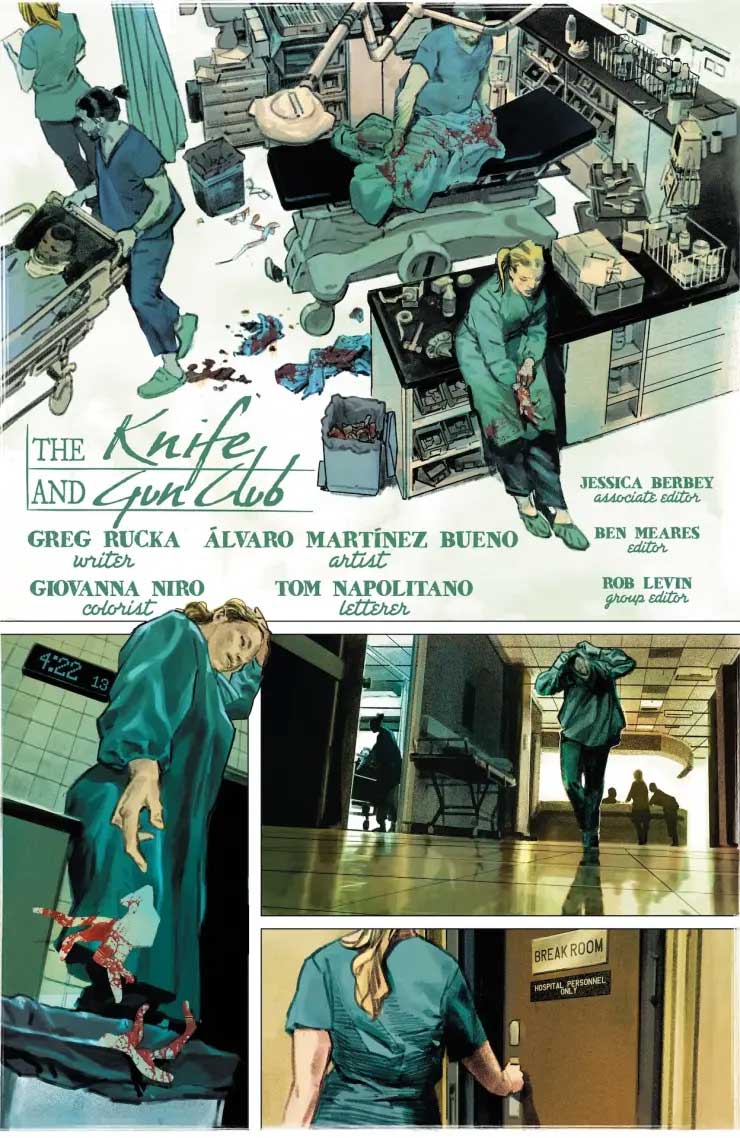
Detective #1100 is an oversized milestone edition with several Batman short stories, all of which are stylishly done and satisfying in their own ways. "Lost and Found" is a silent (i.e. no dialogue, no narrative captions) tale of Batman, aided by Ace the Bat-Hound (a deep cut going back to the goofy Batman comics of the 1950s), helping a deaf child recover his lost dog. It's derivative—Matt Fraction and David Aja did a fantastic issue of Hawkeye several years ago that was from the perspective of Hawkeye's dog Lucky (aka Pizza Dog) that wasn't exactly silent, but the only dialogue rendered in non-gibberish were words Lucky knew—but still fun. "The Knife and Gun Club" barely features Batman at all, it's a peek into the doctors and nurses on staff at the emergency room that treats people involved in a typical night in Gotham City—victims of crime and perpetrators of same that, in one way or another, are sent to the ER by Batman. One doctor is outraged at the number of injured people arriving thanks to the actions of Batman. Another much prefers the injuries they treat now over the fatalities that were the norm pre-Batman. A reveal at the end has Batman himself sneaking in to have a laceration stitched up. "Your Role in the Community" juxtaposes Batman's crime-fighting efforts with the image cultivated by his alter ego Bruce Wayne, who is shown at a fund-raising event in Gotham being browbeaten by a journalist who takes him to task for merely throwing money at society's problems. The last story is "The Fall," which doesn't do anything for me but is illustrated by Bill Sienkiewicz, whose gritty, ink-wash style is always interesting even if not particularly appealing to me.
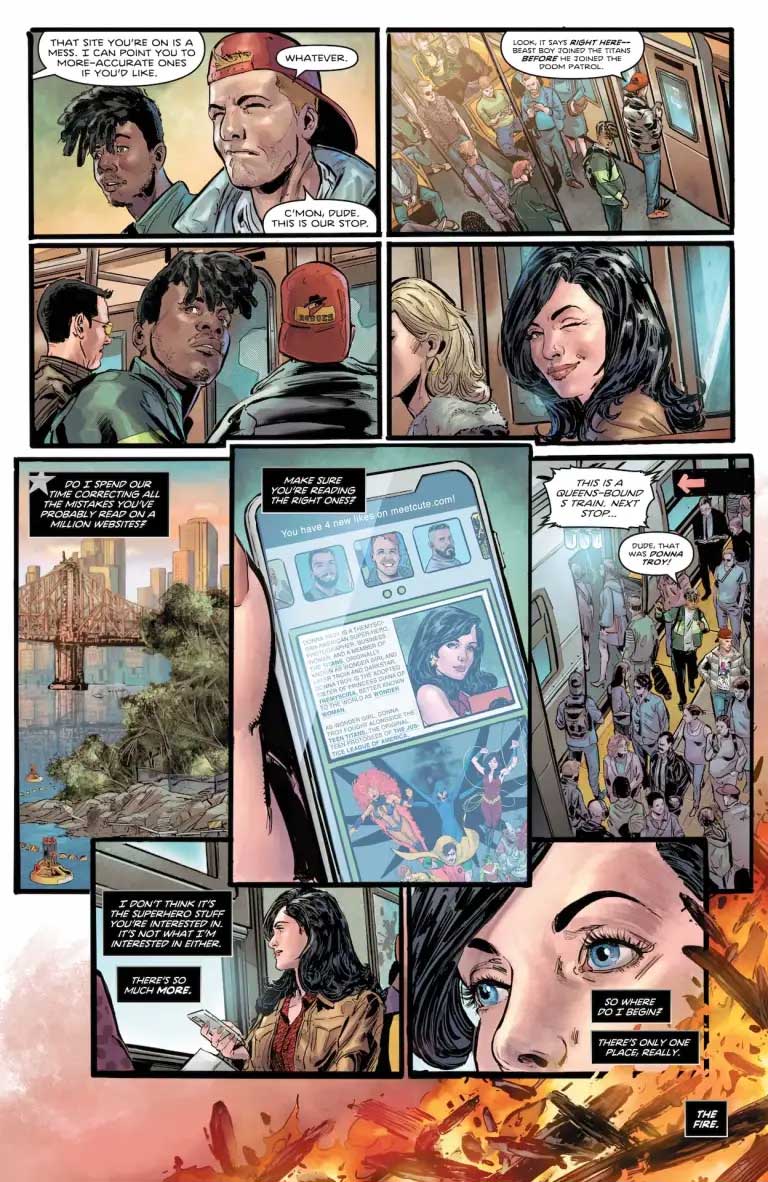
Titans Annual 2025 is a more traditional single-story issue, entirely character-based as Donna Troy recounts her attempt to meet and get to know her birth father. That particular character has had a mysterious background for a long time and there have been a few iterations of "Who is Donna Troy" going back to the ’80s, but this was a welcome addition to the canon, spectacularly written and drawn by Phil Jimenez. The regular Titans title I should probably quit buying, it's one that I simply have a lot of nostalgia for as one of the favorites of my comics-fan heyday even though lately it's been forgettable and ... let's say, unsophisticated. But, had I not been getting it I might have passed on this Annual, and I'm glad to have gotten it.
I've also started the novel Ancillary Justice, by Ann Leckie. It was recommended to me as "in my wheelhouse," but thus far I'm kind of struggling to get into it. Hopefully it'll pick up soon.
So, anything y'all would recommend I add to the entertainment pile?
Tagged
TV,
Comics,
The Black Hole,
Posted on November 19, 2025 at 12:48AM | Permalink |  |
| 
Comments
No one has commented on this page yet.
Post your comment
RSS feed for comments on this page | RSS feed for all comments