

Tag: History
Another orbit complete
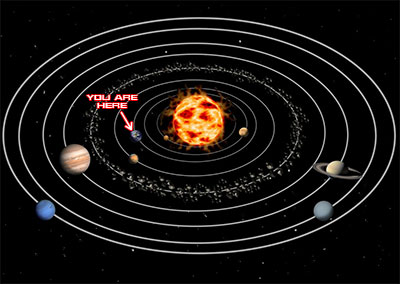 Image not to scale
It is my birthday today, marking the completion of another full orbit around the sun for me. Life moves at you pretty fast, to paraphrase Ferris Bueller, so it kind of snuck up on me this year; I wasn't on the ball enough to plan much of a celebration. Though I am heading out to have a meal with my co-birthday celebrant Mack and a couple of Spuds shortly.
Anyway, now that it's here I've been reflecting on some birthdays past and find four of them stand out for whatever reasons:
- I don't remember which year this was, but I was probably still in single digits. My dad had organized party activities for me and my friends that included a treasure hunt complete with clues and half-dollar coins(? I may be misremembering/conflating that part with a thing before a Triple-A game at Hi Corbett Field) that must have taken him forever to put together. It was a lot of fun.
- Number 11, 1980, when Dad took my friends and me to see Star Trek: The Motion Picture at the Oracle View theater. I'd seen the film probably twice already, but even then I was ensconced in my Trekdom. That said, before the movie one of my friends had brought over his new starship Enterprise toy and wanted me to help him correctly place all the stickers and decals on it and I felt really bad when, after the movie, I found that I'd fucked them up by placing the decals as they would have been on the TV version of the ship rather than the movie version.
- I want to say this was number 13, could have been 12 or 14, when I had planned a big party and invited a mess of friends over but only two showed up. I was initially super bummed out, but my mom took charge and declared a new party plan and took the three of us to mini golf and pizza instead and it turned out to be a really good time.
- And number 30, when my late friend Scott (and others) roasted me with the requisite Logan's Run "carrousel" and "runner!" jokes.
This one is destined to be obscure, but that's more than ok. In the grand scheme of things, it's a day like any other day.
Which in this era means a lot of anxiety and fretting about the world.
Meantime, building off of Erik's post on his recent birthday about people sharing the date, I will again note that I share my birthday not only with Mack (and Elliot Abbott, son of my friends Dawn and Derek), but with three Hall of Famers (Jackie Robinson, Nolan Ryan, Ernie Banks) and five rather forgettable former Seattle Mariners (Yuniesky Betancourt, Dave Cochrane, Tommy LaStella, Rob Whalen, Guillermo Heredia). Also Grant Morrison, Norman Mailer, and an number of actors including Suzanne Pleshette (The Bob Newhart Show remains one of my favorites); Kerry Washington; and, of course, Paul Carr, who's character Lee Kelso, helmsman of the Enterprise, was killed by a power-mad mutated Gary Mitchell in the second Star Trek pilot.
Speaking of Erik, he just returned from Minneapolis and has a nice post up today about his visit that y'all should read.
Tagged
History,
Personal,
Seattle Mariners,
Posted on January 31, 2026 at 6:21PM | Permalink |  |
| 
History break
Society continues to crumble around us, as Secretary of Terrorism Kristi Noem considers Hunger Games-style reality TV competitions for immigrants and the Speaker of the House says crime is OK so long as it's done openly. What a time to be alive, eh?
With all this happening one has to find other things to occupy one's mind or else go utterly mad, so I've been reading a book about baseball in the 1970s. My personal baseball fandom didn't really begin until maybe 1978—that's the first World Series I think I watched any of (Yankees-Dodgers, FWIW)—so most of what I've been reading so far is new-to-me anecdotes and bits of history along with more details to things I sort of knew about already in the broad strokes.
Like Astroturf. Though the synthetic green grass substitute was basically created for the Astrodome after the newly-rechristened Houston Astros moved into the world's first indoor baseball facility and discovered that a) a ceiling made of clear lucite panels makes for a great deal of glare and heat during the day; and b) remedying that by painting the lucite panels gray meant grass won't grow on the field. Hence, Astroturf. They incidentally also discovered that plastic grass was way cheaper to maintain than real grass, so when the plethora of new, multipurpose municipal stadiums started opening up they all featured Astroturf. Even the nice one—Royals Stadium in Kansas City, still in use today despite misguided efforts by some to fund a replacement—used the fake stuff, at least until 1995 (when the trend was moving to the retro-style baseball-only ballparks in fashion today). Candlestick Park in San Francisco wasn't one of these new behemoths, having opened in 1960, but it too converted to Astroturf for ten years. Horrible surface to play on. Well, "surface"; the surface was not terrible—though watch out for rug burns if you dove for a fly ball on it—it was the concrete underneath that made it truly unpleasant. Hard, unforgiving on knees and ankles, and then the extra fun of playing on it on a summer afternoon when it just reflected all the heat back up and made for field temps of 140 degrees (often in Midwest humidity). Thankfully bean-counters were ultimately defeated by players and aesthetics. Nowadays there are five teams that use artificial grass (oddly, the Astros are not among them) in their parks—all indoor or convertible facilities—but it's not the Astroturf of old, it's a rubbery grass-like surface atop a sandy subsurface that promotes drainage and doesn't feel like running on stone, and it's only used because growing grass is a challenge/impossibility in those stadia.
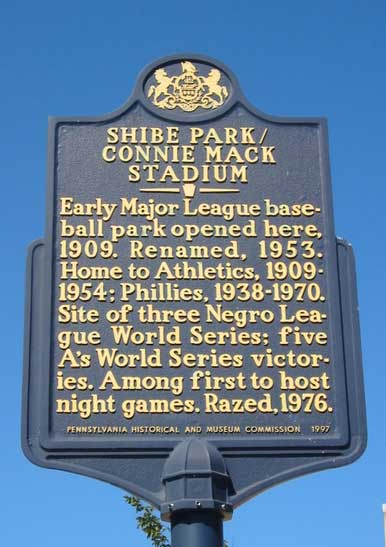
Anyway, the Astroturf train of thought brought me to the Philadelphia Phillies, who moved into their concrete and Astroturf home of Veterans stadium in 1971. That I knew. What I hadn't known was that they were desperate to do so because of their prior digs in Connie Mack Stadium, which the Phils had shared with and rented from the Philadelphia Athletics until the A's moved to Kansas City and which was apparently a nightmare of sunk costs. But it was the tale of the last game at Connie Mack that I wanted to share here today. Construction of Vet Stadium had been delayed a year, so the Phils had to tough out a final season at Connie Mack in 1970, the final game of which was marketed to fans with lots of promotions, giveaways, parts of the ballpark would be raffled off, and a helicopter was to fly down, pick up home plate, and fly it to The Vet at the end of the postgame ceremonies.
However, this was in Philadelphia.
It may be known as "the city of brotherly love," but Philadelphia sports fans are ruthless. (Go to any Phillies game and you'll see.) Throughout the game, fans could be heard hammering things, prying stuff out of foundations, basically stealing anything they could get their hands on as souvenirs of Connie Mack Stadium. When the game ended fans overwhelmed the field to take sod, dirt, the pitching rubber, advertising signs, pieces of the outfield wall, bullpen rosin, anything not bolted down and quite a few things that were bolted down. (After Oscar Gamble singled in Tim McCarver to win the game in the bottom of the tenth, he saw the crowd coming and yelled to his teammates, "Run, man, run like hell. We’ll be happy later.") Only home plate was spared since it was surrounded by officials who still needed to take it to Veterans Stadium. No postgame ceremonies happened, the stuff that was to be raffled off had all been stolen, the giveaway seat-slat replicas had been used as prybars and bludgeons, the emergency room at Temple University hospital was filled with Connie Mack Stadium chaos injuries, and the ballpark was in shambles.
It's a fun story, detailed here as "a day that would live in infamy."

A section of Connie Mack Stadium post-carnage
Tagged
Baseball,
History,
Posted on May 19, 2025 at 7:24PM | Permalink | |
Travelogue VI: Ghosts of 9066
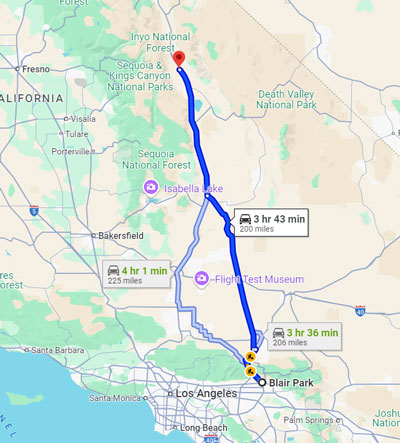 Return trip leg 2
Today is election day and at this moment polls are beginning to close in the eastern time zone. But I'll leave it to others to blog about today's critical decision-making, at least for right now. Erik has a final note on the subject, Mary Trump had a few words on it. Even Andy Borowitz chimed in to lighten the mood.
Instead, this will be the penultimate travelogue post from my trip to SoCal.
Manzanar
In 1942, a few months after the United States' entry into World War II, a stretch of desolate land in eastern California where a long-abandoned township once stood was chosen as one of ten sites to be used as "relocation centers" for anyone of Japanese descent living on the West Coast. Executive Order 9066, issued by FDR of all people, gave in to the paranoia and racism of the day and forcibly removed Japanese and Japanese-Americans—U.S. citizens and non-citizens alike—from their homes and businesses. This unconstitutional violation of rights and ethics was based on the concern that these people would be loyal to the Empire of Japan simply due to their ancestry, that some of them would use their knowledge and existence in the westernmost continental United States to supply an enemy nation with intelligence or act as saboteurs. Because racism. (Notably, German- and Italian-Americans were not similarly treated on the East Coast even though the U.S was also at war with Germany and Italy.)
Manzanar was the first of the camps, though not the largest. At its peak, Manzanar housed over 11,000 people in wood and tar-paper barracks over one square mile of area. Located on the eastern slope of a valley in the southern Sierra Nevada mountains, the environment was harsh and isolation was fairly severe. Yet, for three years the internees made the best of it and turned their concentration camp into a more livable space, planting gardens, running a school, publishing a newspaper, forming a baseball league, and gradually improving their living space structures as materials, such as linoleum flooring, became available over time.
Remarkable, really. The spirit to keep on and make whatever lemonade could be made form the rotten lemons given them impresses me no end. The injustice perpetrated on them was ever-present, and even when the war ended and the camps closed the internees were mostly returned to very little left from their pre-camp lives. It was one of the most abominable episodes in American history, the sort of thing modern Republicans would just assume no one ever thought about or remembered (even though they're now planning on doing this exact sort of thing again if they gain power after today).
Fortunately, the U.S. National Parks Service has taken over the grounds of Manzanar and has preserved what little remains from 1942-1945. They've built a small museum there and are using the few remaining structures as restored museum exhibits, and are slowly working to restore areas of the grounds that camp residents built themselves, like gardens and koi ponds and a small park. The barracks and other buildings are long gone (though one structure near what used to be the staff quarters remains in dilapidated shape), though markers for each "block" show where things used to stand. (Anyone who's watched M*A*S*H would have a sense of how things probably looked in terms of structures and what kind of comforts were available or not; the structures were more stable than tents, less so than the metal structure of the M*A*S*H hospital building.)
I had stopped by Manzanar once before, several years ago, but only had about 40 minutes then and wasn't able to see the grounds at all. This time I made sure to have an hour or so for the museum bits and at least that long to see the grounds themselves. It's actually rather pretty landscape there at the foot of the Sierras. I'd hate to have to live there in mid-summer or winter with no insulation and little electricity, though.
The few things still standing—which no doubt have been restored to some degree by the Parks Service—include the cemetery and the baseball field, as well as the entry gates and an ominous guard tower. Also a few signs at the perimeter warning of "sentry on duty" should anyone try to venture past the fencing.
It's a sobering and yet inspiring place to visit. U.S. Hwy 395 goes right past it, it's easy to get to. I overheard one guy in the visitor's center say to one of the park rangers, "this is the most horrendous place I've ever been, and I work in a prison." And what that place was used for is horrendous, and the conditions and all that surrounded 9066 that is there in the museum in its unvarnished historical accuracy show us how terrible our society has been and can be. But I'm also inspired by it, by the fortitude of the internees, and gratified that the National Parks service is maintaining and preserving this piece of ugly history.
We need these things to be preserved. We need to remember the ugly parts of our past in order to improve in our future. History often repeats itself—in Battlestar Galactica terms, this has all happened before and will all happen again—but it doesn't have to. We can learn from our mistakes, but only if they are remembered and preserved for our edification. And to bring this back to the election just for a second—if Trump wins, he's promised to create more concentration camps, for immigrants legal and otherwise, as a place to "store" them while he institutes mass deportations. We can make a different choice.


 Entry gate with original signage

Restored museum exhibit of a typical barracks unit

Restored museum exhibit of Manzanar schoolroom

Restored museum exhibit of Manzanar mess hall and kitchen


The baseball field has had restoration on the wooden bleachers and dugout benches as well as fencing. I also doubt the traffic cone is original.


A small park area has been restored by the National Parks Service. The dates signify the attempt in 2023 to recreate what existed in 1943.

Part of the restored park

Part of the restored park

The environment is both desolate and picturesque at the foot of the southern Sierra Nevadas
Tagged
Traveling,
History,
Posted on November 5, 2024 at 4:02PM | Permalink | |