



Tag: Craig Calcaterra
In which I parrot Craig C again
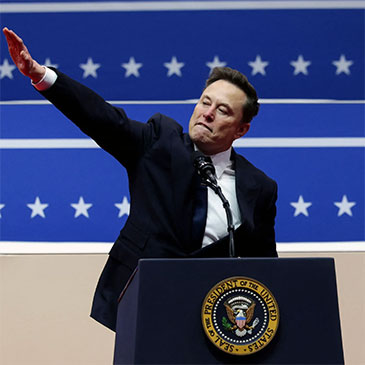 An neo-Nazi has staged a coup and it must not stand
I was going to write a bit of a screed today about how Elon has completely upended critical parts of the Federal government in defiance of law and without any authority to do so. I hadn't quite landed on how to articulate it, though, by the time I read today's edition of Craig Calcaterra's "Cup of Coffee." And, once more, Craig said what I would have said, only better. So I'll simply share his words with a "yes, 100% that" concurrence.
Since Friday, people working for Elon Musk, who do not appear to be government employees of any kind, have taken over the United States Treasury's and the Office of Personnel Management's payment mechanisms, have downloaded the most sensitive personal information of millions of Americans imaginable to private servers, and have locked actual government employees out.
Musk and his people have also taken over the General Services Administration, which is the agency responsible for government contracting. Which means he has taken possession of all the financial and personal information of everyone who does business with the federal government, including the details of government contracts, bids, company filings, and other information.
Musk and his people also have taken over the U.S. Agency for International Development, specifically taking control of its security systems, personnel files, and intelligence reports much of which is classified information and which pertains to thousands upon thousands of U.S. government workers operating overseas, many in classified roles. When Musk's people arrived at USAID headquarters its security officials, quite properly, attempted to bar access. Musk's people threatened to call in U.S. Marshalls and take the information at gunpoint, after which they forced their way in, took possession of the information they sought, and placed USAID officials on leave.
Which is to say, Elon Musk has, unilaterally and without any legal authority whatsoever:
- Unlawfully taken control of the United States Treasury and intends to unilaterally cut off payments to disfavored populations both here and abroad in defiance of Congress, the courts, and the American people;
- Unlawfully taken possession of personal information of hundreds of millions of Americans and thousands of U.S. government workers and has unlawfully downloaded that data to his private servers; and
- Unlawfully obtained the financial and personal information of everyone who does business with the federal government, including classified information.
It is impossible to overstate the levels of illegality we're witnessing. Off the top of my head this would appear constitute theft of U.S. government property, theft of public funds, the violation of taxpayer confidentiality, the unlawful releasing of names, sources, and methods of U.S. overseas activity, and I'm sure multiple other offenses. Just as it is impossible to overstate the illegality, it is likewise impossible to overstate the seriousness of this situation. If any other person or actor had done even a fraction of what Elon Musk and those at his command have done over the past three days they would find themselves in federal prison for decades if not for life.
That being said, I honestly don't know what can possibly be done here given Trump's dictatorial control over government right now, the certainty that he would prevent the DOJ, FBI, or any other authority from investigating any of this, and the certainty that he would issue preemptive pardons for Musk and his team should anyone even think about snooping around. But a coup has occurred. A coup perpetrated by a drug-addled Nazi sympathizer and a small team of extremely young men who likely have no idea how many laws they have broken, even if that's no defense to their crimes. The nightmare will not end unless and until Elon Musk and those he has ordered to infiltrate the United States government are in shackles.
Every Democratic Member of Congress, starting with ranking member of the Senate Banking Committee, Elizabeth Warren, ranking member of the Senate Finance Committee, Ron Wyden, and the ranking members of committees dealing with national security and government contracting should be holding emergency news conferences, raising the alarm, and demanding access to federal facilities, with TV cameras in tow, so it can be documented what they find or, more likely, how they are unlawfully turned away. As for the rest of us: this is the sort of thing for which a general strike is the only possible response, not that I expect such a thing could be effectively pulled off in this country.
Honestly, though, I have no idea what happens next. We are in completely uncharted waters. Nothing like this has ever happened in this history of the United States. But something has to happen in response.
Tagged
Politics,
Craig Calcaterra,
President VonClownstick,
Posted on February 3, 2025 at 5:02PM | Permalink |  |
| 
2025 as film

I only have a few minutes before I need to head out to an umpiring shift (ah, winter league...so far it's been pretty mild weather, but tonight will be in the 30s), so just a quick post today and one I largely lift from someone else.
Once again, that someone else is Craig Calcaterra, who in his Cup of Coffee newsletter today recounts a social media prompt that read "The movie that was number one at the box office on your tenth birthday is how your 2025 will turn out for you." Craig turned 10 in the spring of 1983, when the third (or sixth, depending on your particular thinking) Star Wars movie premiered. Here is his response:
In a time of rising fascism and authoritarianism I'd like my 2025 to turn out the way "Return of the Jedi" did. If we're being literal about it that means that (a) my adorable little friends will defeat my enemies after which they will roast and eat them while I will, personally, with the help of some barely-controlled rage, beat the crap out of either J.D. Vance or Elon Musk at which point they will switch to my side of things, throw Trump down a bottomless shaft, and then themselves die. That's a scenario that is pretty unlikely to actually transpire but, as they say, rebellions are built on hope.
...
[But if we] go with the number one film immediately after my tenth birthday, it'd be the "Saturday Night Fever" sequel, "Staying Alive." That movie is horrible in conception and execution and is basically unwatchable, but the title sets what is at least a moderately realistic goal for me in 2025, and I feel far more comfortable with that.
As usual, Craig, we reach.
For the record, the number-one film on my tenth birthday was Superman—The Movie, which while not as on-target as Return of the Jedi is for Craig, still works in that, like Superman, I would also like to fly fast enough to go back in time and save Lois Lane (or someone) before delivering the egomaniacal greed-obsessed real estate con artist to prison.
Tagged
Star Wars,
Craig Calcaterra,
Posted on January 6, 2025 at 5:41PM | Permalink | |
Miscellany
 Weird but fun, Interior Chinatown is worth a watch
Today's post: A random assortment of disjointed stuff!
- The dishwasher saga is over, with a new one purchased, delivered, and installed and the old one carted away to whatever scrap heap such things are taken to. I hadn't initially planned to replace the broken one so quickly, but holiday sales at Lowe's convinced me I was better off spending $600 now, on a good one on sale, than later on a cheaper one at regular price. It works, it's quiet, and most importantly, it doesn't leak into Rachel's kitchen downstairs.
- I've spent a chunk of time doing maintenance on this here website, including recreating the sketches page and beginning to populate it with stuff readily available, i.e. mostly stuff from the last few years that was either already scanned into my computer or at hand in my currently in-use sketchbook. There's other stuff in my hard drive already digitized, things that were on prior versions of my blog, but they were posted in the olden days of the Internet when nobody had a screen resolution bigger than 800 pixels and are thus pretty lousy scans. I'll have to find the originals and rescan them at some point. Anyway, the current format has clickable icons that produce a fullscreen image and a button to continue to "notes and comments" that takes you to a page for that individual sketch and any blathering I may have done about it, plus a commenting form just like a blog post. Click anywhere other than the button to close the fullscreen image and return to the sketch menu.
- I had my Christmas the other night at K&E's place, enjoying delicious food and talking about the world and also TV. All three of us love the Hulu show Interior Chinatown, starring Jimmy Yang and Chloe Bennett. It's a wacky comedic sendup of action movies, the Law & Order franchise, and meta-storytelling that takes place both within a Law & Order-style TV show and around a mild-mannered Chinese-American's family in a fictional Chinatown neighborhood. Recommended. We also agree on the greatness of Michael Schur's A Man on the Inside (Netflix), which I discussed briefly earlier but deserves a second recommend. The Diplomat (Netflix) also works for all of us, and we commented on the overlap of cast and crew from The West Wing on it (even though neither of them have ever really watched West Wing, which is really a bummer for them). Shrinking (Apple TV+) wasn't something they'd seen but which I think is terrific; they liked Slow Horses, which I've not sampled to this point. I'm very much into Silo (Apple TV+) and, naturally, the just-concluded (boo) Star Trek: Lower Decks, but know better than to try to convince K&E to watch those.
- I was gifted the book What's Next on that early-Christmas evening, and though I've yet to start into it, I am anticipating some great West Wing reflections and truly wonder how it will feel to revisit the details of the fictional Bartlet Administration while living in the impending nightmare of Trump 2.0, Now With More Oligarchy.
- I just learned that baseball Hall of Famer Rickey Henderson died today. One of the all-time greats, Rickey was a fantastic character with is arrogant self-assuredness, his speaking in the third person, and his generosity to others. Despite being exactly my kind of ballplayer—the stolen base king! Consistently walked more than struck out!—he was never one of my favorites, maybe because he took the steals record away from one of my faves, Lou Brock, or maybe because he spent his career primarily with the Oakland A's and the hated New York Yankees. He did spend part of one season in Seattle as a Mariner, in 2000, in the waning days of his very long career, and was always fun to watch no matter who he played for. My two favorite Rickey Henderson anecdotes come from other players. One, from former Seattle Mariner Harold Reynolds, who won the stolen base crown in 1987 with 66 steals (because Henderson was injured that year) and got a postseason call from Rickey congratulating him but also containing Rickey-style mockery, with Henderson ending the call with "Rickey would have had 66 by the All-Star break." Two, from fellow Hall of Famer Mike Piazza, who was Rickey's teammate with the New York Mets; Piazza recounted how Rickey voted when teams would be divvying up the postseason bonuses among the support staff. “Rickey was the most generous guy I ever played with, and whenever the discussion came around to what we should give one of the fringe people—whether it was a minor leaguer who came up for a few days or the parking lot attendant—Rickey would shout out 'Full share!' We’d argue for a while and he’d say, 'Fuck that! You can change somebody’s life!'” Apparently Rickey died from pneumonia, less than a week shy of 66 years old. Bummer.
- Earlier this week, Craig Calcaterra referenced a Washington Post article called "America's Best Decade" in his newsletter. The article analyzes results from polling 2,000 American adults on which decade was best for 20 different things, like best movies, best economy, best music, best reporting, and so on. There are some interesting (though not surprising) things, like Republicans are twice as likely to think the 1950s were awesome as other people are (hey, Republicans, that being the case, let's go back to the 90% marginal tax rate that existed then, which made for a lot of the circumstances you say you want!), or that people think the "best music" is the music they listened to in their formative years. But Craig's takeaway was surprise at the generational consistency of people liking their own youth (not just the music, but everything). "Americans feel nostalgia not for a specific era, but for a specific age," says the article. "The good old days when America was 'great' aren’t the 1950s. They’re whatever decade you were 11, your parents knew the correct answer to any question, and you’d never heard of war crimes tribunals, microplastics or improvised explosive devices." There's a handy graph to illustrate:

If they'd polled me, I might have skewed the results just a smidge. I mean, if I followed the pattern, I'd have my bests coming in the 1980s, and frankly there was a lot about the ’80s that wasn't all that. I mean, sure, those years were largely good for me (well, not ’89), but thinking big picture not so much. I'd say... Best Music? 1970s. Best Movies? I'm not really big into movies like some people, so I don't have a real feeling on this, but I guess the 2000s? Best Fashion? Hell if I know, but certainly not the ’80s; maybe the ’60s, since it spanned a lot of stuff. Happiest Families? Again, WTF do I know, but I'd say maybe 1990s since (a) women had far more agency than in prior decades, and (b) economically things were stable and good throughout. Most Moral Society is a question that inevitably tracks one's politics and I'd be tempted to say the 2020s if not for what happened last month to show us how many millions of Americans are still racist, misogynist, cruel asshats. Most Reliable News Reporting? 1970s again, though it really depends on how you quantify; there's a lot of fine reportage more recently, but also increasingly widespread BS from the dawn of cable TV forward. Best Economy? 1990s. Best Radio? I've no proper context for this, but given how much more radio was a thing the further back you go, maybe the 1940s or ’50s? For me, again the ’70s. Best TV? Right now, man. So much great TV being made even as the TV delivery system is transmogrifying. Least Political Division? Um...never? I mean, now is the worst in ages, but there's always been a lot; maybe the ’40s, what with the war being a unifying purpose. Best Sporting Events? For me, that's limited to baseball, really, and in this area I fit the trend—1980s baseball was great and I wish we could exhume Bart Giamatti to be Commissioner again. Best Cuisine seems like a dumb category, as food doesn't change, really, it's how we eat that changes. I like good food whenever it's eaten. Anyway, kind of an interesting survey.
Tagged
Site issues,
Politics,
West Wing,
Baseball,
TV,
Craig Calcaterra,
Posted on December 21, 2024 at 8:37PM | Permalink | |
More stuff other people said
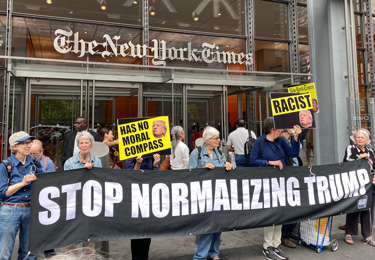
Hot off last night's post, in which I both (a) complain about the corporate media coverage or lack thereof regarding the fascist idiot hatemonger that's running for president as a Republican, and (b) quote Craig Calcaterra on something entirely different, came today's edition of Craig's Cup of Coffee newsletter. Craig unconsciously rebuts some of my complaint while also supporting it, because Craig is a smart guy. I'll share the entire section for you here and also suggest that, if you are interested in baseball, politics, and/or relatively obscure indy musicians, Craig's newsletter is $7/month.
The problem with covering Donald Trump and J.D. Vance
Almost every day on social media you see a tweet in response to something Donald Trump has said or done to the effect of “why isn’t the [name a publication] covering this?!” I’m sure I’ve shared that sentiment myself at times. Usually when stuff happens like Trump telling people at a rally that he’ll suspend all laws as they apply to policing, round up 20 million brown people with a domestically-deployed military, and put them in concentration camps, the day after which the New York Times leads the front page with “How do Trump and Harris’ tax credit plans compare?”
This is galling, but it’s also the case that the news media is covering Donald Trump. If it wasn’t we wouldn’t know about his insane ideas. They do stories on his authoritarian proposals, his racist and sexist comments, and all of those things. Indeed, about 95% of the time you hear someone say “why isn’t the media talking about . . .” the media has, in fact, talked about it already, often extensively.
When people say stuff like that I think they’re saying one of two things.
The first thing they’re saying, at least implicitly, is “why hasn’t the entire country rejected Donald Trump out of hand based on this appalling information?! Why has this appalling information not created a Joseph N. Welch-style ‘Have you no sense of decency, sir, at long last’ moment in which the bad actor is effectively vanquished?” That, of course, is a very different question than one of coverage and a lot of it is tied up in the fact that a hell of a lot of Americans actually want the same horrible things Donald Trump wants. I don’t think our media has done a particularly great job of covering Trump and the Republican Party’s descent into abject fascism—let alone talked seriously about the practical implications and effect of those things Trump and his supporters say they want—but this dynamic is less of a media problem than an America problem.
A different thing people are saying when they talk about coverage—and it’s usually the more media-savvy people who are saying this one—is “while the media may have reported on this or that bad thing Trump has said or done, why hasn’t the media, en masse, made this a daily drip-drip-drip story the way it made Hillary Clinton’s emails or Joe Biden’s age? Why hasn’t the media given us the sort of coverage it has given all manner of other topics and figures for years—the sort of coverage that frames big ideas for weeks or even months at a time?”
I think that is a somewhat more valid criticism in many respects, and that at least part of it is a function of the American media being cowed by decades of bad faith conservative attacks on the press which, in the Trump era, have been weaponized in all manner of ways. Indeed, you can almost hear the meetings at major media outlets in which someone softens language or buries coverage in its entirety because of the fear of blowback from the cable and online conservative movement.
But I don’t think that accounts for it all. Rather, I think there’s a far more basic issue at play. One which I’ve been unable to really articulate before now but which Andrea Pitzer wrote about in a new piece over at her Degenerate Art newsletter on Monday.
Pitzer borrows a term from climate change studies—stationarity—which describes the human tendency to believe in a world that no longer exists. It gets at the idea of how even institutions, policymakers, an commentators who aren’t abject climate change deniers can nonetheless help exacerbate climate change by seeing the world through a prism of past circumstances which keeps them from adapting to present events. Sort of an institutional inertia that fails to properly clock the problem and thus fails to address it.
Pitzer argues that the media has done the same with Donald Trump, J.D. Vance, and other Republicans. They have continued to approach stories and controversies as if Republicans and Democrats both want what’s best for most of America but simply disagree on the means. As if facts and integrity still matter to everyone involved and that merely shedding light on lies or general abhorrence will both cow the liar and/or abhorrent actors and inform those to whom they appealing.
Except, as Trump and Vance have shown, they do not want what’s best for most of America, facts and integrity do not matter to them, and they do not agree to the same set of basic assumptions of how the world works that almost all politicians did before they came onto the scene. The media, however, has not changed its approach to coverage to account for this sort of shamelessness and the result are stories which cast truth and lies as if they are merely competing policy positions to be weighed and cast inherently illiberal or authoritarian pronouncements as if they are equally as valid as whatever normal political actors are proposing. At times they go out of their way to normalize Trump’s and Vance’s radicalness specifically because they do not know how to properly process and report on such radicalness. Some say that’s because they are invested in the concept of “balance.” Some say it’s because the media favors Trump and wants him to win. I think Pitzer’s idea—that they are psychologically tied to a past world, even if they claim otherwise—explains a hell of a lot of this dynamic.
Another thing that is happening which support’s Pitzer’s notion is the way in which the media has continued to behave as if old markers of inherent legitimacy and integrity serve, in and of themselves, as guardrails against extremism. Stuff like a candidate coming from a putatively respectable profession like real estate or finance. Stuff like a candidate being a member of an established religion or political party. Stuff like the fact that they have wives and children and otherwise appear like normal people. There’s, in essence, an institutional bias in the press which equates signifiers of traditional normality with mainstream politics and when normality does not present itself, that normality bias seeks to shove the radicalness into a preexisting frame. Trump CAN’T be a dangerous chaos agent, because the Republican Party nominated him! Vance can’t be a misogynist who wants to make “The Handmaid’s Tale” a reality, because he has a wife with an advanced degree! This happens despite ample press coverage of their words and deeds and is way deeper than anything traditional media criticism can handle. It’s a root psychological problem that both the media and millions of non-MAGA hat-wearing voters who nonetheless vote for Trump because he’s the Republican are experiencing.
I don’t think that the press is the only reason we have Trump and that, if Trump wins, it will be the press’ fault. That’s a facile notion because, again, it ignores the fact that some 80 million voters and many more non-voters are just fine with a president who wants dictatorial powers to go after immigrants and minorities, wants to subjugate women, and wants to hardwire the American system to do even more than it already does to make sure the wealthy stay wealthy and that the non-wealthy know their place. It’s a more popular platform than any of us would like to admit because America is a way more dark and messed-up place than most of us would like to admit.
But yeah, it’s pretty clear that the press is not just fighting the last war. It’s fighting a war from three wars back. The biggest reason it’s doing it runs way deeper than simple editorial choices, but either way it’s doing the country a disservice.
Also, one more quote, this time from one of the links Craig included above (Andrea Pitzer):
The joke about Trump goes that dealing with him is like playing chess with a pigeon who knocks the pieces over, shits on the board, and struts around saying he won. But what’s happening now is that our political and legal institutions have let the pigeon sign up for another chess tournament, and too many news outlets are spending an inordinate amount of time analyzing him like any other contender.
I've never heard that one before, but I now can't think of the orange buffoon as anything but a strutting pigeon taking dumps on a chessboard.
Tagged
Politics,
Craig Calcaterra,
Posted on October 16, 2024 at 4:25PM | Permalink | |
Stuff other people said

I'm not feeling particularly eloquent tonight; I had something of a "lost day," which tends to happen during Black Hole episodes though in this case I think it's more due to the general stress alluded to in the previous post. But I have wanted to say stuff about the source of said general stress, just to vent if nothing else. But since I'm not terribly clearheaded right now I'll instead quote some other folks and see where this goes.
-
I've had (and continue to have) problems with Bob Woodward's choice to withhold critically important information for months in order to sell more books, but I am nevertheless intrigued enough to want to read his new one, War. I'm most intrigued with it for the coverage of the Biden Administration's tremendous handling of foreign affairs, but it's this bit from former Army General Mark Milley that should be Page One News with followups every day for the next three weeks. Said Milley to Woodward about Donald Trump, for whom Milley served as Charmain of the Joint Chiefs of Staff: “He is the most dangerous person ever. I had suspicions when I talked to you about his mental decline and so forth, but now I realize he’s a total fascist. He is now the most dangerous person to this country. A fascist to the core.”
Excerpts from Woodward's book began to make the rounds starting around October 8th, and this quote was made public by the 12th. Nowhere is it mentioned in any way on the front page of the New York Times on any of those days, or in the days since. The Washington Post did publish an article about this on October 12th, but buried deep in the paper, with no mention at all on the front page (though they did feature "Campaign Seeks More Security for Trump" above the fold; the Times' October 12 front page had "Much of World Treating Trump as Power Broker" in similar position). In some alternate universe wherein the corporate press grew a spine and started recognizing the stakes of this election, that front page would have looked more like this:

But we don't live in that universe. We live in the one where mainstream media covers this catastrophic candidate like this.
- Rachel Maddow is also displeased with much of mainstream media, and the other night she took them to task for coverage of the economy vis-à-vis the presidential campaign. I am continually flabbergasted at the impression many voters claim to have that Republicans are better on the economy when that hasn't been true at least as far back as the Kennedy Administration. But part of why people think that is comes from reportage that reinforces the false belief in both subtle and unsubtle ways. Here's Rachel:
Regardless of what your priorities are for the election, the economy is generally seen as the most important issue for the most voters. And because of that, because of that preference among voters, that interest among voters and what you're seeing in the economic news, you're now seeing the political press, again, sort of begrudgingly, admit that, you know, yeah, well, it turns out the Biden administration is leaving in its wake a fantastic economy.
But, when I say begrudging, I mean that the sort of subtext for all of it—and sometimes the overt text of all of it in the political press—is yeah, yeah, yeah it's a great economy, a really great economy, a historically great economy, but surely that can't benefit Kamala Harris, can it? I mean, I know you've seen headlines like this. Here's a typical one from just a couple of days ago at Politico.com, quote, "Harris is riding a dream economy into the election. It may be too late for voters to notice."
It is a dream economy.
I mean, as it says in the piece, "the unemployment rate stands at 4.1%, the S&P 500 stock index is up more than 20% this year, [and] GDP has been growing at a robust 3% pace. Middle-class Americans are more optimistic about their financial future. Gas prices have been falling. The economy added over a quarter-million jobs in September alone—far higher than expectations."
It is a "dream economy" that is being left by the Biden-Harris administration. But Harris can't possibly benefit from that politically, can she?
- Chris Hayes, covering the insane Pennsylvania rally/alleged Town Hall at which Donald Trump spent about 40 minutes just bopping weirdly to his comfort songs, made this observation: "I think his ideal version of the presidency would be 350,000,000 Americans just watching him sway to Bocelli hits on stage."
- Craig Calcaterra has become my favorite baseball writer despite only having read his stuff on an email newsletter. In discussing the National League Championship Series (now tied one game apiece between the New York Mets and Los Angeles Dodgers), Craig indulges in one of my favorite things about the postseason: making fun of Fox color announcer John Smoltz. Craig writes: "During the sixth or seventh inning, Smoltz said that 'it’s been statistically proven' that one game means less in a best-of-seven series than in a best-of-five series. I still remember where I was when I read news of the mathematical breakthrough in which it was discovered that one is a lower percentage of seven than it is of five. A watershed moment to be sure."
I had more in mind when I started this post, but I'm foggy and in need of a meal. I probably spent too much time on that fake WaPo mockup. Bye for now.
Tagged
The Black Hole,
Politics,
Craig Calcaterra,
Posted on October 16, 2024 at 1:32AM | Permalink | |
Every accusation is a confession
The Republican nominee for President is losing his shit over the fact that he hasn't been able to kill the legal proceedings against him and that the public is learning more about what he did while criming. Here's one of his latest rants from "Troth-Senchal," his failing social media platform:
The release of this falsehood-ridden, Unconstitutional, J6 brief immediately following Tim Walz’s disastrous Debate performance, and 33 days before the Most Important Election in the History of our Country, is another obvious attempt by the Harris-Biden regime to undermine and Weaponize American Democracy, and INTERFERE IN THE 2024 PRESIDENTIAL ELECTION. Deranged Jack Smith, the hand picked [sic] Prosecutor of the Harris-Biden DOJ, and Washington, D.C. based Radical Left Democrats, are HELL BENT on continuing to Weaponize the Justice Department in an attempt to cling to power. “TRUMP” is dominating the Election cycle, leading in the Polls, and the Radical Democrats throughout the Deep State are totally “freaking out.” This entire case is a Partisan, Unconstitutional, Witch Hunt, that should be dismissed, entirely, just like the Florida case was dismissed!
There's one true nugget in that rant, though it is festooned with inappropriate capitalization: the upcoming election is, indeed, the most important presidential election in history (because if this clown wins it, America as we know it is over). Everything else is typical Trumpian horse excrement. But it does illustrate continuing patterns, including the projection of his own past and planned wrongdoings and criminality onto his opponents.
"Falsehood-ridden" is a kind term to describe nearly anything Donald Trump says in any context. Projection.
"Unconstitutional" is in some ways meaningless coming from him, as he had no idea what the Constitution says aside from a cherry-picked sentence here or there, but violating the Constitution is like breathing for Trump. He violated his oath to it countless times during his term in office. Projection.
I will agree that Governor Walz's debate performance was less than perfect, but he held his own, while VonClownstick's own debate performance was staggeringly awful. Projection.
The nearness to the election of the release of the legal brief he's talking about is his own fault, aided by the three Supreme Court Justices he installed. Trump and the super-majority of corrupt Justices caused the delays that brought things to basically a month from election day. Not quite projection, but certainly gaslighting.
Interfering in the 2024 election is and has always been his plan. Just listen to him tell people at his rallies that he doesn't need their votes, that he already has "plenty of votes." Why doesn't he need their votes? Because his plan is to ignore votes and cheat, and he has minions in swing states creating obstacles to voting and putting thumbs on the scales and introducing chaos to the proceedings for the purpose of making voting unreliable and suspect. Projection.
"Radical" Democrats? Please, this guy is an authoritarian fascist. Projection.
"Witch hunt" is a favorite term of his, used apparently without intended irony; investigations of his criminality are backed by mountains of evidence, but his own attempted takedowns of Joe Biden, Hunter Biden, Alvin Bragg, Anthony Fauci, and who knows how many others—even Mark Zuckerberg, of all people!—are based in nothing more than the whining grievances of a bully not permitted to bully with unchecked impunity. Projection.
Finally, weaponizing the Justice Department is one of Donald Trump's core policy planks. He's attempted it (both successfully and unsuccessfully) during his term in office and he promises to do it again, this time without pesky DOJ officials that tell him he can't do it. Massive projection.
On that last point, the New York Times—a publication that for some reason refuses to acknowledge the reality of Donald Trump's anti-American fascist dictator-worship—surveyed a number of former DOJ officials about Trump's plans for weaponization. I turn the analysis of that piece over to the great Craig Calcaterra:
The Times spoke with 50 former top officials from the Justice Department and the White House Counsel’s Office to try to game out how Donald Trump would, as he promises he will, use the FBI and the DOJ to go after his political enemies should he be elected. The upshot of these people’s opinion:
Forty-two of the 50 former officials said it was very likely or likely that a second Trump term would pose a significant threat to the norm of keeping criminal enforcement free of White House influence, a policy that has been in place since the Watergate scandal.
Thirty-nine of 50 said it was likely or very likely that Trump, if elected, would order the Justice Department to investigate a political adversary. (Six more said it was possible.) This, too, is something presidents don’t do.
The respondents were more split on how the Justice Department would respond. Twenty-seven of the 50 said it was very likely or likely that career prosecutors at the DOJ would follow orders and pursue the case. Thirteen said it was possible. Nine said it was unlikely or very unlikely.
Some of the people the Times spoke to blithely assert that Trump wouldn’t do this or that, even if they cannot point to formal mechanisms barring him from doing so. Indeed, they believe that people in the FBI and Justice Department would somehow do the right thing and stop Trump from doing what he says he wants to do. I cannot for the life of me understand how anyone who lived through Trump’s presidency can believe such nonsense but I suppose it’s pretty easy to be a Pollyanna about such things when you’re otherwise comfortable.
Personally, I prefer to believe what I see before my very eyes. And what I see is a man who has vowed to weaponize the Justice Department to go after his critics and enemies and has further vowed to use shock troops to round up minorities — including immigrants with legal status — and place them in concentration camps and subsequently deport them. A man who has promised to stretch the powers of the presidency in ways not seen in our lifetime. A man who, thanks to our corrupt Supreme Court, can now be confident that no one will be able to challenge his doing so. Again: this is not conjecture. He has openly and repeatedly promised this. He has promised to usher in what is, by any rational definition, authoritarianism and fascism.
This is not some conspiracy theory about a covert plot. It is not hidden. Donald Trump is saying it loud and clear. Most of the people who know how the system works believe he’ll do it. We had best listen.
I make it a point never to argue with Craig when he's right.
Tagged
Politics,
President VonClownstick,
Craig Calcaterra,
Posted on October 4, 2024 at 8:47PM | Permalink | |
Quote of the day

This comes once again from the incomparable Craig Calcaterra and his Cup of Coffee newsletter:
A Cybertruck caught on fire after crashing in Texas. Which, given that it crashed into a fire hydrant and was soaked in water is a hell of a thing. Best part: it did so “between Sam’s Club and Bass Pro Shop off Spur 54 and Bass Pro Drive.” I have decided that this whole story is The Official Metaphor of 2024.
No argument here.
Tagged
Craig Calcaterra,
Posted on August 30, 2024 at 4:06AM | Permalink | |